
If you trade or invest in crypto, you might have heard the name CoinMarketCap. There are chances that this app is already part of your routine.
The app allows you to check prices, track coins, and explore new listings.
But lately, many users have shared their experiences online because its name keeps coming up in situations it was never meant to be part of.
These are not isolated questions. They are repeated stories. And they all follow a surprisingly similar pattern.
So what is really going on, and why are users talking about CoinMarketCap in this context?
Let us find out.
What Is CoinMarketCap?
CoinMarketCap is a well-established and well-known cryptocurrency data platform. It tracks live prices, market capitalisation, volume, rankings, and historical data for thousands of crypto assets.
Crypto users rely on this app mainly to:
- Check real-time prices
- Compare coins and tokens
- Discover new crypto projects
- Monitor market trends
CoinMarketCap is owned by Binance, but it does not function as an exchange. It doesn’t hold your money, manage wallets, or execute trades.
That distinction is critical because most CoinMarketCap scams exploit confusion around this exact point.
Is CoinMarketCap Real or Fake?
CoinMarketCap itself is a legitimate platform. It has been operating since 2013 but it was acquired by Binance in 2020. It’s widely used by traders, media houses, and analysts.
But here is where people get trapped:

Scammers misuse the CoinMarketCap name, logo, and interface. There are fake tokens, phishing links, and impersonation schemes that circulate daily.
Victims have this misperception that CoinMarketCap manages their funds or investments.
While the platform’s name has been connected to fraud, they have repeatedly clarified that it:
- CoinMarketCap does not have its own token.
- They do not call users.
- They do not offer guaranteed returns, airdrops, or investment advice
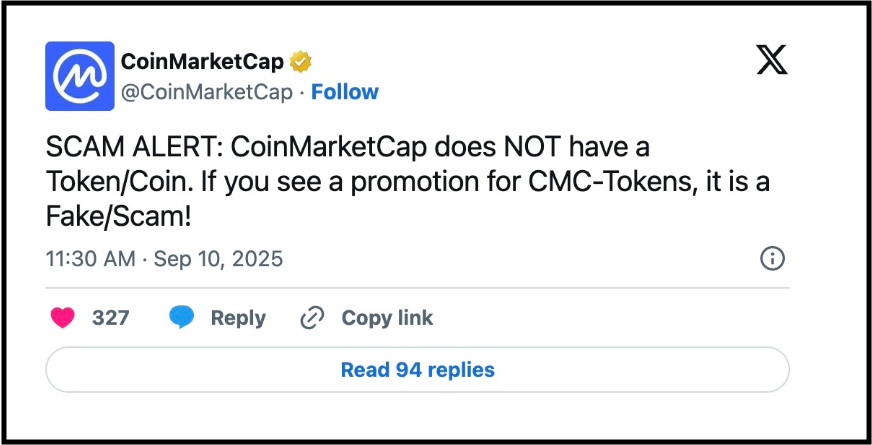
Yet scams keep spreading online in the name of CoinMarketCap.
CoinMarketCap Scams
Crypto scams linked to CoinMarketCap branding usually follow familiar patterns, and once you see them, you will never miss the red flags again.
-
Fake CoinMarketCap Tokens
One of the most common traps involves fake “CMC tokens.” Scammers promote presales or listings claiming they are “official CoinMarketCap coins.”
But CoinMarketCap has publicly confirmed it has no token. If someone offers you one, it is a scam.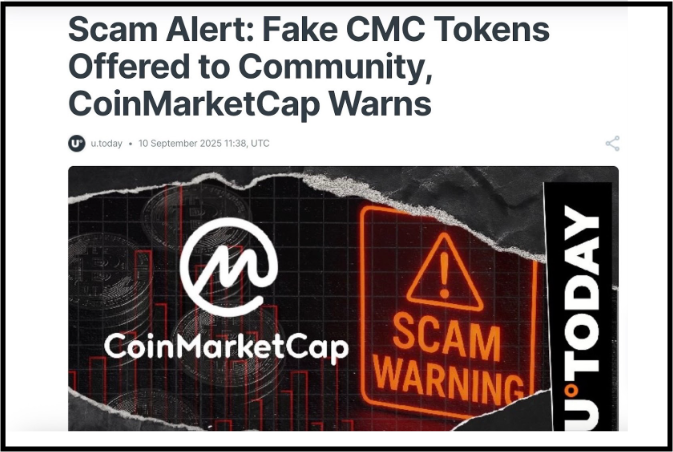
-
Impersonation Calls and Messages
Victims report receiving calls or WhatsApp messages from people claiming to be “CoinMarketCap support.”
They are told:
- Funds are stuck in a CoinMarketCap account.
- A verification fee is required.
- Taxes or gas fees must be paid to unlock balances.
This scam collapses under one fact: CoinMarketCap does not hold user funds at all.
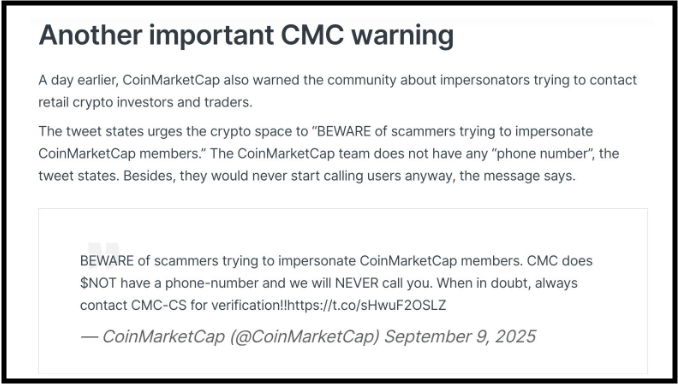
Moreover, CoinMarketCap also clarified this from their official X handle that CMC does not have a phone number and will not call you.
-
Fake Withdrawal Dashboards
Some scams are more sophisticated.
Users are shown fake CoinMarketCap-style dashboards displaying large crypto balances.
Once the trust is built and users are investing their time and money in the app, the scammers demand small payments to “activate withdrawals.”
Once the victim pays, the scammer disappears all of a sudden. No communication at all.
-
Malicious Token Links
Even legitimate CoinMarketCap listings can be dangerous if users do not research properly.
Scam tokens sometimes appear temporarily before being flagged. This redirects users to malicious websites that drain wallets when connected.
-
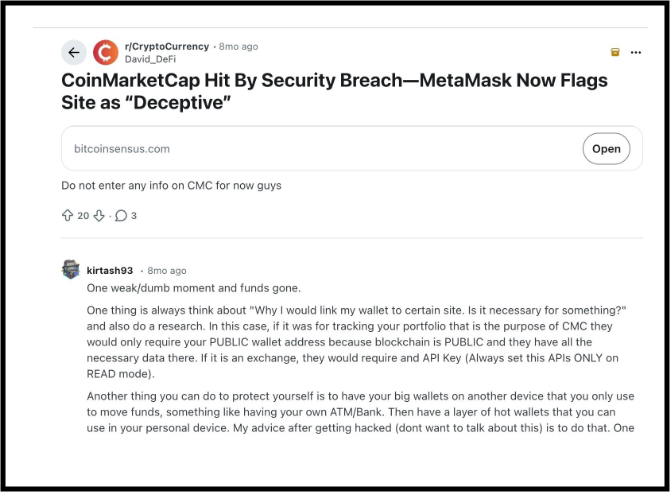
CoinMarketCap’s security breach led to phishing pop-ups
In mid-2025, there was one incident where CoinMarketCap’s website was briefly exploited by hackers.
These hackers inserted malicious code into the website, which caused fake wallet verification pop-ups to appear on the homepage.
These phishing attacks tricked many users.
They believed it was part of the platform and entered their wallet details. This was one of the major security incidents that led to further problems.
This same security incident was also shared on Reddit, where users reported MetaMask marking the site as deceptive.
CoinMarketCap User Complaints
Many frustrated users have reported their issues on review platforms and forums.
On Trustpilot, CoinMarketCap currently has mixed to negative reviews. There are many complaints largely centered around:
- Scam tokens appearing on the platform
- Misleading trending sections
- Delayed response to scam reports
- Poor customer support follow-ups
While CoinMarketCap is not directly stealing money, users feel exposed, especially beginners who assume listed projects are verified or endorsed.
Moreover, there are also many Reddit posts that show the cases of impersonation scams, fake airdrops, and phishing links tied to CoinMarketCap branding.
There are several complaints, such as:
-
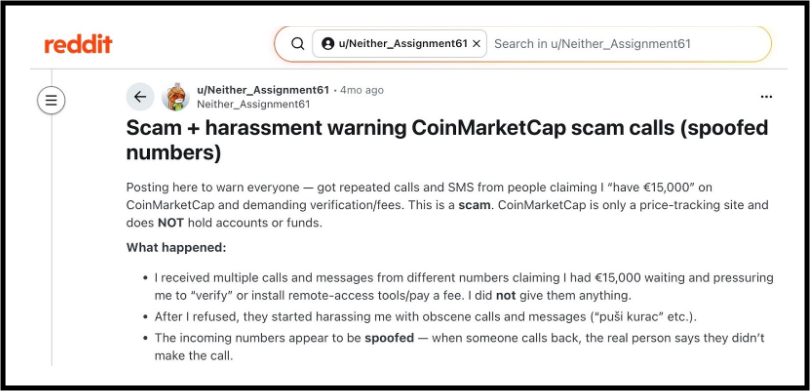
Scammers Pretending to Be CoinMarketCap Support
One Reddit user shared a disturbing experience. They received repeated calls and SMS messages claiming they had money waiting on CoinMarketCap.
But the twist was: they have to pay a verification fee or install remote access tools.
Fortunately, the user understood early that this was a scam. The callers even resorted to harassment when ignored.
-
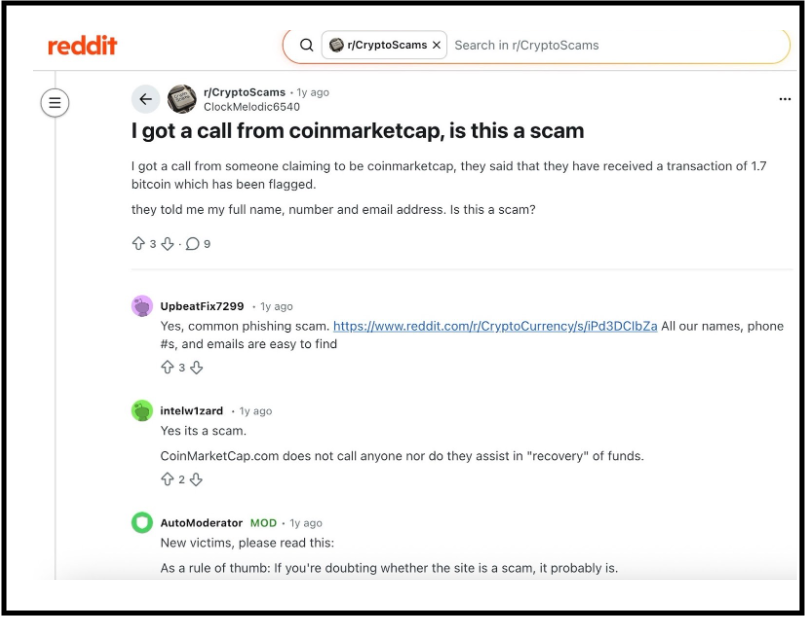
Fake CoinMarketCap Call Claiming Flagged Bitcoin Transaction
One more user got a call from a person claiming to be from CoinMarketCap.
But the replies were clear and blunt: it’s a scam.
CoinMarketCap doesn’t call users, doesn’t flag transactions, and definitely doesn’t help with “recovering” funds. Scammers often already have basic personal info from data leaks or public sources.
-
Fake CoinMarketCap Investment Scam via Telegram
A user on Trustpilot shared how they were lured by a man who was running ads promising 10× returns on Bitcoin with a small investment.
He claimed the profits were visible inside the CoinMarketCap app and said a “transfer fee” was needed to move the money to a bank account.
The moment the fee was paid, the scammer blocked the user, deleted all chats, and vanished.
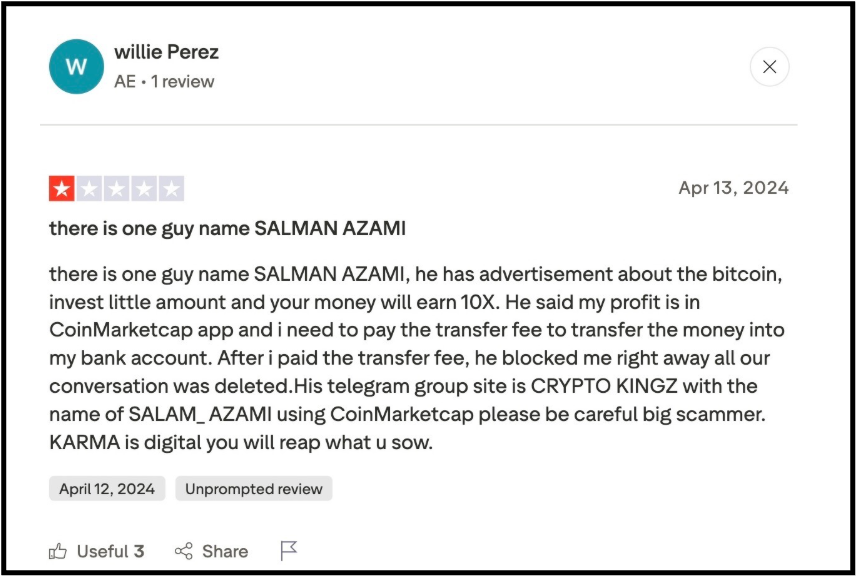
These are the classic signs of a crypto scam: they claim guaranteed profits, show fake app balances, and ask for upfront fees to “release” your own money.
How To Identify Crypto Scams?
There are certain red flags related to any scam, which you can recognize early and avoid such crypto scams.
Because awareness is your strongest defense.
Here’s how to spot trouble early:
- CoinMarketCap never asks for money, OTPs, or wallet access. So, never deposit money if someone is asking you to do so. Also, never ever share your OTPs and wallet access to anyone.
- Any “CMC token,” presale, or guaranteed profit claim that is out there is fake.
- Calls or messages claiming to be CMC support are scams. Because they do not have a phone number.
- Links asking you to connect wallets for rewards should be treated with suspicion.
- Urgency and pressure tactics are classic fraud signs.
If something feels rushed or too profitable – pause.
How to File Crypto Fraud Complaints in India?
If you have come across such a scam or lost money, you need to act quickly. Here is what you can do if you have been misled in the name of CoinMarketCap.
- Report to CoinMarketCap: Save all the screenshots and submit scam details, screenshots, and links directly via the CoinMarketCap official portal.
- File Cybercrime Complaint: You can also register your case on the National Cyber Crime Reporting Portal.
- Police Complaint: For financial loss, file an FIR under the cybercrime and IT Act provisions with all documents attached.
- Inform Your Bank and Exchange: If funds moved through exchanges or wallets:
- Alert the bank or exchange immediately.
- Freeze suspicious transactions if possible.
- Preserve transaction IDs and wallet addresses.
Need Help?
If you have lost money due to a CoinMarketCap-related scam, you can still fight back with full power.
You can join our fraud response plan for professional assistance immediately. Our team offers step-by-step guidance for your complaint.
Conclusion
CoinMarketCap is a legitimate crypto data platform, but its reputation has become a powerful weapon in the hands of scammers.
Fraudsters mainly thrive on trust, speed, and confusion. And in trading-related scams, hesitation can be the difference between safety and loss.
Always remember: The CoinMarketCap platform is about data, and it doesn’t manage your money. Plus, no real platform promises guaranteed profits
So, stay alert and sceptical because in crypto, the smartest investment is caution.
Your awareness today could save your wallet tomorrow.