
The world today depends on the internet.
When the digital world started evolving, cyber crimes were limited to harmless pranks, defacing websites, sending joke emails, and maybe crashing a friend’s computer.
Fast forward to today, and the landscape has shifted dramatically.
Fraudsters now run sophisticated operations that exploit fear, authority, and technology to extract lakhs and crores from unsuspecting victims.
One of the most insidious scams to emerge in recent years is the so-called digital arrest.
The term itself is a fiction because Indian law recognizes no such concept.
No police force or investigative agency has the authority to arrest, interrogate, or detain anyone over a phone call or video link.

Yet thousands of Indians have fallen victim to this scheme, held captive in their own homes by anonymous callers posing as CBI officers, customs officials, or judges.
What Is Digital Arrest?
Digital arrest is a form of cyber fraud in which scammers impersonate law enforcement officers, CBI agents, police officials, income tax officers, customs authorities, and convince victims they are under investigation for serious crimes.
The victim is told to remain on a video call, sometimes for days, under the guise of ‘surveillance’ while they transfer money to settle the fabricated case.
The Computer Emergency Response Team of India (CERT-In) has officially identified this as a cybercrime. It is a type of online scam.
In this scam, victims receive calls, emails, or messages. The scammers claim that the victim is under investigation.
They often accuse the victim of serious crimes like identity theft or money laundering.
Recent Digital Arrest Cases in India
In the past couple of years, digital arrest scams have rapidly increased across India, affecting people from all walks of life, including students, professionals, and even senior citizens.
These cases show how organized and psychologically manipulative such frauds have become.
1. Digital Arrest Case Scam in Ahmedabad
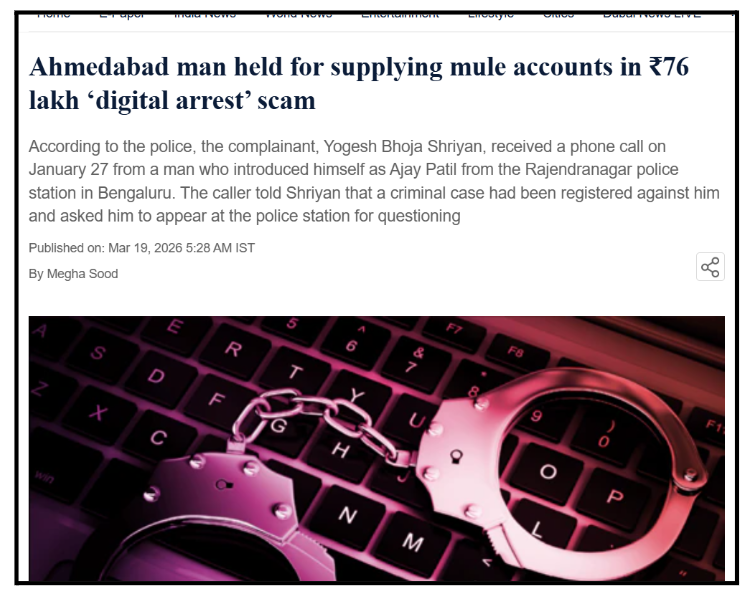
The reported case from Ahmedabad highlights a disturbing example of a ‘digital arrest’ scam, a type of cyber fraud that is rapidly increasing across India.
In this incident, a man received a call from someone claiming to be a police officer from Bengaluru.
The caller falsely informed him that a criminal case had been registered against him and pressured him to cooperate with what was presented as an official investigation.
The intention was to create fear and urgency so that the victim would comply without questioning the situation.
As the investigation unfolded, authorities discovered that the scam was part of a larger network involving ‘mule bank accounts.’
These accounts are typically opened or managed by individuals who allow fraudsters to use them to transfer and withdraw illegally obtained money.
In this case, a man was arrested for supplying such accounts, which were used to route funds collected from victims.
The total amount linked to this fraud was around ₹76 lakh, indicating the scale and coordination involved in such operations.
This case clearly demonstrates how scammers misuse authority and technology to manipulate people.
2. Digital Arrest Fraud Costs Noida Man Rupees 1 Crore
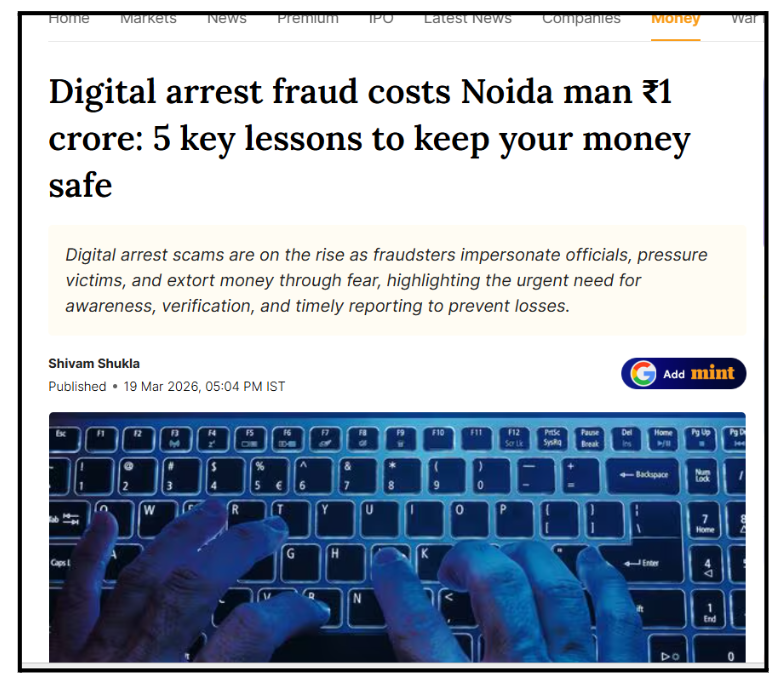
This case from Noida shows how dangerous “digital arrest’ scams have become, with a victim reportedly losing around ₹1 crore.
In this incident, fraudsters impersonated government officials and contacted the victim, falsely accusing him of being involved in illegal activities.
By creating fear and a sense of urgency, they convinced him that he was under investigation and needed to cooperate immediately to avoid arrest or legal trouble.
The scammers used psychological pressure as their main weapon. They likely kept the victim engaged over long calls, possibly even video calls, making it seem like an official interrogation.
During this time, they manipulated him into transferring large sums of money under the pretext of ‘verification,’ ‘clearance,’ or ‘safe custody.’
Since the situation felt real and threatening, the victim complied without verifying the authenticity of the claims.
This case highlights how these scams are not just about technology but about exploiting human emotions like fear and panic.
It also underlines an important lesson: no legitimate authority will ever demand money over a phone call or claim to place someone under ‘digital arrest.’
The mention of ₹1 crore loss serves as a strong warning about the financial and emotional impact such frauds can have.
Overall, the incident emphasizes the need for awareness, caution, and quick action.
3. Cyber fraud in Mumbai
This case from Mumbai highlights how even senior citizens are being targeted in “digital arrest” scams.
In this incident, a 71-year-old man from Dadar was cheated of around ₹1.05 crore by fraudsters who pretended to be officials from agencies like TRAI and CBI.
They contacted him and falsely claimed that he was involved in a serious legal matter, creating panic and fear.
The scammers used a well-planned strategy to gain the victim’s trust and control his actions.
They likely kept him engaged over multiple calls and convinced him that he was under investigation.
Under pressure and confusion, the victim was gradually coerced into transferring large sums of money over several days.
Since the fraud happened step by step, it became difficult for him to realize that he was being scammed until a significant amount had already been lost.
This case clearly shows how these frauds are not just quick scams but carefully executed psychological manipulations.
By posing as high-level authorities, fraudsters exploit fear, especially among elderly individuals who may be less familiar with such tactics.
The use of multiple agencies’ names also adds a layer of credibility, making the scam seem more real.
Ultimately, the incident is a strong warning that no genuine government authority will ever demand money or conduct an investigation.

4. Bengaluru Digital Arrest Scam
This case from Bengaluru highlights how ‘digital arrest’ scams are increasingly targeting elderly individuals.
An elderly woman was defrauded of approximately ₹38 lakh by fraudsters who posed as officials and falsely accused her of involvement in illegal activities.
By using fear and authority, they convinced her that she was under investigation and needed to cooperate to avoid serious consequences.
The scammers likely kept her engaged over phone or video calls, creating a controlled environment where she felt monitored and pressured.
They used official-sounding language and possibly fake documents or identities to make the situation appear legitimate.
Under stress and confusion, she was gradually manipulated into transferring money, believing it was necessary for verification or to clear her name.
This case shows how these frauds rely heavily on psychological manipulation rather than just technical tricks.
Elderly victims are particularly vulnerable because scammers exploit their trust in authority and limited familiarity with such cybercrime tactics.
The loss of ₹38 lakh reflects how convincing and prolonged these scams can be.
No real law enforcement agency will conduct investigations over calls, demand money, or place someone under ‘digital arrest.’
Awareness, verification of unknown contacts, and immediate reporting of suspicious calls are key steps to staying protected from such scams.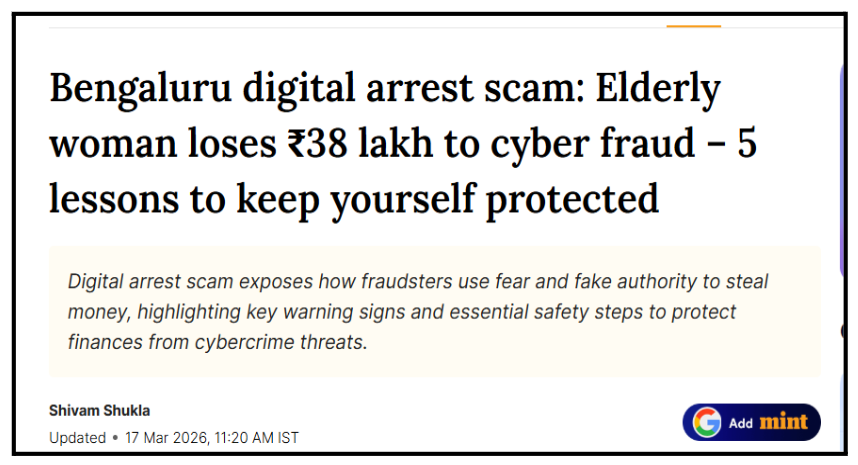
A common question many people ask when first hearing about these cases is: Is digital arrest a thing?
Legally speaking, the answer is no. Under the Bharatiya Nagarik Suraksha Sanhita (BNSS) and current Indian law, there is no such thing as a “digital” or “virtual” arrest.
An arrest requires physical detention by authorized personnel following due process.
What To Do In Such Situations?
If you ever find yourself in such a situation, remember that staying calm, acting quickly, and verifying every claim before responding can make all the difference in preventing further loss.
You can take the following steps to file a digital arrest complaint:
1. Act Immediately
Time is the most critical factor in cyber fraud cases.
As soon as you realize something is wrong, stop all communication with the scammer and avoid making any further payments.
Quickly inform your bank and request them to freeze or flag the suspicious transaction.
The faster you act, the higher the chances of recovering your money or blocking further loss.
2. File Cybercrime Complaint
File a complaint on the official National Cyber Crime Reporting Portal.
Choose the appropriate category (financial fraud) and provide complete details such as transaction IDs, phone numbers, and screenshots.
You can also call the cybercrime helpline for immediate assistance, especially in urgent financial fraud cases.
3. Preserve All Evidence
Keep a record of everything related to the scam.
This includes call logs, messages, emails, bank statements, transaction receipts, and any screenshots of conversations or video calls.
Do not delete anything, as these pieces of evidence are crucial for investigation and can help authorities trace the fraudsters more effectively.
4. Inform Local Police
Along with online reporting, visit your nearest police station and file an FIR. Provide all the evidence and details of the fraud.
This ensures that your complaint is officially recorded and helps in faster legal action against the accused.
5. Stay Alert and Follow Up
After reporting, regularly follow up on your complaint status through the portal or with authorities.
Stay alert for any further suspicious contact, as scammers may try to reach out again.
Taking continuous action and staying informed increases the chances of resolution and prevents repeat targeting.
Need Help?
If you’re confused about what to do after a digital arrest scam, we’re here to guide you at every step.
For a better understanding of the overall process, you can also review the information available in our online fraud response plan.
Beyond reporting, this will help you organize your evidence, understand your rights, and take the next legal or financial steps with confidence.
Our aim is to make the process simple, clear, and less stressful so you can focus on recovering from the situation.
Conclusion
Digital arrest scams are a serious and growing threat, where fraudsters misuse fear, authority, and technology to manipulate victims into transferring large sums of money.
As seen in multiple cases across cities, these scams are well-planned and can impact anyone, regardless of age or experience.
The key to staying safe lies in awareness and quick action.
Always remember that no genuine authority will demand money or conduct investigations over calls.
Verifying suspicious communication, avoiding panic, and reporting incidents promptly to platforms like the National Cyber Crime Reporting Portal can significantly reduce the risk of loss.
To protect yourself, it is crucial to understand the digital arrest modus operandi.
By staying informed and cautious, individuals can protect themselves and their finances from such cyber threats.
Spreading awareness and guiding others is equally important in preventing more people from falling victim to these scams.