

You’ve probably seen those flashy posts on social media, people showing off luxury cars, international trips, and wads of cash, all thanks to Nexus.
Friends and family might be urging you to join, promising insane returns with zero effort. Sounds too good to be true, right?
That is a question worth examining carefully, and in this blog, we will look at the facts so you can form your own informed view.
In this blog, we’ll break down what Nexus actually is, what makes a Ponzi scheme tick, and the glaring red flags that should make you think twice before investing your hard-earned money.
Nexus Review
Nexus markets itself as an investment platform or multi-level marketing (MLM) opportunity, promising unusually high returns, often 2–3% daily, simply for investing money and bringing in new members.
While this may sound attractive, such structures share characteristics that regulators and financial experts commonly associate with high-risk or potentially unsustainable investment models, including those that have been classified as Ponzi schemes in other contexts.
A Ponzi scheme is a fraudulent investment setup where:
- Early investors are paid using funds collected from new investors, not from real profits.
- There is little to no genuine business activity generating sustainable income.
The connection with Beldex comes into play because some publicly available Nexus-related promotional materials have referenced this cryptocurrency in the context of transactions.
Nexus Connection with Beldex
Beldex is a privacy-focused digital currency which can make transaction tracking more difficult.
This feature is sometimes exploited by suspicious platforms to obscure fund flows and reduce transparency.
It has been publicly observed that platforms including GCCHUB, Aarman, and Nexus2U share certain structural and operational similarities.
And that Beldex has appeared as a referenced cryptocurrency across some of these platforms’ promotional materials.
This publication has not independently verified whether these are related entities, and this observation should not be read as a confirmed finding of common ownership or coordination.
However, it’s important to clarify: the use of Beldex itself does not automatically make it illegal or a scam.
The concern arises when a platform like Nexus uses such cryptocurrencies within a structure that shows classic Ponzi scam characteristics, high guaranteed returns, referral-based earnings, and unclear revenue sources.
Is Nexus Real or Fake?
In India, investment schemes that promise assured returns or rely on structured recruitment models may raise concerns under applicable financial regulations, including those governing collective investment schemes and multi-level marketing.
Whether any specific platform violates these regulations is a determination made by the relevant regulatory authorities, not by this publication. Investors are encouraged to consult a qualified financial or legal advisor before participating in any such scheme.
Understanding this distinction is crucial before putting your money at risk.
-
What Nexus Dashboard Reveals
The image below shows the internal dashboard of Nexus (NEXUS2U), and several elements here raise important concerns.
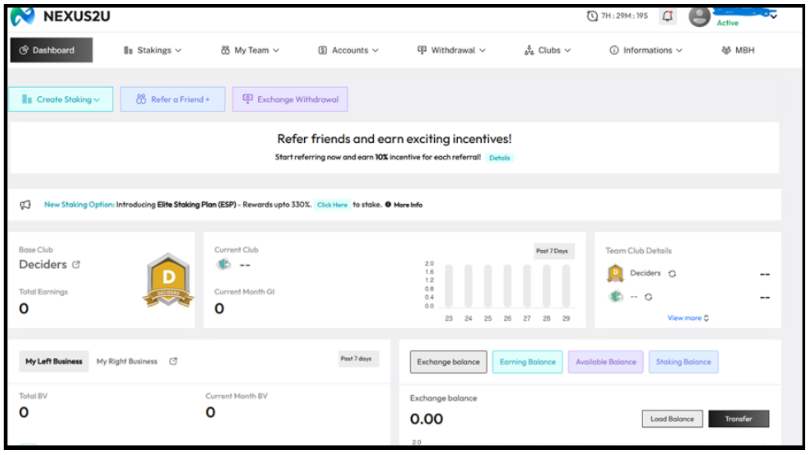
First, there is a strong emphasis on ‘Refer friends and earn incentives’, with claims like earning bonuses for each referral.
This clearly indicates that income is heavily tied to recruitment, which is a common characteristic of pyramid or Ponzi-style models.
Second, the platform promotes ‘staking rewards up to 330%,’ which is an extremely unrealistic return.
No legitimate financial or crypto investment consistently offers such high profits without significant risk; this is a major red flag.
Additionally, the dashboard includes sections like:
- My Left Business / My Right Business
- Team Club Details
- Current Club
These terms are typically associated with MLM (multi-level marketing) structures, where users earn based on team growth rather than actual investment performance.
Investors should independently verify whether withdrawals are processed reliably before committing funds to any platform.
Nexus Major Red Flags
These warning signs highlight why platforms like Nexus should be approached with extreme caution, especially when promises seem too good to be true.
Recognising these red flags early can help investors avoid falling into schemes that prioritise recruitment over real financial value.
1. Unrealistic Returns
Nexus and similar platforms often promise daily or weekly returns of 1–5%. Annualised, such returns would exceed 300%.
Sustainable investment returns at this level are not characteristic of legitimate regulated financial products. Investors should treat any such claims with serious scepticism and seek independent financial advice.
2. Recruitment-Based Earnings
Your income depends more on bringing in new members than on any actual product or service. This is a structure commonly associated with pyramid models.
In such models, the sustainability of payouts is directly dependent on continued recruitment, which carries significant risk for later participants.
3. No Clear Business Model
Ask yourself: Where is the money actually coming from? If there’s no real product being sold or service being rendered, the “profits” are just funds from newer investors being recycled.
4. Pressure to Invest Quickly
Scammers create urgency. Limited slots! Join before the opportunity closes! This pressure tactic stops you from doing proper research.
5. Unregistered with SEBI or RBI
Legitimate investment platforms operating in India are typically registered with SEBI (Securities and Exchange Board of India) or regulated by the RBI.
Investors are strongly encouraged to independently verify whether any platform they are considering holds the relevant registrations before investing.
6. Anonymous or Untraceable Leadership
Who runs Nexus? Where are they based?
Investors should be cautious of any platform where the identity, qualifications, and location of founders or directors cannot be independently verified through public records or regulatory filings.
7. Withdrawal Issues
Early investors might withdraw easily; that is how trust is built. But over time, withdrawals may get delayed, excuses may accumulate, and platforms may become inaccessible.
This pattern has been documented in connection with numerous investment schemes and is a key risk factor to monitor.
How to Report a Ponzi Scam?
If you or someone you know has been trapped, act fast. Here’s what you need to do:
Step 1: Collect All Evidence
Gather everything that proves the scam: screenshots of chats and promises made, Bank statements showing money transferred, Receipts and transaction IDs, and Marketing materials or videos shared by promoters.
Step 2: File Cybercrime Complaint
Visit the National Cyber Crime Reporting Portal. Register your complaint with all the details and evidence.
This portal is monitored by authorities across India.
Step 3: Call the Financial Fraud Helpline
Dial the national helpline for financial fraud. They can help block further transactions and guide you on the next steps.
Step 4: Lodge an FIR
Visit your local police station and file an FIR.
Bring all your documents: Transaction proofs, Communication screenshots, and any identification of the promoters.
Need Help?
Falling for a Ponzi scheme feels embarrassing, but you’re not alone. Thousands of people get trapped by these slick operations every year.
If you’ve been scammed, don’t suffer in silence.
You can look for the details in our crypto fraud response plan to get more clarity on the next steps.
The sooner you act, the better your chances of recovering your money and stopping these fraudsters from hurting others.
Conclusion
Based on publicly observable features, Nexus displays several characteristics that financial regulators and consumer protection bodies commonly associate with high-risk investment schemes.
Whether Nexus constitutes a Ponzi scheme or any other specific category of financial fraud is a determination that rests with the relevant regulatory and judicial authorities.
This publication does not make that finding.
The purpose of this article is to help readers identify and evaluate the risk factors present so they can make informed decisions.
These are serious concerns that deserve careful consideration before any investment decision is made.
Your money deserves better. Before investing anywhere, ask hard questions, verify registrations, and remember: if it sounds too good to be true, seek independent advice before proceeding.
Stay alert. Stay informed. And if something feels off, trust your gut.





 Add us as a preferred source on Google »

