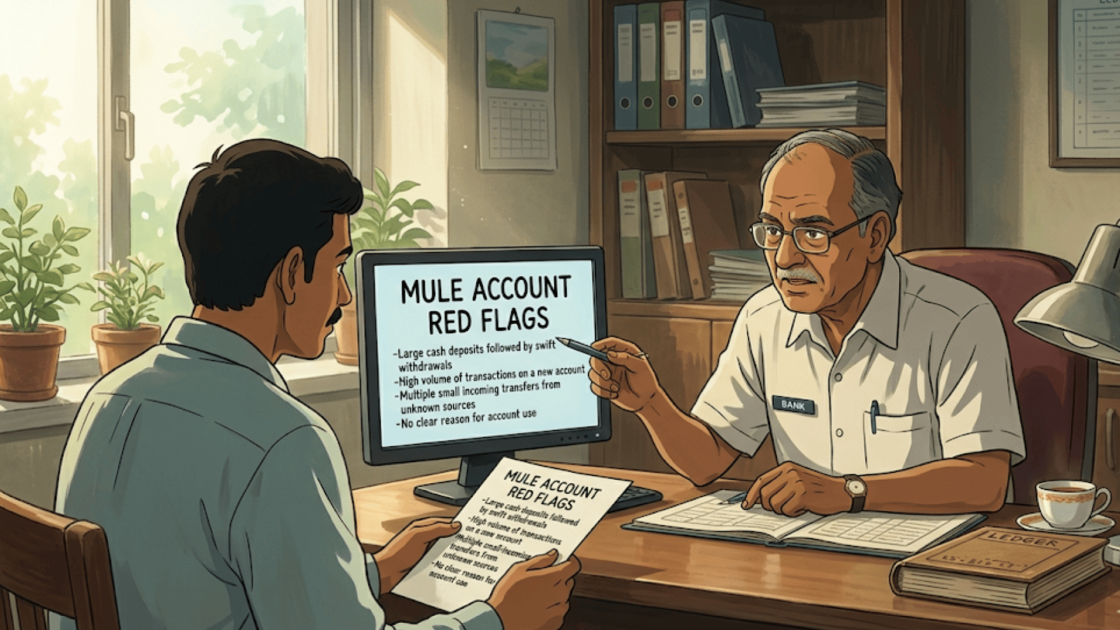
Not every problem looks like a problem in the beginning. Sometimes, it shows up as a simple request. A quick offer or a small task that feels easy to accept.
At that moment, nothing feels serious. You don’t see a risk, but you just see something that looks normal.
You tell yourself it’s just one transaction. Just one step and nothing more. But this is exactly how mule account situations start.
The warning signs are usually there from the beginning.
They don’t hide, they just look harmless. And that’s why most people miss them.
In this blog, we will see the red flags you should never ignore when it comes to mule accounts.
Mule Account Red Flags You Should Never Ignore
You don’t always need deep analysis to spot a mule account risk.
Some situations clearly tell you that something is not right. The problem is, they look simple in the moment.
If you are worried about your own account or a suspicious offer, here is how to detect mule account patterns effectively:
1. Someone Offers Easy Money for Using Your Bank Account
Someone approaches you with a simple offer.
They tell you that you can earn money just by using your bank account for transactions. You don’t need skills.
You don’t need effort. You just need to receive money and send it forward.

This may sound harmless, but this is one of the most direct signs of a mule account setup. If someone offers money for using your account, you should stop immediately.
2. You Are Asked to Receive and Transfer Money for Someone Else
You don’t use the money for yourself. You receive it, and then you send it to another account based on instructions. You act like a middle person in the transaction.
If your role is only to move money from one place to another, your account fits the exact pattern of a mule account.
3. You Don’t Know Where the Money Is Coming From
Money appears in your account, but you cannot clearly explain its source.
You may trust the person who gave you instructions, but you don’t know who actually sent the money or why.
If you cannot confidently explain where the money came from, you should treat it as a serious warning.
4. Someone Pushes You to Act Quickly
Someone tells you to transfer money immediately after you receive it. They don’t give you time to think or ask questions.
They just want you to act fast.
This urgency is not random, it is used to stop you from checking the transaction. If someone creates pressure, you should slow down instead of speeding up.
5. You Are Asked to Share Your Bank Details or OTP
Someone asks for your account details, login access, or OTP.
They may give you a reason, but no genuine situation requires this level of access.
The moment you share these details, you lose control of your account.
6. You Are Added to Groups That Involve Money Transactions
You get added to a group where people talk about tasks, payments, and transfers.
At first, it looks like a normal earning opportunity. But soon, the instructions involve handling money through your account.
These setups often lead directly to mule account activity.
7. You Feel Something Is Not Right, But You Still Continue
This is the most ignored red flag. You feel unsure. Something doesn’t make sense. But you continue anyway because the situation looks easy or harmless.
That hesitation is your signal. If something feels off, you should stop and check instead of moving forward.
You don’t need to see all these signs together. Even one clear red flag is enough to pause and rethink your decision.
How to Detect a Mule Account?
You don’t need a detailed process to detect this. You just need to check a few things about your account activity.
- Check who controls your transactions: If someone else tells you when to receive or send money, your account is not fully under your control
- Check if you understand every transaction: If you cannot clearly explain why money came in or went out, something is not right
- Look at how money moves in your account: If money comes in and goes out quickly without staying with you, it shows a pattern
- Notice if you only move money for others: If your role is only to receive and transfer money, your account may be acting as a mule account
- Ask yourself if the activity feels normal: If your account doesn’t match your usual usage, you should not ignore it
When your account activity depends on someone else or lacks a clear purpose, it points to a problem that needs attention.
Why You Should Not Ignore These Red Flags?
Red flags don’t appear without a reason. They show up to warn you before the situation gets bigger.
When you ignore them, you give the problem more space to grow. What looks like a small step at first can quickly turn into multiple transactions, larger amounts, and more complications.
In many cases, people don’t realize the seriousness until their account gets flagged or restricted. By that time, the situation becomes harder to explain and manage.
That’s why these signals matter. They give you a chance to stop, question, and take control before things move further.
How To File A Mule Account Complaint?
Once you notice these red flags, don’t ignore them or wait for things to become clearer. You don’t need complete information before you act. You just need to take the right first steps.
1. Stop All Further Transactions
Immediately stop sending or receiving money through the affected account. Avoid using UPI, cards, or net banking until the issue is resolved.
This helps prevent further fraudulent activity and protects you from deeper involvement.
2. Inform Your Bank Immediately
Contact your bank as soon as you notice suspicious activity in your account. Clearly point out the transactions you do not recognize and request immediate action.
Prompt reporting helps the bank flag your account and prevent further misuse or loss.
3. Report Cybercrime Complaint
File a complaint through official platforms like the National Cyber Crime Reporting Portal or your bank’s grievance system.
Share complete details about what you observed and how your account may have been involved.
Accurate reporting ensures your case is formally recorded and investigated by the authorities.
4. Keep Your Records Safe
Save all relevant evidence, including transaction details, messages, emails, and call logs. Do not delete anything, as these records are crucial for investigation.
Well-organized documentation can significantly strengthen your case and speed up resolution.
Taking action early can prevent the situation from getting more complicated. For a detailed step-by-step process, you can refer to the full mule account complaint guide.
Need Help?
Seeing these warning signs can leave you unsure about what to do next.
You may recognize that something isn’t right, but you may not know how to handle it or how serious the situation actually is.
This is where most people get stuck. They either wait, take random steps, or avoid dealing with it because they don’t feel confident about the process.
Getting the right direction at this point matters. We help you understand your situation and guide you on how to move forward in a clear and practical way.
If you’re not sure about your next step, you can check out our online fraud response plan and get the clarity for the further process.
Conclusion
Red flags don’t always look serious in the moment. They often appear as small, easy decisions that don’t feel risky at all.
That’s why people miss them. But once you recognize these signs, your response matters.
Every step you take after that either protects you or pushes the situation further.
Pay attention to what doesn’t make sense. Question anything that involves your account without clear reason.
A small pause at the right time can prevent a much bigger problem later.