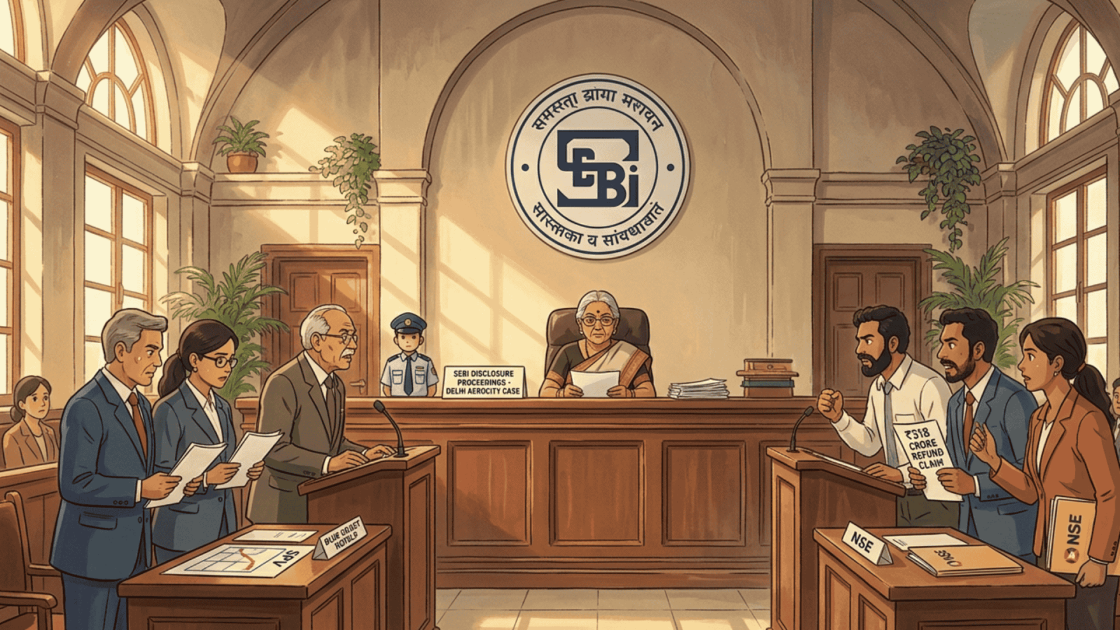
A routine examination by the National Stock Exchange (NSE) recently brought attention to a decade-old episode involving a listed hospitality company and a failed real estate project near Delhi airport.
The matter revolves around Blue Coast Hotels Limited, a company known for owning and operating hospitality properties such as Park Hyatt Goa Resort & Spa and Sheraton hotels in Chandigarh and Amritsar.
What began as an ambitious hospitality project around 2011–12 eventually turned into a legal and regulatory case involving ₹318 crore collected from investors, a terminated project, court-ordered refunds, and a disclosure issue that later drew the attention of SEBI.
This is the sequence of events.
How the Aerocity Hospitality Project Began?
Around 2011–12, Blue Coast Hotels planned to develop a five-star hotel project near Delhi Airport’s Aerocity district, one of the most commercially attractive hospitality locations in the country.
Instead of funding the entire project through its own capital, the development was structured through a Special Purpose Vehicle (SPV).
As part of the financing model, commercial spaces within the proposed hotel complex were offered on long-term lease to buyers.
The proposition appeared attractive:
- Prime location near the international airport.
- Association with a listed hospitality company.
- Expectations of rental income and property appreciation.
Investors responded to the opportunity.
In total, about ₹318 crore was collected from buyers who believed they were securing commercial space in the future hotel development.
Why the Project Collapsed in 2015?
The project, however, did not proceed as expected.
By 2015, the entity responsible for the project failed to pay licence fees to Delhi International Airport Ltd (DIAL), which controls development rights around the airport area.
Due to the non-payment, DIAL terminated the agreement associated with the project.
Once the licence was terminated, the hotel development could no longer proceed.
For investors who had already committed funds for commercial spaces, this meant that the project they had invested in effectively ceased to exist.
Investors Approach the Court
Following the termination of the project, investors approached the courts seeking recovery of their money.
In 2018, the Delhi High Court ordered refunds of approximately ₹318.95 crore to investors connected with the project.
However, based on information referenced in proceedings and reports around the matter, only a small portion of that amount, roughly ₹8–10 crore, appears to have been refunded so far.
The remaining amount has continued to be a point of concern for affected investors.
Undisclosed Liability in Company Filings
Years later, the matter resurfaced from a different angle.
During an examination of company disclosures and financial statements, NSE noticed that the large liability related to the Aerocity project had not been properly disclosed to the stock market for multiple years.
For a listed company, this is significant.
If a company faces a potential liability of hundreds of crores due to court proceedings, that information is expected to be disclosed in financial statements and filings so that stock market investors are aware of the risks associated with the company.
According to the regulator’s findings, this contingent liability connected to the Aerocity project was not properly disclosed in the company’s financial statements for several years, even while the company’s shares continued trading in the market.
NSE flagged the issue to SEBI (Securities and Exchange Board of India).
SEBI Action Against Blue Coast Hotels
SEBI’s focus on the matter was not the original real estate dispute itself.
Instead, the regulator examined whether the company had complied with disclosure requirements applicable to listed entities.
For SEBI, the central question was straightforward:
Were stock market investors adequately informed about the ₹318 crore liability arising from the failed Aerocity project and the court proceedings connected with it?
Following proceedings, the matter was resolved through a settlement, with the company paying approximately ₹89–90 lakh.
After the settlement process, the case related to the disclosure lapse was closed.
Market Impact on Blue Coast Hotels
During the period in which these developments unfolded, Blue Coast Hotels’ stock price also experienced a significant decline, with the share price falling by roughly 60% over the broader timeline of the episode.
Stock price movements can occur for many reasons, but the Aerocity project dispute and subsequent disclosure issues formed part of the larger context surrounding the company during this period.
What Happened to the ₹318 Crore?
While the regulatory case addressed the issue of disclosure to stock market investors, the original project dispute continues to raise questions for those who had invested in the Aerocity development.
More than a decade after the project was announced and several years after the court ordered refunds, a large portion of the ₹318 crore collected from investors remains a subject of concern.
The case ultimately illustrates how a failed real estate project, legal proceedings, and disclosure obligations can intersect in the public markets.
And it leaves one question that still attracts attention:
What ultimately happened to the ₹318 crore collected from investors in the Aerocity hotel project?