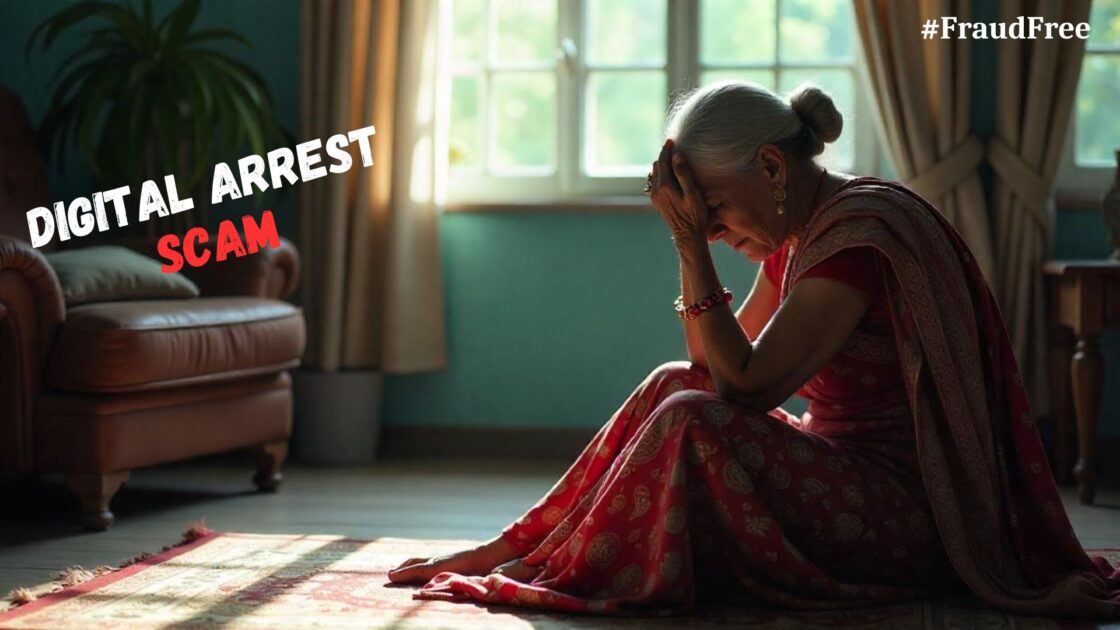
Think about this: your phone rings. The person on the other end sounds official, cold, and serious. They claim to be a police officer or an agent from the Enforcement Directorate.
They tell you your Aadhaar is linked to a massive money-laundering ring or a parcel full of illegal drugs.
Before you can even catch your breath, they tell you that you are under digital arrest.
They order you to stay on the call and tell you not to speak to your family. They say they are investigating you currently.
Soon enough, they will ask you to transfer money to a safe account to prove you are innocent.
It sounds like a bad movie, but it is a terrifying reality for thousands of people in India.
But what is actually a digital arrest, and how can you avoid such a thing happening to you? Let’s find out.
What is Digital Arrest?
Let’s get one thing straight right now: if you are asking Is digital arrest a thing?
Then you must know- Digital arrest does not exist in Indian law. There is no such thing.
Scammers invented the term to make you feel trapped.
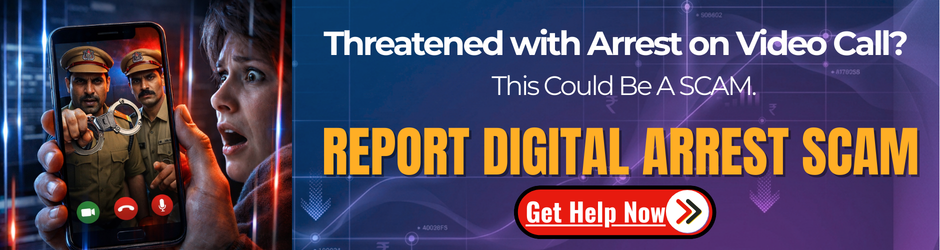
They pretend to be from the CBI, the Police, or Customs. They accuse you of drug trafficking or funding terrorism to make you panic.
The scammers will show you fake arrest warrants over WhatsApp or wear uniforms in video calls just to make the lie feel heavy.
But remember: No real government agency will ever arrest you over a call. It is a trick, plain and simple.
Digital Arrest Modus Operandi
Every story is a bit different, but the blueprint is usually the same. It starts with a random call.
They say they are from a courier company like FedEx or a telecom provider. They claim a parcel with your ID on it has been seized.
Then, they transfer you to a fake senior officer. This person takes over the call and tells you that you are in digital custody.
They might keep you on a video call for hours, or even days, watching you. They will not let you hang up or talk to your lawyer.
Eventually, they will suggest a security deposit or a verification fee to clear your name. Once that money hits their account, they disappear.
Depending on this, understanding how to check digital arrest is crucial, as scammers often create panic without any legal basis.
Digital Arrest Cases From India
There are hundreds of complaints every year about digital arrest scams in India. Some of the recent ones include:
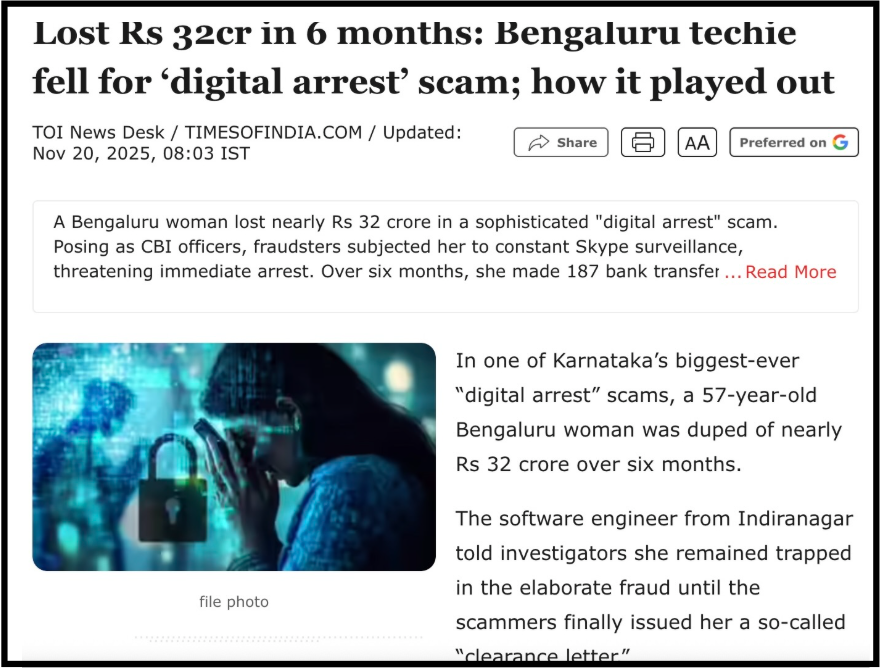
1. The Six-Month Digital Surveillance Scam
In one of the most extreme cases reported, a woman in Bengaluru was kept under what scammers called digital surveillance for half a year.
It started with a call from someone claiming to be a CBI officer who told her she was a prime suspect in a money-laundering case.
The criminals monitored her constantly via Skype and made her feel like she was being watched every minute of the day.
Whenever she got scared or asked questions, they reassured her that the money she was sending was just for legal verification and would be returned once the case closed.
She ended up making 187 different transactions, losing nearly ₹32 crore before realising the entire investigation was a fake.
2. The Retired Teacher Who Lost His Life Savings
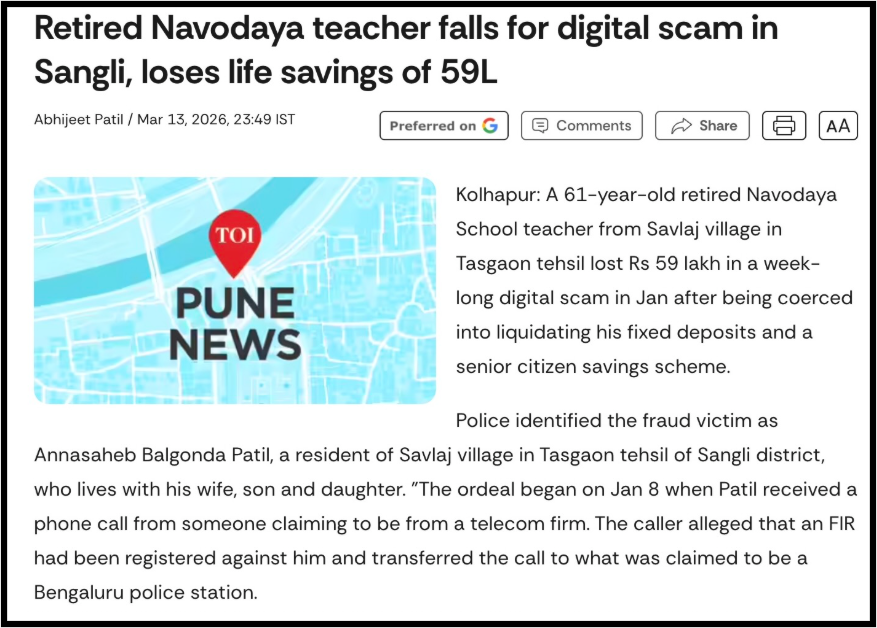
A retired Navodaya school teacher in Maharashtra lost everything after a caller claimed his identity was linked to a human trafficking investigation.
The scammers were incredibly professional; they showed him fake evidence and even a photo of his own Aadhaar card allegedly found at a crime scene.
Frightened by the threat of jail and public shame, the teacher followed their orders and moved all his money from his fixed deposits using RTGS transfers.
By the time his family realised he was being manipulated, he had already transferred ₹59 lakh. This was his entire life’s work, gone in a matter of hours because of a fake phone call.
3. The Six-Hour Video Call in Bhopal
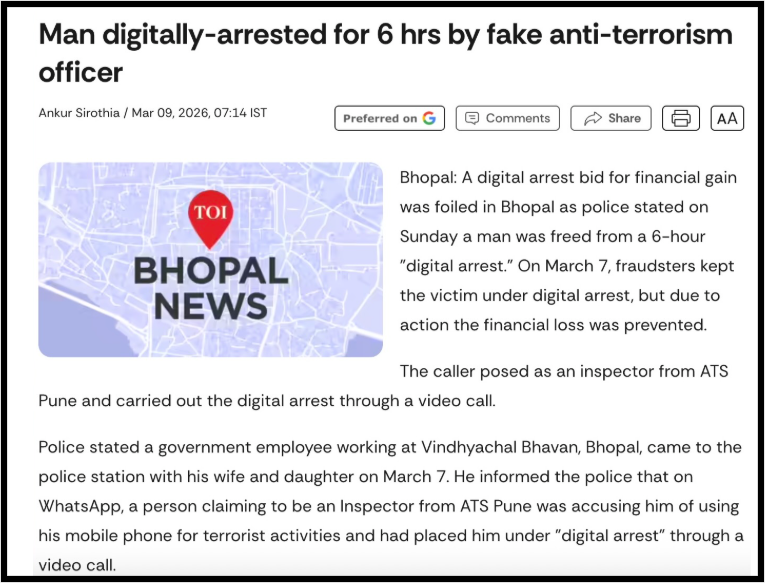
A government employee in Bhopal was digitally arrested for six hours by a fraudster pretending to be from the Anti-Terrorism Squad.
The scammer used a WhatsApp video call to question him about his bank accounts and personal details, claiming he was involved in terrorist activities.
The victim was kept in a state of constant fear throughout the afternoon.
Fortunately, he eventually became suspicious of the aggressive questioning and managed to alert the real police.
When a genuine officer joined the video call and began questioning the ATS agent, the scammer immediately cut the connection and deleted the profile.
4. Threatening a Pune Senior with Terror Charges
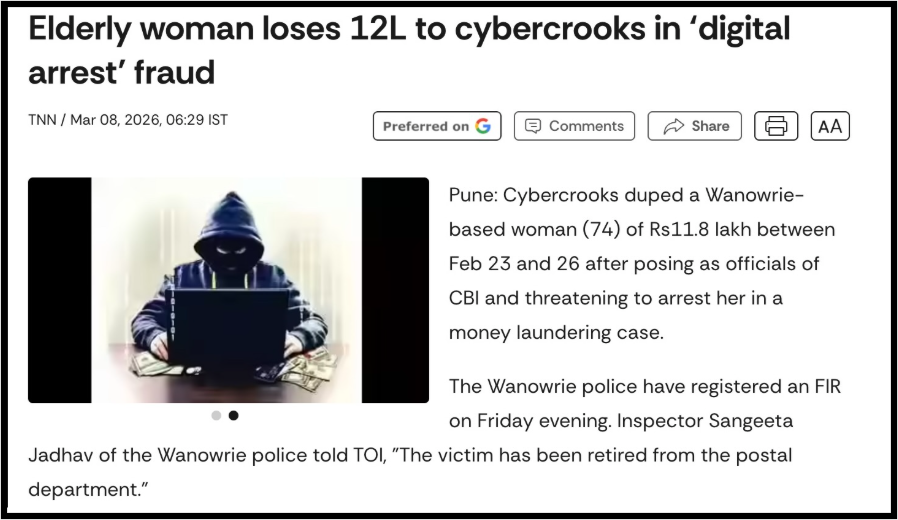
An elderly woman in Pune, who had retired from the postal department, was targeted by scammers posing as CBI officials.
They claimed her bank account was being used to fund a terrorist organisation and warned her that she would face immediate arrest and public humiliation if she didn’t cooperate.
They kept her under intense pressure for several days, telling her she had to prove her innocence by moving her money to a secure government account.
Believing she was clearing her name, she broke her fixed deposits and sent ₹11.8 lakh to the criminals before finally telling her family what was happening.
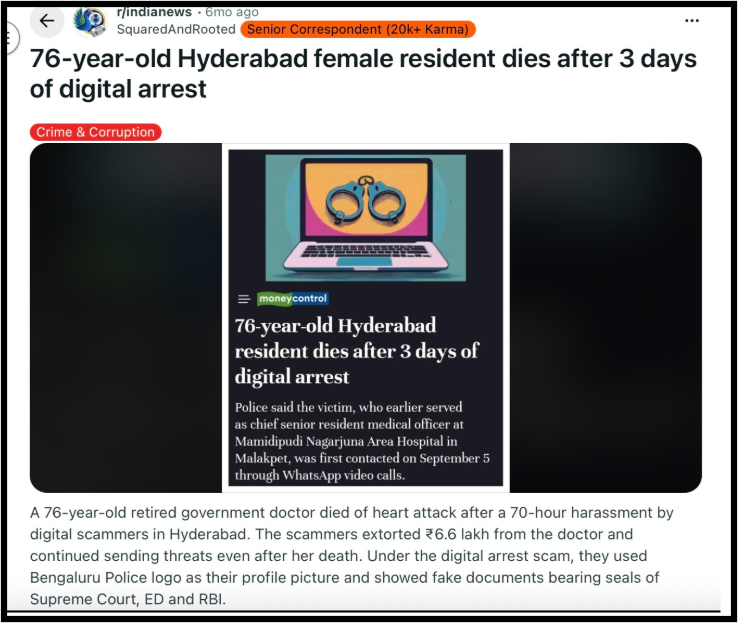
5. A 76-Year-Old Hyderabad Doctor Died After 70 Hours of Harassment
A 76-year-old retired government doctor from Hyderabad tragically lost her life after being harassed for nearly three days in a digital arrest scam.
The fraudsters, pretending to be officials, terrified her with fake accusations and kept pressuring her for around 70 hours.
During this ordeal, they extorted ₹6.6 lakh from her and used fake documents carrying the seals of the Supreme Court, ED, and RBI to make the threats look real.
They even used the Bengaluru Police logo on their profile picture to appear genuine.
The constant fear and pressure reportedly led to a heart attack, and what makes the case even more disturbing is that the threats did not stop even after her death.
6. 2.5 Crore Digital Arrest Scam
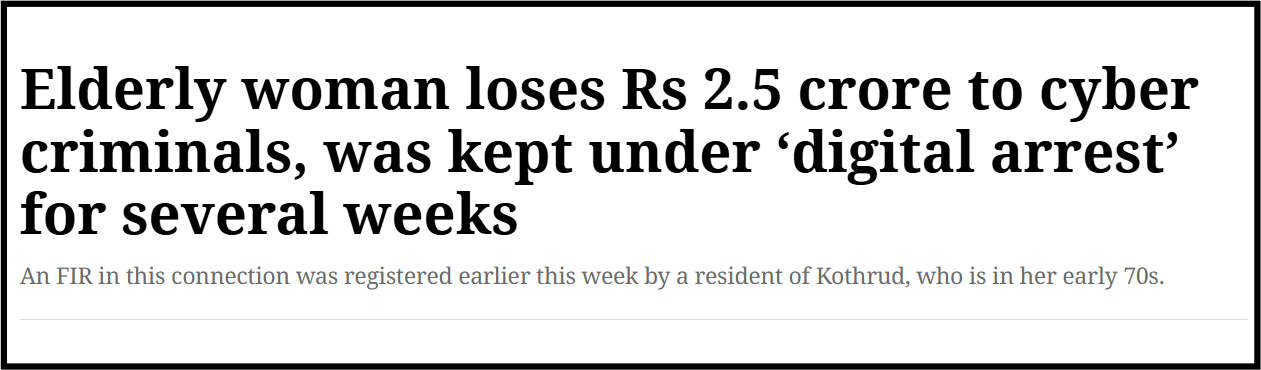
In another shocking cybercrime incident, a woman from Pune was manipulated into transferring ₹2.5 crore after scammers claimed she was under investigation for financial crimes.
Posing as police and enforcement officials, the fraudsters used fear and authority to keep her on constant calls and prevent her from seeking help.
They isolated her, demanded regular updates, and instructed her to transfer funds to “safe accounts” for verification.
Believing she needed to prove her innocence, she moved her money into accounts suggested by the scammers, only to later discover that the so-called “digital arrest” was a scam designed to drain her life savings.
How to Report a Digital Arrest?
If you have received any such call threatening you with digital arrest, do not panic. And if you have already been scammed and lost your money, you need to follow these steps.
1. Just Do Not Send the Money
This is the most important step. If a government official asks you for money over a phone call, they are lying.
Real investigations do not happen on WhatsApp, and they certainly do not involve you sending UPI payments to personal accounts.
If they ask for cash, hang up.
2. Gather Proof
Save all evidence before deleting anything.
Keep screenshots of call logs, WhatsApp chats, payment receipts, bank transaction IDs, UPI details, and any fake documents shared by the scammer.
This proof can help while reporting the matter to the cybercrime portal, bank, and police.
3. File a Complaint in Cyber Crime
Contact the cybercrime helpline immediately. This is the national helpline.
If you have already sent money, every second counts.
Reporting it in the first few minutes gives the authorities a chance to coordinate with banks and freeze the scammer’s account before they withdraw your cash.
4. Use the Online Portal
Go to the National Cyber Crime Reporting Portal and file an official complaint.
You will need to sign up and give them proof: the scammer’s number, the bank details they gave you, and the transaction IDs.
Upload your screenshots and any call recordings you have. This creates a legal trail that helps the police track down the network.
5. Talk to Your Bank
Call your bank’s fraud department. Don’t wait. Tell them you were defrauded and give them the transaction details.
They might be able to block the transaction or flag the recipient’s account, which can sometimes lead to getting your money back.
6 File a Proper FIR
Go to your local police station and file a First Information Report (FIR).
This is a vital legal document. Bring your ID, your bank statements, and printouts of your chat logs.
Having an FIR makes it much easier to pursue legal action later on.
Need Help?
Losing money this way is incredibly stressful and embarrassing, but you should not stay silent.
Many victims feel overwhelmed after experiencing cyber fraud. They may not know where to report the incident or how to gather evidence.
In that case, for further guidance on the reporting steps and process, you can check out our online fraud response plan.
Getting help quickly can improve the chances of resolving the issue and preventing further losses.
Conclusion
Digital arrest is a pure scam.
No such kind of official arrest exists. It is a story told by criminals to make you panic. Remember: no police officer is going to arrest you through a WhatsApp video call.
Stay skeptical. If an official call feels weird or aggressive, it is probably a scam. People are reporting these cases every day on social media, so you are not alone.
Report the fraud, tell your story, and never send money to someone you only know through a screen.