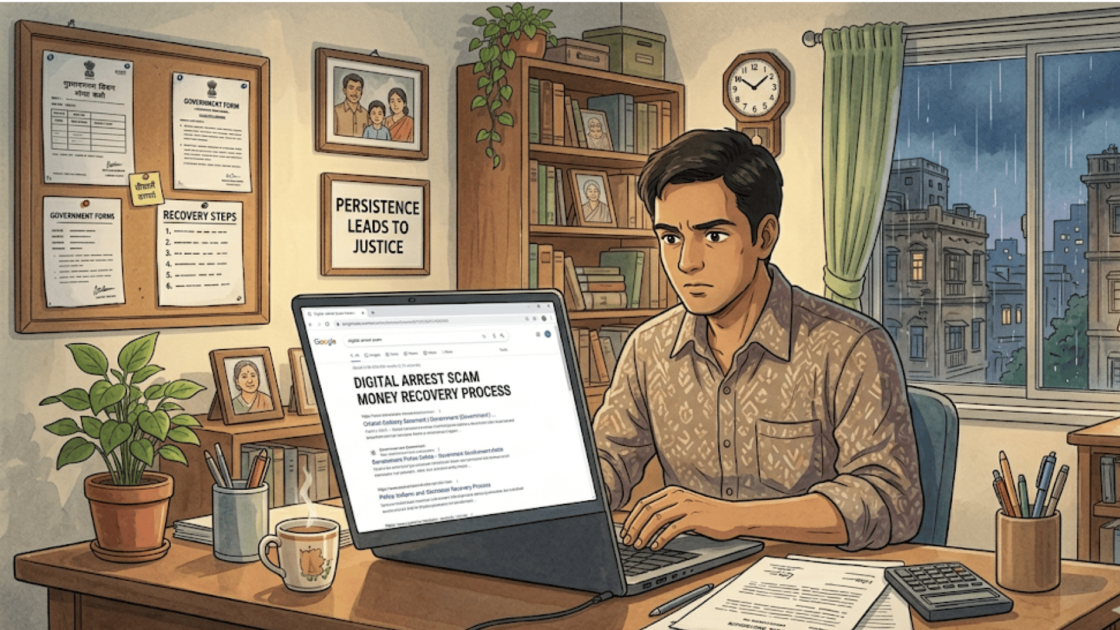
Digital arrest scams have quickly become one of the most dangerous forms of cyber fraud in India.
These scams are not just about stealing passwords; they are psychological traps.
Criminals impersonate high-ranking officers from the CBI, ED, or Narcotics Bureau to convince you that you are a criminal.
Under this extreme pressure, victims often transfer their life savings within hours.
After the initial shock, the most urgent question is: Can I get my money back?
While many believe that digital money vanishes once sent, the truth is that recovery is happening every day.
But success depends entirely on two things: speed and the right reporting process.

Cases Where Money Recovery is Possible
Recovery is a race against the scammers’ ability to move money.
In India, the banking system has layers. If you act while the money is in the early layers, your chances are excellent.
1. The Golden Hour (1–2 Hours)
This is the most critical window.
If you report the fraud to the cybercrime helpline within two hours, the authorities can often freeze the money in the scammer’s very first account.
At this stage, the money has not been moved to multiple other accounts yet.
2. Layer 1 and Layer 2 Freezing
Even if the scammer moves the money to a second account (a mule account), modern tools used by the cyber cell can track the flow in real-time.
If the police can place a lien (a legal hold) on these accounts before the cash is withdrawn at an ATM or converted to crypto, the money is effectively saved.
3. Substantial Evidence Trail
Recovery is much more likely when you provide a clear paper trail.
This includes the exact UTR (Unique Transaction Reference) numbers, the specific UPI IDs used, and the timestamps of each transfer.
This data allows bank nodal officers to act without searching through thousands of transactions.
4. Reporting to the Police in Time
Reporting to the police while the scam is still happening or immediately after allows for live intervention.
This can stop the money from leaving the banking system.
High-value transfers often stay in a pending or processing state for a short time.
So, cyber police can use direct hotlines to bank Nodal Officers to stop the transaction before it is fully settled.
By acting in real-time, the police can also place an emergency Debit Freeze on the scammer’s mule account.
This can lock the funds instantly and prevent the criminal from withdrawing the cash at an ATM or moving it to another account.
Mistakes to Avoid If You Have Been Scammed Through Digital Arrest
Avoid panic and act immediately; every minute matters when trying to stop the flow of stolen funds.
Staying calm and taking the right steps quickly can significantly improve your chances of recovery.
-
Delaying Out of Embarrassment
Scammers win when you feel too ashamed to speak up.
They hope you will think, I’m too smart to be tricked and stay silent.
This is because many victims are worried about what their family or neighbours might say. Every minute you spend worrying about your reputation is another minute the scammer has to withdraw your cash.
Remember, these are professional criminals who trick even the smartest people.
So, there is no shame in being a victim. The only real mistake is staying quiet and giving them more time to get away.
-
Deleting the Evidence Pack
In a state of panic, victims often delete WhatsApp chats, block the scammer, or clear their call logs.
Do not do this. These logs contain the IP addresses, phone numbers, and account details.
Police need these details to build a case and investigate more effectively.
-
Failing to File a Physical FIR
An online complaint is just the start. For large amounts, the police need a physical First Information Report (FIR) to start a criminal investigation.
Without an FIR, the frozen money might just stay stuck in the bank system forever.
So, as soon as you realise you have been scammed, visit your nearest police station and file an FIR.
How To Report A Digital Arrest Scam?
If you have been targeted by a scammer, the most important thing is how quickly you act.
In digital arrest cases, time really matters. Sometimes, even a delay of an hour can make a difference.
Here is a simple, practical way to file a digital arrest complaint and improve your chances of recovering the money:
1. Organise Your Evidence
Before rushing into complaints, take a moment to gather everything related to the scam.
Think of it as putting your story together clearly for the police. Save screenshots of chats, video calls, and any documents the scammers sent you.
Keep a record of phone numbers, WhatsApp details, and especially your bank transaction receipts.
The UPI ID or account number where you sent the money is very important.
When you have all this ready in one place, it becomes much easier for authorities to understand what happened and take action quickly.
2. Call the Cybercrime Helpline
As soon as you realise it is a scam, do not wait. Call the cybercrime helpline immediately.
This is one of the fastest ways to trigger action.
The team on the helpline will ask for your transaction details and basic information.
If you report early, ideally within the first couple of hours, there is a chance the money can be frozen before it is withdrawn.
3. Report Online Fraud
Once you have made the call, go to the cybercrime portal and file your complaint online.
Take your time while writing it. Explain everything in order – how the call started, what they told you, and when you transferred the money.
Upload all the screenshots and documents you collected earlier.
A clear and detailed complaint helps the police connect your case with other similar scams and trace the flow of money more effectively.
4. File a Physical FIR
Visiting the police station is not optional; it is essential.
Go to your nearest cyber cell or police station with all your documents.
Filing an FIR gives your complaint legal strength.
Once it is registered, the police can formally investigate, contact banks, and take necessary action to trace and freeze funds.
In many recovery cases, things only move forward properly after an FIR is filed. So do not skip this step.
5. Notify Your Bank Immediately
At the same time, inform your bank about the fraud.
You can call their helpline or visit the branch in person.
Tell them clearly that this is a cyber fraud case and share your transaction details.
If you have already filed an FIR, take a copy with you. Banks have internal processes to deal with such situations and can coordinate with the receiving bank to try.
They can also stop or trace the money. But again, speed is everything here; the sooner you inform them, the better your chances.
Need Help?
Dealing with the police and banks while you are emotionally drained is incredibly difficult.
It is okay to ask for help.
If you are unsure about how to proceed or need guidance in filing your complaint, you can check the complaint process in our online fraud response plan
The sooner you act, the better your chances of addressing the issue effectively.
Conclusion
A digital arrest is just a fear-based scam; it only works until you realise it is not real.
Moreover, to protect yourself, you must understand the specific digital arrest modus operandi used to trap unsuspecting victims
Once you understand that no genuine authority operates this way, the scammer loses control.
If you have been targeted, do not panic or feel embarrassed.
Remember that recovery is possible.
Act quickly, report the fraud, and reach out to official channels.
Your timely action can help recover your money and stop others from being scammed.