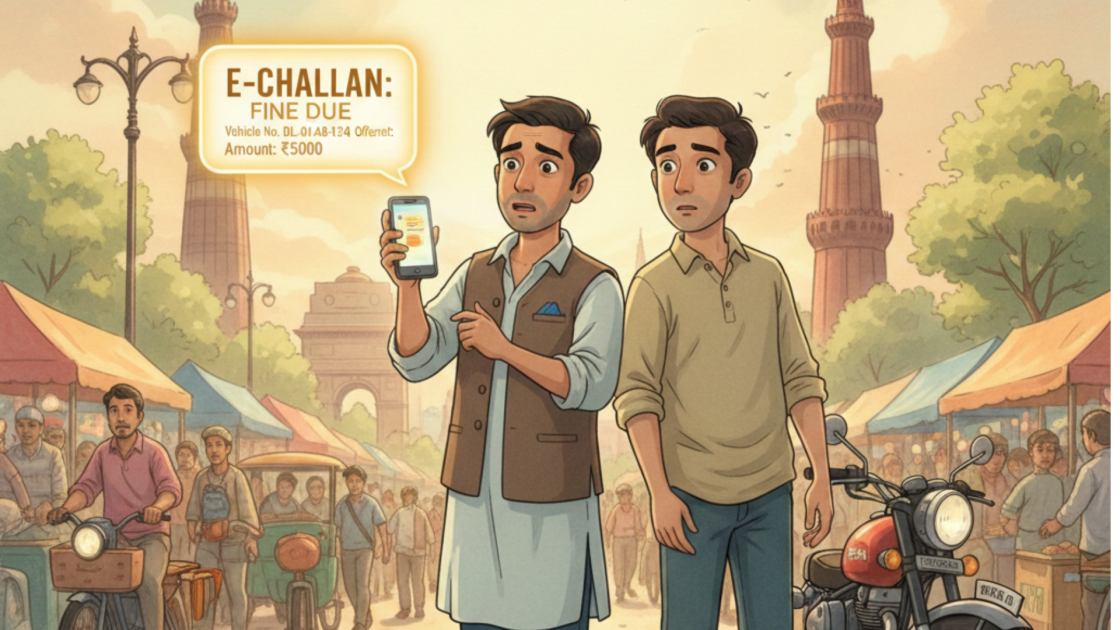
Your phone buzzes. A message flashes on the screen: “Traffic violation detected. Pay your e-challan now.” Your heart skips a beat. Was it speeding? A red light? Before panic pushes your finger toward that payment link, pause for a second, because that single click could be exactly what scammers are counting on. This is how the E-challan Scams are working.
We live in a time when our smartphones double up as wallets, scanners, and even traffic monitors. That convenience is powerful, but it also has a shadow. If you own a vehicle in India, chances are high you’ve already received at least one message about a traffic fine.
And while many of these are genuine, a growing number are not. Welcome to the world of the e-challan scam.
So how do you tell the real from the fake? How do you protect your money, your data, and your peace of mind when a simple SMS can trigger instant fear? That’s exactly what this blog is here to unpack.
Think of it as your road safety guide for the digital highway, helping you understand how these scams work, how to spot the warning signs before it’s too late, and how to stay one step ahead of fraudsters who thrive on haste and confusion.
Because when it comes to e-challans, the smartest move isn’t paying.
What are E-Challan Scams?
Imagine your phone buzzes with an SMS or WhatsApp alert claiming you’ve violated a traffic rule. Over speeding. Signal jumping. A pending e-challan must be paid immediately. The message looks official, carries familiar words like “Parivahan” or “RTO,” and even mimics the tone of a government notice. That’s exactly how an e-challan scam begins.
The trick isn’t sophistication. It’s an urgency. Scammers know most people panic at the thought of fines or legal trouble. So they push you to act fast, warning of penalties or consequences if you don’t click the link right away.
One tap later, you’re taken to a website that appears indistinguishable from the real government portal. Same logo. Same layout. And same colours.
But behind that polished facade is a trap. The moment you enter your card details, UPI PIN, or even just allow certain permissions, your data is compromised. In some cases, the link silently installs malware, giving scammers access to far more than just your money.
What looked like a routine traffic fine suddenly turns into a costly lesson in digital deception.
Modus Operandi of E-Challan Scams
By 2026, these scams will no longer look like scams at all. This isn’t the old-school “click a suspicious link” trick anymore. What you’re dealing with now is a carefully designed, multi-layered attack that blends psychology with technology to lower your guard before you even realise something is wrong.
Here’s the unsettling part.
Scammers don’t always guess anymore; they prepare. Many of them buy leaked databases that contain vehicle registration numbers linked to phone numbers. That’s why a message can land on your phone displaying your actual vehicle number.
The moment you see that detail, your brain switches from “This might be fake” to “This sounds legit.” That split second of trust is exactly what they are counting on.
These fraudsters follow a predictable playbook, refining it with each successful scam. The scary truth is that most victims don’t fall for the scam because they’re careless; they fall for it because the scam feels real.
If you want to stay safe, the first step isn’t installing another app or memorising rules. It’s understanding how these scams actually operate, how they earn your trust, and how they move you step-by-step toward a mistake. Once you recognize their methods, the illusion starts to crack, and that’s when you regain control.
1. The Phishing Link Method
Sometimes you get an SMS claiming you’ve been fined for a traffic violation. It looks urgent, official, and convincing. There’s a link waiting to be clicked. Curious or worried, you tap it, and that’s where the trap snaps shut.
The link quietly redirects you to a website that looks exactly like the Parivahan portal. Same colours, same layout, same government-style seriousness. You’re asked to “pay the fine” to avoid further action. You enter your card details, thinking you’re settling a small issue. In reality, you’ve just handed over your card number, CVV, and expiry date to scammers sitting behind the screen.
But it doesn’t stop there. Moments later, an OTP lands on your phone. Before you can even read it properly, a screen overlay flashes up, tricking you into entering that OTP as well. That single step gives them full access. Within seconds, money starts vanishing from your bank account. No alarms, no warnings, no time to react.
That’s the phishing link method. Simple, fast, and dangerously effective. Because it preys on urgency, fear, and trust in official-looking messages.
2. The Malicious APK File Scam Method
You get a WhatsApp message that looks completely legit. The sender urges you to download an “official” app file, confidently calling it the “New mParivahan App” and promising quick, hassle-free payments. It feels urgent, it feels authentic, and that’s exactly the trap.
The moment you install this APK, the game changes. What you thought was a harmless government app quietly turns into spyware. It starts reading your SMS to intercept OTPs, peeks into your contact list to map out your network, and in some cases, even gives scammers remote control over your phone.
Every tap, every message, every alert can suddenly be watched or manipulated, without you realizing what went wrong.
By the time you sense something is off, the damage may already be done. That “official app” wasn’t designed to help you at all. It was built to watch you, exploit you, and drain your digital life from the inside.
3. The QR Code Scam
A message pops up with a shiny QR code and an irresistible line, “Scan to pay your challan and get a 50% discount.” Sounds convenient, right? Almost too good to ignore.
Now pause for a second. In real life, discounts don’t arrive via random WhatsApp messages, and challans don’t get cleared through mystery QR codes. Here’s the trick they want you to miss: scanning a QR code in any payment app is meant for sending money, not receiving a benefit. There is no “discount mode,” no cashback button, no safety net.
The moment you scan that QR code and type in your UPI PIN, you’re not paying a fine at half price; you’re authorising a transfer straight from your bank account. No confirmation call. No second chance. Just money quietly leaving your account and landing in a scammer’s wallet.
That’s how the QR code scam works. It doesn’t hack your phone or break into your account. It simply convinces you to approve the transaction yourself, while you believe you’re doing something completely legitimate.
E-Challan Scams Real Cases
The e-challan scam has evolved into a highly sophisticated digital threat in 2026, typically involving fake traffic violation notices sent via SMS or WhatsApp. To understand the gravity, let’s look at some recent incidents reported across India:
Case 1: Hyderabad Fake Link case
It started with what looked like a routine warning. A message alerting a Hyderabad resident about a pending traffic e-challan. No sirens, no panic, just a ₹500 fine waiting to be cleared. The link looked official, the website appeared authentic, and everything about it felt legitimate. So, as most of us would, he clicked and proceeded to pay.
That single click changed everything.
Hyderabad Police Commissioner V.C. Sajjanar later revealed on X that the moment the payment was attempted, the victim’s credit card details were silently captured. Within minutes, fraudsters struck, not with a small deduction, but with a massive international transaction of €6,900, roughly ₹6 lakh, drained straight from the card.
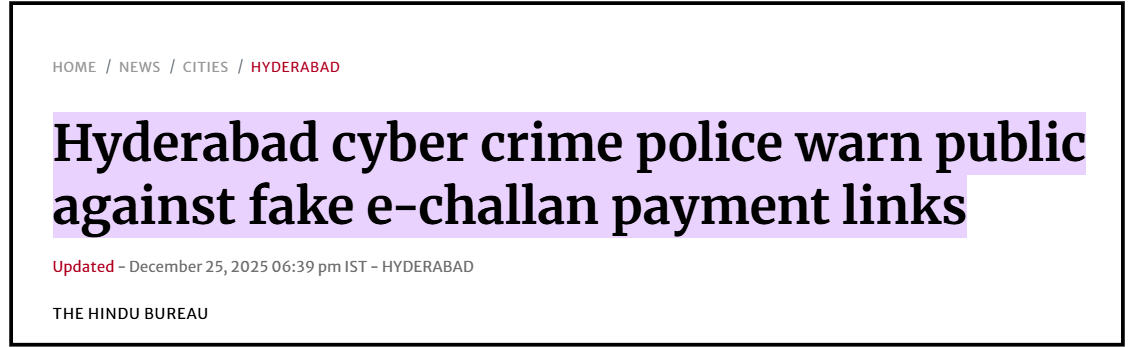
What made the scam so dangerous was its simplicity. The fake payment link closely mirrored the official police portal, leaving little room for suspicion. While the victim believed he was settling a minor traffic violation, cybercriminals were already executing high-value foreign transactions in the background.
The incident is a stark reminder that cyber fraud doesn’t always arrive with obvious red flags. Sometimes, it disguises itself as a harmless notification, and all it takes is one moment of trust for the damage to be done.
Case 2: Malicious APK Installation
It started with a simple WhatsApp message and a file that looked harmless enough,“TRAFFIC CHALLAN 500.APK.” His son tapped download, probably thinking it was just another routine notice. But in that single moment, the phone quietly slipped out of their control.
What followed was nothing short of a digital ambush. The file wasn’t a challan at all. It was malware. Once installed, it gave cybercriminals remote access to the phone, turning it into an open vault. Without alerts or warnings, money began to move.
Fixed deposits were broken. Funds were transferred. Loans were taken out in the man’s name, all without his consent or knowledge.
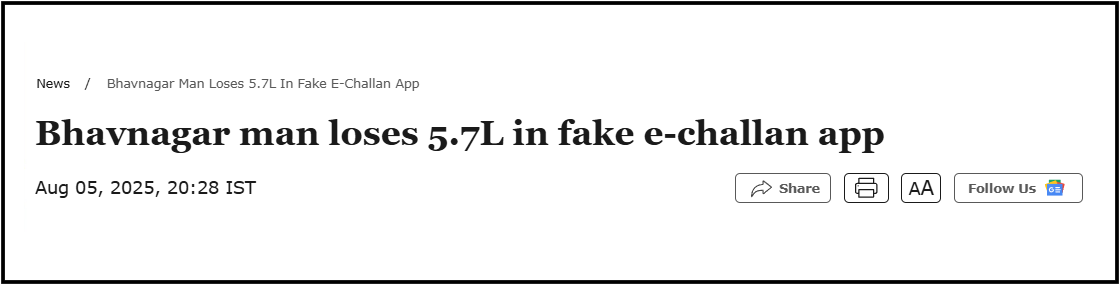
By the time the family realized something was wrong, ₹5.77 lakh had vanished.
No dramatic hacking scene, no complex passwords cracked. Just one deceptive file and a few seconds of trust. In Bhavnagar, this incident is now a stark reminder that today’s scams don’t always arrive with red flags. Sometimes, they come disguised as a traffic fine on WhatsApp.
How to Check If a Challan Is Real or Fake?
Before you panic or pay, take a moment to verify. A genuine e-challan can always be checked independently, no links, no urgency, no guesswork.
Start by visiting the official e-Challan portal of the Ministry of Road Transport & Highways. Open the site manually in your browser and search using your vehicle registration number or driving licence number. If a challan is real, it will appear there. If it doesn’t, the message you received isn’t genuine.
Next, look at the sender. Authentic challan alerts usually come from verified government sender IDs like VM-PARIVAHAN or DDCSMS. Messages from random mobile numbers, international numbers, or WhatsApp forwards are a major red flag.
Most importantly, never click payment links sent via SMS or WhatsApp. Government authorities do not demand instant payments through random links, APK files, or QR codes. If a message pressures you to act fast, that urgency itself is a warning sign.
When it comes to e-challans, remember this simple rule: verify first, pay later. A real challan will wait. A scam won’t.
How to Report E-Challan Scams
If you have been scammed or have received a suspicious message, don’t stay silent. Your report could save the next victim.
- File a formal complaint on the National Cyber Crime Reporting Portal. Upload screenshots of the message, the link, and the transaction details.
- Call the National Cyber Crime Helpline number
- Immediately call your bank to block your cards and net banking access.
Need Help?
Navigating the aftermath of a cyber scam can be overwhelming. From filing FIRs to communicating with banks for a chargeback, the process is technical and exhausting.
If you have lost money to an e-challan scam and don’t know where to start, register with us. Our expert team will help you in recovery.
Conclusion
The e-challan system was created to simplify life on the road, not to scare you into paying in a hurry. Yet, in the wrong hands, even a helpful digital tool can turn into a trap. That’s why one rule matters more than anything else: the government will never pressure you to pay a fine through a random link or a panic-filled message.
The moment your phone buzzes with an urgent “last chance” warning, pause. Take a breath. Open your browser and type echallan.parivahan.gov.in yourself—don’t click, don’t rush. Scammers thrive on fear and speed, but verification steals their power.
If a message tries to make your heart race, chances are it’s not official. Stay alert, stay sceptical, and protect your hard-earned money from the digital pickpockets lurking in today’s online world.