Imagine checking your phone and seeing a message claiming a ₹80,000 smartphone was ordered from your Amazon account, complete with a realistic-looking fake Amazon order screen, even though you never placed it.
Before you can process what’s happening, a call arrives from someone claiming to be Amazon support, asking for an OTP to cancel the order.
Many people panic in this moment, and that’s exactly how the scam works.
Fake Amazon Order Scam
Since Amazon and Flipkart are widely trusted e-commerce platforms in India, most people never stop to ask, “Can you get scammed on Amazon?”, at least not until a strange message or call suddenly appears.
But scammers use loopholes or use the brand name to defraud people.
To execute the scam, a fake Amazon order scam occurs when fraudsters claim that an order has been placed on a victim’s Amazon account without their knowledge.
The main goal is to trick the victim into:
- Sharing OTPs or banking details.
- Installing malicious apps.
- Sending money under the pretext of cancelling or refunding an order.
The scam is dangerous because it exploits trust in Amazon’s brand and creates a sense of urgency, making victims act impulsively.
How the Amazon Order Scam Works?
Here is the modus operandi of the scam:
- Initial Contact: The victim receives an SMS, email, or WhatsApp message about a “confirmed order.”
- Fraudulent Call: Scammers call pretending to be Amazon support, claiming the order can be cancelled.
- Request for Sensitive Information: Victims are asked to share OTPs, UPI details, card information, or install apps.
- Execution: Once the information is shared, scammers either withdraw money, steal account access, or commit identity theft.
The scam often feels convincing because it combines official-looking messages with urgent phone calls.
Common Types of the Fake Amazon Order Scam
The Fake Amazon Order Scam doesn’t follow a single pattern. Scammers use multiple tricks to make the scam appear real and increase the chances of success.
Understanding these variations can help shoppers spot warning signs quickly. The most common types include:
- Refund Scam: Scammers send messages claiming a refund is due for an order. They ask for bank details or OTPs to process the refund, but instead, they steal money from the account.
- OTP/UPI Scam: In this version, victims are asked to share OTPs or UPI PINs to “verify” or “cancel” a supposed order. Once the details are shared, the scammer can immediately withdraw funds.
- Gift Card Scam: Some scammers ask for Amazon gift card codes to cancel an order or process a refund. This allows them to convert digital codes into cash, making it difficult to trace.
- Fake Invoice Scam: Fraudsters send a PDF or screenshot resembling an official Amazon invoice. This creates a false sense of authenticity, convincing victims that the order is real.
Example of a Fake Amazon Order Screen
One of the reasons the Amazon fake order screen scam works so well is because the messages look surprisingly real. Scammers carefully copy the style, wording, and layout of genuine Amazon notifications to make victims believe the order is legitimate.
For example, you might receive a message claiming there’s a “Safety Recall” or a confirmation for a costly product you never ordered.
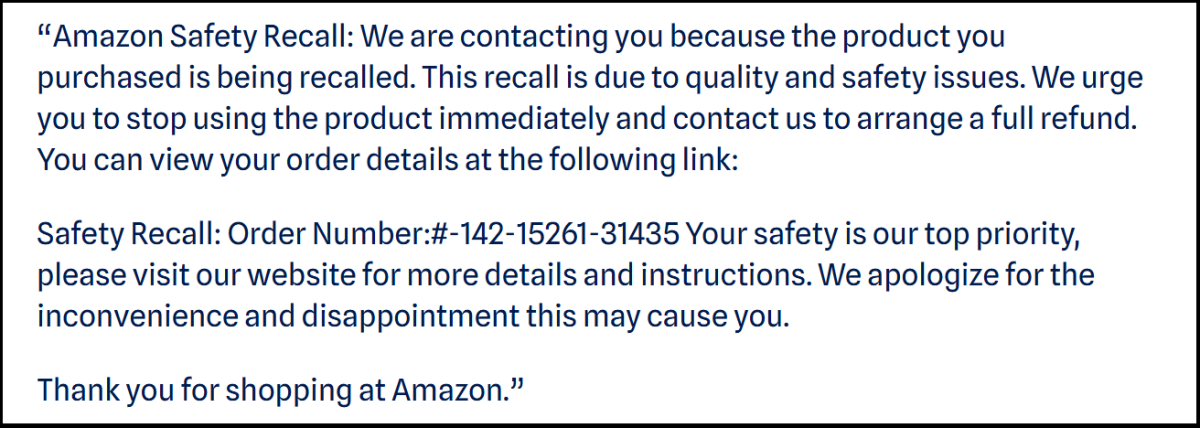
The message may include an order number, customer service instructions, and a link to check details. At first glance, it feels official — and that’s exactly what scammers want.
However, when you slow down and examine the message, certain warning signs usually appear.
- Most fake Amazon order screens use generic language instead of personal details.
Instead of mentioning your name or exact purchase information, the message may say something vague like “the product you purchased” or “your recent order.” Real Amazon notifications typically match the details inside your account history. - Another common tactic is urgency. You may see phrases such as “stop using immediately,” “cancel now,” or “contact support urgently.” These pressure tactics are designed to create panic so you act quickly without verifying whether the order is real.
- Pay attention to links and contact information as well. Fake order messages often direct you to external websites or phone numbers that are not part of Amazon’s official support system.
Even if the design looks professional, the destination could be a phishing page created to capture login details or financial information. - Small formatting issues can also be a clue. Slightly unusual grammar, inconsistent spacing, or wording that feels just a bit off are common in scam messages.
These details are easy to miss when you’re worried about an unexpected charge. - The safest way to confirm whether an order is real is simple: open your Amazon app or type the official Amazon website directly into your browser and check your order history.
If the order doesn’t appear there, the message is almost certainly part of an Amazon fake order scam.
Scammers rely on trust and urgency. By creating realistic-looking fake order screens, they hope users react emotionally instead of verifying calmly. Taking a few extra seconds to check inside your actual account can prevent a costly mistake.
How to Spot Fake Amazon Order Screen
Scammers often create a sense of urgency by claiming an order was placed without your knowledge. Spotting fake orders quickly can prevent financial loss. Here’s how to identify them:
- Verify in Your Official Amazon Account: Always check the Amazon app or website. If the order does not appear in your purchase history, it is fake. Screenshots or messages alone are not reliable.
- Check Order Details Carefully: Look for unusual products, suspicious pricing, or incorrect delivery addresses. High-value items you never ordered are a major red flag.
- Be Wary of Urgent Messages: Scammers often pressure you with messages like “Cancel within 10 minutes” or “Your account will be charged immediately.” Legitimate orders do not require immediate action outside the Amazon app.
- 4. Ignore Unverified Links and Contact Numbers: Do not click links or call numbers provided in unsolicited messages. Always use official Amazon contact options via the app or website.
- 5. Watch for Requests for Sensitive Information: Amazon will never ask for OTPs, passwords, UPI pins, or card details to cancel or confirm an order. Any such request is a scam.
- 6. Confirm with Official Support if Unsure: If anything feels off, reach out to Amazon support through the official app rather than relying on numbers or emails in suspicious messages.
By following these checks, one can quickly differentiate real orders from fake ones and avoid falling victim to scams.
How to Report Fake Amazon Order Screen Scam?
If a suspicious message, call, or email is received, reporting it quickly can prevent further fraud. Follow these steps:
- Do Not Respond or Click Links: Avoid sharing OTPs, passwords, or payment details. Any action requested outside the official Amazon platform should be treated as suspicious.
- Report Directly to Amazon: Forward phishing emails to [email protected] or use the “Report Suspicious Activity” option in the Amazon app.
- Contact Your Bank or Payment Provider: If any financial details were shared, immediately block the card, UPI, or bank account to prevent loss.
- File a Cyber Crime Complaint: Visit a Cyber Crime portal and submit a complaint under “Other Cyber Crimes.” The helpline 1930 is available for urgent assistance.
- 5. Lodge a Police Complaint (FIR) if Financial Loss Occurs:Include screenshots of messages, emails, and transactions.
Prompt reporting helps authorities investigate and prevents others from falling victim.
Need Help?
In case you have been scammed in any such shopping fraud, register with us and we will guide you with the steps involved to file a complaint online that help you get recovery of losses.
Conclusion
The Fake Amazon Order Scam works because it combines fear, urgency, and trust in a familiar brand. Shoppers are pressured to act quickly, making it easy for scammers to succeed.
The rule is simple: always verify orders directly in the official Amazon account before taking any action. Ignore unsolicited messages, never share sensitive details, and report any suspicious activity immediately.
Awareness, verification, and caution are the most effective defenses. By staying alert, online shopping can remain safe and worry-free.