Most investors believe that choosing a large, well-known broker automatically ensures a smooth experience. That assumption does not always hold true.
Even with a broker like ICICI Securities, investors encounter issues from time to time.
These issues can range from platform glitches during trading hours to unexpected charges, delays in customer support, or confusion around how trades get executed.
This does not mean the broker is unreliable. It simply reflects the nature of the system. When technology, markets, and money come together, problems can arise.
What matters is how often these issues occur, how the broker responds to them, and how prepared you are to handle them if they affect you.
In this blog, we will look at verified complaint data from stock exchanges, examine a real arbitration case, and understand the kind of issues investors have reported.
More importantly, we will focus on what you should do if you face a similar situation.
The purpose of this analysis is not to judge ICICI Securities. It is to help you approach investing with clarity and make informed decisions when things do not go as expected.
ICICI Securities Complaints Overview
ICICI Securities is a well-established full-service broker in India. Many investors choose it for its brand value and range of services.
At the same time, investors do report issues.
Most complaints fall into a few common areas.
Some investors also report serious concerns, such as ICICI securities unauthorised trading, where trades appear without clear consent.
Others raise concerns about charges, including situations often described as ICICI securities excess charges, where they do not fully understand the deductions or brokerage fees applied to their accounts.
Technical issues also come up. Users sometimes struggle with login access, platform slowdowns, or delays at critical moments.
These issues directly affect trading decisions.
Customer support forms another concern. Some investors feel that responses take time or lack clarity, which adds to the frustration when money is involved.
You will see similar complaints across most brokers. ICICI Securities is not an exception.
The real question is not whether complaints exist, but how often they occur and how effectively they get resolved.
To understand that better, you need to look at actual exchange data.
Exchange Complaint Data
Understanding complaints in general is useful, but it only gives you a surface-level view. To get a clearer picture, you need to look at actual data reported to stock exchanges.
Exchanges like NSE and BSE track complaints against brokers in a structured way.
This includes how many complaints investors file, how many get resolved, and how many move to arbitration.
This data carries more weight because it reflects formally recorded issues, not just opinions or isolated experiences.
When you look at this data for ICICI Securities, you start to see patterns.
You can track whether complaints increase over time, whether the broker maintains consistent resolution, and whether disputes escalate beyond the initial stage.
This helps you move from assumptions to facts. Now let’s look at the actual complaint data across financial years.
| Financial Year | Total Clients | No. of Complaints | % of Complaints | Resolved Complaints | % Resolved | Arbitration |
|---|---|---|---|---|---|---|
| 2022–23 | 1,986,214 | 598 | 0.030% | 582 | 97.32% | 6 |
| 2023–24 | 1,986,214 | 621 | 0.031% | 607 | 97.74% | 4 |
| 2024–25 | 2,148,903 | 912 | 0.042% | 912 | 100% | 2 |
| 2025–26 | 2,074,916 | 657 | 0.032% | 591 | 89.95% | 0 |
But when you look deeper, a different picture starts to emerge.
The number of complaints increased noticeably in 2024-25. While the client base also grew, the jump in complaints is still significant.
This usually indicates that more users experienced friction, whether due to platform issues, charges, or execution concerns.
The resolution trend also needs attention.
ICICI Securities reported 100% resolution in 2024-25, which looks strong on paper. However, the following year shows a drop to 89.95%.
This change matters because it suggests that not all issues closed as smoothly in the most recent period.
Arbitration numbers remain low, which means most disputes did not escalate to that level. In one way, this indicates that many issues get handled before reaching arbitration.
But it also tells you that the complaint system itself plays a crucial role, because most investors never go beyond it.
What you should take from this is not just the numbers, but the pattern. Complaints do increase at times, and resolution is not always consistent.
As an investor, you should not assume that every issue will get resolved automatically.
You need to stay alert, track your transactions, and act quickly when something feels off.
ICICI Securities User Reviews
Looking at data gives you structure, but user reviews show you how investors actually experience the platform.
These reviews come from real users who actively use the ICICI Securities app. They highlight practical issues that affect day-to-day trading.
1. Slow Performance and Chart Loading Issues
Some users highlight serious concerns around the app’s speed and responsiveness, especially while accessing charts and searching for stocks.
Before you look at the review, understand the context. For any trader, speed matters. Delays in charts or search results directly affect decision-making.
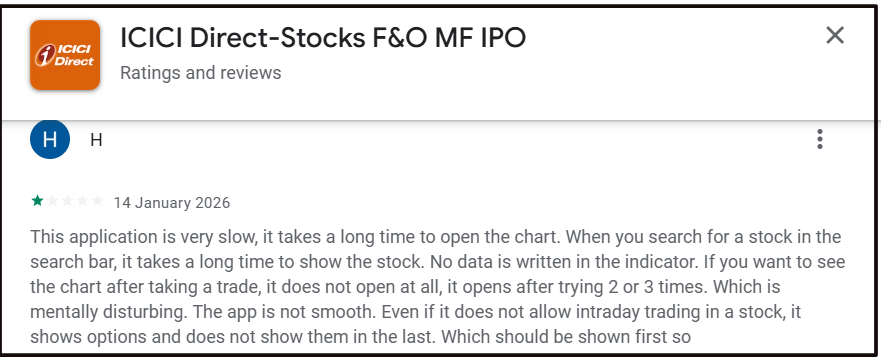
This review clearly points to performance issues. The user struggles with slow chart loading, delayed search results, and repeated attempts just to open charts.
The mention of mental disturbance shows how frustrating this becomes during live trading.
This kind of issue matters because trading decisions depend on timing. If the platform does not respond quickly, it can lead to missed opportunities or poor execution.
2. Limited Chart Options and Usability Concerns
Another user points out changes in chart functionality that affect usability.
Chart access should remain simple. Most users just want quick price history without navigating through complex technical tools.
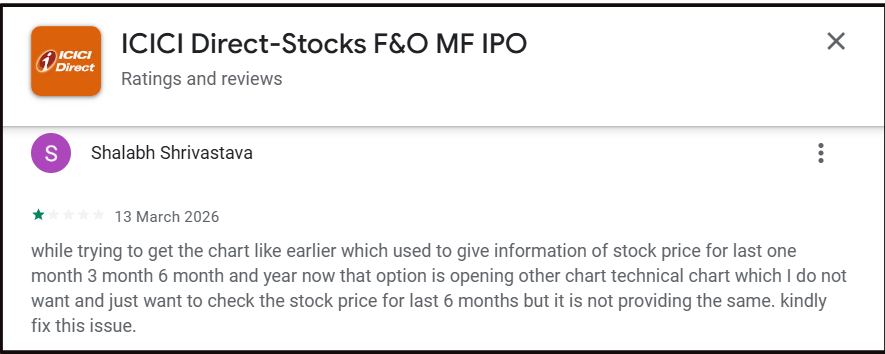
This review shows that the app forces users into technical charts even when they only want basic price data.
The user specifically mentions the inability to view simple time-based price history like 6-month performance.
This reflects a usability gap. When basic features become harder to access, the overall experience suffers.
3. Account Closure and Charges Frustration
Some reviews go beyond app performance and focus on account-related issues.
Before reading the review, note this. Ease of account management plays a big role in user satisfaction, especially when users want to exit.
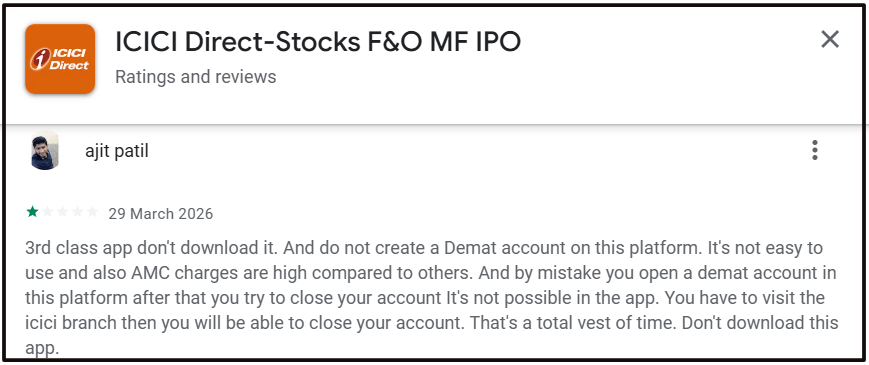
This review highlights two major concerns. The user finds the app difficult to use and feels that the charges are higher compared to other platforms.
More importantly, the user claims that closing the account requires visiting a physical branch.
This creates friction. When users cannot manage or close their accounts easily, it leads to strong dissatisfaction.
4. Missing Features and Incomplete Functionality
Another set of concerns revolves around missing features and incomplete functionality within the app.
For active users, consistency between the app and the web platform matters. Missing features create gaps in experience.
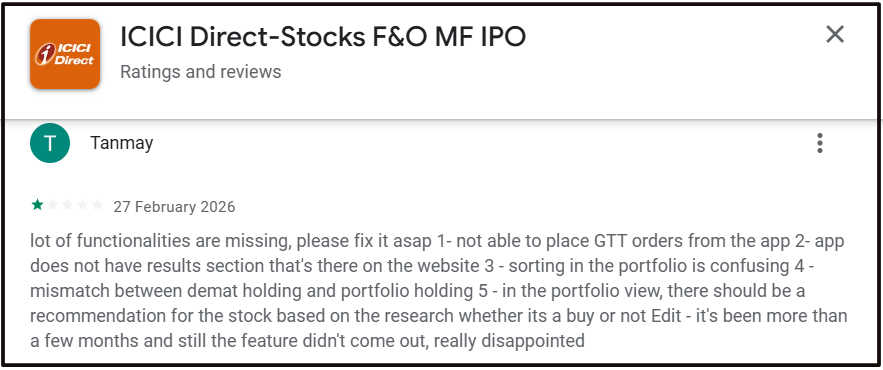
This review lists multiple issues. The user cannot place GTT orders, does not find key sections like results, and notices confusion in portfolio sorting.
The mismatch between demat and portfolio holdings raises a serious concern.
The follow-up comment shows that these issues remained unresolved for months. This indicates delays in feature updates and improvements.
These reviews point to a few clear patterns.
Users face issues with performance, usability, missing features, and account handling. Not every user experiences all these problems, but these patterns appear consistently.
You should not treat reviews as the absolute truth. At the same time, you should not ignore them.
They help you understand where friction can occur. If you plan to use the platform, you should stay aware of these areas and monitor your own experience closely.
When To Take Action Against Brokers?
Many investors ignore issues in the beginning. They assume it is a one-time glitch or something that will fix itself. That approach usually backfires.
You should treat any issue involving your money, trades, or account control seriously from the start. Small problems often turn into bigger ones when you delay action.
You should take action in the following situations:
- You notice trades in your account that you did not place. This could indicate unauthorised trading activity, and you should report it immediately.
- You see charges that look unclear or higher than expected. Do not assume they are correct. Check your contract notes and raise the issue if something does not match.
- The platform lags, crashes, or fails during active trading hours. If this affects your ability to place or exit trades, you should treat it seriously.
- Your fund withdrawal takes longer than the expected timeline. Your money should move without unnecessary delays.
- You face repeated issues with order execution, such as delays, rejections, or mismatches in trade details.
- Customer support does not respond on time or gives unclear answers. Lack of proper communication often makes the issue worse.
- You see mismatch in your portfolio, holdings, or account balance. These discrepancies should never be ignored.
The key is simple. Do not wait for the problem to grow.
When you act early, you can track the issue clearly, collect proper proof, and improve your chances of getting it resolved without escalation.
How to File a Complaint Against a Stock Broker?
You should follow a clear process when you report a broker. Do not skip steps. Each stage builds your case and improves your chances of resolution.
Step 1: Gather Evidence
Keep records of approved trades, invested amounts, and communication with the broker.
When irregularities arise, collect supporting proof such as screenshots, trade confirmations, contract notes, messages, or call recordings.
These documents strengthen your case while filing a complaint.
Step 2: Raise a Complaint with the Broker
Start by reporting the issue directly to ICICI Securities.
Explain the problem clearly. Mention dates, transactions, and what exactly went wrong. Attach supporting proof such as contract notes, screenshots, or account statements.
Give the broker time to respond. Many issues get resolved at this stage when you present them properly.
Step 3: Lodge a Complaint in SCORES
If the explanation or solution provided is unsatisfactory, investors can lodge a complaint in SEBI through the SCORES system.
This step brings regulatory oversight and ensures that your complaint gets reviewed at a higher level.
Step 4: File a Complaint in SMART ODR
If the issue still remains unresolved, you can move to the ODR platform.
ODR provides a structured system where both you and the broker interact under exchange supervision.
It aims to resolve disputes through a guided and time-bound process before moving to formal arbitration.
Step 5: Arbitration in the Share Market
If the issue still does not get resolved, it moves to arbitration.
This is a formal dispute resolution process.
Both you and the broker present your case with proper documentation. The exchange reviews trade records, communication, and evidence before passing a final decision.
Follow this process step by step. When you act in sequence, you create a strong record and improve your chances of getting a fair resolution.
Need Help?
Handling a broker-related issue on your own can feel overwhelming, especially when money is involved, and responses are delayed or unclear.
Many investors stop midway because they do not know what to do next or how to present their case properly.
In some situations, even a valid issue does not get resolved simply because it was not raised or followed up on in the right way.
If you are facing a similar problem with ICICI Securities or any other broker, you do not have to handle it alone.
You can register with us.
We can also assist in monitoring SEBI complaint status online and representing your case during arbitration.
Conclusion
ICICI Securities is a well-established broker with a large client base and a wide range of services. At the same time, like any platform that handles trading and investments at scale, it is not free from issues.
The complaint data shows that while the overall percentage of complaints remains low, the number of complaints and resolution trends do change over time.
User reviews highlight practical challenges related to performance, usability, and support. The arbitration case further shows how disputes get decided when they escalate.
None of this means you should avoid the broker. It means you should stay aware.
As an investor, you need to track your trades, understand your charges, and act quickly when something does not seem right.
The system provides you with multiple ways to raise and resolve issues, but the outcome depends on how you use them.
In the end, the responsibility does not lie only with the broker. It also lies with you.
When you stay informed and take timely action, you put yourself in a much stronger position to handle any issue that comes your way.