

Have you ever joined a Telegram channel for stock tips, felt confident about a call, acted on it, and then quietly watched your money disappear? If that sounds familiar, you are not alone.
Thousands of retail traders across India go through this experience every week, and most of them never find out why it happened or what they could have done differently.
The answer, more often than not, starts with a single question they never asked: is this channel actually allowed to give me investment advice?
The Insider Stocks Telegram Channel, operating under the handle @insidestck, is one such channel worth examining closely.
With hundreds of subscribers receiving daily stock calls, buy signals, BTST targets, and paid subscription offers, it presents itself as a valuable resource for traders.
But surface appearances and regulatory legitimacy are two very different things, and every trader deserves to understand that difference before they act on a single call.
In this blog, we take a close look at the Insider Stocks Telegram Channel, what it posts, why each type of content raises a specific regulatory concern under SEBI’s framework, what SEBI has done in similar cases, and what you should do if you have already been following it.
Insider Stocks Telegram Channel Review
The Insider Stocks Telegram Channel runs under the public handle @insidestck on Telegram and describes itself as being “only for educational purposes.”
However, a straightforward look at the channel’s content tells a very different story.

The channel’s bio goes on to state that its admins have “great expertise in all types of trading” and will “suggest profitable calls, expert tips, and advice daily.”
That description alone, combining claimed expertise with a promise of daily tips, crosses the line between general commentary and securities recommendation, at least in terms of how it presents itself to subscribers.
The channel posts stock calls with specific buy levels, short-term targets, BTST targets, weekly targets, and stop-loss levels across a range of listed equities.
Stocks covered in the channel’s posts include names like Aries Agro, SBIN, Zensar Tech, SGIL, Poonawalla Fincorp, Parsvnath Developers, Devyani International, Century Plyboards, Bhagyanagar Property, Rico Auto, and Chemplast Sanmar, among others.
Beyond free calls on the main channel, there is also a paid subscription tier, where subscribers are promised 2 to 3 trading calls per day, along with WhatsApp-based support with entry, stop-loss, and target levels.
Payment amounts mentioned in posts go up to ₹4,500 per month for what is described as “prime” access.
Now that the picture of what this channel does is clear, let’s look at its actual posts and the specific regulatory concerns each type of content creates.
Insider Stocks Telegram Channel Posts
Each post type on the Insider Stocks Telegram Channel raises its own distinct concern under SEBI’s regulatory framework.
Here is an honest look at four categories of content and what traders should understand about each one.
Category 1: Specific Buy Calls with Targets and Stop-Loss, Unregistered Advisory Activity
This post recommends buying Aries Agro at ₹153–154, with a BTST target of ₹160–164, a weekly target of ₹170–175+, a short-term target of ₹250+, and a stop-loss at ₹145.
It received over 2,270 views, meaning this specific directional call reached thousands of traders.
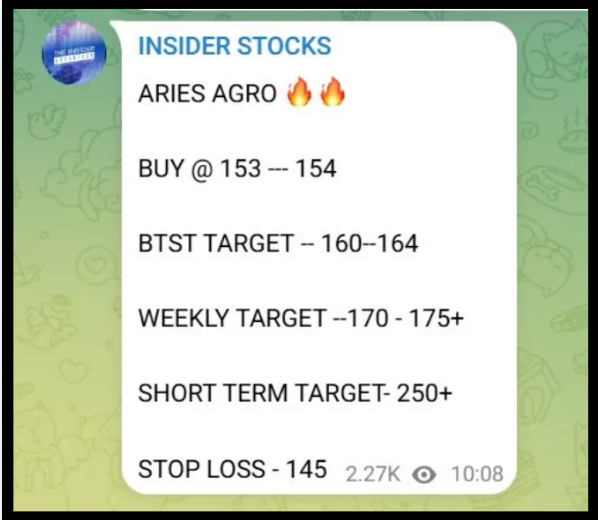
Under SEBI’s Research Analysts Regulations, 2014, any person who provides a buy, sell, or hold recommendation on a specific listed security, complete with entry levels, target prices, and stop-loss instructions, is performing the function of a Research Analyst.
Doing so without SEBI registration is a clear violation of the law, irrespective of whether a “for educational purposes only” disclaimer appears elsewhere on the channel.
A disclaimer does not neutralise an actionable call.
When a channel specifies a stock name, entry range, targets, and stop-loss to an audience of paying or free subscribers, it is providing investment research, and that activity requires mandatory registration.
Category 2: Selective Winner Announcements, Creating a False Picture of Accuracy
This post announces that the channel’s BTST call on KPIT Tech made a high of ₹705.50, declaring the target achieved with celebratory emojis.
It had 1,470 views. Notice that it specifically references its own earlier call to frame this as a success story.
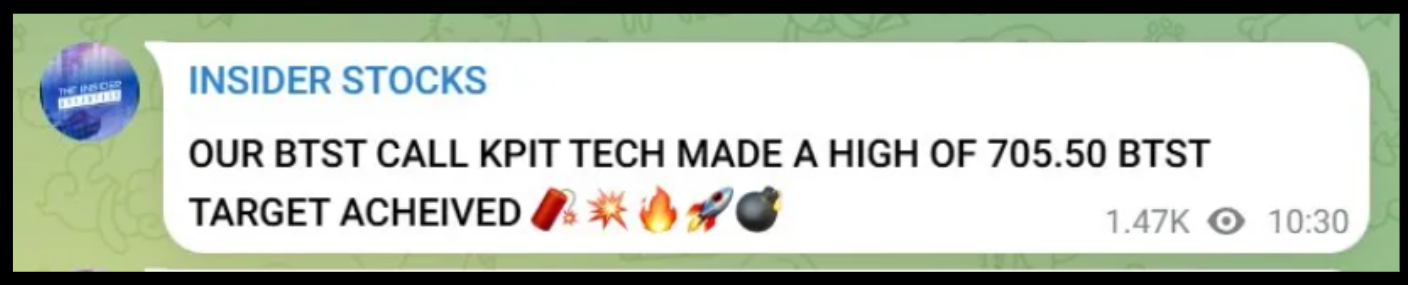
The practice of publicising only winning calls while making no mention of calls that failed or resulted in losses is a well-documented, misleading tactic.
SEBI’s enforcement orders, including the April 2026 Intraday Jackpot case, explicitly identify the selective showcasing of profitable trades as a prohibited method of misrepresenting advisory performance.
Real trading involves both wins and losses. Any service that shows you only the green trades is not showing you how it actually performs; it is showing you a curated highlight reel designed to build trust and drive subscriptions.
Traders who see only success announcements are more likely to pay, follow advice, and then experience losses that were never factored into the picture they were shown.
Category 3: Paid Subscription for Trading Calls with Guaranteed Profit Claims
This post advertises a premium subscription at ₹4,500 per month (originally ₹5,000, after a 10% discount), promising 2 to 3 trading calls daily.
A basic plan is offered at ₹2,500 per month for one call per week. The post then claims subscribers can “earn huge ₹2,000–₹10,000 profit daily” and also advertises “99% accuracy PLUS.”

Two separate and serious regulatory violations are visible here.
First, charging any fee for trading calls without SEBI registration as a Research Analyst or Investment Advisor is illegal; the medium (WhatsApp, Telegram, or any other platform) does not change this.
Second, and equally important, claiming specific daily profit amounts or projecting near-perfect accuracy is explicitly prohibited by SEBI.
No registered advisor is permitted to promise assured returns or guaranteed profits, let alone an unregistered one.
The combination of a commercial fee structure and profit guarantee claims represents one of the most direct patterns SEBI has targeted in its recent enforcement actions against unregistered Telegram-based advisory services.
Category 4: Profit Screenshot Sharing, Selective Disclosure to Influence Subscribers
This post shares a brokerage position screenshot showing a realised profit of ₹39,173.60 on a single trade in AMJLAND-EQ (AMJ Land Holdings Limited).
The screenshot displays only this one position, entirely green, with no context about other trades, total capital deployed, or any losing positions.
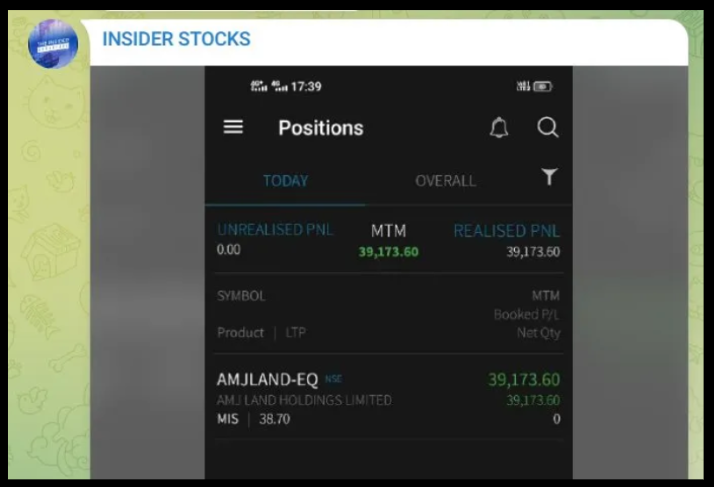
Sharing screenshots of individual profitable trades to an audience of current or potential subscribers is a recognised form of selective disclosure.
SEBI’s regulatory framework prohibits any entity, registered or otherwise, from creating a false impression of consistent profitability. Showing a single winning trade without disclosing the full picture of activity is precisely this kind of misleading representation.
For traders, seeing these screenshots feels like social proof. But it is not proof of a reliable service; it is a snapshot of one trade, cherry-picked from an unknown pool of activity.
The question that these posts never answer is: how many other trades happened that day, and how did those perform?
The pattern is consistent, and it is the same pattern that SEBI has repeatedly flagged and penalised across its enforcement history. This raises a natural question: what exactly does SEBI prohibit such channels from doing?
What SEBI Does Not Permit Telegram Channels to Do?
Based on SEBI’s enforcement actions and its regulatory framework governing Research Analysts and Investment Advisors, here is a clear picture of activities that are prohibited.
Stock Advisory Violations:
- Issuing buy, sell, or hold calls on individual listed stocks without SEBI registration as a Research Analyst.
- Providing specific entry price, target, and stop-loss levels for intraday, BTST, or positional trades as a service to subscribers.
- Charging any fee, through any platform, including Telegram, WhatsApp, or a dedicated app, for stock recommendations.
- Offering advisory services through a free-to-join channel that funnels subscribers into paid groups.
Manipulative Violations:
- Building positions in a stock, recommending it publicly to a large subscriber base to drive up the price, then exiting for profit, a practice SEBI calls scalping or front-running
- Coordinating with promoters, company insiders, or connected entities to artificially inflate a stock’s price through coordinated Telegram recommendations
- Disseminating recommendations through channels with large subscriber bases specifically to create artificial demand in a scrip
Misleading Violations:
- Publicising only winning trades while suppressing or ignoring losing calls creates a false track record.
- Claiming assured daily profits, guaranteed returns, or specific income targets such as “₹2,000–₹10,000 profit daily”.
- Claiming accuracy percentages such as “99% accuracy” that have no independently verifiable basis.
- Using urgency tactics, “limited seats,” “offer closing tonight,” “register now”, to push traders into financial decisions without time for due diligence.
- Presenting oneself as a “certified professional” or “expert” without valid SEBI credentials to back the claim.
These are not theoretical prohibitions. SEBI has acted against channels that engaged in exactly these behaviours, and the consequences have been significant.
Understanding these restrictions is important, but what matters more is knowing how to respond if you’ve already been engaging with such channels.
What to do If You are Following Such Telegram Channels?
For those who have already fallen victim to these tactics, the search for a telegram stock market scam recovery process becomes a priority.
Understanding how these groups operate, often by masking their true identity and manipulating stock prices, is the first step in avoiding further loss and seeking potential recourse.
here are the steps to take immediately:
- Stop acting on calls from unregistered channels immediately: No channel operating without a valid SEBI registration is legally permitted to give you investment advice of any kind. Every trade you make based on unregistered advice gives you zero regulatory protection and no legal recourse if losses follow.
- Verify the registration status of any advisory source you use: Before trusting any Telegram channel, YouTube influencer, or WhatsApp group with your trading decisions, check SEBI’s Intermediaries Portal. Registration is tied to a real person or entity, not a social media handle. If you cannot confirm it independently in two minutes, treat it as unregistered.
- Preserve every piece of evidence if you have paid money: If you subscribed, paid fees, or suffered losses, save all screenshots of the calls you received, the payment links or UPI transactions, bank records or digital wallet receipts, and any communication with the channel operator or admin. This evidence is essential for any formal complaint or recovery effort.
Before you decide on your next move, the most important question is, can you actually recover the money you may have already lost?
Can I Get Money Back From Telegram Channels?
This is one of the most common questions traders ask, and the honest answer is: yes, recovery is possible, but it’s not easy or fast.
The outcome largely depends on the strength of evidence and the scale of the case.
Here’s how it typically works:
- SEBI can order refunds in proven cases: In serious violations, SEBI has the authority to direct operators to return investor money. For example, in the April 2026 Intraday Jackpot case, a total of ₹9.02 crore was ordered to be refunded, showing that full recovery is possible in clear-cut fraud cases.
- The process takes time: Recovery isn’t immediate.
SEBI follows a structured process:- Investigation
- Evidence collection
- Show-cause notices
- Hearings
- Final order
This entire cycle can take months or even years.
- Individual recovery is challenging: If you’ve paid a smaller amount, getting it back on your own can be difficult, especially if the operators don’t have traceable assets or funds available.
- Stronger cases come from collective action: When multiple investors file complaints together with proper documentation, the case becomes more powerful. This increases the chances of regulatory action and recovery.
- Documentation is critical: The success of any claim depends on proof:
- Payment receipts.
- Screenshots of chats or calls.
- Transaction records.
- Service promises or advertisements.
Without this, recovery becomes significantly harder.
While recovery is possible in certain cases, it often depends on the nature of the service and whether regulatory violations can be established.
Let’s take a look at a few cases wherein SEBI ordered a refund to users.
SEBI Actions Against Telegram Channels
SEBI has taken strict action against misleading Telegram-based stock tip channels. Here are the key orders every trader should be aware of.
1. Intraday Jackpot & Professional Day Trading Institute: April 2026
In April 2026, SEBI passed a detailed order against Akshay Kumar, Mithun Sah, Arjun Sah, and Beauti Kumari, who operated the Telegram channels Intraday Jackpot and Professional Day Trading Institute without any SEBI registration whatsoever.
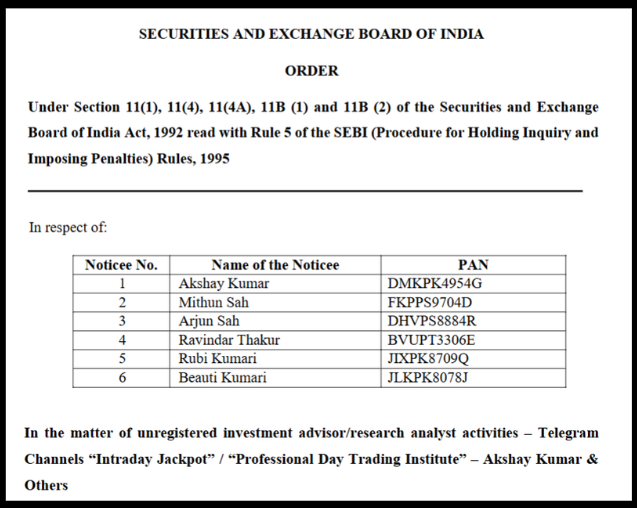
SEBI’s investigation, initiated after an investor complaint, found that the so-called free Telegram channel was nothing more than a funnel, an entry point designed to push subscribers into paid groups offering stock tips and Bank Nifty intraday calls.
The operators made misleading claims, including promises of “highly safe” trades, assured daily profits of ₹5,000–₹10,000, and returns of 100%–200%.
They also falsely presented themselves as certified professionals, and selectively showcased only profitable trades in their public-facing content.
Subscription fees were routed through multiple bank accounts and platforms, including Rigi and Cosmofeed, with total collections from investors amounting to approximately ₹9.02 crore, all collected without any regulatory authorisation.
SEBI concluded that Akshay Kumar was the key architect of the scheme, with the others playing active supporting roles.
The regulator directed all three main operators to jointly refund the entire ₹9.02 crore collected from investors, restrained them from disposing of assets, and imposed a two-year ban on securities market access.
2. Unison Metals Limited, Telegram-Driven Pump & Dump: July 2024
SEBI’s July 2024 order in the matter of Unison Metals Limited (UML) exposed a meticulously orchestrated scheme involving 17 traders, Telegram channel operators, and individuals connected to the company itself, including two of its promoters.
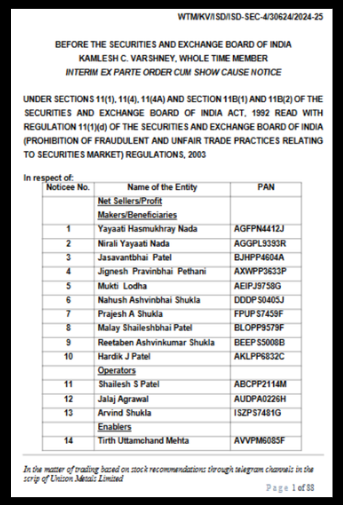
In December 2021, buy recommendations in UML shares were disseminated across multiple Telegram channels with subscriber bases ranging from 4 to 15 lakh subscribers.
These recommendations were often deleted on the same day they were posted. SEBI’s investigation found this was not coincidental; it was deliberate.
During the investigation period, UML’s average daily trading volume surged to nearly seven times the previous month’s levels, and the share price jumped over 84% on an open-to-high basis, not driven by any change in company fundamentals, but purely by artificially manufactured demand from Telegram recommendations.
SEBI found that the identified net sellers reduced their collective shareholding from over 17% to under 2% within a single month, accounting for over 44% of total market volume on recommendation days.
SEBI, armed with trade data, call records, WhatsApp conversations, seized electronic devices, and sworn statements, concluded the scheme was deliberate fraud and market manipulation by a coordinated group that used subscriber trust as a mechanism for personal profit.
The final penalty resulted in exceeding ₹3.6 crore.
As regulatory scrutiny tightens, it’s important to understand how authorities are acting against unregulated tips and misleading claims on social platforms.
Still confused about the next step?
Need Help?
If you’ve experienced financial loss after acting on trading calls from unregistered Telegram channels, including the Insider Stocks Telegram Channel, there is a way forward.
Start by gathering your evidence:
- Screenshots of trading calls or messages.
- Payment proofs.
- Transaction records.
- A brief summary of your experience.
Once you share these details with us, our team will carefully evaluate your case and guide you through each stage of the complaint process.
From structuring your complaint to handling the filing and directing it to the appropriate authorities, we ensure your case is presented clearly and effectively.
You’ve already dealt with the financial impact; getting support now can make the recovery process far less overwhelming.
Simply register with us, submit your details and documents, and we’ll handle the rest.
Conclusion
The boom in online trading has made stock markets easier to access than ever before, but it has also opened the floodgates to unchecked and often unreliable advice.
Today, countless Telegram channels offer “free” stock tips, intraday calls, and claims of high returns, all without any regulatory oversight.
The Insider Stocks Telegram Channel reflects a pattern SEBI has repeatedly flagged: active posting, growing followers, frequent “profit” screenshots, and a premium subscription for exclusive calls, yet no clear, verifiable SEBI registration supporting these activities.
Recognising the risks, SEBI has stepped up its actions.
Since 2024, it has restricted collaborations between registered entities and unregistered finfluencers, made registration disclosures mandatory in financial content, and worked with digital platforms to tighten oversight.
Cases like the April 2026 Intraday Jackpot order and the July 2024 Unison Metals order show that enforcement is not just theoretical; violations can lead to serious financial and legal consequences.
For traders, one simple check can make a significant difference: ask for the SEBI registration number and verify it independently. If that basic transparency is missing, it’s a strong warning sign.
Market opportunities will always exist, but recovering from losses caused by unregulated advice is far more difficult than avoiding them in the first place.





 Add us as a preferred source on Google »

