
Quick Summary
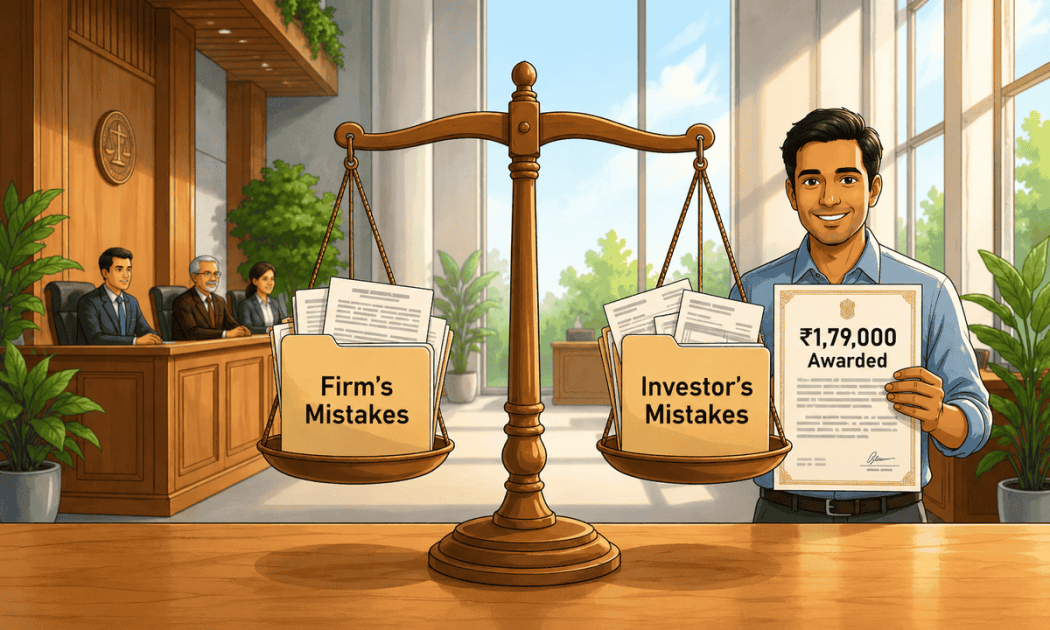
Most recovery stories are clean wins. This Inspire Algo Research complaint was not, and that is exactly why it is worth reading. The investor did something many do. He kept trading even as the losses piled up. The arbitrator noticed, and held him partly responsible. He recovered anyway. In matter NSE-RA-2025-08-664627, the tribunal split the fault down the middle and awarded him ₹1,79,000, half his fees and half his loss. We told him upfront the blame would be shared. We also told him he would still recover, and he did.
There is a fear that keeps a lot of people from ever filing.
They think: “I kept trading after I started losing, so this is partly my fault, so I have no case.”
That belief costs people real money, because it is wrong. This case is the proof.
Patel Nasirhusen Aaiyubahamad, an investor from Surat, took a service linked to Inspire Algo Research. He was given market indications, and he traded on them. He kept going even as the account bled. By his own conduct, he shared in what went wrong.
He still walked away with ₹1,79,000.
What the Firm Did Wrong
The tribunal looked hard at how Inspire Algo had run the relationship, and found real failures.
- No proper onboarding: There were no KYC links, no onboarding documents, and no invoices. Trading had simply begun on the back of shared payment links.
- No welcome kit, no guidelines: The firm handed the investor nothing that set out how the service worked or what its limits were.
- No transparency: The arbitrator, Arun Kumar, held that the firm had not followed SEBI and exchange guidelines meticulously, and lacked transparency in its work.
On the firm’s side, this was a service run without the basic structure the rules require.
What the Investor Did Wrong
Here is the part most blogs would leave out. We will not, because it is the whole lesson.
The investor kept putting money in after the losses had started. He was not forced. He watched the account fall and continued trading on the firm’s indications rather than stopping.
The arbitrator weighed that. A tribunal does not only judge the firm. It judges how the investor behaved too. And continuing to trade through a clear run of losses was conduct the arbitrator could not ignore.
So the tribunal did something even-handed. It did not hand the investor a full win, and it did not throw the case out. It split the responsibility.
Why a Split Award Is Still a Win
This is the point we want anyone in the same position to understand.
An arbitration case is not all or nothing. When there is fault on both sides, an arbitrator can divide it. A share of the blame does not end your claim. It adjusts the size of your recovery.
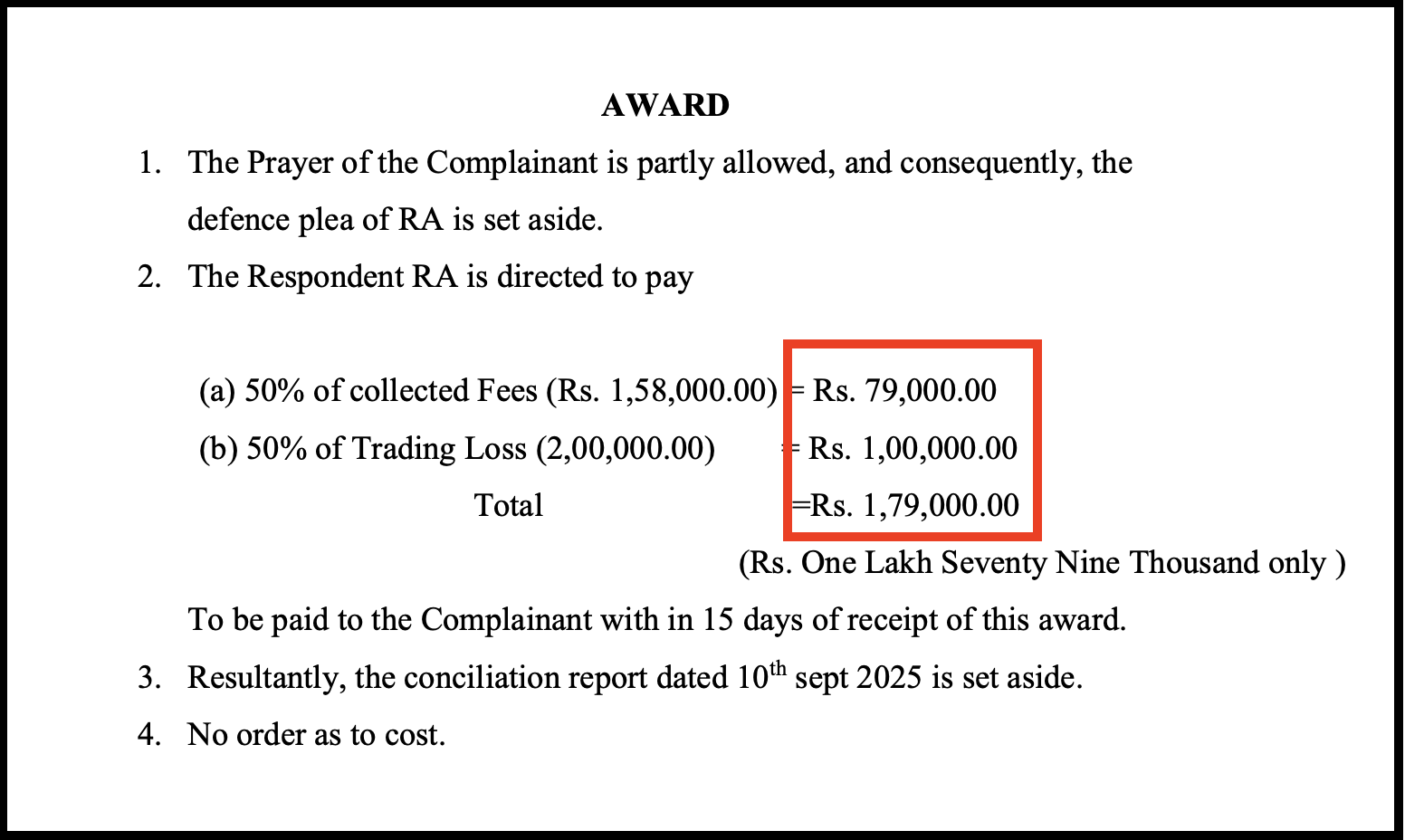
The tribunal directed both parties to bear the loss equally, and directed the firm to refund half the fees it had collected. The maths was clean:
- Half of ₹1,58,000 in fees came back as ₹79,000
- Half of the ₹2,00,000 loss came back as ₹1,00,000
- Total recovery: ₹1,79,000
The earlier conciliation report was set aside, and the split award took its place.
₹1,79,000 is not a consolation prize. It is a real recovery in a case the investor assumed he could not bring.
Inspire Algo Research Complaint: The Award
| Detail | Value |
|---|---|
| Matter number | NSE-RA-2025-08-664627 |
| Amount awarded | ₹1,79,000 |
| Fee refund | ₹79,000, half of ₹1,58,000 |
| Loss compensation | ₹1,00,000, half of ₹2,00,000 |
| Timeline to pay | Within 15 days of the award |
This is a public arbitral record.
Held back from filing because you kept trading after the losses started?
Shared fault does not close the door. It changes the number, not the outcome. We give you an honest read on what your case is really worth.
Register with us for a free consultation.
How to Judge Your Own Case Honestly?
The Inspire Algo award is a good lens for looking at your own situation without fooling yourself either way.
Ask two sets of questions.
1. About The Firm
- Did they skip proper onboarding?
- Was there no welcome kit or written guidelines?
- Did they lack invoices, KYC, or transparency?
Each yes is a failure on their side.
2. About Yourself
- Did you keep adding money after clear losses?
- Did you ignore your own doubts and continue?
Each yes is a factor the arbitrator will weigh against you.
A case with failures on both sides still recovers. It simply recovers a share rather than the whole. Knowing that in advance is what stops a valid claim from being abandoned out of misplaced guilt.
Conclusion
Patel was not a blameless victim, and we never told him he was. He kept trading when he should have stopped, and the arbitrator held him to it.
But the firm ran a service with no onboarding, no guidelines, and no transparency, and that carried real weight. Faced with fault on both sides, the tribunal split it and awarded ₹1,79,000.
If you have held back from filing because part of what happened was your own doing, take this case as your answer. Shared blame lowers the number. It does not take away the claim.
Report. Recover. Stay Fraud Free.
Frequently Asked Questions
Yes. In the Inspire Algo matter the investor did exactly that and still recovered ₹1,79,000. The arbitrator treated it as a shared fault, which reduced the amount rather than ending the case.
The firm failed on onboarding, guidelines, and transparency, while the investor kept trading through clear losses. With genuine fault on both sides, the tribunal divided the loss equally and refunded half the fees.
₹1,79,000 came back in a case the investor assumed he could not bring. A partial recovery is still a real recovery, and it is far better than the nothing that comes from never filing.
The absence of KYC, onboarding documents, invoices, and a welcome kit. The tribunal treated these as a lack of transparency and a failure to follow SEBI and exchange guidelines.
If you keep adding money after clear losses, an arbitrator may weigh that against you. It rarely ends a claim, but it can reduce the recovery, which is why an honest early assessment matters.





 Add us as a preferred source on Google »

