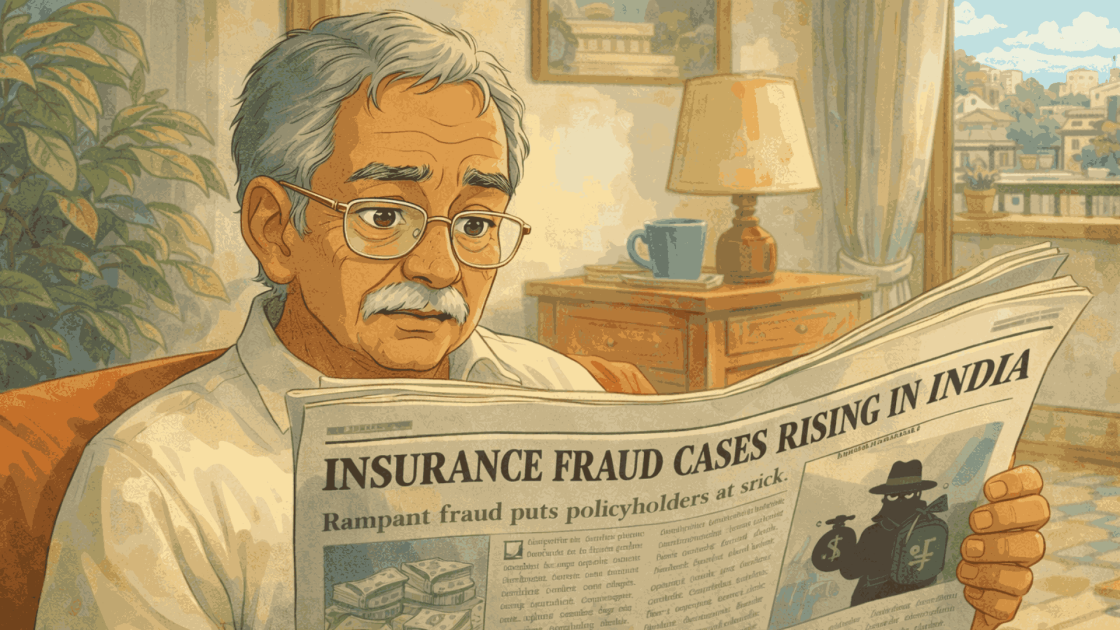
Insurance works on trust. People pay premiums regularly because they expect support when something goes wrong. Most of the time, the system works as intended.
But some cases show a different side. Several instances of insurance fraud in India reveal how individuals and groups misuse policies, claims, and even customer trust to make illegal gains.
These scams don’t always look suspicious in the beginning. They often start with something simple: a policy purchase, a claim request, or a phone call that feels routine.
By the time the fraud comes to light, the financial loss and confusion have already happened. Looking at real cases makes this easier to understand. Each case shows a different method and highlights how these scams actually work.
Let’s look at some real insurance fraud cases in India and break down what really happened.
Major Insurance Fraud Cases in India
Insurance fraud in India does not follow one pattern. Different cases show how people misuse insurance in completely different ways, depending on the opportunity.
Some frauds involve fake death claims, while others target customers directly through calls or fake policies. Looking at real cases helps you understand how these scams actually happen in real life.
Let’s look at five different insurance fraud cases in India and how each one unfolded.
1. Life Insurance Fraud
This case stands out because of both its scale and the disturbing way it was executed.

In Sambhal, Uttar Pradesh, investigators uncovered a large network that exploited life insurance policies. Fraudsters got policies issued in the names of vulnerable individuals and later claimed the money after their deaths.
In several instances, gang members posed as nominees and submitted claims using forged documents and fake identities. Investigators also found that multiple policies were taken out on the same person to increase payouts.
Authorities estimated the fraud amount crossed ₹100 crore, making it one of the largest insurance fraud cases in India.

2. Fake Insurance Investment Scam (Ahmedabad, 2025)
Not all insurance fraud involves claims. Some scams directly target people by creating fake investment opportunities.

In Ahmedabad, a retired businessman was approached by fraudsters posing as insurance officials. They convinced him that he had unclaimed insurance benefits worth lakhs.
To release the amount, they asked for processing fees, GST charges, and other payments. To build trust, they even paid small monthly returns initially.
Over time, the victim transferred more than ₹20 lakh, but received only a small portion back, resulting in a loss of around ₹19 lakh.
3. Fake Insurance Call-Centre Scam (Noida, 2026)
This case shows how organized fraudsters target policyholders directly instead of manipulating claims.

In Noida, police busted a fake call centre that had been running insurance scams for years. Fraudsters posed as insurance company representatives and contacted customers across India.
They offered fake policy renewals, bonuses, and additional benefits, convincing people to transfer money. To make the scam believable, they used scripts, fake documents, and multiple SIM cards.
Authorities found that over 300 people were cheated, and several bank accounts were used to route the money.
4. Fake Insurance Policy Racket (Ghaziabad, 2025)
This case highlights how fraudsters misuse customer data to sell completely fake insurance policies.
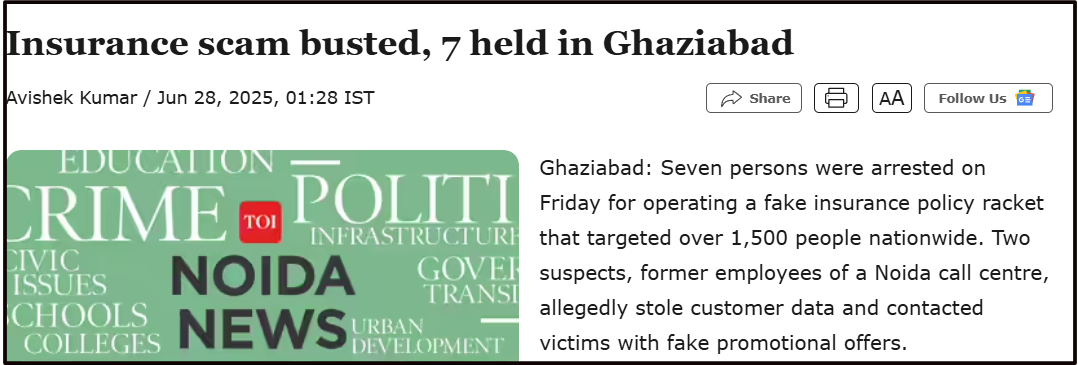
In Ghaziabad, a group used stolen customer data to contact people and sell fake insurance policies. They created forged receipts and documents to make the policies look genuine.
Victims believed they were purchasing real insurance coverage and transferred money accordingly.
The gang targeted more than 1,500 people across India and collected around ₹4.5 crore before police arrested them.
5. Motor Insurance Fraud (Tamil Nadu, 2024–2026)
Motor insurance fraud is one of the most common types of insurance scams, and this case shows how it can scale.
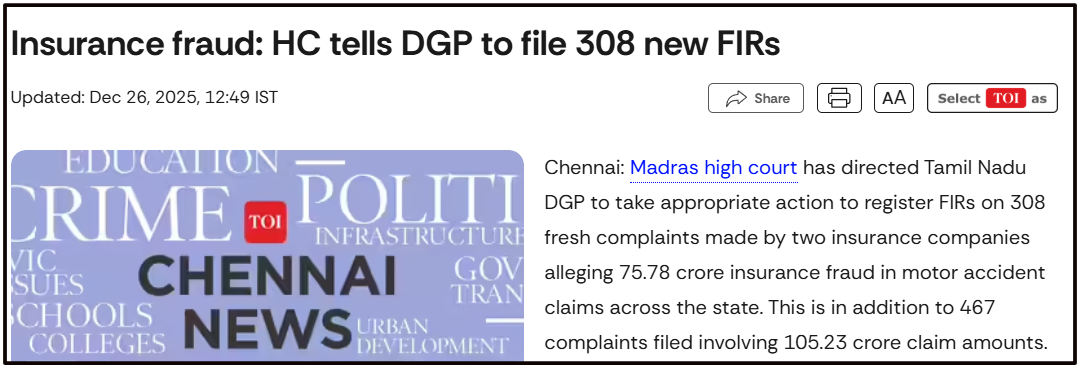
In Tamil Nadu, insurance companies flagged hundreds of suspicious motor accident claims. Fraudsters staged accidents or exaggerated damage to claim higher compensation.
Many cases included fake witnesses and manipulated accident reports. Initially, individual claims looked small, but patterns started emerging over time.
The total fraud linked to these cases crossed ₹75 crore, with earlier cases pushing the amount even higher.
Impact of Insurance Fraud on Policyholders
Insurance fraud does not affect only companies. It slowly impacts every genuine policyholder.
- Insurance companies increase premiums to recover fraud losses
- Claim verification becomes stricter and slower
- Genuine claims may face delays due to additional checks
- Trust in the insurance system reduces over time
These cases show that insurance fraud in India is not limited to one method. Fraudsters use different strategies depending on the situation, but the goal remains the same.
Once you understand how these scams work, it becomes easier to identify risks and avoid falling into similar traps.
Common Modus Operandi in Insurance Fraud Cases
When you look at these insurance fraud cases closely, one thing becomes clear. The stories are different, but the way fraud happens often follows a pattern.
Fraudsters rarely act randomly. They repeat methods that have worked before and refine them over time.
Here are some of the most common ways insurance fraud actually happens:
1. Using Fake Documents: Fraudsters create or manipulate identity proofs, medical records, and accident reports to support false insurance claims. These documents often look genuine, which makes detection difficult at the initial stage.
2. Staging or Exaggerating Incidents: In many cases, fraudsters either stage accidents or exaggerate damages to increase the claim amount. What looks like a genuine incident on paper may actually be planned. Such claims are often supported with manipulated evidence like photos, repair bills, or witness statements to appear legitimate.
3. Misusing Medical Billing Systems: Some frauds involve fake hospital admissions or inflated treatment bills submitted for insurance reimbursement. In certain cases, treatments are exaggerated or completely fabricated. This type of fraud may also involve collusion between patients and healthcare providers to maximise claim payouts.
4. Using Fake Nominees or Identities: Fraudsters often file claims using false nominee details or stolen identities, especially in life insurance cases. This helps them divert the payout without raising immediate suspicion. These identities are often backed by forged documents, making detection difficult without thorough verification.
5. Impersonating Insurance Officials: In scams like fake call centres, fraudsters pose as insurance representatives and convince victims to transfer money. They use scripts, fake documents, and urgency to make the interaction look real.
6. Working in Organized Networks: Many large frauds are not done by one person. They involve multiple people, including agents, insiders, or intermediaries, who coordinate to execute the scam. Once you understand these patterns, most insurance fraud cases stop looking random. You start seeing how the same methods repeat across different scams.
How to Identify Insurance Fraud?
After looking at real cases, one thing becomes clear. Most frauds don’t look like fraud in the beginning.
They look normal, convincing, and sometimes even urgent. That’s exactly how people get trapped.
But if you know what to look for, you can catch the red flags early.
- Someone asks for money urgently over a call
Fraudsters often create pressure by saying your policy will lapse or your benefits will expire. Genuine insurers do not rush you into making instant payments over the phone.
- You receive calls about unknown policies or bonuses
If someone claims you have a policy or bonus that you don’t remember, stop and verify it. This is a common tactic used in call-centre scams.
- Documents look correct, but feel suspicious
Fraudsters use well-made fake documents that appear genuine at first glance. Always cross-check policy details directly with the insurance company.
- You are promised unusually high returns or benefits
If something sounds too good to be true, it usually is. Insurance policies follow defined structures and do not offer unrealistic payouts.
- You are asked to share personal or policy details
Never share OTPs, policy numbers, or identity details with unknown callers. Fraudsters often use this information to misuse your policy.
- Hospital bills or treatment details seem inflated
In health insurance cases, always review bills carefully. Unnecessary tests or inflated charges can sometimes indicate fraudulent practices.
- Multiple people are involved, but no one gives clear answers
If you deal with agents, intermediaries, or callers who keep redirecting you, take a step back and verify everything independently.
In most cases, a simple pause and verification can prevent a bigger financial loss. Staying alert is your first line of protection against insurance fraud.
How To Report An Insurance Fraud Complaint?
If you come across something suspicious, don’t ignore it. Reporting insurance fraud not only protects you, but also prevents others from becoming victims.
You don’t need to overcomplicate the process. Start with the basics and take it step by step.
1. Contact Your Insurance Company First
If the issue is related to your policy or claim, report it directly to your insurer as soon as possible. Most insurance companies have dedicated fraud detection or grievance redressal teams to handle such concerns.
Clearly explain the situation, provide policy details, and attach any supporting documents.
Early reporting can trigger an internal investigation and may help prevent further misuse of your policy or financial loss.
2. File a Complaint with the Police
If the case involves financial loss, cheating, or any other scam, you should file a complaint at your nearest police station. This ensures that the matter is officially recorded.
Providing detailed information, such as names, contact details, and transaction proof, can help authorities begin their investigation more effectively.
3. Report Through IRDAI
You can also raise a complaint with the Insurance Regulatory and Development Authority of India (IRDAI), which oversees insurers and intermediaries.
Filing a complaint here adds regulatory oversight and ensures that the insurer or agent is required to respond within a defined framework.
4. File a Complaint in Cybercrime
If the fraud involves online transactions, fake websites, or digital communication, you should file a complaint in the cybercrime portal.
Provide complete details such as transaction IDs, bank details, screenshots, and communication records. Reporting early can sometimes help authorities trace the transaction and take timely action.
5. Keep All Documents and Communication Records
Maintain a record of all relevant documents, including call logs, messages, emails, policy papers, and payment proofs.
Proper documentation helps authorities understand the case clearly and strengthens your complaint during the investigation or follow-up stages.
Need Help?
Conclusion
Insurance fraud cases in India show that these scams are not random or rare. People plan them carefully and keep finding new ways to exploit gaps in the system.
From fake death claims to staged accidents and call-centre scams, the methods may differ, but the intent remains the same. Fraudsters try to make everything look normal so that no one questions it in the beginning.
At the same time, these frauds do not affect insurers alone. The impact reaches honest policyholders through higher premiums, stricter checks, and delays in genuine claims.
That is why awareness becomes important. Once you understand how these scams work, it becomes easier to spot warning signs and avoid unnecessary financial loss.
Being cautious, verifying information, and taking timely action can make all the difference.