
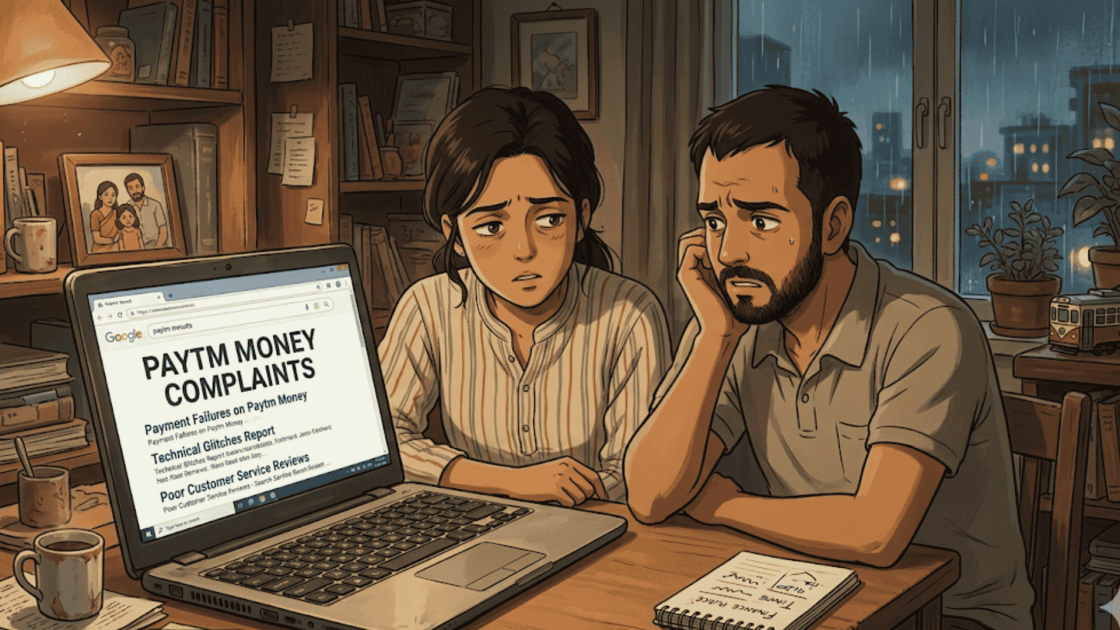
Quick Summary
Paytm Money complaints on NSE nearly doubled to 354 in 2024-25 from 188, even though active clients fell by about 17%, then dropped to 237 in 2025-26. NSE shows every complaint in those years closed and no arbitration cases at all. Service related issues are the biggest category in most years. NSE has no separate excess charges category, so charge complaints can’t be counted on their own. This page covers the yearly figures, complaint types, user reviews, Paytm Money’s own complaint email and number, and how to escalate step by step.
You hit withdraw on Monday. By Thursday, the money still hasn’t arrived, and support keeps sending the same reply.
Is that rare, or is it just you? NSE’s numbers on Paytm Money complaints say it’s a small share: 354 in 2024-25, about 0.05% of active clients.
But here’s the part that doesn’t add up. Complaints almost doubled that year while the client base shrank by about 17%.
So what’s going on behind that number?
This page walks through what NSE’s reports show, what users say happened to them, and where to go when you’re the one stuck waiting.
Is Paytm Money Legit? What do Official NSE Records Show?
Short answer: yes, on NSE’s own records.
Paytm Money Ltd. is listed in the exchange’s member directory as a trading member, with member code 90165.
Look a little closer, and the directory gives you the rest. Its SEBI registration number is INZ000240532, dated 15 March 2019, and the company was incorporated in 2017.
It’s enabled for capital market, futures and options, and currency futures trading, plus the mutual fund service system.
The app NSE has on file is “Paytm Money: Stocks, MF, IPO,” and the firm is a CDSL depository participant too.
A valid registration shows Paytm Money is allowed to operate.
It doesn’t settle whether you should trust a broker with your money. The complaint record below shows how things work out in practice.
How Many Paytm Money Complaints Does NSE Show? Year-Wise Data
NSE publishes complaint reports for every trading member, and the broker can’t edit them.
The table below pulls Paytm Money’s row from NSE’s redressal reports for each year.
Two things to know first. These figures cover NSE only, because BSE reports separately. And 2026-27 is a partial year, so it shouldn’t be compared with the full years above it.
| Year | Active clients | Complaints | Resolved | Non-actionable | Pending | Complaints as % of clients | Arbitration |
|---|---|---|---|---|---|---|---|
| 2022-23 | 6,46,387 | 238 | 217 | 21 | 0 | 0.037% | 0 |
| 2023-24 | 8,03,188 | 188 | 176 | 12 | 0 | 0.023% | 0 |
| 2024-25 | 6,64,294 | 354 | 354 | 0 | 0 | 0.053% | 0 |
| 2025-26 | 8,76,693 | 237 | 237 | 0 | 0 | 0.027% | 0 |
| 2026-27 (to 31 Aug) | 7,90,743 | 74 | 54 | 0 | 20 | 0.009% | 0 |
NSE updates these reports throughout the year, so a figure copied mid-year can be lower than the final one. Check the report’s last-updated date before comparing numbers from different places.
Read three things together: the total, the share of clients, and how many were closed.
Each tells you something the others can’t.
The share stays small. In any full year, between about 0.02% and 0.05% of active clients filed a complaint with NSE.
But 2024-25 was a spike. Complaints jumped from 188 to 354, up 88% in one year, while active clients fell about 17%, from 8,03,188 to 6,64,294.
More complaints from fewer clients is the opposite of what growth would explain, and NSE’s reports don’t say what drove it. In 2025-26 it reversed: clients rose about 32% to 8,76,693, and complaints fell to 237.
Closure looks clean through 2025-26. Every complaint in those four years shows as closed, either resolved or non-actionable.
Non-actionable means NSE could not act on the complaint, for example because it was incomplete or outside the exchange’s scope.
In 2026-27 so far, 74 complaints were received by 31 August, 54 resolved and 20 pending.
No arbitration at all. NSE shows zero arbitration cases filed, decided, or pending in every period above.
That can mean disputes close early. It can also mean few clients take a dispute that far.
The data can’t tell you which.
What Types of Complaints Do Paytm Money Clients File?
A total tells you how many people complained. The type tells you what went wrong, and that’s the part worth reading closely.
NSE sorts every complaint into a fixed set of types.
The table shows how Paytm Money’s complaints fall across them:
| Type | NSE’s label | 2022-23 | 2023-24 | 2024-25 | 2025-26 | 2026-27 (to 23 Sep) |
|---|---|---|---|---|---|---|
| V | Service related | 42 | 116 | 201 | 132 | 38 |
| IX | Others | 57 | 35 | 76 | 43 | 25 |
| I | Delay in payment | 35 | 24 | 15 | 14 | 6 |
| IV | Unauthorised trades/misappropriation | 5 | 10 | 46 | 37 | 15 |
| II | Delay in securities | 0 | 0 | 9 | 5 | 3 |
| III | Non-receipt of documents | 2 | 2 | 2 | 1 | 0 |
| VIII | IPO related | 3 | 1 | 5 | 1 | 1 |
| VI | Closing out / squaring up | 0 | 0 | 0 | 4 | 2 |
| No type recorded | 94 | 0 | 0 | 0 | 0 | |
| Total | 238 | 188 | 354 | 237 | 90 |
Service-related complaints dominate.
They made up 116 of 188 complaints in 2023-24, 201 of 354 in 2024-25, and 132 of 237 in 2025-26.
In 2022-23, 94 of the 238 complaints carry no type in NSE’s report, so that year’s split is incomplete.
The unauthorised trades row also stands out: 5 in 2022-23, 46 in 2024-25 and still 37 in 2025-26. It gets its own page further on, in the section on when to act.
Also Read: Bonanza Portfolio reviews, an eight-month wait, just for a working login ID.
Paytm Money Excess Charges
“Excess charges” is one of the most common worries about any broker, and it’s also the hardest to measure. The reason is how NSE files complaints.
There’s no excess charges category. Excess brokerage is one sub-type inside service-related, alongside non-execution of orders, wrong execution, connectivity problems, and other service defaults.
The report shows only the main type.
So the honest answer to “how many Paytm Money complaints are about excess charges?” is that nobody can say from NSE’s data. Service-related complaints are an upper limit, because they include everything else in that bucket too.
They were 17.6% of complaints in 2022-23, 61.7% in 2023-24, 56.8% in 2024-25, 55.7% in 2025-26, and 42.2% so far in 2026-27. Treat any exact “excess charges” figure for any broker with caution.
Then there’s the practice itself.
Churning in the stock market means an account is traded far more than the investor’s own strategy needs, mainly to generate brokerage. Nothing in NSE’s numbers shows churning at Paytm Money.
The data simply can’t isolate it.
What you can do is check your own account.
These four checks take about ten minutes:
- Compare every deduction on a contract note with the brokerage plan you chose, line by line.
- Look at what changed right after a profit or a withdrawal, since that’s when mismatches tend to show.
- Ask Paytm Money in writing for an itemised breakup of any charge you can’t explain.
- Count your trades against your own decisions. If there are more than you remember making, treat that separately.
Paytm Money Reviews: What Users Say?
Complaint data counts cases. Reviews describe what it felt like, and that’s why they’re worth reading, even though each one is a single person’s account.
None of these proves a pattern on its own.
Together they show where users say things go wrong, and each one lines up with a type in NSE’s data, which helps you read it in context.
1. Charges, Settlement and a Delayed Withdrawal
One user says that after a profitable trade, the amount that finally settled didn’t match what they expected.
He says the charges were higher than they’d anticipated and the settlement figure wasn’t clearly explained. He also reports that a withdrawal placed within the expected time window was delayed.
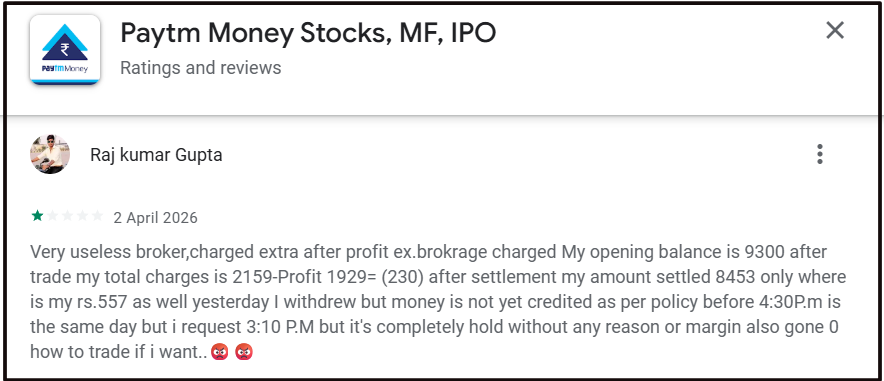
Two separate worries sit inside this one review.
The first is reconciliation. Brokerage, taxes, and exchange charges all come out of trade proceeds, so the settled amount is normally lower than the headline profit.
The question is whether the gap matches the charges you were told to expect. The second is timing, because money that doesn’t arrive when it should is the fastest way to lose trust in a platform.
NSE’s category for payment delays is Type I. Paytm Money had 35, 24, 15, and 14 such complaints in 2022-23 to 2025-26, and 6 so far in 2026-27.
That doesn’t show this user filed one.
It shows payment delays are a recognised, recurring type of complaint.
If it’s you, line up the contract note against your plan, note the exact time you placed the withdrawal, and ask support for the status in writing.
2. A Margin Shortfall and a Heavy Loss
Another user says a margin shortfall led to a heavy loss, and says they stopped using the platform altogether. It’s a short review, but it describes the kind of event that hurts most.
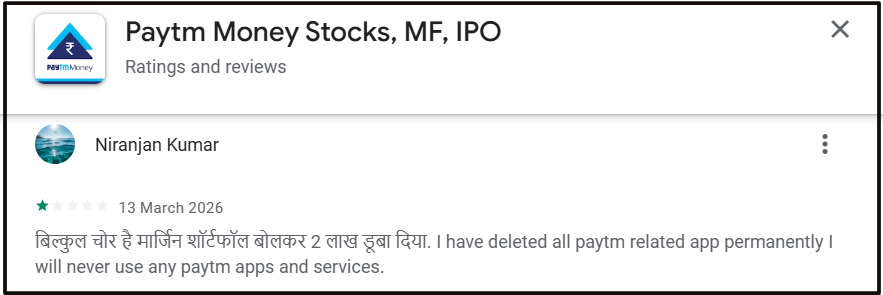
A margin shortfall typically means the funds in your account no longer cover what your open positions require.
At that point, a broker can ask you to add money or may close positions. Whether that was handled fairly depends on the margin rules you accepted and the alerts you received, and one review can’t show either.
Margin losses usually involve both the platform’s rules and the trader’s own decisions, so this account can’t say who was at fault.
NSE files closing out a position without consent under Type VI. Paytm Money had none in 2022-23 to 2024-25, 4 in 2025-26, and 2 so far in 2026-27.
That doesn’t make the review wrong. It suggests disputes like this rarely reach NSE as formal complaints.
If it’s you, ask in writing for the time, price, and reason each position was closed, and keep every alert you received.
3. Technical Glitches and Thin Support
A third user lists several problems at once: wrong stock chart data, automatic logouts, delayed mutual fund updates, and errors logging in to the web platform.
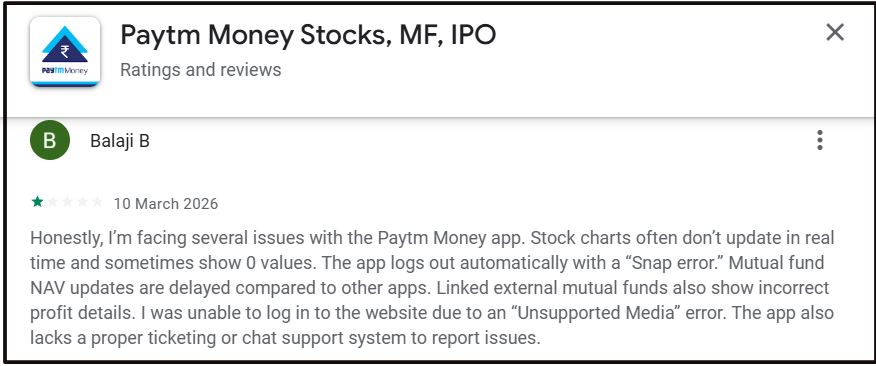
He added that there was no proper channel to report any of it.
It helps to separate three strands. The first is data accuracy.
If the numbers on screen are wrong, whether charts, fund values, or portfolio figures, decisions built on them are wrong too, so check a second source before acting.
The second is access, meaning the logouts and login errors. The third is support, which is the fix for the other two when it works.
On access, a failed login in the middle of a trade is a problem of its own. The causes, quick fixes, and the reporting steps are covered on our page on Paytm Money login issue.
On the data, service-related is the largest NSE category, and it includes connectivity and system problems. NSE’s report can’t show how many of those were technical.
On support, the reporting section below shows exactly where to write.
When Should You Take Action Against Paytm Money?
Most people wait too long. They assume a charge will sort itself out, or that support will eventually reply. Waiting usually makes the record weaker, not stronger.
These are the points where it’s worth writing to the broker the same day:
- Funds you expected haven’t been credited, or a withdrawal is delayed.
- A charge or deduction doesn’t match your plan or your contract note.
- An order executed at a price that doesn’t make sense.
- You asked for contract notes or order confirmations and didn’t get them.
- Someone is pushing you to trade without a clear reason.
- The same technical problem keeps repeating.
- A trade appears that you don’t remember placing.
Even a small mismatch deserves attention. A gap that looks minor on one trade adds up across many.
Keep one rule: if something in your account doesn’t make sense, raise it immediately and follow it until you get a clear resolution.
The last item on that list needs more than a bullet. A trade you don’t remember might be an order you forgot, or it might be something else.
NSE’s reports show complaints in this category jumping from 5 in 2022-23 to 46 in 2024-25, and still at 37 in 2025-26, and our page on Paytm Money unauthorised trading shows how to rule out the innocent explanations first and what to do if none fits.
How to File a Paytm Money Complaint?
Not every problem needs the same door. A wrong charge, a stuck withdrawal, and a trade you didn’t place all start the same way, but they can end up in different places.
So here’s how to match each step to your situation, beginning with the one every complaint needs:
1. Start by Complaining to Paytm Money Directly
Paytm Money has its own complaint route, and you need to use it first.
Its own escalation matrix asks you to quote the service ticket or complaint reference number when you take a complaint to an exchange, SEBI SCORES, or the ODR portal.
Without that record, the later steps start from nothing.
Send your complaint in writing, with your client ID, the dates and amounts, and screenshots. Add contract notes, trade confirmations, messages, and any call recordings you have.
Keep the ticket number safe.
Paytm Money Complaints Email
Writing leaves a record, so email is the best place to begin. Paytm Money’s own pages give a clear order to follow.
First, raise it through the customer support tab in the app, or email [email protected]. Paytm Money’s contact page labels this address “For Complaints.” Quote your client ID and give a short timeline.
If it’s unresolved after 15 days from the date you first raised it, or you’re not satisfied with the reply, Paytm Money’s grievance page says you can write to its Compliance Officer at [email protected].
It also says that if a case needs more time, the company should tell you why and give an expected timeline.
Paytm Money Complaints Number
Phone numbers help you chase a complaint, though a call leaves no record. Use one to push a ticket along, then follow up in writing and note who you spoke to and when.
Paytm Money’s Investor Grievances Escalation Matrix lists these contacts, as published on its own site in October 2026:
| Level | Number | |
|---|---|---|
| Customer Care Desk | 7969292500 | [email protected] |
| Head of Customer Care | 7969292501 | [email protected] |
| Compliance Officer | 7969292502 | [email protected] |
| Chief Executive Officer | 7969292503 | [email protected] |
The matrix gives working hours of 9:30 am to 5:30 pm on weekdays, except market holidays, Saturdays, and Sundays.
Paytm Money’s contact page also lists 022-64891010 for its business operations office, with office hours of 9 am to 5 pm, Monday to Friday.
Its documents don’t give identical numbers or hours, so check the current ones on Paytm Money’s official site before you call.
2. If the Broker’s Reply Is Weak or Missing
Take it to SEBI.
Our guide on how to lodge complaint in SCORES covers filing it with your evidence attached, so the broker has to answer on the record.
Once it’s filed, keep an eye on your SEBI complaint status.
That way you can see where it stands and whether the broker has replied.
3. If the Issue Is About Trades That Ran on NSE
NSE complaint online explains how to file with the exchange, which then takes the matter up with the broker.
If your trades ran on another exchange, use that exchange’s own process.
4. If Emails Keep Going in Circles
The SMART ODR platform moves the dispute into a structured process, with both sides working from documents instead of trading replies.
5. If Real Money Is at Stake and Nothing Has Worked
Stock market arbitration is the last formal step. An independent arbitrator reviews both sides’ evidence and decides.
For the whole process in one place, our guide on how to file complaint against stock broker walks through every stage.
Conclusion
On NSE’s own numbers, Paytm Money complaints are a very small share of its clients, nearly all are closed, and none have gone to arbitration.
That’s a reasonable record on paper.
But the share of clients isn’t the experience of the person who complained. Service-related problems are the biggest group, and NSE’s data can’t split out charges or login failures from the rest.
Keep your contract notes, question anything that doesn’t add up, and write it down early. That’s what makes a complaint worth pursuing.
Report. Recover. Stay Fraud Free.
Frequently Asked Questions
Not by itself. It only counts clients who complained formally, and many don't. It also doesn't show how those complaints ended, so read it alongside the types and your own account.
No. They cover NSE only. BSE publishes its own complaint reports, so a complete picture of any broker needs both. Always check which exchange a figure refers to.
Not from NSE. It has no separate category, and excess brokerage sits inside service related. Service related is the closest measure, but it includes other problems too.
Email, or raise a ticket in the app. A written complaint leaves a record you can quote later. Use a phone number to chase it, then write down who you spoke to and when.
The contract note, the brokerage plan you agreed to, a screenshot of the deduction, and the dates and amounts. A short written timeline helps, too.



 Add us as a preferred source on Google »