

Quick Summary
If your portfolio manager has mismanaged your account, overcharged you, or gone silent, SEBI’s SCORES portal is the official way to file a complaint against them, starting with a written notice to their compliance officer before you escalate. This guide walks through the complete process, how to file a complaint against portfolio managers online and in India, what documents to prepare, and how to escalate through SMART ODR arbitration if SCORES doesn’t resolve it. It also includes two real arbitration outcomes, including a full ₹7,00,000 recovery, secured through this exact process.
Handing your money to a portfolio manager is supposed to mean less worry, not more.
But when your account is churned for no reason, your statements don’t add up, or your calls stop getting answered, the natural next question is what to actually do about it.
This guide covers exactly that. You’ll find who counts as a portfolio manager under SEBI, why investors end up filing complaints against them, and the full step-by-step process for how to file a complaint against portfolio managers, both online and offline, in India.
If you’d rather have someone handle this for you, Aseem Juneja works with investors who have been mismanaged or misled by their portfolio managers, helping them put together a complaint or arbitration claim that actually gets a result.
You can see documented case outcomes on the arbitration achievements page.
How to check if your portfolio manager is SEBI registered
Before you file anything, confirm the registration status of the entity you invested with. SEBI publishes a list of registered intermediaries on its website, searchable by name or registration number.
If your portfolio manager does not appear there, you are dealing with an unregistered entity, and the process for that is slightly different, covered further below.
Take a screenshot of this search result before you move forward. It becomes useful supporting evidence once you actually file.
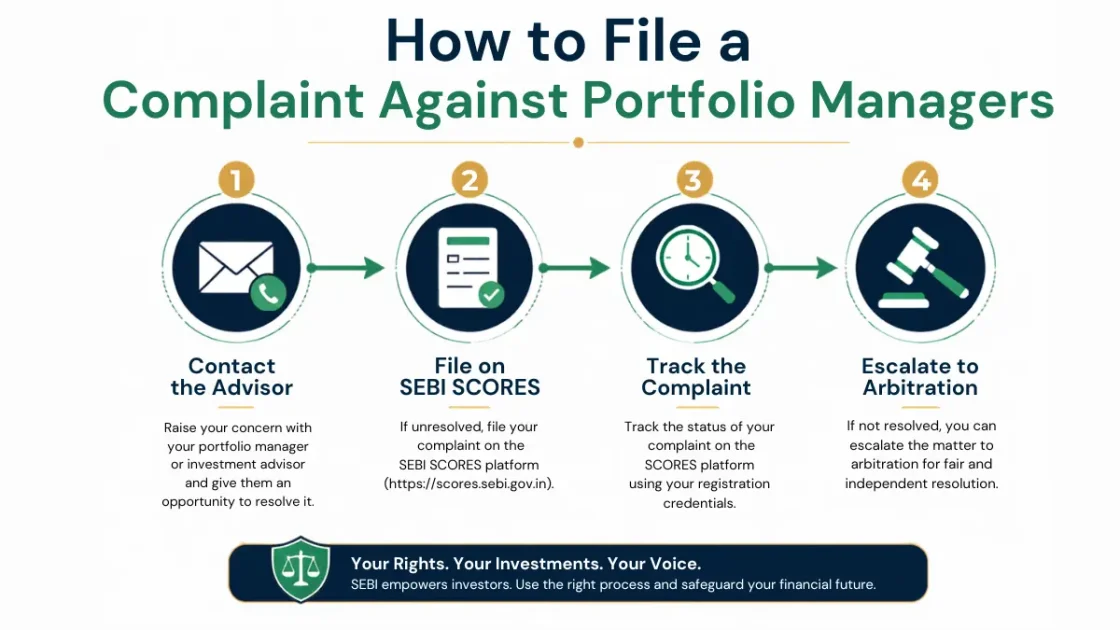
How to file a SEBI complaint, step by step
The exact sequence to follow when a portfolio manager, research analyst, or investment advisor has not acted in your interest.
-
1
Write to the entity directly
Email the portfolio manager, research analyst, or investment advisor in writing. State the issue, the amount involved, and the resolution you want. Keep every reply, since this trail is what SEBI checks first.
-
2
Lodge it on SEBI SCORES
Register on the SCORES portal, pick the correct category (research analyst, investment adviser, or portfolio manager), and attach account statements, contract notes, and payment proof. You’ll receive a complaint registration number to track it.
-
3
Track the response
The entity has thirty days to file an Action Taken Report. Log back into SCORES with your registration number to see whether they’ve responded and what SEBI has asked for next.
-
4
Escalate to arbitration if needed
If SCORES doesn’t resolve it, move to the SMART ODR platform for conciliation, mediation, or binding arbitration. This is where a properly evidenced claim makes the biggest difference to the outcome.
-
5
Get an expert to build your case
Aseem Juneja has secured arbitral awards for investors, including a full ₹7,00,000 recovery against Motilal Oswal. See documented outcomes and get help structuring your complaint.
View arbitration case outcomes →
Filing your complaint through the wrong channel can cost you weeks. Confirm the process on SEBI’s own investor complaints cell page before you begin.
How to file a complaint against portfolio managers, step by step
Here is the full process broken down, whether you’re doing this for the first time or have already tried reaching out on your own without any luck.
Step 1: raise it with the portfolio manager’s compliance officer first
Every SEBI registered portfolio manager is required to have a designated compliance officer who handles investor grievances.
Write to them directly, laying out the issue, the amount involved, and the outcome you’re asking for. Keep a copy of everything you send and everything they send back.
This step matters even if you’re fairly sure it won’t lead anywhere.
SEBI generally expects you to have approached the entity first before you escalate, and having that written trail in place strengthens your position considerably at the next stage.
Step 2: how to file a complaint against portfolio managers online through SCORES
If the compliance officer doesn’t respond within thirty days, or the resolution offered isn’t satisfactory, the next move is SEBI’s SCORES portal, short for SEBI Complaints Redress System.
This is the official answer to how to file a complaint against portfolio managers online, and it’s the only channel SEBI actually tracks and acts on.
Create an account on the SCORES portal using your email ID and mobile number, then verify it through OTP.
Once you’re logged in, select Lodge Complaint, choose the portfolio manager category, and pick the exact registered name of the entity from the dropdown.
Describe the issue clearly, mention the relevant dates and amounts, and attach your supporting documents, things like account statements, the signed client agreement, fee invoices, and any email correspondence.
Once submitted, SCORES generates a complaint registration number. Save this, since you’ll need it for every future reference to your case.
The portfolio manager is then required to respond with an Action Taken Report within thirty days.
Step 3: track your complaint
Log back into SCORES anytime with your credentials to check where things stand. The dashboard shows whether the entity has responded, whether SEBI wants further clarification from either side, and whether your complaint is still open or has been closed.
If the portfolio manager misses the response deadline, SCORES sends automatic reminders on its own, so the complaint doesn’t just sit there unattended.
Step 4: escalate through SMART ODR arbitration
If SCORES doesn’t get you a fair resolution, the next step is SEBI’s SMART ODR platform, which combines conciliation, mediation, and arbitration in a single system.
This route is particularly relevant for portfolio manager disputes where a specific monetary claim needs to be resolved through a binding decision rather than a regulatory back and forth.
This is also the stage where an experienced consultant makes the biggest difference.
Building a strong arbitration claim means structuring your case properly, presenting the right documentation, and understanding how the arbitral tribunal actually evaluates a dispute like this.
Aseem Juneja has represented investors through this exact process, with case outcomes documented below.
Who is a portfolio manager, and what are they allowed to do
A portfolio manager is a SEBI registered entity that manages your equity, debt, or mixed investments directly, usually for a minimum investment of fifty lakh rupees.
This falls under portfolio management services, often shortened to PMS investment or just sebi pms, and it is governed by the SEBI Portfolio Managers Regulations, 2020.
There are two broad types. In a discretionary arrangement, the portfolio manager makes buy and sell decisions on your behalf without checking in every time.
In a non-discretionary arrangement, they can only act after you approve each move.
Either way, the portfolio manager is required to maintain a minimum net worth, sign a proper client agreement, disclose their fee structure upfront, and send you periodic performance reports.
Investment analysis and portfolio management, done properly, should never involve guaranteed returns or vague reporting, since neither of those is legal under SEBI’s rules.
Before you invest in pms with anyone, it is worth checking exactly what kind of mandate you’re signing up for, because the complaint you’d file over an unauthorised trade looks very different from one over a fee dispute.
Common reasons investors file a complaint against portfolio managers
Most complaints against portfolio managers fall into a handful of repeating patterns.
Unauthorised or excessive trading is the most common one. A portfolio manager churns your account far more than necessary, generating extra brokerage for themselves while putting your portfolio at risk with no real strategic reason behind the trades.
Fee disputes come next, where the performance fee or exit charge doesn’t match what was disclosed in the original agreement, or gets calculated in a way you were never told about.
Poor or dishonest reporting is another big one. Some portfolio managers delay statements, send incomplete performance data, or quietly change strategy without informing clients, making proper portfolio risk management on your end almost impossible.
And then there are the cases of outright fraud, where an entity claims to run portfolio management services but was never actually SEBI registered in the first place, collecting client money with no real oversight at all.
Whatever the specific issue, the pattern is the same: money invested, results or communication that don’t match what was promised, and no clear way to get answers on your own.
How to file a complaint against portfolio managers in India when they aren’t registered
Sometimes the entity that mismanaged your money was never SEBI registered as a portfolio manager to begin with.
This happens more often than people expect, particularly with smaller, informally run PMS-style setups that operate without proper licensing.
You can still report this through SCORES, flagging it as an unregistered entity offering portfolio management services, since operating without registration is itself something SEBI actively investigates and penalises.
Alongside this, it is worth filing a parallel complaint with cybercrime authorities through the National Cybercrime Reporting Portal if any part of the transaction happened online, since that gives you a second track working on tracing the money.
Documents you need before you file
Getting your paperwork together before you start saves a lot of back and forth later.
Keep the following ready: your KYC and account opening documents with the portfolio manager, the signed client agreement or disclosure document, all periodic performance statements covering the disputed period, fee invoices and payment receipts, and any written communication where specific returns or strategies were promised.
If your dispute is largely about unauthorised trades, transaction-level statements showing the exact trades in question will matter more than anything else you submit.
What happens after you file a SEBI complaint against a portfolio manager
Once your complaint is lodged, SEBI forwards it to the portfolio manager, who must submit an Action Taken Report within thirty days.
If SEBI isn’t satisfied with that response, or the resolution offered doesn’t match the actual harm caused, the matter can be escalated for further review, or you can be guided toward SMART ODR arbitration for a binding outcome.
You’ll get updates by email and SMS on your registered contact details throughout.
It’s worth checking your SCORES dashboard every couple of weeks instead of waiting passively, since responding quickly whenever SEBI asks for clarification tends to speed things up.
Real arbitration outcomes secured for investors
To give you a sense of what a properly built arbitration claim can actually achieve, here are two recent outcomes from cases handled through this exact process.
In one case dated 23rd October 2025, a client’s dispute was taken to arbitration with a total claim of ₹7,00,000.
The arbitral tribunal awarded the client the full amount, ₹7,00,000, a complete recovery.
In another matter, a client named Renu filed a claim for ₹19,82,893. Through the arbitration process, she was awarded ₹2,00,000.
Even when the full claim isn’t recovered, arbitration remains one of the few routes where an investor walks away with a binding, enforceable decision instead of an open-ended complaint that never really closes.
Both of these arbitral awards, along with other case outcomes, are documented on the arbitration achievements page, where you can see the kind of evidence and documentation that goes into building a claim SEBI and arbitral tribunals actually take seriously.
Portfolio risk management: protecting yourself before you invest in PMS
Filing a complaint deals with damage that has already happened. Portfolio risk management is about not needing to file one in the first place.
Before you invest in pms with anyone, verify their SEBI registration yourself instead of trusting a certificate shown to you, since documents can be forged.
Insist on a written client agreement that spells out fees, strategy, and reporting frequency in plain terms.
Track your own holdings independently, using a basic stock portfolio tracker rather than relying entirely on the manager’s own updates, so you have an outside reference point if numbers ever stop matching up.
And be wary of anyone offering fixed or guaranteed returns, since no legitimate management of investment ever comes with that kind of promise attached.
Good portfolio mgmt isn’t about eliminating risk, since markets carry risk by definition.
It’s about making sure the person handling that risk on your behalf is registered, transparent, and answerable to you.
Why work with a consultant like Aseem Juneja
You can absolutely file a complaint against portfolio managers on your own using the process above.
But SEBI’s SCORES system and the arbitration route both involve a fair amount of procedure, and small missteps, like a thin evidence trail or a vaguely worded complaint, can slow things down or weaken your case.
Aseem Juneja works specifically with investors who have been affected by mismanagement, unauthorised trading, or outright fraud by portfolio managers, helping them build a complaint or arbitration claim that’s properly evidenced from the start.
The two outcomes above, the full ₹7,00,000 recovery and the ₹2,00,000 award, reflect the kind of documentation and preparation that goes into each case.
You can review these and other outcomes on the arbitration achievements page.
If you believe your portfolio manager has mismanaged your money or misrepresented what they were doing with it, getting an expert opinion early, before you file anything, can be the difference between a complaint that goes nowhere and one that actually gets your money back.
Before you file
Losing confidence in the person managing your money is unsettling, but SEBI’s grievance system does give you a real path to accountability, provided the complaint is filed correctly and backed by proper documentation.
Use this guide as your step-by-step reference if you want to handle it yourself.
If you’d rather have someone experienced build and pursue the case for you, Aseem Juneja has worked through this exact process for investors in similar situations, with documented arbitration outcomes you can review on the arbitration achievements page.
Frequently Asked Questions
Through SEBI's SCORES portal. Register with your email and mobile number, select the portfolio manager category, choose the entity's registered name, and submit your complaint along with supporting documents like account statements and your client agreement.
SEBI requires a minimum investment of fifty lakh rupees for portfolio management services.
Yes. If SEBI finds serious or repeated violations, it can suspend or cancel a portfolio manager's registration, in addition to any other action taken on an individual investor's complaint.
You can still report it through SCORES as an unregistered entity offering portfolio management services. It's also worth filing a parallel complaint with cybercrime authorities if money was transferred digitally.
The portfolio manager is required to submit an Action Taken Report within thirty days of the complaint being lodged. If the issue isn't resolved at that stage, it can be escalated through SMART ODR arbitration.
Complaints are not accepted by post or general email. They must be filed through the official SEBI investor complaints portal, which is the only recognised channel.
You can still report it through SCORES as an unregistered entity violation, and it is worth also filing a parallel complaint with cybercrime authorities if money was transferred digitally.

