

Quick Summary
Bonanza Portfolio complaints have nearly doubled in two years, from 20 in 2023-24 to 40 in 2024-25, while the active client base actually declined. A SEBI adjudication order found six categories of violations, including alleged misuse of client funds up to ₹19.63 crores in a single instance, resulting in a ₹10 lakh penalty. Unauthorised trading is the single largest complaint category on record. Excess charges and brokerage churning form a separate, persistent pattern within that same data. This blog covers the full complaint breakdown, the SEBI order violation by violation, four real user reviews, and exactly how to escalate if your own account shows any of this.
Imagine holding a stock through two years of losses, finally watching it turn profitable, and logging in to sell, only to find your account suspended with no way to reach anyone.
That’s not a hypothetical. It’s one of several real experiences behind Bonanza Portfolio complaints, and it’s a small preview of what a ₹10 lakh SEBI order later confirmed at a much larger scale.
Bonanza has been operating in India since 1994, a genuinely long track record as a full-service broker.
But the complaint data below shows the real story goes well past slow support or a clunky app, straight into how your money is actually handled once it’s in their system.
Bonanza Portfolio Complaints Overview
Bonanza Portfolio Limited is a SEBI-registered stock broker holding Registration No. INZ000212137.
Its origins date back to 1994, making it one of India’s older full-service broking firms.
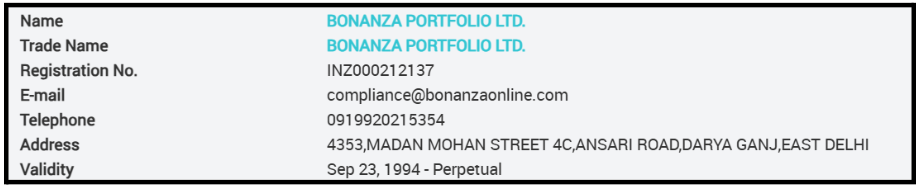
It offers equity trading, derivatives, currency, depository, and portfolio services to retail and institutional investors. Retail clients access the platform through the Bonanza WAVE app on Android and iOS.
However, the WAVE app has consistently appeared in Bonanza Portfolio complaints, with users reporting account suspensions, fund transfer failures, password reset failures, and support teams that redirect without resolving.
What Types of Bonanza Portfolio Complaints Do Clients File?
As a SEBI-registered stock broker with memberships on NSE and BSE, Bonanza Portfolio falls under the full jurisdiction of exchange-level investor grievance mechanisms, where Bonanza Portfolio complaints are formally recorded.
| Type | Description of Complaint Type | Count |
|---|---|---|
| Type I | Non-receipt / delay in payment | 2 |
| Type II | Non-receipt / delay in securities | 4 |
| Type III | Non-receipt of documents | 2 |
| Type IV | Unauthorised trades/misappropriation | 54 |
| Type V | Service related | 49 |
| Type VI | Closing out / squaring up | 1 |
| Type IX | Others | 12 |
Notably, unauthorised trades and misappropriation are the highest complaint category, indicating frequent instances of trades or fund movements without proper client consent.
Such issues directly impact control over your own investments.
Service-related complaints are also significantly high, pointing to consistent issues with execution, platform performance, charges, and customer support.
This is a red flag because repeated service failures result in missed opportunities, delays, and unresolved grievances over time.
Bonanza Portfolio Exchange Complaint Data
The following data is sourced from Bonanza Portfolio’s disclosed complaint records on the NSE member complaint data portal.
| Financial Year | Active Clients | Complaints Filed | % of Complaints | Resolved | Unresolved | % Resolved | Arbitration Cases |
|---|---|---|---|---|---|---|---|
| 2025-26 | 53,845 | 37 | 0.069% | 33 | 4 | 89.19% | 0 |
| 2024-25 | 59,026 | 40 | 0.07% | 40 | 0 | 100% | 0 |
| 2023-24 | 54,099 | 20 | 0.03% | 20 | 1 | 100% | 0 |
| 2022-23 | 54,099 | 27 | 0.04% | 27 | 0 | 100% | 0 |
Complaints have nearly doubled in two years. Complaints increased from 20 in 2023-24 to 40 in 2024-25. In 2025-26, 37 complaints have already been reported.
During the same period, the active client base declined from 59,026 to 53,845. The broker is generating significantly more complaints per remaining client, a pattern that may indicate service deterioration rather than growth-driven noise.
Resolution rate has slipped in 2025-26. After three consecutive years of 100% resolution, the current financial year shows 4 complaints still unresolved and a resolution rate of 89.19%. With the year still ongoing, this number could worsen.
No arbitration cases across all four years does not mean investors are satisfied. It more likely indicates that most investors are either unaware of the arbitration mechanism or give up before reaching that stage.
Also Read: PhonePe Wealth Broking complaints, a broker building its track record, worth watching closely.
Bonanza Portfolio SEBI Order
According to the SEBI Adjudication Order issued against Bonanza Portfolio Limited, SEBI conducted a comprehensive inspection of the broker’s operations for the period April 2020 to July 2021.
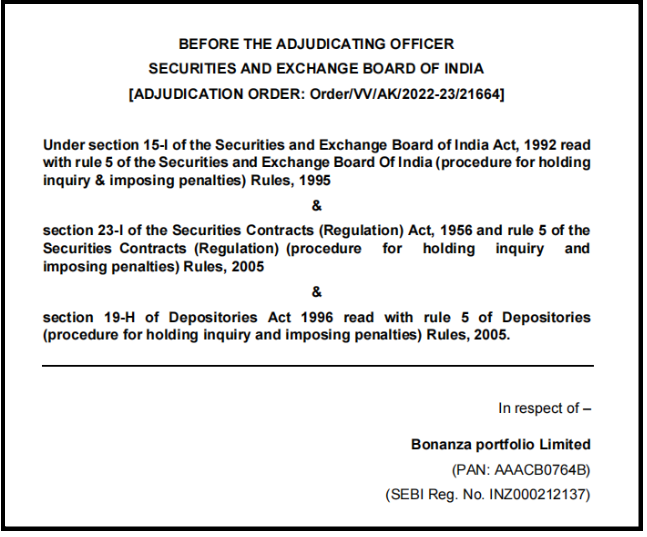
The inspection identified systemic and repeated violations related to how Bonanza handled client money, securities, and order records.
After providing Bonanza opportunities to respond and conducting a personal hearing, the Adjudicating Officer held the company liable across 10 established violations.
Here’s what the order actually found:
1. Mis-Utilisation of Credit Balance Client Funds
In 23 out of 43 sample instances, Bonanza allegedly used funds belonging to credit balance clients.
The amounts allegedly misutilised ranged from ₹27 lakhs to ₹19.63 crores per instance.
When a broker uses your money to cover another client’s losses or to support its own trading, your capital is directly at risk.
2. Client Funds Used for Proprietary Margin Obligations
In 6 additional instances, Bonanza allegedly used client funds specifically to meet its own proprietary margin obligations, money owed by the broker for its own trading positions.
This is among the most serious categories of broker misconduct.
A broker using client money to fund its own speculative trading positions is a fundamental betrayal of what that money was handed over for.
3. Borrowed Funds Reported as Client Funds
Bonanza allegedly included Fixed Deposits funded by bank loans as part of its available client funds when reporting to stock exchanges.
The reported shortfall was calculated at ₹26.28 crores as of October 31, 2019.
If a broker inflates its apparent client fund availability using borrowed money, regulators may not trigger alerts even when the broker is actually underfunded.
4. Failure to Settle Client Accounts Within Mandated Timelines
In 7 instances out of a sample of 100, Bonanza failed to settle funds and securities with active clients. Amounts involved ranged from ₹1.31 lakhs to ₹7.34 lakhs per instance.
SEBI mandates periodic settlement to ensure investors periodically receive their own funds and securities back from the broker.
Holding client assets beyond permitted timelines increases exposure to broker financial risk.
5. Incorrect Enhanced Supervision Data Submitted to Exchanges
Bonanza submitted incorrect weekly Enhanced Supervision data to exchanges.
Exchanges use this data specifically to detect whether brokers are misusing client funds.
If a broker submits incorrect data, exchange monitoring systems may not trigger alerts even when fund misuse is actually occurring underneath the reported numbers.
6. Failure to Close Prohibited Client Demat Accounts
Bonanza failed to close two client demat accounts that SEBI had ordered to be wound up by August 31, 2019. One account remained active and showed transactions of ₹0.09 crores during the inspection period.
The other account was delayed in closure by 699 days.
Bonanza’s explanation that the clients were untraceable was rejected because the broker could not provide evidence of genuine efforts to locate them.
Penalty Imposed on Bonanza Portfolio
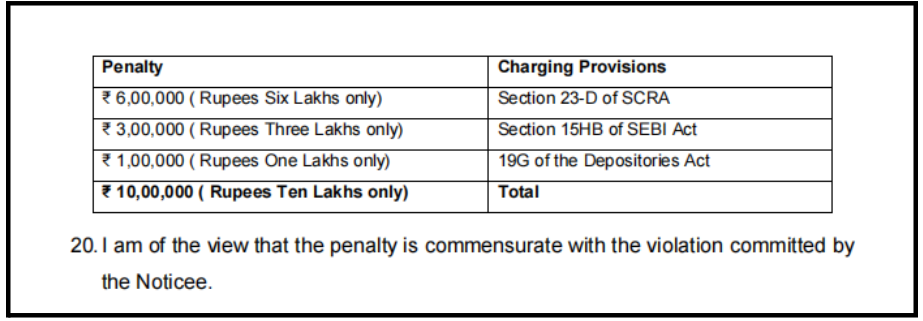
The Adjudicating Officer held the company liable for 10 established violations and imposed a total monetary penalty of ₹10,00,000 under the following provisions:
- ₹6,00,000 under Section 23-D of SCRA
- ₹3,00,000 under Section 15HB of the SEBI Act
- ₹1,00,000 under Section 19G of the Depositories Act
What every investor should know from this case: The alleged mis-utilisation of client funds across 23 instances, with amounts up to ₹19.63 crores per instance, was not a one-time error. It was a pattern SEBI identified across a sample, meaning the actual universe of instances could be larger.
Bonanza’s alleged use of client accounts to meet its own proprietary pay-in obligations in F&O and Currency segments means client money was potentially subsidising the broker’s own speculative trading.
Reporting borrowed funds as client funds to exchanges, if proven, is a form of regulatory deception that compromises the entire monitoring framework investors rely on for safety.
The ₹10 lakh penalty, while significant, is modest relative to the reported scale of the violations, which involved alleged fund misuse in the crores range across multiple instances.
Corrective action taken after a SEBI inspection does not erase the period during which violations allegedly occurred. Investors who suffered losses during that window retain their right to seek redress.
Also Read: Alice Blue reviews, “fraudulent application,” one reviewer’s own blunt description.
Bonanza Portfolio Reviews
Complaint data shows the scale of a problem. Real reviews show what it actually feels like when it happens to you.
Here is what real investors and clients are saying about Bonanza Portfolio across Google Reviews and the Bonanza WAVE app on Google Play.
1. Account Suspended When Shares Finally Appreciated
A February 2021 review on the Bonanza WAVE app, rated 1 star, describes an investor who held shares through years of market underperformance.
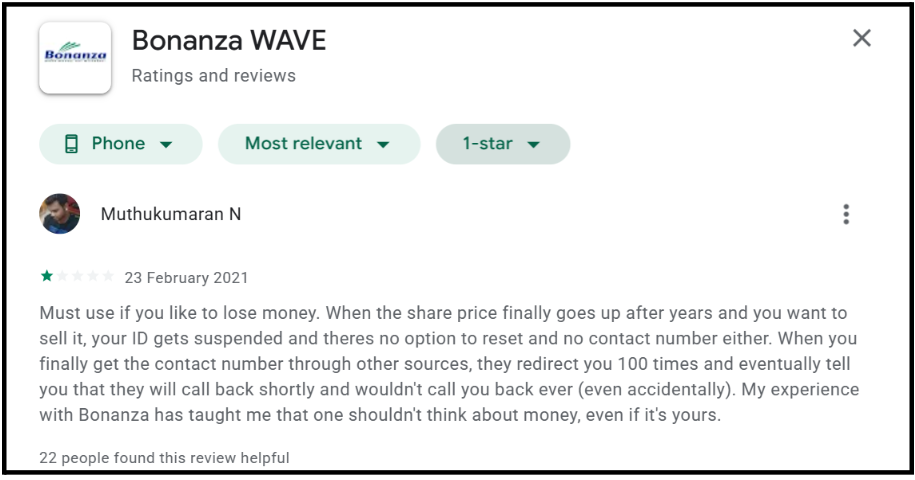
When the shares finally rose to a profitable level and they wanted to sell, their account ID was suspended with no reset option and no contact number available on the app.
After sourcing a number through other means, the reviewer was redirected multiple times and promised a callback that never came.
2. No Password Reset Option, Funds Impossible to Access
A March 2022 review on the WAVE app, rated 1 star, describes a client who forgot their password and found no reset mechanism on the app whatsoever.
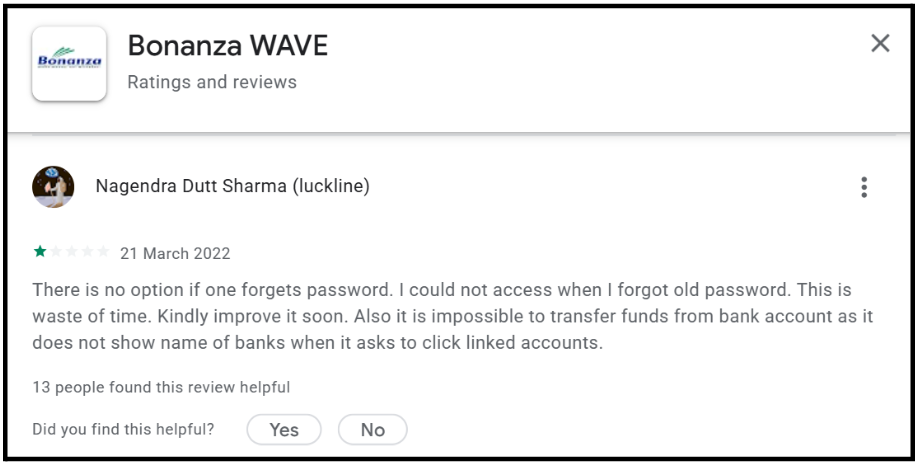
Additionally, the reviewer reported that transferring funds from a bank account was impossible because the app failed to display linked bank names when prompted.
3. Account Closed and Payout Sent to Wrong Bank
An August 2022 review on the WAVE app, rated 1 star, describes an investor who waited eight months for a trading password and login ID that was never provided.
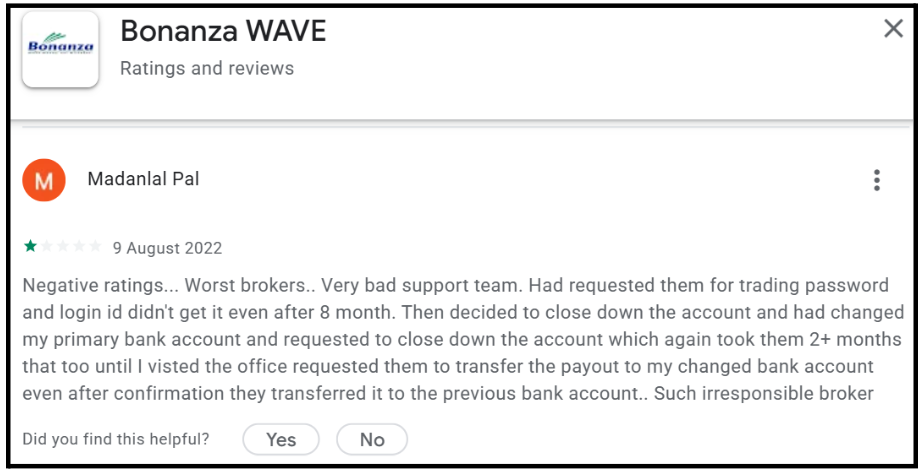
When they finally decided to close the account, the process took another two-plus months and only moved forward after the investor physically visited the office.
Most critically, even after confirming a new bank account and requesting the payout to that account, Bonanza reportedly transferred the money to the old, previously linked account.
4. Unexplained Deductions, False Assurances, and Zero Resolution
A May 2022 review describes repeated unexplained deductions from the investor’s account with no corresponding trade or charge explanation.
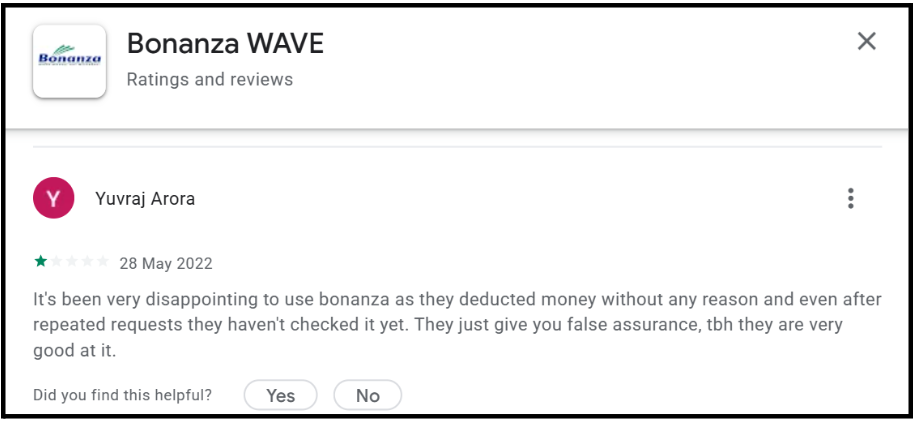
The investor claims to have made multiple requests for investigation, receiving only false assurances in response, with no actual check or resolution ever conducted.
This pattern of acknowledged complaint followed by empty assurance and no action directly mirrors the SEBI inspection finding that Bonanza’s operational systems were not designed to protect investor interests.
Dealing with unsettled funds, unexplained deductions, or an account Bonanza Portfolio won’t properly explain?
Our team will review your ledger and trade records, map them against what SEBI’s own order already found, and help you build a complaint that gets a real response.
Bonanza Portfolio Excess Charges
Stockbrokers make their money when you trade. Every time you buy or sell, they collect a fee. Usually, this is a fair trade-off for the tools, research, and platform they provide.
But a serious problem arises when a broker starts pushing trades just to increase their own commission checks. This is called churning in share market.
It happens when a relationship manager or broker nudges you into frequent, unnecessary trading that does not actually help your portfolio.
Here’s what a separate reporting subset shows specifically for Bonanza Portfolio excess charges:
| Year | Total Complaints | Brokerage Churning Complaints |
|---|---|---|
| 2021-22 | 15 | Around 2 |
| 2022-23 | 27 | 0 |
| 2023-24 | 20 | Around 11 |
| 2024-25 | 40 | Around 21 |
| 2025-26 | 31 | Around 17 |
Worth being upfront about: NSE doesn’t maintain a dedicated “excess charges” or “churning” complaint category, so these figures reflect charges-related grievances identified within the broader complaint data, not an official classification. Treat them as approximate.
Even with that caveat, the pattern is hard to dismiss.
Over half of all complaints in both 2024-25 and 2025-26 trace back to this pattern, and the total number of complaints rose noticeably between 2023-24 and 2024-25 alongside it.
When can it actually be considered brokerage churning? It is a lopsided relationship when you are taking all the risk while the broker takes a guaranteed cut.
You are likely being charged extra if you experience any of the following:
1. Manipulation Through Frequent Calls
Some brokers use constant, high-pressure phone calls to nudge you into trading more often than you should.
They might push you into illiquid stocks where prices swing wildly, or suggest you exit and re-enter the same stock within hours for no logical reason.
This constant pressure is designed to keep the transaction wheel spinning, regardless of whether the trade actually makes you a single rupee.
2. Unauthorised Trading in Your Account
This is the most serious sign of trouble and often the primary way churning happens. Trades show up in your account that you never actually confirmed or placed yourself.
Sometimes a relationship manager might claim they had verbal instructions, or use your login details to execute orders “on your behalf” to maintain margins or generate brokerage.
3. Account Handling Issues
Poor account handling often acts as a distraction for excess charges. When a broker is not particular about the paperwork, it is much harder for you to spot the problem.
Watch for delays in updating your ledger or sending contract notes, margin calculations that seem unnecessarily complex, and a lack of transparency in how brokerage is broken down per trade.
When it becomes difficult to track where your money is going, it is usually because the broker does not want you to see the true cost of their advice.
Also Read: Samco Securities complaints, why trades you never authorised deserve immediate, same-day action.
How Do These Complaints Impact Retail Investors?
Complaints related to brokerage churning or excess charges have a significant impact on investors, especially those who rely on brokers or relationship managers for trading advice.
One of the most immediate effects is higher trading costs.
When multiple trades are executed in a short period, brokerage and transaction charges increase quickly. Even if some trades generate small profits, these costs reduce overall returns.
Another impact is erosion of investment capital. If frequent trades lead to losses along with high brokerage deductions, investors may see their account balance gradually decline over time.
For new or inexperienced investors, these situations can be particularly confusing.
Without a clear understanding of brokerage structures or trading strategies, they may follow frequent recommendations without realising how much brokerage they are actually paying.
When Should You Take Action Against Bonanza Portfolio?
Many investors wait until the situation feels impossible to reverse. By that point, timelines have lapsed, and evidence has weakened.
These are the situations that require immediate action:
- Money not settled despite written request. If you have sent a settlement or withdrawal request in writing and your funds have not been transferred within the standard timeline, that is a regulatory violation you can formally report.
- Account suspended and no reset available. If your Bonanza account is suspended and the app provides no mechanism to reset credentials or access support, file a written complaint immediately.
- Unexplained deductions with no justification provided. If money has left your account without a matching contract note, charge schedule, or trade record, request your full ledger statement and file a complaint the same day if the deduction cannot be explained.
- No response within 30 days of a written complaint. SEBI mandates that registered brokers acknowledge and resolve investor complaints within 30 days. Silence beyond this window is itself a regulatory violation and your trigger to escalate.
The investors who recover their money are the ones who act early, document everything, and escalate formally rather than waiting for the broker to voluntarily resolve the issue.
How To File a Complaint Against Bonanza Portfolio Online?
Here’s what most people don’t realise until they’re already in the middle of a dispute. This process isn’t optional guesswork; SEBI has a fixed ladder for it, and skipping a rung usually just costs you time.
Your first move should always go to Bonanza directly, in writing, not a phone call.
Email their official grievance address, name the exact issue, the dates, the amounts, and what you actually want done about it.
That date matters more than you’d think; it’s the clock SEBI uses to judge whether the broker responded within the 30 days they’re legally given.
Thirty days pass with nothing?
That’s your cue to bring in the regulator. A SEBI SCORES complaint puts your case in front of SEBI directly; upload your original complaint, the email trail, and your account statements showing exactly where the money went missing.
SEBI tracks how Bonanza responds from this point, and a weak response can trigger enforcement action on its own.
Still stuck after that?
The exchanges themselves get involved next. A BSE complaint, or NSE if that’s where Bonanza holds your registration, puts a formal grievance mechanism to work.
The exchange reaches out to the broker on your behalf, which carries a different weight than a customer complaint ever will.
And if none of that closes the loop, there’s a faster route than a lawsuit: SMART ODR registration, a conciliation-first process built specifically for disputes like this
If conciliation itself doesn’t resolve things, the same framework can move your case into arbitration, where an independent authority reviews the evidence from both sides and issues a binding decision.
Awards reached this way are legally enforceable under Indian law, which makes this one of the sharper tools a retail investor actually has.
For the complete process laid out end to end, our guide on complaint against stock broker SEBI walks through every stage in detail.
Conclusion
Bonanza Portfolio Limited is a SEBI-registered stock broker with over three decades of operation and a SEBI registration dating to 1994.
The SEBI adjudication order confirmed 10 regulatory violations, including the alleged mis-utilisation of client funds, the alleged use of client money to fund the broker’s own proprietary trading, and incorrect data submitted to exchanges on multiple occasions, resulting in a ₹10 lakh penalty.
Complaints data from exchanges shows that formal grievances have nearly doubled in two years while the client base has declined, and the current year’s resolution rate has slipped below 90% for the first time.
A meaningful share of that volume traces back to excess charges and brokerage churning specifically.
User reviews across Google and the WAVE app describe fund settlement failures, account lockouts, payouts to wrong accounts, and support teams that offer assurance without action.
Check your ledger, document every anomaly, and file formally at the first sign of a problem.
Report. Recover. Stay Fraud Free.
Complaints rose from 20 in 2023-24 to 40 in 2024-25, and 37 have already been filed in 2025-26, even as the active client base declined over the same period. Six categories of violations including alleged misuse of client funds up to ₹19.63 crores in a single instance, a ₹26.28 crore reported shortfall, and failure to settle client accounts on time, resulting in a ₹10 lakh penalty. Within a specific reporting subset, over half of all complaints in both 2024-25 and 2025-26 trace back to excess charges or brokerage churning, though NSE doesn't maintain this as an official category. Unauthorised trades and misappropriation, Type IV, is the single largest category on record, ahead of service-related complaints. File through SEBI SCORES once 30 days have passed with no resolution, since SEBI mandates a response within that window and silence beyond it is itself a violation.Frequently Asked Questions


 Add us as a preferred source on Google »

