Motilal Oswal Arbitration: 32 Awards, 18 Wins, and How Investors Recovered

Motilal Oswal Arbitrations

Quick Summary

We went through 32 NSE and BSE arbitration awards involving Motilal Oswal from 2021 to 2024, and in 18 of them the tribunal directed the broker to pay the client, with wins running from ₹26,000 to ₹2,54,35,606 and two awards crossing a crore. This page carries the full data, the three landmark cases told in complete detail, a housewife who won ₹7 lakh, a first time investor who recovered ₹1,01,958, and a COVID era liquidation reversed for ₹2.54 crore, plus the platform glitch awards, and the one thing that separated the eighteen winners from the fourteen who lost.
A housewife who had never bought a share. A first-timer promised ₹4,000 a day. A fifteen-year client whose portfolio was sold off in an afternoon.

All three took Motilal Oswal to arbitration. All three won.

They are part of a bigger count, because we reviewed 32 published awards against this broker, and in 18 of them the tribunal ordered the broker to pay, from ₹26,000 up to ₹2.54 crore.

If your own complaint has hit a wall, read how they did it, because their stories are the map, and the one habit every winner shared is something you can start today.

Motilal Oswal Arbitration Cases: The Numbers

Right now you probably hold a loss, a stalled complaint, and one nagging doubt: whether fighting a broker this big ever actually works.

The honest answer sits in the published record, and we counted it award by award across four years.

Two small tables below hold that count, first the overall scoreline, then the four biggest amounts tribunals ordered paid.

Look at the win column against the total, and let that ratio set your expectations before you read a single story:

Count
Total awards reviewed, 2021 to 2024 32
Client won or partly won 18
Dismissed or broker won 14

That win rate is worth sitting with, because it is far higher than most investors expect.

And the biggest amounts tell their own story:

Year Issue Awarded
2023 Wrongful liquidation, no MTF agreement ₹2,54,35,606 + 10% interest
2023 Unauthorised trading, back door PMS ₹1,12,48,910 + 12% interest
2023 Broker acting as advisor, churning ₹7,39,592 + 12% interest
2023 Shares sold despite objection ₹6,44,200 on appeal

Below those sit a long run of unauthorised trading wins in the one to four lakh range, plus a cluster of brokerage refunds.

One of those refunds returned the entire brokerage, and that full story sits on our page on Motilal Oswal excess charges.

Add the big four to those smaller wins, and the full picture emerges.

Eighteen clients, in total, walked away with money.

The obvious question is what separated them from the fourteen who lost.

What Determines the Outcome of Motilal Oswal Arbitration Cases?

Looking at all eighteen wins together, one common thread ties them all.

The broker could not back up its own records.

In the ₹2.54 crore case, the broker liquidated a client’s shares claiming a margin trading facility, but failed to produce the signed agreement to prove it.

In the ₹1.12 crore case, an authorised person ran a back-door portfolio scheme in a conservative elderly investor’s account with no pre-trade confirmation for any of it.

How that pattern works and how victims prove it, check our guide: Motilal Oswal unauthorised trading.

And in dozens of cases in the one to four lakh range, the broker simply could not produce the call recordings or order logs needed to prove consent.

When the paperwork failed, the client won. Now, look at the fourteen who lost. They didn’t lose because they lacked a valid grievance.

The awards repeat the same phrases over and over: the applicant produced no evidence to corroborate, or the claim is not substantiated.

The tribunals were not saying the client was wrong.

They were saying the client failed to prove it. A claim rarely fails because the grievance is weak.

It fails because the evidence was incomplete.

Closing that gap between having a complaint and proving it is the whole game.

Here is how that winning approach played out across three real cases.

Case 1: The Housewife, the WhatsApp Chats, and the ₹7 Lakh Award

motilal oswal arbitration case

Gurmeet Kaur had never bought a share in her life.

She ran her home, and the stock market was something that happened on television.

Then one day in late 2022, two well-dressed men from Motilal Oswal, a Mr. Rahul and his senior Mr. Verma, arrived with a friendly pitch about tax savings. Open two demat accounts, they said, one in your name, one in your son Harsdeep’s.

It sounded responsible. She agreed.

Then came the third man. Mr. Kamran was introduced as the one who would handle everything. He messaged on WhatsApp. He visited her home. He made it all feel taken care of.

And quietly, her account went to war.

Trades exploded across F&O and currency, markets she could not have named, let alone chosen. She placed nothing.

She approved nothing. But on 21 December 2022, her phone displayed a message that would later silence a hearing room: Mr. Kamran had created a password and was asking her to send him the OTP.

The money bled in ways she only understood later. ₹18,886, ₹10,266, and ₹8,516 in brokerage, gone in a single day.

By the end, the charges had swallowed ₹2,16,000, and a call recording from 27 December caught the method: trades executed first, confirmation calls after, with the broker coaching her to just say ha.

No one had ever asked about her risk appetite. There was nothing to ask; she had none, and SEBI’s suitability rules had simply been ignored.

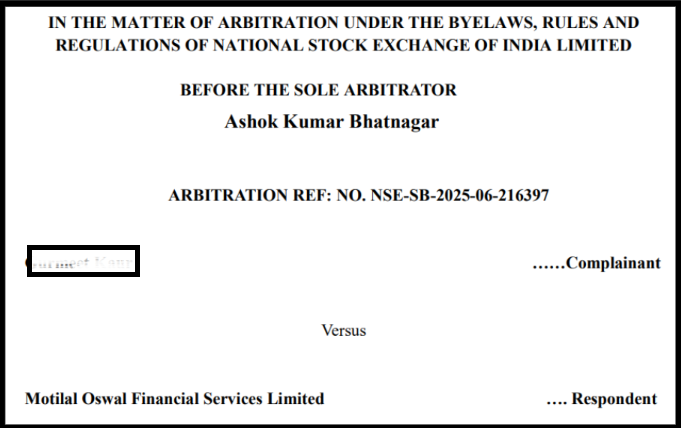
When the case reached sole arbitrator Ashok Kumar Bhatnagar, the broker tried to distance itself from the chats.

It could not explain them, and the hearing confirmed what mattered most: Kamran was their employee.

Where the damage comes through a representative like this rather than the head office, the accountability route runs through our page: Motilal Oswal authorised person complaint.

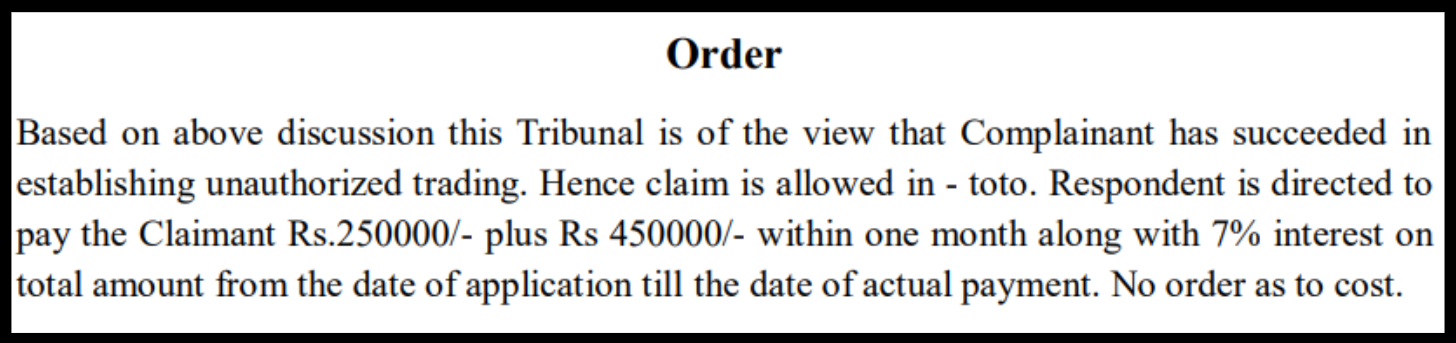
On 24 October 2025, the award landed, and it held nothing back.

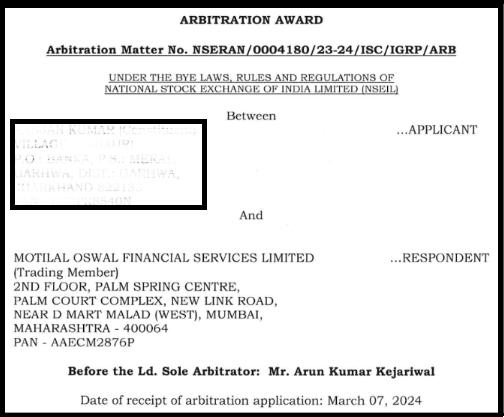
₹2,50,000 of brokerage returned, ₹4,50,000 of trading losses paid, ₹7,00,000 in full with 7 percent interest running until the last rupee arrived.

Motilal oswal arbitration award

A homemaker with zero market knowledge had beaten a national brokerage house, because she never deleted a chat.

Case 2: ₹4,000 a Day, Guaranteed. The Call That Cost ₹1.8 Lakh

recovery from motilal oswal

The phone rang in April 2023, and Ranjan Kumar almost did not pick up.

He knew nothing about markets and said so openly. The voice on the line, a Motilal Oswal representative named Pramod Patel, heard that confession and treated it as an opening.

I am a SEBI-registered advisor, Patel said. ₹4,000 to ₹5,000 a day, guaranteed.

Kumar doubted it. So Patel offered a free trial, and the trial worked, the way trials designed to hook always do. An account opened. Then the ask arrived: deposit ₹10 lakh.

When Kumar said he did not have it, Patel had a solution ready: take loans; the profits will repay them.

Kumar put in ₹2,06,000. Small wins trickled in, just enough to feel real.

Then came 23 May 2023. Buy 2,400 lots in the currency segment, Patel instructed. Nobody mentioned what 2,400 lots could do to a man’s savings.

By that evening, ₹92,000 was gone. Hold, said Patel. By the next day, the loss stood at ₹1,80,000.

At arbitration, the broker reached for a clever defence: Kumar held seven other broker accounts, so he was no novice. Arbitrator Arun Kumar Kejariwal swept it aside, because the question was never Kumar’s experience.

The question was whether Patel’s conduct met regulatory standards, and it did not: a fake advisor claim, an impossible guarantee, and a high-risk product pushed for brokerage.

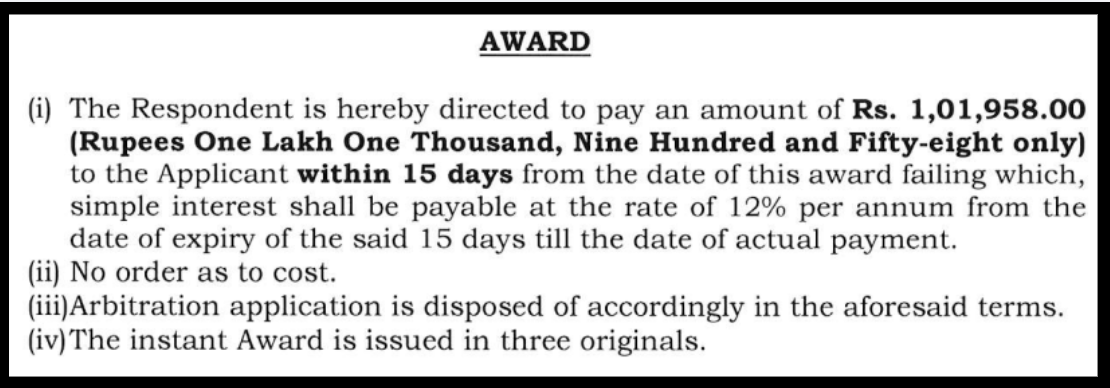
The award ordered 80 percent of the brokerage plus IGST returned, ₹1,01,958, with 12 percent interest ticking on any delay past 15 days.

Motilal oswal award

If someone ever made you a promise like Patel’s, that message in your phone is not a memory. It is evidence.

Case 3: Shares Sold in the COVID Crash, ₹2,54,35,606 Recovered

motilal oswal arbitration case detail

Anil Agrawal and Motilal Oswal went back fifteen years.

Since 2005, they had run a funding arrangement, the broker financing 70 percent of his share purchases at 14 percent interest, his portfolio standing as security.

Through every market cycle, it held.

Then March 2020 arrived, and the world stopped. As COVID crushed the markets, Agrawal did what he had always done: he paid every margin call on time, right through the worst week, 18 to 23 March.

On the 24th came a call for ₹7.43 lakh. He immediately sold ₹5.20 lakh of shares himself and was deciding the rest.

He never got to decide.

The broker sold 4,000 shares of Bharat Bijlee and 20,000 shares of Rallis India, ₹47.29 lakh of his portfolio, in one day, without his consent.

The next morning at 2:08 PM, a fresh demand, ₹35.84 lakh, payable by 9:00 AM. Nineteen hours, in the middle of a global pandemic.

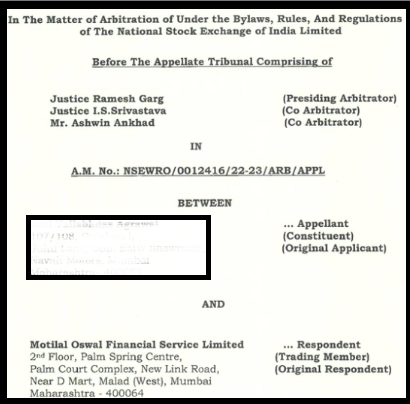
The fight that followed ran for years, through rejections, through the Bombay High Court, and back to an appellate panel of Justice Ramesh Garg, Justice I.S. Shrivastava, and Mr. Ashwin Ankhad. And there, the broker’s entire position collapsed on one missing piece of paper.

The margin trading agreement. SEBI’s 2004 circular makes it mandatory, signed in writing. Asked to produce it, the broker first blamed COVID lockdowns, then claimed it existed online somewhere.

The panel rejected both. Without that agreement, the margin escalations from 30 to 50 to 100 percent overnight had no authority, and the scrip concentration used to justify them was created by the broker’s own selective selling.

It had manufactured the problem, then cited it as justification.

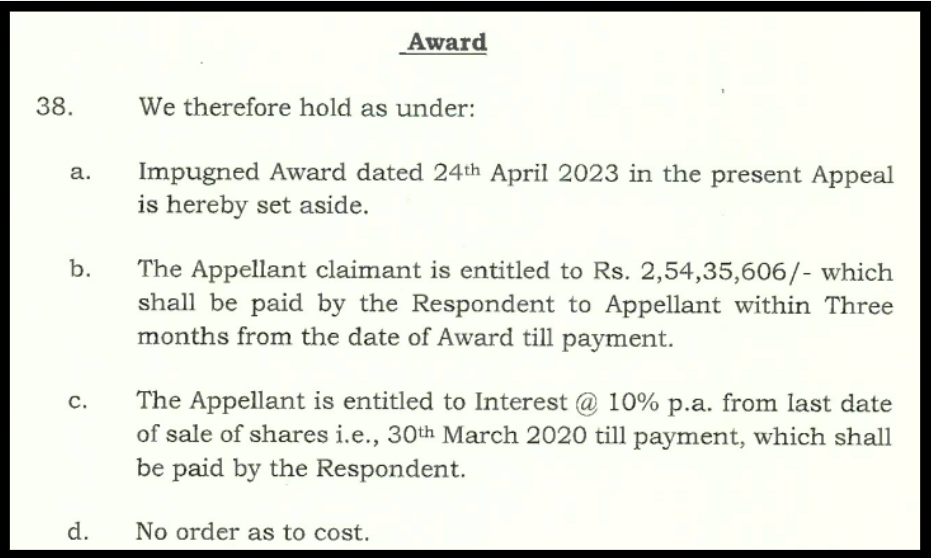
The panel set aside every earlier award in the broker’s favour and directed payment of ₹2,54,35,606 with 10 percent interest from 30 March 2020 until the day it is actually paid.

motilal oswal award

Fifteen years of loyalty had not protected Agrawal. One demand for a document did.

Motilal Oswal App Glitch Cases: Arbitration Wins for System Failures

Maybe your loss did not come from a bad decision at all.

The app froze at the wrong moment, showed a number that was not real, or fired activity you never touched.

Claims like that feel unwinnable, because the broker controls the technology and can call any failure a one-off.

Two investors refused to accept that answer, and both were paid.

Their cases below show you exactly what convinced the tribunals, so read each one against your own incident and note which of the two your evidence resembles:

Case 1: The 44 Trades That No Human Could Place, ₹1,44,809 Won

Vinita Choudhary knew her own rhythm. Trading since 2014, steady pattern, no surprises.

Then one day her account showed something no human hand could produce: 44 trades, executed within the same single second.

The loss they left behind, the broker suggested, was simply hers to absorb.

Her answer to the tribunal was almost mathematical. No person alive places 44 trades in one second. If no human did it, the system did, and the system belongs to the broker.

The tribunal agreed.

It held that trading members bear a significant responsibility for the integrity and stability of their platforms, found that 44 trades in a single second was virtually impossible without a software irregularity in the broker’s own systems, and that her loss stemmed from that abnormality rather than any decision she made.

And crucially, it never asked her to prove what broke in the code. The impossibility itself was the proof.

The earlier grievance committee order was set aside, and ₹1,44,809 plus interest ordered paid.

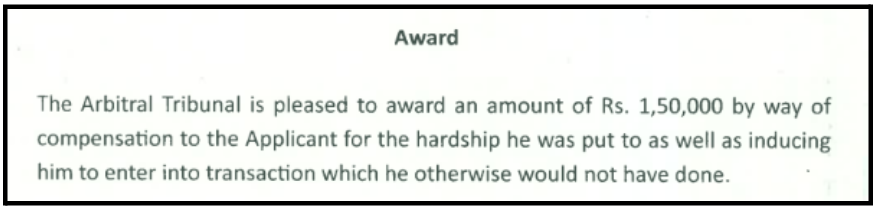
Case 2: The App That Showed a 2,200 Percent Gain, ₹1,50,000 Won

The second victim was an IT professional scrolling his app on an ordinary day, when one of his mutual fund holdings showed a gain of around 2,200 percent.

The screen said his fund was worth roughly ₹35 lakh. He did what the screen invited him to do; he redeemed. About ₹1 lakh arrived.

The app had displayed a NAV of ₹2,323 against a true value near ₹94, and the broker admitted the glitch while arguing he deserved nothing, since the loss was only notional.

The tribunal split the difference with surgical honesty. No, he could not have the fantasy ₹35 lakh; that price never existed.

But yes, the broker had failed its obligation to provide reliable infrastructure, and its false screen had induced a transaction he would never otherwise have made.

For that hardship and inducement, ₹1,50,000.

Motilal Oswal arbitration award snippet granting Rs 1,50,000 compensation for technical glitch and app display error.
Arbitral Tribunal award order granting ₹1,50,000 compensation against Motilal Oswal for app display failure and hardship caused.

Two different failures, one principle worth memorising.

A broker owns the reliability of its platform, and when the platform misleads or misfires, the broker answers for it.

Neither client decoded a single line of software.

One showed impossibility, the other held the broker’s own admission, and both refused to accept it was just a glitch as the end of the conversation.

If a glitch has cost you money, your claim rests on catching the failure before it is quietly corrected, so gather these now:

  • Timestamped screenshots of the error itself, the wrong price, or the impossible trade list.
  • Your contract notes and ledger showing what actually executed.
  • The exact time of the disputed event, down to the second where the record allows.
  • Any email or chat where support admits a glitch or error occurred.
  • Your own trading history, showing the disputed activity breaks your normal pattern.

Glitch evidence is perishable, so the timestamped screenshot you take today is the award you collect tomorrow.

What Every Trader Should Take Away From These Awards

Six investors, six different wounds, one winning method. Make these five habits yours before you ever need them:

  • Document everything. WhatsApp chats, RM call recordings, contract notes downloaded regularly. In every case above, documentation was the deciding factor. In every case above, documentation was the deciding factor. And if the app freezes or blocks your login while you try to download them, our guide on Motilal Oswal login issue will help you sort it out.
  • Understand your brokerage structure in writing before trading, and never let charges accumulate silently.
  • Know your risk profile, and refuse in writing when anyone pushes you beyond it.
  • Act early, because records fade and timelines complicate, and the moment something feels wrong is the moment to document it.
  • Use the formal process, because several of the biggest wins came at arbitration or appeal, after the client had already been rejected. An early rejection is often just the point where the case had not been built properly yet.

Complaint rejected once and told that was the end of the road?

The ₹2.54 crore award was won on appeal after earlier rejections, and that is exactly the stage we build for, organising the records, mapping every violation to its regulation, and presenting the claim the way the eighteen winners did.

Register with us for a free consultation.

Your Losses Have a Route. Here Is Where It Starts

Everything above is the destination. The road to it begins earlier, with stages that must come in order.

Arbitration is never the first step.

The dispute travels from the broker’s grievance desk through the regulator, and the exchange’s conciliation machinery, and only an unresolved money dispute reaches the tribunal that passed every award on this page.

The complete route, with the grievance emails, the customer care numbers, the SCORES walkthrough, and the timeline each stage owes you, is our step-by-step guide: how to file complaint against Motilal Oswal.

The broker’s record with the regulator adds a separate line of accountability too: a ₹5 lakh order for compliance lapses, covered on our page: SEBI penalty against Motilal Oswal.

Conclusion

Across the reviewed awards, the scoreline reads 18 wins in 32, from ₹26,000 to over ₹2.5 crore, and none of the eighteen came down to luck.

They came down to one thing: whether the broker could be forced to stand behind its own records, and whether the client built the case to make that happen.

A housewife, a first-time investor, a fifteen-year client, and two platform victims all answered that question the same way.

If your complaint hit a wall, arbitration is the stage where it can still turn into a real payment.


Report. Recover. Stay Fraud Free.


Frequently Asked Questions

In the 32 awards reviewed from 2021 to 2024, tribunals directed the broker to pay the client in 18 cases, with the rest dismissed or decided for the broker. The figures reflect awards published as of the review, not every dispute ever filed.

₹2,54,35,606 plus 10 percent interest, for wrongful liquidation where the broker could not produce the margin trading facility agreement it relied on. The matter travelled through the Bombay High Court before being re decided in the client's favour.

Yes, and in the ₹7 lakh case it was central, including a chat where the representative asked for the client's OTP. Save every conversation, screenshot it, and back it up immediately, because the burden of disproving it then falls on the broker.

Yes. Tribunals awarded ₹1,44,809 for 44 trades firing in one second and ₹1,50,000 for a false NAV display, holding the broker responsible for its platform's reliability. Capture the error with timestamps immediately, because glitch evidence is perishable.

Mostly for lack of proof, not lack of a real grievance. The dismissed awards repeatedly note records never produced and claims never substantiated, because the burden sits with the client, which is why how the case is built decides which side of the eighteen and fourteen you land on.


loader

FraudFree Support

We're online — reply instantly
Scroll to Top