
Quick Summary
On July 30, 2026, SEBI issued a final order banning textile manufacturer Kalahridhaan Trendz Limited and its three promoter directors from the securities market. In August 2024, the company falsely announced a ₹115.50 crore export order from a non-existent Bangladeshi buyer, triggering sharp stock price volatility. Regulatory checks revealed the buyer’s email was operated from India and inactive since May 2024. SEBI imposed a two-year ban on the company and its MD, a one-year ban on two other directors, ₹1 crore in total penalties, and recommended compulsory delisting. Trading remains suspended.
When Kalahridhaan Trendz Limited listed on the NSE SME platform in February 2024, its numbers painted a picture of steady growth.
Operating out of Narol in Ahmedabad, the fabric manufacturer raised ₹22.49 crore at ₹45 a share, backed by solid revenues and rising profits.
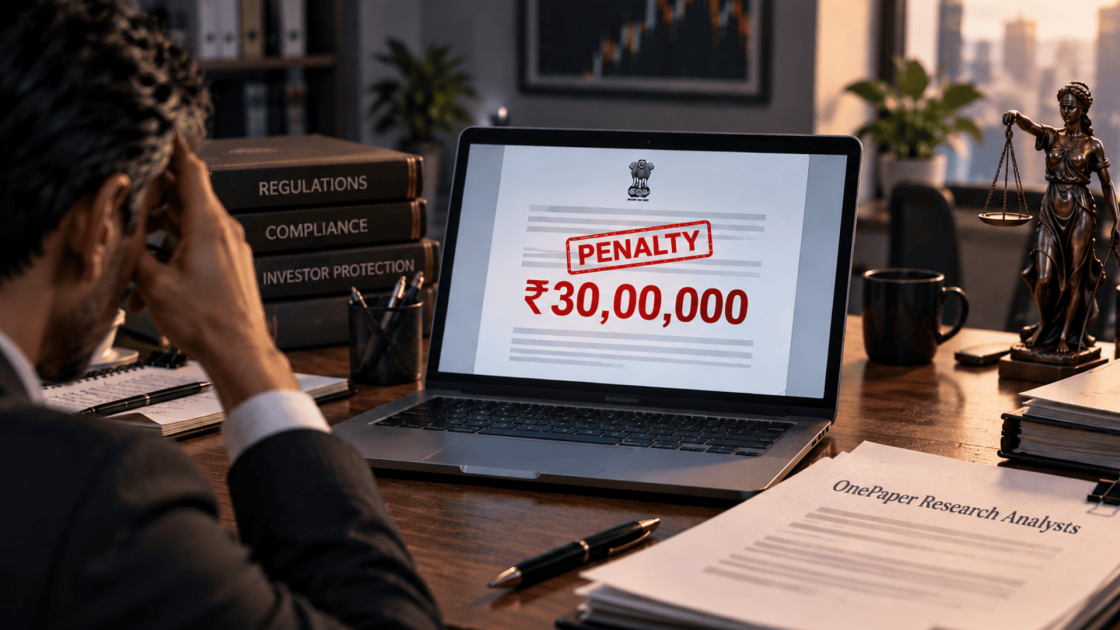
Just two years later, the company and its promoter directors stand barred from the securities market, facing ₹1 crore in SEBI penalties.
What happened in between is a textbook case of missed bank disclosures, baseless financial projections, and a fabricated ₹115 crore export order from a buyer that didn’t exist.
How a Textile SME Went from IPO to Trading Ban in Two Years
Kalahridhaan Trendz Limited manufactures and trades fabrics and operates out of Narol in Ahmedabad.
It listed on the NSE SME platform on February 23, 2024, raising ₹22.49 crore at an issue price of ₹45 per share.
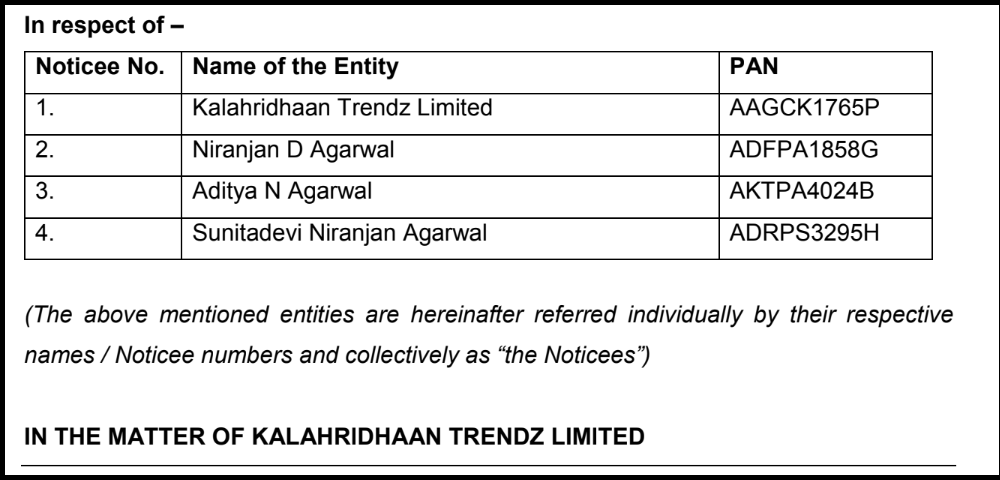
The financials it listed on looked fine. Net profit of ₹6.60 crore in FY23 and ₹8.05 crore in FY24, on revenue of around ₹194 crore.
Within three months of listing, the company had begun defaulting on its dues to HDFC Bank.
By FY25 it posted a loss of ₹68.07 crore and revenue had almost halved to ₹106.99 crore. In between those two points sit the two announcements that this order is really about.
The first thing that went wrong, though, was not something the company said. It was something it did not say.
The Bank Complaint that Started the Investigation
HDFC Bank wrote to SEBI on September 9, 2024, complaining that the company had failed to inform the exchange about a default on credit card dues of ₹50.99 lakh. The bank wrote again on November 18, 2024, this time about a business loan default of ₹30.23 lakh.
SEBI went back to the credit card statements. As on April 21, 2024, the minimum due was ₹34.80 lakh. It was not paid, and by the next statement it had grown to ₹70.29 lakh.
What the Disclosure Rules Actually Require
Under the LODR Regulations, a default by a listed company is one of the events that must be disclosed with no materiality test applied at all.
It does not matter how small the amount is or what the company’s own materiality policy says. Regulation 30(6) gives a listed company 12 hours to disclose an event arising inside the company.
So the disclosure was due by April 22, 2024. It was never made, not then and not later.
What SEBI found most damning was what happened next. Both SEBI and NSE asked the company repeatedly about it.
In October 2024, the company replied that it had missed the disclosure by oversight and asked for two days to make it. That extension was granted. The disclosure still never came.
The company argued in its defence that credit card dues are not covered by the rules and that disclosure was a management call under its materiality policy.
SEBI rejected that, noting the company had itself admitted the lapse earlier, and that in any case the ₹34.80 lakh was above the materiality threshold too.
While that disclosure was pending, the company was telling investors something very different.
The First Announcement: Big promises, No numbers
On May 2, 2024, the company announced a “Strategic Expansion and Expected Increase in Profit Margin”.
It said it planned to raise production capacity to 7 lakh meters per month, expected a 25 percent increase in profit margin, and projected revenue of ₹75 crore to ₹100 crore for the year.
There were no supporting details. No existing capacity figure, no timeline, no investment amount, no funding plan, nothing about which orders justified the expansion.
SEBI’s Master Circular requires all of those when a company discloses a capacity addition.
Trading volume and number of trades rose by about 300 percent on that announcement.
The company defended this as genuine business optimism based on past profits.
SEBI’s answer was that past profit is not a basis for projecting future margins, particularly when the company was defaulting on bank dues in the very same month and its half-year profit was about to fall from ₹4.83 crore to ₹97.64 lakh.
That announcement, though, was mild compared with what came three months later.
The Bangladesh Order that Fell Apart Under Checking
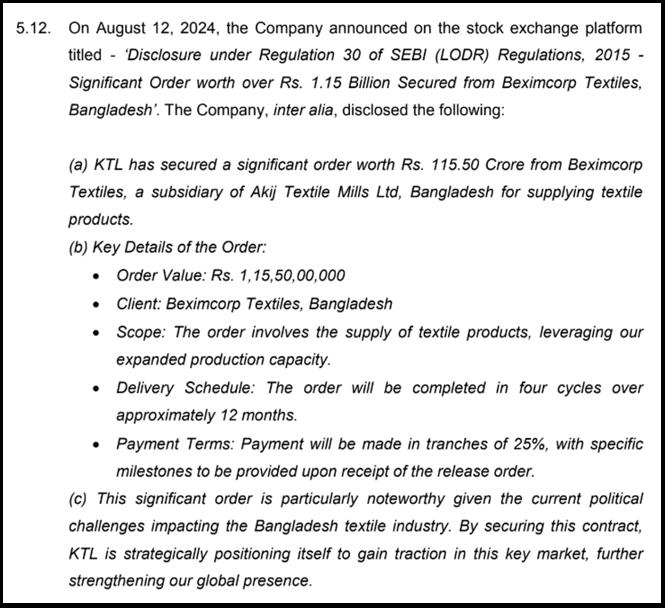
On August 12, 2024, the company told NSE it had secured an order worth ₹115.50 crore from Beximcorp Textiles, described as a subsidiary of Akij Textile Mills Ltd of Bangladesh.
It said the order would run in four cycles over roughly twelve months.
For a company with annual revenue near ₹194 crore, this was an enormous piece of news.
What SEBI Found When it Checked
SEBI searched the central database of companies registered in Bangladesh. There was no Beximcorp Textiles.
There was a similarly named Beximco Textiles Limited, so SEBI asked the Bangladesh Securities Exchange Commission whether Beximco had awarded any contract to the Indian company.
On January 16, 2025 the answer came back that no contract had been signed.
SEBI also searched the Bangladesh registrar for the Akij group, whose subsidiary Beximcorp was claimed to be. The search returned 128 companies. None of them was Beximcorp.
Then came the details that anyone could have checked in five minutes:
- The entire correspondence ran through a Gmail address, not a company domain.
- The website printed on the buyer’s letterhead, beximcorptextiles.com, did not resolve at all.
- The contact numbers given for the buyer carried the country code +971, which is the United Arab Emirates, not Bangladesh.
- Truecaller showed those numbers registered to two unrelated individuals, one of them tagged as a car service.
- Google confirmed the Gmail account was operated from India, and that its last login was on May 6, 2024. The emails supposedly sent from it in August 2024 were therefore fabricated.
A ₹115 Crore Deal Closed in About an Hour
The email trail the company itself submitted shows how fast this supposedly happened. The first contact arrived at 2:41 pm on August 11, 2024.
The company sent pricing at 3:09 pm. The buyer agreed at 3:19 pm, ten minutes later. Terms went across at 3:51 pm. The order was finalised the following day and announced to the exchange.
The company’s defence was that it had been introduced to the buyer by a middleman named Ankit Shah and was itself a victim of misrepresentation.
SEBI noted that this explanation appeared only during the proceedings, that no document on record showed any communication with that person, that the company never filed a police complaint, and that it never told investors the order had fallen through.
The company also submitted that when transaction values are large, it does not verify the identity of the counterparty. SEBI called that submission contrary to how any reasonable person would act.
What the announcement did to the share price is the part every trader should look at.
What the Stock Actually Did
The announcement hit the NSE platform at 13:00:45. Of the 113 trades that day, only two took place before it. The remaining 111 came after, starting at 13:01:21.
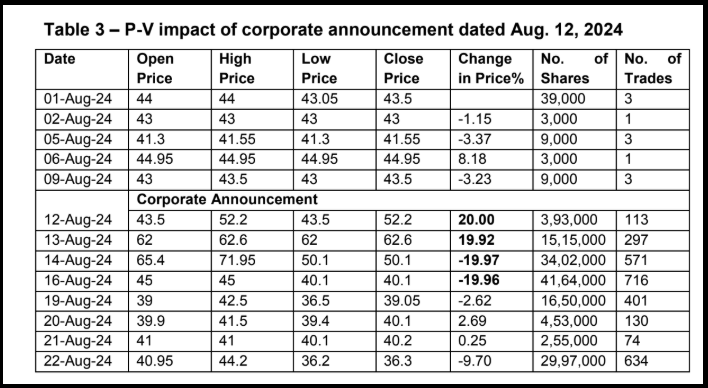
The price rose 20 percent that day, from ₹43.50 to ₹52.20. The next day it added another 19.92 percent to ₹62.60. Then it fell 19.97 percent, then 19.96 percent. Volume went from 39,000 shares on August 1 to 41,64,000 shares on August 16.
Anyone who bought into the excitement on August 13 was down roughly a third within three sessions.
Behind these announcements sat a governance structure that had already stopped working.
The Governance Gaps Underneath
Fabricated announcements and price spikes don’t happen in a vacuum.
Underneath the misleading disclosures sat a complete collapse of basic corporate governance, one that allowed major decisions to be taken, announcements to be published, and regulatory deadlines to pass without any internal oversight or check.
SEBI’s order highlighted two major structural failures that made this breakdown possible:
1. No compliance officer for over two years
The company’s Compliance Officer resigned on June 19, 2024. Under the rules, the post had to be filled within three months, so by September 19, 2024.
As of this order, more than two years later, it has still not been filled, and no appointment has ever been disclosed.
SEBI held that the compliance officer role is a substantive governance obligation and not a formality that can be waived away as a procedural lapse.
2. An “independent” director who was a partner in a promoter firm
On October 19, 2024, the company announced the appointment of an independent director for five years.
SEBI found that the person held 34 shares and was classified as a public shareholder, and that he was also a partner in M/s Manish Garments, a firm controlled by the promoters, from whose premises the company’s own registered office was leased.
The company argued he held only a 1 percent partnership share and that no rule expressly barred such an appointment.
SEBI held that independence cannot be assessed only against the letter of the eligibility checklist, and that shareholders had been misled about it.
All of this fed into what the regulator finally decided.
What SEBI Ordered
The company and its Managing Director, Niranjan D Agarwal, are barred from the securities market for two years.
Aditya N Agarwal and Sunitadevi Niranjan Agarwal, both promoter directors, are barred for one year. The three of them held over 68 percent of the company between them.
Penalties, payable within 45 days:
| Who | Amount |
|---|---|
|
Kalahridhaan Trendz Limited |
₹40,00,000 |
|
Niranjan D Agarwal |
₹40,00,000 |
|
Aditya N Agarwal |
₹10,00,000 |
| Sunitadevi Niranjan Agarwal |
₹10,00,000 |
SEBI also advised NSE to take action for continuing non-compliance, including starting the process of compulsory delisting if warranted.
One procedural detail is worth noting. The promoters tried to settle the case, but their settlement application was returned in October 2025 because it was filed after the 60-day limitation period had expired.
So what does a retail investor do with all this?
What SME Investors Should Take from this Case?
Look at what the company left out, not just what it put in. An expansion announcement with no capacity figure, no timeline and no investment number is not information. It is atmosphere.
Verify counterparties yourself when an order looks transformative. The Bangladesh registrar is publicly searchable. So is a website. A five-minute check would have shown that the buyer did not exist.
Treat a compliance officer vacancy as a red flag in itself. It is disclosed to the exchange, it is easy to see, and a company running without one for months is telling you something about how it is run.
Read the follow-up, or notice the absence of one. A real order worth ₹115.50 crore over twelve months generates progress updates. This one generated silence, and silence after a big announcement is information.
Watch the gap between announcements and results. This company was announcing a 25 percent margin improvement in the same month it was missing credit card payments. The pattern is common enough that we have written separately about how to identify pump and dump stocks.
Be extra careful on SME platform stocks. Lower float means announcements move prices much harder, as the 20 percent move here shows.
If you are already holding a stock like this, the position is harder but not hopeless.
If You Are Stuck Holding a Suspended SME Stock
Your shares stay yours. Suspension stops trading; it does not cancel ownership, and the holdings remain in your demat account.
Keep every record now rather than later. Contract notes, ledger entries, your demat statement and screenshots of the announcements you acted on are the evidence base for anything you do next.
A SEBI penalty is not compensation to you. The money goes to the government, not to shareholders, which is the single most misunderstood point about orders like this one.
Your route is a complaint of your own, and how that works is set out in our guide on how to complaint in SEBI.
If you want to see how a similar manipulation case unfolded and what it did to shareholders, our breakdown of the ₹5,500 crore pump and dump case covers that ground.
Frequently Asked Questions
The company and its promoter directors are barred from accessing the securities market, for two years in the case of the company and its Managing Director and one year for the other two directors. Separately, trading in the shares was already suspended by NSE for non-compliance, which SEBI clarified was NSE's own action and not a direction in the interim order.
No. Penalties under the SEBI Act are paid to the government. They are not a compensation fund for investors who lost money in the stock.
You continue to own them, but you cannot sell them on the exchange. In a compulsory delisting the promoters are required to buy out public shareholders at a price fixed by an independent valuer, and the promoters and directors of the delisted company face a long bar on accessing the market. In practice, recovering value from a company in this condition is difficult.
SEBI recorded that there was nothing on record showing a quantifiable gain, and noted the promoters could not have exited anyway because their shareholding was under lock-in during the relevant period. It held that this does not matter, because the definition of fraud covers conduct that induces others to deal in securities whether or not the person gains.
Search the buyer's name on the company registry of the country it claims to be from, open the website on the letterhead, check whether the phone number matches the country, and see whether the seller has issued any follow up disclosure. In this case every one of those checks would have failed.
Not necessarily, but time matters, because limitation periods run from when the issue arose. Start with a written complaint and keep the acknowledgement, because that record is what any later forum will work from.



 Add us as a preferred source on Google »

