

Quick Summary
On 16 June 2026, SEBI’s Adjudicating Officer issued a formal order against OnePaper Research Analysts Private Limited, imposing a ₹30 lakh penalty for fraudulent and unfair trade practices and regulatory non-compliance. The order followed a March 2024 inspection where staff were told to say they were at lunch, then sat idle when called back. Inspectors tested the firm by having an employee call a lead in their presence, and recorded her assuring the client of guaranteed returns. This page works through the order in full, its procedural history, the evidence, the firm’s defence, and why SEBI rejected it point by point.
SEBI’s Adjudicating Officer imposed a ₹30 lakh penalty on OnePaper Research Analysts Private Limited on 16 June 2026, in Adjudication Order No. Order/AK/DS/2026-27/32446.
This page exists because that order deserves more room than a summary paragraph in a general firm review.
It runs 28 pages, covers an 18-month procedural history, and documents specific evidence, named clients, named employees, and a test the inspection team ran themselves. All of it is worth reading in full.
For OnePaper’s registration details and pricing, see our OnePaper Research Analysts page.
SEBI Order Against OnePaper Research Analysts
The order’s formal citation is Order/AK/DS/2026-27/32446, issued under Section 15-I of the SEBI Act, 1992, read with the SEBI adjudication rules. It was signed by Adjudicating Officer Amit Kapoor in Mumbai.
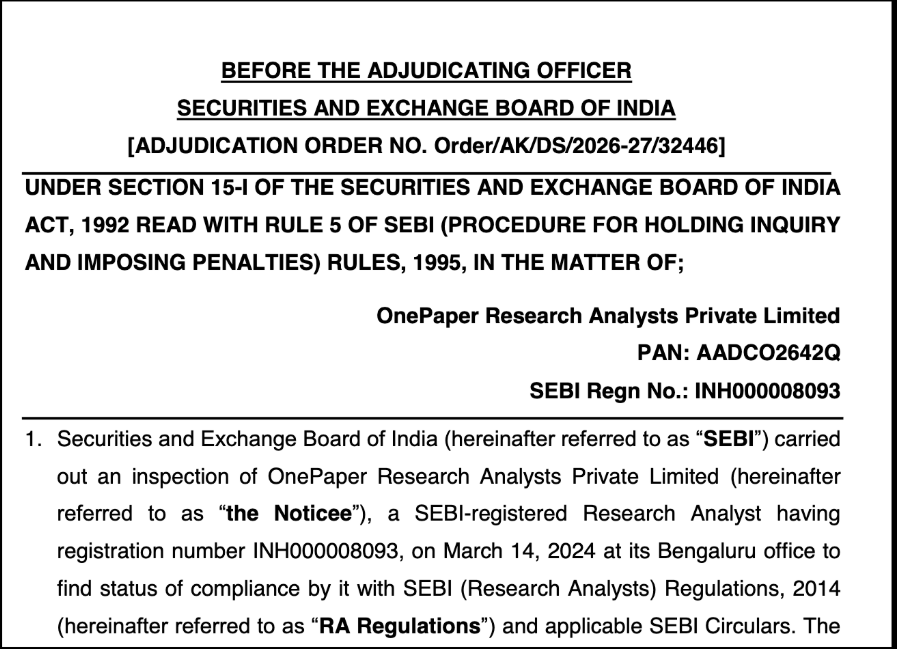
It follows an inspection that SEBI carried out at OnePaper’s Bengaluru office on 14 March 2024, covering the inspection period from 1 April 2022 to 13 March 2024, to check the firm’s compliance with the Research Analyst Regulations and applicable circulars.
That inspection led to a Show Cause Notice, SEBI/EAD-2/NH/YK/35518/2024, dated 14 November 2024.
From there, the matter ran for a further nineteen months before the final order, through two rounds of written replies, a rejected settlement application, a procedural appeal to the Securities Appellate Tribunal, and a personal hearing, before concluding in June 2026.
How Long Did the Process Take, and What Happened Along the Way?
The gap between the original inspection and the final order is unusually long, and the reason is worth understanding, because it shows the firm actively contesting the process at every stage rather than the delay sitting with SEBI.
1. The Show Cause Notice and first replies
The SCN was issued in November 2024. OnePaper requested and received an extension, then filed its first substantive reply on 13 December 2024, followed by a request to inspect certain internal SEBI documents.
2. A Settlement Application, Rejected
At some point after its first reply, OnePaper indicated an intention to file a settlement application, a route that lets a regulated entity resolve proceedings without a full adjudication finding.
SEBI rejected that application on 10 September 2025, and the adjudication proceedings resumed.
3. An Appeal to the Securities Appellate Tribunal, on a Procedural Point
OnePaper appealed to the SAT, not against the substance of the allegations, but against SEBI’s handling of its document access requests.
The Tribunal’s order, dated 13 February 2026, directed SEBI to give OnePaper inspection of one specific document, the order authorising the original surprise inspection.
SEBI complied, providing a redacted version, and offered OnePaper an inspection date in March 2026.
OnePaper argued the redacted version was incomplete. SEBI responded that the redactions covered only internal SEBI notings and third-party information, and declined to provide an unredacted copy.
4. A Personal Hearing and Final Submissions
OnePaper was granted a personal hearing, ultimately held on 21 May 2026, where its Authorised Representative reiterated the firm’s earlier written submissions and requested additional time to submit further material, which was granted until 6 June 2026.
The order followed ten days later.
None of this procedural history changes what the inspection found.
It does show a firm that used every available process before the order was finalised, which is relevant context for reading the order as a considered final finding rather than a fast or one-sided process.
What Did SEBI’s Inspectors Actually Find on Site?
This is the part of the order that reads least like a compliance document and most like an eyewitness account, because much of it is exactly that.
The Scale of the Operation
During the inspection period, OnePaper served 6,730 clients, broken down as 4,745 monthly subscribers, 1,192 quarterly, 389 half-yearly, and 404 annual.
To service that client base, the firm employed roughly 100 sales executives, while holding only two certified Research Analysts on staff.
The order records the office layout directly: one computer and one phone at each workstation, a setup the Adjudicating Officer describes as resembling a call centre rather than a research operation.
What Happened when the Inspection Team Arrived
When SEBI’s inspectors arrived, staff were told to say they were at lunch.
The inspection team checked the lunch hall. No one was there.
When the office manager was instructed to call the employees back, they returned, but sat idle, neither attending calls nor making them, for the remainder of the inspection.
The Test the Inspectors Ran Themselves
OnePaper told the inspection team it did not retain call recordings.
To test how staff actually spoke to clients, the inspectors asked an employee, Sarita Pattanayak, to call one of the firm’s own leads while they observed.
On that call, Sarita assured the client, Ramesh Chandra Sahoo, that subscribing to OnePaper’s service would bring good returns.
The firm’s compliance officer initially told the inspection team she would send them recordings of employee calls by email.
She later stated that no recordings existed at all, a position the order treats as inconsistent with her earlier statement.
What Did the WhatsApp Evidence Show?
Separately from the site inspection, SEBI’s order draws on WhatsApp chat screenshots submitted by clients through complaints on the SCORES portal. Six specific exchanges are set out in the order by name.
1. A Saranya, contacted by employee Bilna
Bilna set a target and stop loss on a Bank Nifty position, then instructed the client to add a further lot, assuring her the market would recover.
2. Jagdish Prasad Gujar, contacted by employee Shanu
Across several messages, Shanu repeatedly moved the stop loss on the client’s position downward, each time instructing him to continue holding rather than exit.
The position ultimately closed at a loss.
3. Nirmala Devi, contacted by an Employee identified only by a Partially Masked Mobile Number in the Order
The employee described a market decline as a healthy correction, told the client to hold and average her Bank Nifty position, and set a stop loss.
When the position moved into loss, the same employee assured her the loss would be recovered on the following trade.
4. Mohan Lal Sahu, contacted by employee Meghna
Meghna asked the client directly for an additional ₹6 lakh in funds.
5. Praveen Pawar, contacted by employee Prathamesh
After the client reported that half his capital had already been lost on a position, Prathamesh assured him the loss would be recovered within two further trades.
6. Prikshit Gupta, contacted by employee Samikshya Pradhan
Samikshya set a specific price target for the client’s position.
None of the six employees named in these exchanges held NISM certification as Research Analysts.
The order’s own reading of these chats is that they go well beyond passing along a research call: setting and revising stop losses, pressuring clients to hold, requesting additional funds, and promising recovery of losses are all activities the order treats as outside what a sales employee may do.
What Did OnePaper Argue in Its Defence?
OnePaper filed two substantive written replies and made further submissions at its personal hearing.
Its defence rested on several distinct arguments, each addressed and rejected in turn by the Adjudicating Officer.
1. The Policy Defence
OnePaper’s central argument was that its internal SMS policy required all research recommendations to be sent by SMS only, that the WhatsApp messages were unauthorised departures from that policy carried out on employees’ personal phones, and that the firm issued warning letters once it discovered the practice.
The Adjudicating Officer rejected this directly, finding that a policy which exists only on paper, without any mechanism to check whether it is actually being followed, does not discharge a firm’s regulatory responsibility.
The order states plainly that policies without enforcement are, in its own words, pieces of paper and nothing else, particularly for a firm running a hundred-person sales floor.
2. The “Not an Advertisement” Defence
OnePaper argued that its communications with existing, fee-paying clients could not be classed as advertisements, since an advertisement by definition targets the public at large rather than someone already subscribed.
SEBI’s order treats this as missing the actual allegation.
The violation was not that OnePaper advertised to the public improperly, but that individual messages to existing clients contained assurances of guaranteed returns, which the advertisement code prohibits regardless of who receives the message.
3. The “Clients initiated some conversations” Defence
OnePaper pointed out that in some instances, clients had messaged first rather than the firm’s employees. The order finds this immaterial, since employees initiated the exchanges in every other instance documented, and responding to a client’s question with a promise of guaranteed returns is still a violation regardless of who spoke first.
4. The Partial Refund Defence
OnePaper noted it had already issued a partial refund to one complainant, Jagdish Prasad Gujar, and argued that his subsequent SCORES complaint, filed despite that refund and a signed no claims declaration, amounted to an attempt to pressure the firm unfairly.
SEBI’s order reads this differently.
Having investigated and refunded that complaint at all implies OnePaper’s own review process would have surfaced the underlying WhatsApp conduct, undermining the firm’s separate claim that it was unaware employees were contacting clients on personal numbers.
5. The “No Obligation to Record Calls” Defence
OnePaper argued that the specific requirement to maintain call recordings was only introduced by regulatory amendment in December 2024, after the inspection period ended, so it could not be faulted for a standard that did not yet apply.
The order accepts that the formal recording requirement postdates the inspection period, but finds this beside the point.
Given the scale of the operation, a hundred sales staff who could not be individually monitored, some internal mechanism to prevent mis-selling was necessary regardless of whether a specific regulation mandated call recording by name.
The absence of any such mechanism, not the absence of recordings specifically, is what the order treats as the failure.
6. The PFUTP Applicability Defence
OnePaper argued that because its revenue comes from pre-paid subscriptions rather than from client trading activity, the fraud provisions under the PFUTP Regulations should not apply, since the firm had no financial stake in how a client’s trade performed.
The order rejects this on the basis that providing an assurance of returns or loss recovery is itself a misleading statement likely to influence an investor’s decisions, regardless of whether the firm profits from the trade’s outcome.
The mechanism of harm the PFUTP Regulations address is the misleading statement itself, not only a direct financial stake in the trade.
What Violations Did SEBI Find Established?
After considering the evidence and OnePaper’s defence point by point, the order found the following violations established.
Under the SEBI (Prohibition of Fraudulent and Unfair Trade Practices relating to Securities Market) Regulations, 2003, the order found violations of Regulations 3(a) through (d) and 4(1), the general prohibitions on fraudulent and manipulative dealing, together with 4(2)(k), (o) and (s), covering the reckless dissemination of misleading information, fraudulent inducement to deal in securities, and mis-selling of securities services.
Under the Research Analyst Regulations, the order found violations of Clauses 1, 2 and 7 of the Code of Conduct in the Third Schedule, covering honesty and good faith, diligence in preparing research, and general regulatory compliance.
Clause 8, covering senior management responsibility, was alleged in the original Show Cause Notice but was not carried into the final finding, since the notice had been issued against the company itself rather than against any named member of its senior management.
The order also found a violation of the advertisement code under SEBI’s April 2023 circular and May 2024 master circular, both of which prohibit any promise or guarantee of assured or risk-free returns.
The order notes one further point worth knowing on its own: OnePaper had been penalised by SEBI once before this case, for an earlier violation of the RA Regulations.
Additionally, the order does not detail that prior matter further, only that it factored into the Adjudicating Officer’s assessment of penalty quantum as evidence that the conduct was not a first instance.
How Did SEBI Calculate the ₹30 Lakh Penalty?
Section 15J of the SEBI Act requires an Adjudicating Officer to weigh three specific factors when setting a penalty: any quantifiable gain the firm made from the violation, any quantifiable loss caused to investors, and whether the conduct was repetitive.
The order states plainly that no quantifiable figures were available for either the firm’s gain or investor losses, largely because OnePaper’s own failure to maintain call records and WhatsApp logs made the true scale of the practice impossible to establish precisely.
The order treats that absence of records as working against the firm rather than in its favour, since it obscured rather than limited the apparent scale of the conduct.
On repetition, the order weighs both the prior penalty and the pattern across six separate named client instances as evidence that this was systemic rather than an isolated lapse by one employee.
The Penalty Breakdown
| Penalty Under | Basis | Amount |
|---|---|---|
| Section 15EB, SEBI Act | Regulatory non-compliance | ₹10,00,000 |
| Section 15HA, SEBI Act | Fraudulent and unfair trade practices | ₹20,00,000 |
| Total | ₹30,00,000 |
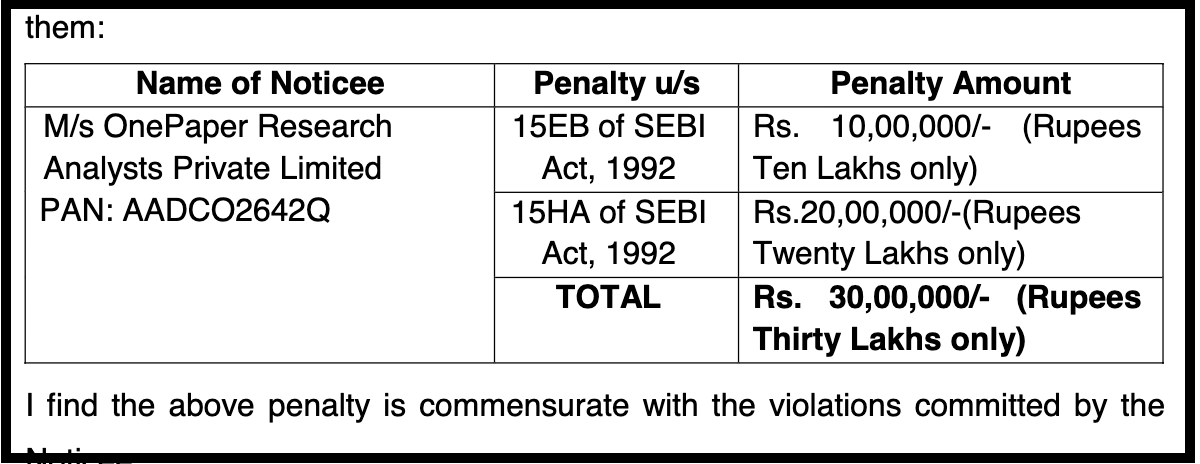
OnePaper was directed to pay the full amount within 45 days of receiving the order, through SEBI’s online payment portal.
The order states that failure to pay within that window may lead to recovery proceedings under Section 28A of the SEBI Act, including attachment and sale of the firm’s movable and immovable property.
What Does This Order Mean If You Have a Complaint of Your Own?
If your own experience with this firm involved anything resembling the conduct this order documents, being told to hold a losing position, promised recovery of a loss, or pressed for additional funds, you are not raising an isolated dispute.
A regulator has already examined this firm’s conduct in detail and found it established.
Citing this order by its number, Order/AK/DS/2026-27/32446, in your own complaint gives it added weight, since it demonstrates the pattern is not unique to your case.
The full route for raising a complaint, along with the firm’s own complaint disclosure and independent reviews, is set out on our OnePaper Research Analysts Reviews page.
Need Help Organising Your Evidence and Using This Order as Proof?
Register with us, and we’ll help you line up your chat records, call logs, and payment receipts against this order to build a stronger complaint.
Disclaimer
This page is a direct summary of public Adjudication Order No. Order/AK/DS/2026-27/32446, dated 16 June 2026. Every fact, name and figure above is drawn from that order.
The order itself is the authoritative source. Verify any detail against the original order text before citing it elsewhere, and treat this page as a summary, not legal advice.
Conclusion
The SEBI order against OnePaper Research Analysts is a rare thing on this site: a fully documented, formally adjudicated finding rather than a pattern inferred from reviews or complaint disclosures.
It took eighteen months from Show Cause Notice to final order, survived a settlement attempt and a procedural appeal, and concluded with SEBI rejecting every defence OnePaper raised.
What it found was a firm running a hundred-person sales operation behind two certified analysts, unable or unwilling to show how it monitored that staff, and caught on tape assuring a client of guaranteed returns the moment it was tested.
The ₹30 lakh penalty is now a matter of public record, and it is a stronger foundation for any complaint against this firm than a review or a disputed trade would be on its own.
Report. Recover. Stay Fraud Free.
Frequently Asked Questions
Adjudication Order No. Order/AK/DS/2026-27/32446, issued by Adjudicating Officer Amit Kapoor on 16 June 2026, following an inspection conducted on 14 March 2024.
The process included a Show Cause Notice, two written replies from OnePaper, a rejected settlement application, a procedural appeal to the Securities Appellate Tribunal over document access, and a personal hearing, each adding time before the order was finalised.
The inspection team's own test call, where an employee was asked to contact a lead in the inspectors' presence and was recorded assuring the client of guaranteed returns, sits alongside six separate named WhatsApp exchanges as the core evidence.
Yes. The order states the firm had been penalised earlier for a separate violation of RA Regulations, though it does not provide further detail on that prior case.
The order imposes a monetary penalty; it does not cancel the firm's registration. Registration status and the disciplinary record are separate facts, both of which can be checked independently.




 Add us as a preferred source on Google »

