
Quick Summary
A recovery scam is a second fraud that specifically targets people who already lost money once.
The defining tactic is always the same: an upfront fee demanded before any funds are released.
Genuine recovery assistance, whether through SEBI, exchanges, or legal channels, never requires payment upfront to begin.
This checklist covers exactly what to verify before trusting anyone offering to recover your lost funds.
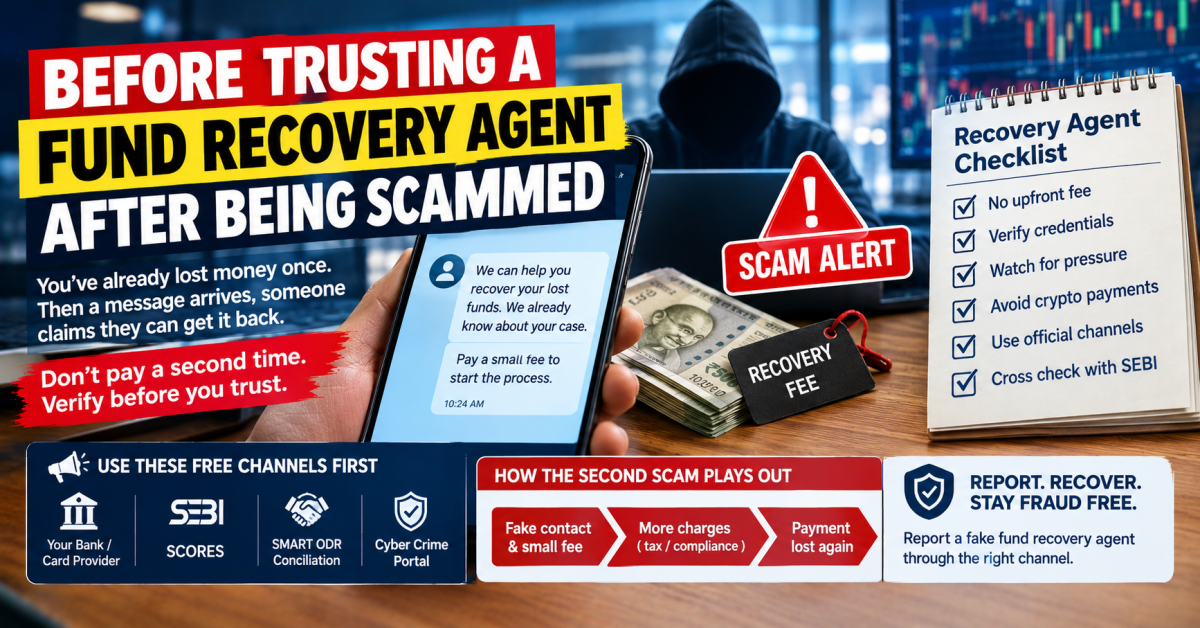
You’ve already lost money once. Then a message arrives, someone claims they can get it back.
They know details about your original scam that feel oddly specific and convincing.
That’s not luck. Your details were likely sold or shared after your first loss.
Before you pay a second time, run this checklist.
Common Beliefs About Fund Recovery, Checked Against Reality
Myth: Paying a small upfront fee is a reasonable cost for professional recovery help.
Fact: Genuine channels, SEBI SCORES, SMART ODR, and exchange arbitration, are free. A fee to “start” is the defining sign of a second scam.
Myth: Someone who already knows details about my original loss must be legitimate.
Fact: That knowledge often comes from data sold or shared after the first scam, not from any genuine recovery process.
Myth: If a recovery agent shows documents or credentials, they must be real.
Fact: Documents can be fabricated just as easily as the original scam’s promises were. Verify independently, never take them at face value.
The Recovery Agent Checklist
Go through each point below before engaging with anyone offering to recover your funds.
- Upfront fee demand: Any request for a processing fee, tax, or deposit before recovery begins is the clearest warning sign.
- Unsolicited contact: Be suspicious of anyone reaching out to you first, claiming knowledge of your specific loss.
- Guaranteed recovery claims: Legitimate recovery professionals never promise a guaranteed outcome or money back guarantee.
- Identity verification: Ask for verifiable credentials and check them independently, not just what they tell you.
- Request for crypto or personal accounts: Payment demands routed to personal accounts or cryptocurrency are a major red flag.
- Pressure and urgency: Tactics pushing you to act immediately are designed to bypass your judgment.
- Cross check with official channels: Compare their process against SEBI SCORES, SMART ODR, or exchange arbitration, which are all free.
The Free Channels You Should Try First
1. Contact your bank or card provider: if the original loss involved a direct transfer or card transaction.
2. File on SEBI SCORES: if a SEBI registered entity was involved in your original loss.
3. Use SMART ODR conciliation: for disputes specifically involving registered brokers or intermediaries.
4. File a cyber crime complaint: through the National Cyber Crime Reporting Portal for unregistered entity fraud.
How the Second Scam Typically Plays Out
A fraudster contacts a previous scam victim, sometimes even the same operator behind the original scam.
They request a small fee relative to the original loss, making it feel like a low risk step.
Further charges follow, framed as taxes, compliance checks, or wallet activation, until the person disengages.
Bottom Line
Real recovery support never charges you to simply begin, walk away from anyone who asks.
For genuine, fee transparent guidance on recovery, you can explore Aseem Juneja‘s Fraud Free resources for every scam type.
If you’re dealing with a fake recovery agent right now, you can report a fake fund recovery agent through the correct channel.
Report. Recover. Stay Fraud Free.
Frequently Asked Questions
No. Genuine recovery assistance through your bank, SEBI SCORES, SMART ODR, or exchange arbitration doesn't require an upfront fee to begin. Any such demand is the clearest sign of a recovery scam.
Details from a previous scam are often sold or shared among fraud networks. A new scammer, or sometimes the same one, exploits the victim's desperation to recover what was already lost.
No legitimate recovery professional can guarantee an outcome. Recovery depends on factors like where funds went, how quickly action was taken, and whether the original entity is traceable.
SEBI SCORES, SMART ODR conciliation, and NSE or BSE arbitration are all free channels for grievances involving registered entities. A cyber crime complaint is also free for unregistered entity fraud.
Do not pay any upfront fee. Verify their credentials independently and compare their process against SEBI SCORES or SMART ODR before engaging or sharing any further personal or financial details.
Yes. Documents and credentials shown to you can be just as fabricated as the original scam's promises. Always verify independently rather than accepting anything shown to you at face value.





 Add us as a preferred source on Google »