

You trust your broker to execute trades correctly, explain charges clearly, and operate your account within the instructions you provide.
But many investors only begin questioning how their account was actually being handled after unexpected losses, unexplained charges, or confusing trading activity start appearing.
Searches relating to “Axis Securities account handling” are growing because investors increasingly want to understand dealer-assisted trading, unexpected transactions, settlement confusion, and whether every trade in their account was actually understood properly.
This blog explains the warning signs investors commonly discuss, how account handling disputes usually develop, and what steps investors can take if something inside their trading account no longer feels fully clear.
Did Axis Securities Trade Without Your Consent?
We often assume that large institutional brokers operate with absolute, flawless precision.
However, behind the polished app interfaces and massive corporate branding, it is easy for small, quiet discrepancies to slip through unnoticed.
A growing number of everyday traders have started realizing that compliance isn’t always as airtight as it looks on paper, leaving them to wonder if their own accounts are truly being managed according to their wishes.
Now things become concerning and raise red flags regarding account handling when you notice:
- High-frequency trading activity.
- Intraday square-off confusion.
- Unexpected brokerage deductions.
- Delivery versus intraday classification.
- Dealer-assisted transactions.
- Communication gaps.
- Difficulty understanding statements and charges.
And all this accompanied by when they were no longer fully sure:
- Why certain trades happened,
- How positions were classified,
- Or why charges increased unexpectedly.
And in stock market disputes, confusion itself can become financially dangerous very quickly.
The Investor Confusion That Often Starts These Disputes
One publicly visible review on the Axis Direct Trader platform discussed confusion regarding same-day buy-and-sell transactions.
According to the reviewer, shares that were sold and repurchased on the same day were allegedly processed separately instead of being treated in the manner the investor expected.
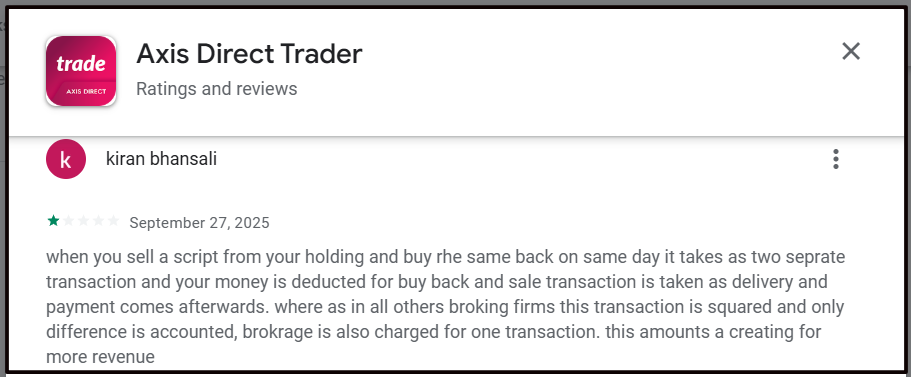
The user further claimed this resulted in additional brokerage or settlement-related deductions.
Now, this reflects the investor’s personal interpretation of events and does not independently establish regulatory misconduct by the broker.
But the complaint highlights something extremely important:
Many retail investors do not fully understand:
- Settlement systems,
- Intraday classifications,
- Brokerage calculations,
- Margin implications,
- How certain trades are processed internally.
And this is where disputes often begin.
At first, it may look like a small accounting issue.
Later, investors realise the financial impact may have become much larger than they initially understood.
Can a Broker Legally Handle Your Account?
This is where many investors become confused.
A broker can execute trades on your behalf only under authorised arrangements and regulatory procedures.
For example, if you voluntarily opt for dealer-assisted trading and provide instructions, certain trades may be executed through authorised channels.
However, brokers are generally expected to maintain proper records, communication trails, and compliance procedures while dealing with client instructions.
You should remember something very important: Giving someone informal access to your account can become risky.
The core point: brokers operate under detailed rules, and not every unexpected charge or settlement behaviour is necessarily a violation.
But investors are entitled to a clear explanation, and if that explanation isn’t forthcoming, there are formal channels to pursue it.
So, when does a complaint become serious enough for regulatory action?
Let us understand that next.
How To Report A Complaint Against Broker?
India’s investor grievance system is layered.
You start at the broker level and escalate as needed.
Acting early and keeping records at every stage will give you the strongest position.
Step 1: Collect All Evidence
Keep contract notes, account statements, trade confirmations, brokerage statements, emails, and any screenshots of the app or platform.
The more specific and documented your records, the stronger your position at every stage of this process.
Step 2: Raise it with Axis Securities Directly
Send a written complaint to the broker’s grievance cell or compliance officer, email is preferable so you have a dated, documented record.
Describe the specific transaction, the date it occurred, what you expected to happen, and what actually happened.
Ask for a written explanation of how the transaction was classified and what charges were applied.
Step 3: File a Complaint in SCORES
SEBI’s Complaint Redress System is available.
This is the official portal for grievances against SEBI-registered market intermediaries.
Your complaint will be logged, tracked, and the broker will be required to respond. SEBI monitors resolution timelines.
Step 4: Consider SMART ODR
SEBI has introduced an Online Dispute Resolution platform for securities market disputes.
This is a structured, time-bound alternative to the traditional GRC route and may be faster depending on the nature of your grievance.
Step 5: Stock Exchange Arbitration
This is a binding process where an Arbitral Tribunal hears both sides and issues an award.
Arbitration has resulted in significant awards for investors in past cases involving broking disputes.
Need Help?
Many investors only realise the seriousness of account-handling issues after reviewing their ledger entries, brokerage deductions, or dealer communication carefully.
If certain transactions, charges, or exposure levels no longer make sense, early review can help preserve important evidence.
But waiting too long can sometimes weaken your position.
Our team helps investors:
- review account activity,
- organise evidence,
- understand brokerage records,
- prepare complaint documentation,
- and navigate escalation mechanisms like SCORES, SMART ODR, and arbitration support where applicable.
We do not promise guaranteed recovery or guaranteed outcomes.
Every matter depends on records, communication history, account activity, and regulatory findings.
But timely review, proper documentation, and early escalation can often make a significant difference.
If you are struggling to understand unusual transactions, brokerage deductions, dealer-assisted activity, or unexpected exposure in your account, you may register with us to understand the possible next steps.
Conclusion
Axis Securities is a recognised brokerage platform operating within India’s regulated securities ecosystem.
At the same time, some users publicly report concerns relating to account handling, transaction processing, dealer activity, brokerage deductions, and communication gaps.
These complaints should not automatically be treated as proof of misconduct.
However, they do highlight why investors must remain actively involved in monitoring their own trading accounts.
Blind trust is never a substitute for verification.
Stay informed, keep your records, and don’t hesitate to ask questions about your own account.
That is the most practical form of investor protection.
Frequently Asked Questions
1. My broker keeps giving explanations verbally but avoids written clarification. Is that a warning sign?
It can become risky. In many disputes, investors later realise there was very little written evidence supporting what was discussed over calls. That is why written communication and email trails are extremely important.
2. My broker or dealer asked for my OTP to “execute trades faster.” Is that allowed?
No. Investors should never share OTPs, TPINs, passwords, or authentication credentials with anyone. Using client credentials to place trades without proper authorisation can become a serious compliance and account access issue.
3. My account suddenly showed a large F&O exposure that I never intended to take. Can I still complain?
Yes. If you believe the exposure, transactions, or risk level did not align with your instructions or understanding, you can raise a written complaint and seek clarification regarding how the positions were created.




 Add us as a preferred source on Google »

