
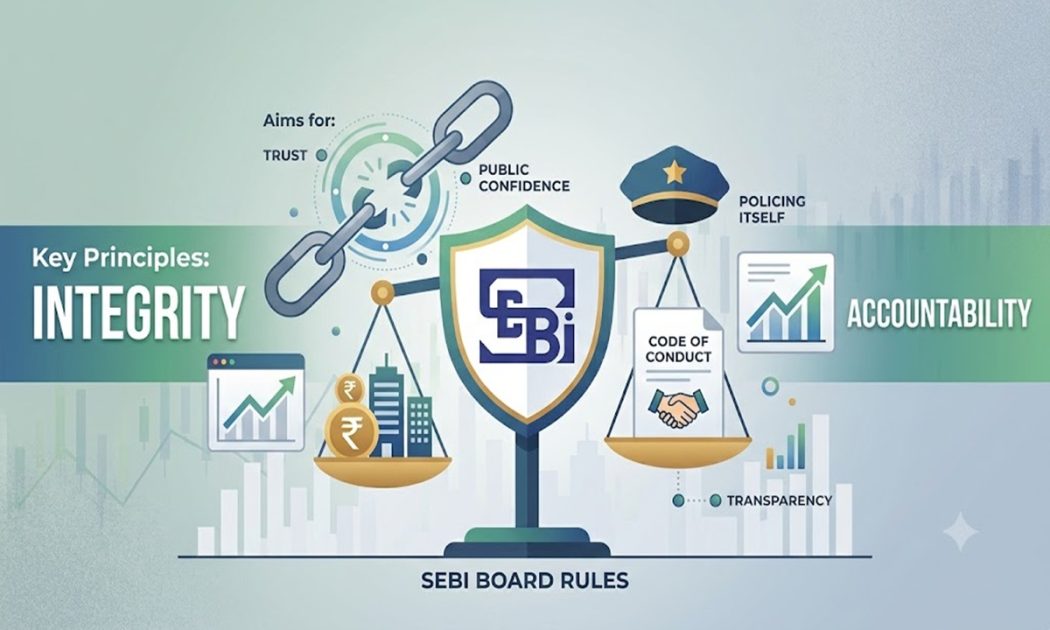
SEBI is the body that polices India’s stock market. It bans fake advisors, fines brokers, and freezes the accounts of people who cheat investors.
But who polices SEBI?
On June 19, 2026, SEBI answered that question about itself. It wrote a rulebook for its own bosses. And some of the rules are stricter than you would expect.
Here is the simplest one to start with. The people who run India’s stock market regulator are not allowed to own a single share.
At Aseem Juneja, through our Fraud Free initiative, we read these documents so you do not have to. Here is what this one says, in plain words.
What the SEBI Code of Conduct for Board Members is
A code of conduct is just a rulebook for how people should behave. This one is for the people at the very top of SEBI.
Two things about it are worth knowing straight away.
First, nobody forced SEBI to write it. No court ordered it, no law demanded it. SEBI’s own board sat down on June 19, 2026, and adopted it for themselves.
Second, SEBI says openly why it did this. The document states the purpose is to build public trust that its members do their job fairly and transparently. In other words, SEBI is aware that people wonder whether the referee is clean, and this is its answer.
Who These Rules Apply To
SEBI’s board has two kinds of people on it, and the rules treat them very differently.
- Whole-Time Members are the full-timers. They come to SEBI every day, they run the place, and they are the ones who sign the orders that ban fraudsters. The Chairperson is one of them. The document calls them WTMs, and the rules on them are tight.
- Part-Time Members are the occasional ones, usually government officials who attend board meetings but work elsewhere. Called PTMs. The rules on them are much lighter, mostly because their own government department already keeps tabs on them.
Why Family is Included Too
Here is something the rulebook understood well. If you ban a man from owning shares but let his wife own whatever she likes, you have banned nothing.
So most of these rules stretch to cover family. For a full-timer, family means the husband or wife, the children who depend on them, anyone they are a legal guardian for, and any relative who genuinely lives off their money.
For a part-timer, family is just the spouse and children under 18.
What SEBI Board Members Are Not Allowed to Own
This is the part that surprises most people.
A Whole Time Member of SEBI cannot own shares. Cannot own anything that turns into shares later. Cannot trade in futures and options, which is the risky end of the market.
Their family cannot either.
Think about what that means in practice. A person who has spent a career in finance takes the top job at SEBI, and on the way in, their share portfolio has to go.
The reason is obvious once you see it. If a WTM owns shares in a company and then has to decide whether to punish that company, one hand is deciding while the other hand is holding the money. The rule removes the second hand entirely.
There are two things they are still allowed to own. Mutual funds are fine, because a fund manager picks the shares, not them. So are units of InvITs and REITs, which are similar arrangements for infrastructure and property.
What Happens to Shares They Already Own
Nobody arrives at SEBI with an empty bank account. So the rulebook gives four choices for the shares a new member already holds.
Sell them all before starting. Freeze them completely and do not touch them for the whole term. Declare a plan in advance saying exactly when they will be sold. Or sell them along the way, but only with permission from above.
If they own a stake in their own private business, only two of those choices apply. Sell it or freeze it. No selling during the term.
And if they keep the shares frozen, they lose their voting rights on them. A frozen shareholder gets no say in the company at all.
The One Fund House Rule
There is a smaller rule here that is clever, and easy to miss.
Even mutual funds have a limit. A WTM cannot put more than 25 percent of all their investments into products from any one fund house that SEBI regulates.
Why? Because if a quarter of your savings sits with one company, and you are the person deciding whether that company gets punished, you are not really neutral anymore. Spreading it out keeps them honest.
Where the Family Gets Some Breathing Room
The rulebook is strict, but not unreasonable about family who have their own careers.
If a spouse is given company shares as part of their salary package, that is allowed. They earned it at their own job.
If family members hand their money to a professional manager who makes all the decisions independently, that is allowed too. Same logic as mutual funds. They are not choosing.
And family can run their own private business and own unlisted shares in it, because that is their livelihood, not a bet on the market.
What SEBI board members have to declare
The second big idea in the rulebook is simple. If you cannot see it, you cannot check it.
- Everything they have to write down
A Whole Time Member has to declare their family members, their relatives, every job or advisory role they held in the last three years, every property they own, every investment, every loan they owe, and any property they have rented out.
That is a fairly complete picture of a person’s financial life.
- When they have to declare it
Three times, always. When they join. Every year by April 30. And when they leave.
But it does not stop there. If anything changes, they have a month to report it. New family member, sold a house, bought a house, took a new tenant. All of it.
There is even a rule for individual transactions. If they buy or sell anything financial worth more than two months of their basic salary, that gets reported within a month too.
- What the public actually gets to see
Not everything they declare becomes public. But their property holdings do. SEBI publishes what property its members own.
One sensible exception. The full address is not published, for their safety and privacy. You see that a member owns a flat in a city. You do not see which flat.
- The lighter rules for part timers
Part-timers who come from a government department do not have to file all this twice. If they already declare their property and investments to their own department, they just confirm that to SEBI and move on.
The other part-timers declare their family, their shares when they join, their trades each year, and their past jobs.
When a SEBI board member must step away from a case
This part decides how fair SEBI’s actual decisions are, so it deserves attention.
- When they have a conflict
The rulebook says a member must step away from any case where they have what it calls a conflicted relationship.
In plain terms, they must step away if a relative works in a senior job at the company being investigated. If they themselves worked for or advised that company in the last three years. If a close friend is involved. If they have serious money invested in it.
There is a phrase used twice in this section that is worth pausing on: perceived bias. The test is not just whether the member would actually be unfair. It is whether it would look unfair. That is a higher bar, and a fair one, because trust is about appearances as much as reality.
- How much money counts as too much
The rulebook puts real numbers on it, which is refreshing.
A member has too much at stake if they and their family together have put more than ₹20 lakh into the company being examined. Or if that investment makes up more than 5 percent of everything they own.
Cross either line, and they are out of the case.
- What stepping away really means
Here is where the rulebook has genuine teeth.
In most places, “recusing yourself” means you do not vote. Here it means three things at once. You are not in the room when the case is discussed. You do not get to see the file. And you do not vote.
Read that middle one again. They are not even allowed to read it.
That is a serious standard. You cannot quietly influence a decision you know nothing about.
- The sensible exception
The rulebook is careful not to make this silly. If SEBI is writing a general rule for an entire industry, a member does not have to step away just because they once worked in that industry. Stepping away applies to cases about a specific company or person, not to broad policy.
- How it gets counted
Every time someone steps away, it gets recorded. A digital system logs it. And the number of times each member stepped away gets printed in SEBI’s Annual Report, for the Chairperson and everyone below.
So you cannot quietly never recuse yourself. The count is public.
How the Public Can Raise a Concern About a SEBI Board Member
This is new, and it is worth knowing about.
If you have a genuine reason to believe a SEBI member has a conflict in a case, you can write to something called the Office of Ethics and Compliance, inside SEBI.
Here is how it works. You send your concern with evidence. That office looks at it and asks the member to respond. If they decide there is no conflict, they tell you and close it. If they think there might be something in it, they send the whole thing upstairs, to the Chairperson, or to the rest of the board if the Chairperson is the one in question.
Two honest points about this route. You need actual evidence, not a hunch. And you will not see the individual outcome published, though the overall recusal numbers do appear in the annual report.
Two more Rules Worth Knowing
They are treated as insiders automatically. In market law, an insider is someone who knows things the public does not, and there are strict rules against them trading on it. The rulebook simply declares that Whole Time Members are insiders. No argument needed. It applies from day one.
They cannot switch sides for two years. After leaving SEBI, a member cannot turn around and represent someone against SEBI, or before SEBI, for two years. And while still in the job, if they start talking to a future employer, they have to disclose it within a month.
This closes a familiar door. The regulator who goes soft on a company today and joins them next year.
What This Means for You as an Investor
Let us be straight with you. This rulebook will not help you spot a fake advisor. It will not get your money back. It gives you nothing to do.
So why read about it at all?
Because every SEBI order you have ever seen, every ban on a fraudulent advisory, every penalty on a cheating broker, is only worth something if the person who signed it was neutral. That is the whole value of a regulator. Not its power, its neutrality.
This document is SEBI writing down, in public, what neutrality is supposed to mean. No shares. No derivatives. Declare your property. Declare your relatives. Leave the room if you have a stake, and do not even read the file.
You now know what standard applies. That is the point.
And if you ever have real evidence that someone at the top has a conflict in a case that matters to you, there is a named place to send it.
Conclusion
SEBI wrote a rulebook for itself, when nobody made it.
The rules say its top people cannot own shares while they police the share market. They must declare their property, their relatives and their past jobs. They must walk out of any case where they have a stake, without even reading the file. Their recusals get counted in public. And they cannot walk out of SEBI and straight into a job fighting SEBI.
None of this protects your money directly. What protects your money is the same as it has always been. Check that an advisor is registered before you pay them. Walk away from anyone promising guaranteed returns. Keep every receipt and every message.
But it is worth knowing the referee has written down its own rules, and made them public. That is not nothing.
Report. Recover. Stay Fraud Free.




 Add us as a preferred source on Google »

