
In January 2021, an investor named Pankaj Kumar filed a complaint with SEBI. He had been promised ₹1,000 a day. He had handed over his money to a stock advisory. It was gone.
On July 15, 2026, SEBI passed an order directing that his money be returned to him.
The amount was ₹410.
What the SEBI Investocare Order Actually Says
The order is dated July 15, 2026, signed by Santosh Shukla as Quasi-Judicial Authority, and it deals with a matter titled Investocare Financial Research and Others.
It has an unusual history. SEBI first passed an order in this matter on May 25, 2023. That order went against three parties.
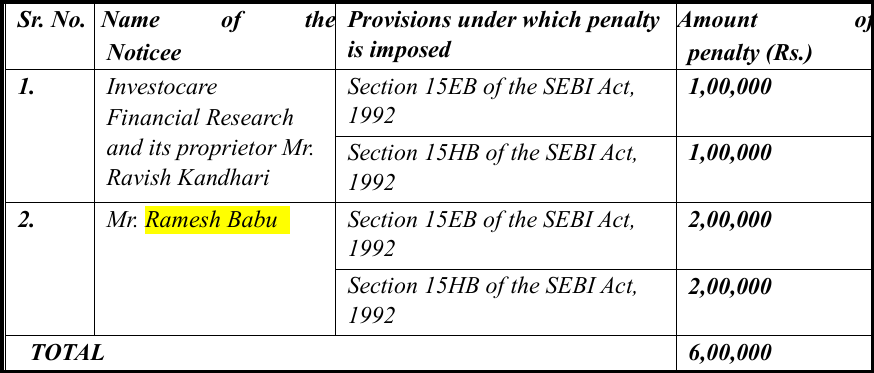
Investocare Financial Research and its proprietor, Ravish Kandhari, were debarred from the securities market for a year and penalised with a penalty of ₹2 lakh between them.
A third person, Mr. Ramesh Babu, whose bank account the investor’s money had landed in, was hit far harder. He was ordered to refund investors, barred from selling his own assets, banned from the market for two years, and penalised ₹4 lakh.
Ramesh Babu had never been heard. The 2023 order against him was passed ex-parte, meaning without his side of the story. He says the notice never reached him.
He appealed. In May 2026, the Securities Appellate Tribunal set the 2023 order aside and sent the matter back to SEBI to be decided afresh. This time he appeared, made oral submissions in June 2026 and filed written submissions.
The July 2026 order is the result of that fresh hearing. SEBI examined the case against him again and found the allegations were not established. He was given the benefit of doubt and held not liable for any action under the SEBI Act.
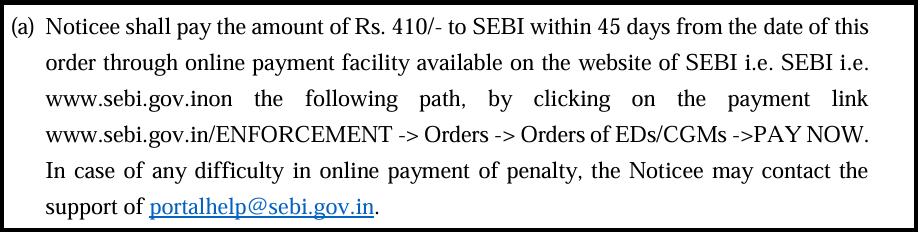
The only direction that survives against him is this. He must pay ₹410 to SEBI within 45 days. SEBI will then return that ₹410 to the complainant.
That is the entire refund in this matter.
The Pitch: ₹1,000 a Day and 80 to 90 Percent Accuracy
Before getting to why the number is so small, look at how the money was taken in the first place, because this part matters more to you than anything else in the order.
According to the complaint, an agent of Investocare contacted Pankaj Kumar and told him he could earn ₹1,000 a day on an investment of ₹5,000 to ₹10,000. The firm would take a commission of 50 percent of the gains. It claimed to have experts on its team. It claimed a 20 percent stop loss to protect him.
After a few trades, Investocare had used up all his money and he was sitting on a loss.
The firm’s website tells you everything about the operation. It ran at investocares.com from December 2013 to December 2021, which is eight years.
It advertised investment advisory services with assured accuracy of 80 to 90 percent in stocks, commodities and forex. It sold service packages ranging from ₹6,800 at the lowest to ₹1,51,200 at the highest, in monthly, quarterly, half-yearly and yearly plans.
Stop on that phrase. Assured accuracy of 80 to 90 percent.
Nobody has that. Not a fund manager, not a bank, not a registered research analyst, nobody.
A genuine SEBI registered advisor is not permitted to promise returns at all, let alone guarantee an accuracy rate. The moment you see a number like that, whether it is 80 percent accuracy or ₹1,000 a day, you are not looking at an advisory. You are looking at the pitch.
And it worked for eight years.
The Bank Account that Never Received a Rupee
Here is the detail in this order that should genuinely change how you think about paying anyone for advice.
Investocare’s website listed a bank account. That account was in the name of Investocare. The authorised signatory on it was the proprietor, Ravish Kandhari. Everything about it was correct and above board on paper.
That account had no credit entries at all. Not one rupee ever went into it.
So where did the money go?
An employee of Investocare named Yatender Singh gave the complainant the details of a completely different bank account and asked him to transfer money there.
That account belonged to Ramesh Babu.
The person who had nothing to do with Investocare. He ran a small digital marketing firm doing bulk SMS, bulk WhatsApp, website and logo work. Yatender was a client of his, paying him for SMS delivery.
There is more. This vendor also told SEBI that Yatender had persuaded him to open a trading account and hand over his own login credentials, on the understanding that Yatender would trade and share the profits.
There were no profits, only losses. When the vendor demanded his money back and threatened to go to the police, Yatender began routing payments into his account, and three of those payments happened to come from the complainant.
This is the mechanism worth understanding.
The company had a clean, official bank account that never touched a rupee of investor money. The actual collection ran through an unrelated third party’s account, arranged by an employee, off the books entirely.
When the whole thing collapsed, there was no money trail leading back to Investocare. There was a trail leading to a digital marketing vendor who did not know what was going on.
That is not an accident. That is the design.
The ₹410 Refund and How it Works
Now the number.
The complainant’s actual documented payments into that account were three transfers, made over six days in December 2020. ₹150 on December 3. ₹160 on December 5. ₹100 on December 8. All by UPI, through the GPay app.
Total: ₹410.
SEBI’s original concern was much bigger. The account showed 890 credit entries totalling around ₹60.94 lakh between November 2015 and July 2021. On its face, that looked like a large unregistered advisory operation.
When SEBI finally went through the statement line by line with the account holder’s submissions, the picture fell apart.
- ₹25.24 lakh across 322 entries was money he had transferred in from his own other bank account.
- ₹19.28 lakh across 207 entries was from buying and selling gift cards online, backed by a Paxful statement.
- ₹8.02 lakh was salary and freelance payments, with narrations naming his employers.
- ₹2.35 lakh was a loan he had taken against his own credit card.
- ₹1.81 lakh across 171 entries was refunds and cashback, most of them ranging from one rupee to a few hundred.
- ₹3,094 was bank interest.
- Another ₹3.41 lakh he described as borrowings from friends.
He backed it with documents. His firm’s registration certificate from the Delhi Department of Labour, GST records, and his registration with a bulk SMS provider.
SEBI concluded that these credits were not payments for investment advisory services, and that the allegations against him were not established.
This leaves only the ₹410.
SEBI held that this money came from the complainant, was consideration for advisory activity carried out by Yatender, Investocare or Ravish Kandhari without registration, and therefore cannot be allowed to sit in the account holder’s account. It has to go back, in the interest of justice.
The route it takes is worth noting. He pays ₹410 to SEBI within 45 days through SEBI’s online payment facility. He then forwards the payment details to SEBI’s Western Regional Office in Ahmedabad within 15 days. SEBI then takes steps to refund the ₹410 to the complainant.
Three steps, two deadlines, one regional office, for four hundred and ten rupees.
And one line in the order deserves to be read carefully.
SEBI notes that it has not examined Yatender’s role at all, despite the complainant stating that Yatender was the one providing investment advice and it was Yatender who shared the bank account details. There has been no examination of the connection between Yatender and the account holder, or between the account holder and the complainant either.
Five and a half years after the complaint, the person the complainant actually dealt with has still not been looked at.
What the Investocare Case Means for Retail Investors
There are four things here that are worth carrying with you.
The first is the promise. ₹1,000 a day. 80 to 90 percent accuracy. A 20 percent stop loss to make it sound technical and safe. This is the entire scam, in one sentence, and it ran successfully for eight years. If anyone offers you a guaranteed return or an accuracy rate, the conversation should end there. There is nothing else to check.
The second is where the money goes. Check the name on the account you are paying into. If a firm’s representative asks you to transfer to an account that is not in the firm’s name, that is not a paperwork quirk. That is the whole trick. It is how the firm keeps investor money off its own books, and it is why so little comes back later.
The third is documentation, and this one cuts both ways. The complainant paid ₹410 through UPI and that is traceable, which is why exactly ₹410 is coming back. The account holder was cleared because he could document every category of credit in his account with certificates, GST records and statements. If you can prove it, it counts. If you cannot, it does not exist.
The fourth is about the system itself. Do not read this order as a reason to stay quiet. The complaint is what triggered the whole examination, and it is why Investocare and its proprietor were penalised at all. But be clear about what filing achieves. The system can only return what it can trace. It traced ₹410.
Conclusion
An advisory promised a man ₹1,000 a day and ran a website claiming 80 to 90 percent accuracy for eight years. He paid. He lost. He complained. Five and a half years later, ₹410 is coming back to him through a three step process, and the employee he actually dealt with has still not been examined.
Read that as a warning about the front end, not the back end. Everything that could be recovered here was recovered. The problem is that almost nothing was traceable, because the operation was built that way from the start, with a clean company account that never saw a rupee and a stranger’s account collecting the money.
You cannot fix that after the fact. You fix it before you pay, by checking registration, by refusing anyone who guarantees a return, and by never sending money to an account that does not carry the firm’s own name.
If you have already been caught by something like this, file on SEBI’s SCORES portal with every email, receipt and message you have. The paper trail is the only thing that comes back. If the process feels overwhelming, this is where we help.
Report. Recover. Stay Fraud Free.
Frequently Asked Questions
It concerns Investocare Financial Research, which offered stock advisory services without SEBI registration. The July 15, 2026 order deals specifically with a third party whose bank account the investor's money was routed into, and finds the allegations against him not established.
Because that is the total the complainant is documented to have transferred into that particular account. Three UPI payments of ₹150, ₹160 and ₹100 in December 2020.
The 2023 order was set aside by SAT and the matter was decided fresh. The penalty and the two year ban do not survive that.
The complaint was filed on January 14, 2021. The refund direction came on July 15, 2026. Around five and a half years.
₹1,000 a day on an investment of ₹5,000 to ₹10,000, with a 50 percent commission on gains. Its website claimed assured accuracy of 80 to 90 percent in stocks, commodities and forex.
The account listed on the website, in Investocare's name, had no credits at all. An employee directed the investor to a different account belonging to an unrelated third party. This keeps investor money off the firm's books.
They were separately debarred and penalised in the 2023 order. The July 2026 order deals only with the third party's case.


 Add us as a preferred source on Google »

