
Quick Summary
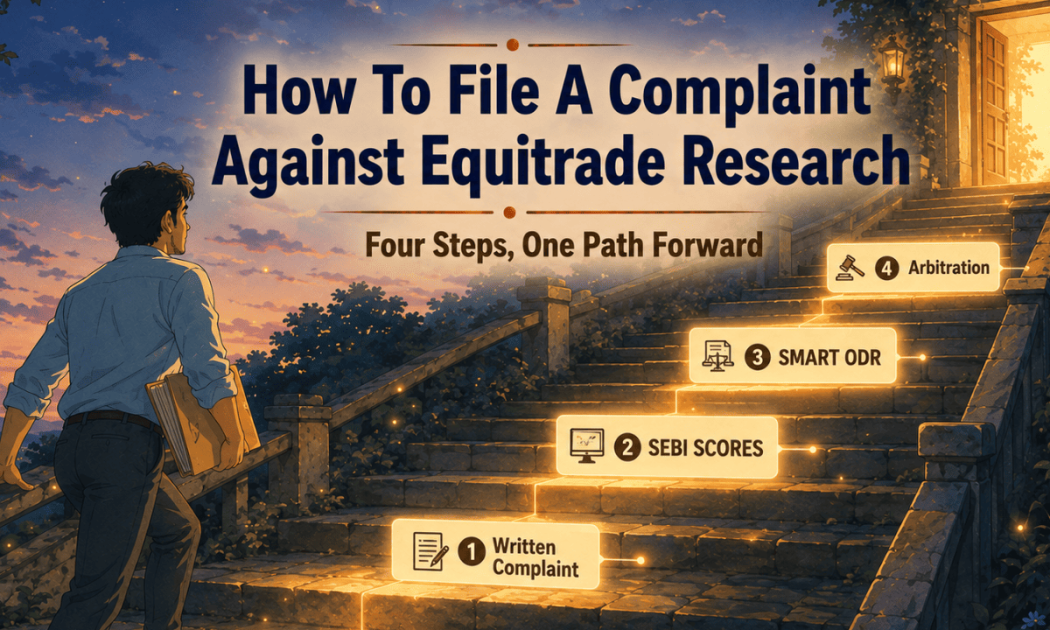
The formal complaint path against Equitrade Research runs through four stages. Written complaint to the firm first, then SEBI SCORES under registration number INH000017170 selecting Research Analyst as the intermediary type, then SMART ODR conciliation, then arbitration if needed. Valid complaint grounds include fees above Rs. 1,51,000 in a financial year, outcome-implying promises before subscription, no written service agreement before payment, and recommendations without documented research methodology. The entire process is free. For claims below Rs. 10 lakh, arbitration costs you nothing.
Seven investors filed formal SEBI complaints against Equitrade Research in FY 2025-26.
All seven were resolved. But reaching the point of filing a formal SEBI complaint means seven investors first tried to resolve their concerns directly and did not get a satisfactory outcome internally.
If you are at that same point, or approaching it, this page covers the exact process from your first written complaint to Equitrade Research all the way through SEBI SCORES, SMART ODR, and exchange arbitration if it comes to that.
Equitrade Research holds SEBI Research Analyst registration INH000017170 under proprietor Anjali Gupta. That registration means the firm is subject to SEBI’s formal complaint mechanism and you have a clear regulatory path available.
What Qualifies as a Valid Complaint Against Equitrade Research
Not every disappointing experience gives you complaint grounds. But several specific situations do.
If you reviewed the Equitrade Research page on this site before reaching this point, you already have context for each of these grounds, including the six red flags sourced from the firm’s own website.
- Fee cap violation. SEBI caps the total fees a single client can pay to one registered Research Analyst at Rs. 1,51,000 per financial year. Two quarterly Premium plan renewals at Rs. 85,000 each cost Rs. 1,70,000, which exceeds the annual cap.
If your combined annual payments to Equitrade Research exceeded Rs. 1,51,000, the excess is recoverable. Calculate your total from payment receipts and bank records. - Outcome-implying promise before subscription. If any representative of Equitrade Research implied, stated, or created the expectation of a specific return, profit outcome, or loss recovery through their service, that is a direct violation of SEBI’s Schedule III under the Research Analyst Regulations. Document the exact words, the medium they were delivered in, and the date.
- No written service agreement before payment. SEBI’s Research Analyst Regulations require a signed service agreement before any fees are collected.
If you paid without first receiving and signing a written agreement that specified the service scope, fee structure, and refund terms, that is a procedural violation you can cite in your SEBI SCORES complaint. - Recommendations without documented research methodology. SEBI’s Code of Conduct requires recommendations to be backed by documented analysis.
If you received BUY or SELL calls without any explanation of the research basis and the calls consistently produced losses, the absence of documented methodology is a complaint ground alongside the financial loss. - Refund refused for unused subscription period. SEBI’s December 2024 amendment requires registered Research Analysts to refund the pro-rata unused portion of advance fees on early exit.
A blanket no-refund policy or a refusal to return fees for an unused subscription period does not override this regulation.
These are the situations that map to named SEBI regulatory violations rather than general market disappointment.
Step-By-Step Guide on Complaining Against Equitrade Research
Anjali Gupta’s firm has resolved all seven complaints filed against it this year, which tells you the outcome depends less on whether you have a case and more on how you build it.
The five steps below turn a scattered grievance into a documented SEBI violation.
Miss the sequence or skip the paper trail, and even a genuine fee cap breach becomes hard to prove months later.
Step 1: Collect Your Evidence Before Contacting Anyone
This step happens before any call or email. Everything you collect now is the foundation of your case at every subsequent stage.
Save every WhatsApp message, email, and communication from any Equitrade Research representative. Note the exact words used in any outcome promise with the date and medium. Screenshot any marketing material or website language you relied on before subscribing.
Save all payment receipts, bank transfer records, and UPI screenshots for every subscription payment. Add up the total paid in the current financial year and compare it against Rs. 1,51,000.
Save any service agreement you received or note specifically that no agreement was provided before payment. This absence is itself evidence.
Save your records of every recommendation received, the stock, the call type, and what actually happened. If calls were given without stop-loss levels or research rationale, note each one.
Write a one-page chronological summary of what happened with dates and amounts at each step.
Step 2: Write to Equitrade Research Formally
SEBI requires investors to attempt internal resolution before escalating. A written complaint creates the paper trail SEBI will ask about when you file on SCORES.
Contact Equitrade Research through their official complaint channel listed on their website. If an email address is available, use that. If the firm’s website does not clearly list a grievance email, write to the proprietor Anjali Gupta directly through whatever official contact channel is available.
State what you paid, on which dates, for which plans, and what was promised or implied before you subscribed. State what you actually received and the specific resolution you are seeking. Attach your payment receipts.
Give the firm 21 days to respond with a satisfactory written resolution. If no response arrives or the response does not address your concern, move to Step 3 immediately.
Step 3: File on SEBI SCORES
If 21 days pass without a satisfactory response, SEBI SCORES is your next step.
Select Research Analyst as the intermediary type. Enter INH000017170 as the registration number. This ensures the complaint is correctly routed to Equitrade Research under the correct regulatory framework.
In the complaint description, name the specific violation.
- For a fee cap breach, state your calculated total and that it exceeds Rs. 1,51,000 for the financial year.
- For outcome-implying promises, quote the exact language and the date.
- For no written agreement, state that fees were collected without a prior signed service agreement.
Attach your payment records, the internal complaint you sent in Step 2, and every piece of evidence you collected in Step 1.
Filing on SEBI SCORES is completely free. Equitrade Research has 21 days to respond formally after the complaint is forwarded.
The detailed step-by-step guide covering every SCORES field and what each status label means is available on the complaint against SEBI registered research analyst page on this site.
Step 4: Escalate to SMART ODR
If SCORES does not produce a satisfactory resolution, SMART ODR is the next stage.
Do not file on SMART ODR while your SCORES complaint is still active. Filing on SMART ODR automatically disposes the SCORES complaint. Confirm SCORES has genuinely concluded before moving here.
An independent conciliator is assigned. Both you and Equitrade Research must participate. Pre-conciliation runs first where both sides submit their positions online. Formal conciliation follows if pre-conciliation produces no agreement.
Most cases with clear SEBI violation grounds and strong documentation settle at this stage. The firm knows what arbitration costs them.
The full guide is available on the SMART ODR complaint portal page on this site.
Step 5: Exchange Arbitration
If SMART ODR conciliation fails, formal arbitration produces a binding award enforceable as a civil court decree under the Arbitration and Conciliation Act 1996.
For claims below Rs. 10 lakh, the exchange bears the arbitration cost. You pay nothing.
The strength of the arbitration outcome depends entirely on what was documented in Step 1. An arbitrator cannot award recovery for payments that have no paper trail. Every rupee paid needs a corresponding receipt.
Unsure whether your documentation is strong enough or which specific SEBI violation applies to your situation?
We review your case, identify every applicable violation under SEBI’s Research Analyst Regulations, draft the SEBI SCORES complaint, and represent you through SMART ODR and arbitration. Register with us for a free consultation.
Conclusion
Equitrade Research holds SEBI registration INH000017170. That registration gives you access to a formal complaint mechanism with real teeth.
Seven investors used that mechanism in FY 2025-26. Fee cap violations, outcome-implying promises, missing service agreements, and recommendations without documented methodology are all named SEBI violations with a clear complaint path behind them.
Collect your evidence. Write formally. Follow the sequence. Every stage completed correctly makes the next one stronger.
For the full picture of the firm, including the six red flags, the complaint data showing zero to seven in one year, and the pricing analysis that reveals how the cap is breached at just two renewals, the Equitrade Research review on this site covers everything before you decide.
Report, Recover, Stay FraudFree
Frequently Asked Questions
Equitrade Research holds SEBI Research Analyst registration INH000017170 under proprietor Anjali Gupta. Verify the current Active status at SEBI's website under the Research Analyst intermediary category before filing any complaint.
Yes. SEBI caps combined Research Analyst fees at Rs. 1,51,000 per client family per financial year. Two quarterly Premium plan renewals at Rs. 85,000 each total Rs. 1,70,000, which exceeds the cap. File on SEBI SCORES under INH000017170 citing the fee cap violation and include your calculated total with payment dates and receipts.
SEBI's Research Analyst Regulations require a signed service agreement before any fees are collected. If you paid without first receiving and reviewing a written agreement, that is a procedural violation. Document the absence of the agreement specifically in your SEBI SCORES complaint as a named regulatory non-compliance.
Yes. SEBI complaints have a three-year limitation period from the date the issue occurred. If your experience happened within the last three years, you are within the window. Do not wait as WhatsApp records and service communications are not preserved indefinitely by either party.





 Add us as a preferred source on Google »

