

Quick Summary
Supreme Investrade and Research Services holds SEBI Research Analyst registration INH000008747, granted September 9, 2021, under proprietor Abhishek Kumar Singh, operating from Navi Mumbai. SEBI has issued two separate adjudication orders against the firm, one in December 2024 imposing ₹5,00,000, and a second imposing ₹2,00,000, a combined ₹7,00,000 in penalties within roughly a year. Two separate BSE arbitration cases resulted in real payouts, ₹25,000 to Mr. Mukul Singh and a full ₹1,97,000 refund to Ms. Shikha Sharma. This page covers the full registration verification, both SEBI orders, real WhatsApp evidence, both arbitration cases, and how to report the firm yourself.
Rakesh received a call that sounded convincing. The representative claimed market expertise and showed examples of successful trades.
Before paying, he searched online: “Supreme Investrade real or fake?”
If you’re asking the same question, you’re really asking three separate things: whether it’s SEBI-registered, whether it’s safe, and whether it’s actively defrauding people.
This page brings all of it together: the registration record, both SEBI orders, real WhatsApp chat evidence, both arbitration outcomes, and what to do if your own experience matches any of it.
Supreme Investrade And Research Services
Supreme Investrade and Research Services is a sole proprietorship registered in Maharashtra, operated by Abhishek Kumar Singh, who also serves as the firm’s own compliance officer.
It positions itself as a research-driven platform for intraday traders, focused on Nifty, Bank Nifty, and equity options, delivering alerts through WhatsApp and a mobile app.
On the surface, the credentials check out. A valid SEBI licence, a registered office address, a compliance officer, and a website carrying the required disclaimers.
But regulatory filings, two BSE arbitration awards, and public commentary from a senior financial journalist tell a more complicated story, one involving profit guarantees, client manipulation, and repeated penalties.
Is Supreme Investrade SEBI Registered?
Yes. Supreme Investrade holds SEBI Research Analyst registration number INH000008747, granted on September 9, 2021, valid perpetually.
Here’s exactly what SEBI’s own database shows. The registration is listed under the name Abhishek Kumar Singh, Proprietor of Supreme Investrade and Research Services.

The registered email is [email protected], notably an IIM Calcutta address.
The registered address is Office No. 613, 6th Floor, Rupa Solitaire Millennium Business Park, Plot No. A-1, Mahape, Thane, Maharashtra, 400710, listed identically as both the registered and correspondence address, with Abhishek Singh named as the contact person.
One correction worth flagging clearly: the firm is registered in Thane, Mahape, not Navi Mumbai as several source pages stated.
Mahape is itself a locality within Navi Mumbai, so this isn’t necessarily a contradiction, but the precise, verified address above is the one worth using in any formal complaint correspondence.
To verify this yourself, go to SEBI’s official website, open Intermediaries, select Research Analyst, and search “Supreme Investrade” or INH000008747 directly.
Also Read: Finlight Research India Private Limited, a two-year operating history, and what it actually shows.
Is Supreme Investrade Real or Fake?
The better question isn’t “real or fake,”; it’s whether you have enough verified information to decide.
Supreme Investrade is a real, existing, SEBI-registered entity. That fact is not in dispute.
What’s also real: two separate regulatory actions within a single year, a documented arbitration award, and public commentary from a named financial journalist.
Neil Borate, a well-regarded markets journalist, publicly summarised the December 2024 order’s implications.
He noted it drew clear regulatory lines for all research analysts, soliciting clients by displaying other customers’ profit screenshots is prohibited, and issuing real-time execution commands goes beyond the permissible scope of research.
Before transferring any money to this or any similar firm, ask yourself the questions below:
- Have I verified the registration status directly on SEBI’s own portal?
- Do I understand exactly what service I’m buying?
- Have I read the refund policy?
- Are the risks clearly explained in writing?
- Is everything being communicated in writing, not just over WhatsApp?
Is Supreme Investrade Safe?
To answer this honestly, you need to look beyond the brochure.
A SEBI registration confirms the firm is allowed to operate. It says nothing about how that firm actually treats real clients, real money, and real trades.
Here’s what “safe” actually requires you to weigh.
- A registration alone tells you a firm cleared SEBI’s minimum eligibility bar, nothing about ongoing conduct.
- Two separate SEBI penalty orders within roughly a year suggest the first penalty didn’t meaningfully change behaviour.
- Real WhatsApp evidence shows specific representatives making specific prohibited promises, not a one-off miscommunication.
- Two separate clients had to escalate all the way to formal arbitration just to get partial or full recovery.
None of this means every subscriber has a bad experience. But “safe” isn’t really the right word for a firm carrying this specific history. A more useful question is whether you’re willing to accept the documented risk pattern above before you pay anything.
Also Read: Fusion Tech Research, guaranteed-return language that violates SEBI’s own rules.
What Is Unauthorised Trading Advice by Supreme Investrade?
Before the specific violations, it helps to know what “unauthorised trading advice” actually means for a SEBI-registered Research Analyst.
A registered RA is legally permitted to provide independent research-based recommendations, buy or sell calls with target prices and stop losses. That’s it.
They cannot manage your funds, promise profits, interfere with your trading decisions, push you to stay in losing trades, or charge fees beyond SEBI-prescribed limits.
When an RA does any of the above, those practices step outside the boundary of what SEBI authorises.
That’s exactly the space Supreme Investrade operated in, according to SEBI’s own findings.
Supreme Investrade SEBI Orders: Two Penalties in Twelve Months
SEBI issued two separate adjudication orders against Supreme Investrade, one in December 2024 and a second either in December 2025 or May 2026; sources on this differ, worth confirming directly against the actual order before treating either date as final.
Two orders within roughly a year is a pattern, not a coincidence.
SEBI Order 1: December 27, 2024, Penalty of ₹5,00,000
This order was passed by Adjudicating Officer Amar Navlani, following SEBI’s inspection of the firm’s WhatsApp chats and audio clips.
The order examined 29 formal investor complaints and communications involving the firm’s 30+ sales employees.
The adjudicating officer upheld multiple violations.
- Sharing profit screenshots of existing clients to lure new subscribers.
- Pressing loss-making clients to deposit more capital.
- Issuing real-time buy/sell instructions beyond the scope of research.
- Orchestrating a false SCORES complaint closure.
- A systematic contradiction between written disclaimers and actual verbal conduct.
Supreme Investrade argued these were harmless “marketing gimmicks.” SEBI flatly rejected this argument, finding the firm had violated the PFUTP Regulations and the Research Analyst Code of Conduct.
The complete breakdown of this specific order is covered on our SEBI action against Supreme Investrade for guaranteed returns page.
SEBI Order 2: Penalty of ₹2,00,000
This order focused specifically on promises of returns and fee structure.
The firm allegedly assured clients of daily returns ranging from 15 to 20 percent, and sought 50 to 70 percent of clients’ profits as fees, both far outside what a SEBI-registered RA is permitted to charge or claim.
SEBI rejected the firm’s defence, clarifying that influencing investor decisions through misleading statements falls within the scope of fraud, even without directly executing trades.
SEBI noted the conduct was repetitive, and the advisor had already been penalised once before.
Combined, both orders total ₹7,00,000 in penalties. In case of non-payment, SEBI reserved the right to initiate recovery proceedings, including property attachment.
The complete breakdown of this second order is covered on our SEBI action against Supreme Investrade for misleading services page.
What Supreme Investrade’s Own WhatsApp Chats Actually Show?
SEBI’s order describes these violations in formal regulatory terms: inducement, PFUTP breaches, code of conduct failures.
The actual WhatsApp exports investigators reviewed tell a plainer, more direct story.
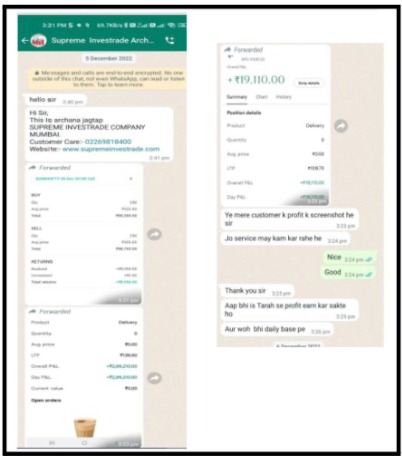
1. The Guaranteed Daily Profit Bait
Onboarding a client identified as Mr. Axxx, a representative named Archana Jagtap shared profit screenshots and wrote that he could earn the same way, and that too daily, a direct promise, not a possibility.
2. The Loss Recovery Trap
After a client’s trade went into loss, a representative pitched a costlier “senior” package as the fix, claiming a single trade under that tier could recover the visible loss entirely.
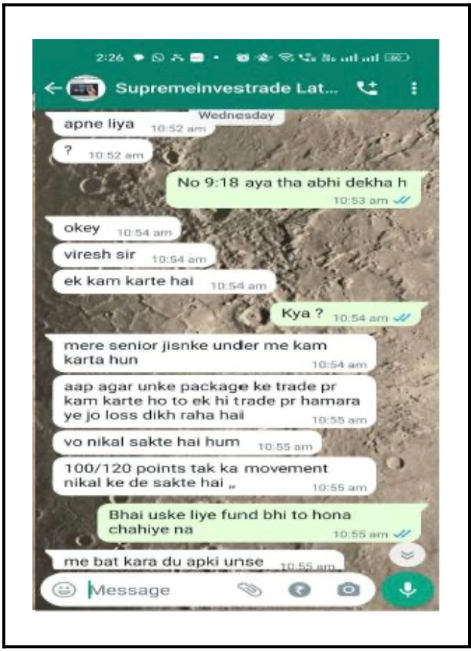
The client, referred to as Mr. Kumar, asked back whether he’d even need more funds for that to work, a question more revealing than the pitch itself.
3. Aggressive Real-Time Handholding
For a client identified as Mr. Rawat, messages during live trades included urgent instructions to buy quickly, buy maximum quantity, and exit exactly when told to.
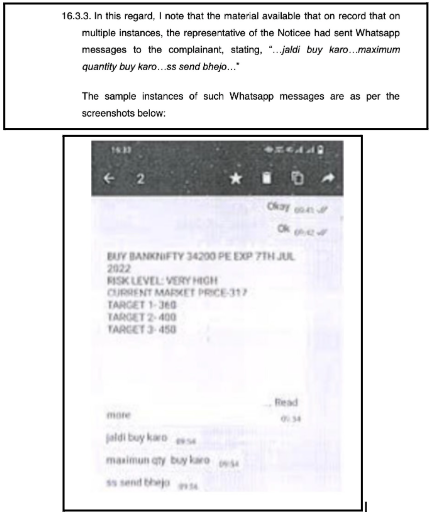
This is direct trade execution pressure, not research.
4. Forcing a Fake Satisfaction Email
After a client, referred to as Mr. Jadoun, complained about pressure to add more money, the firm allegedly drafted a fake “thank you” message and instructed him to send it to SEBI to close his own active complaint, then tracked him in real time to confirm it had been sent.
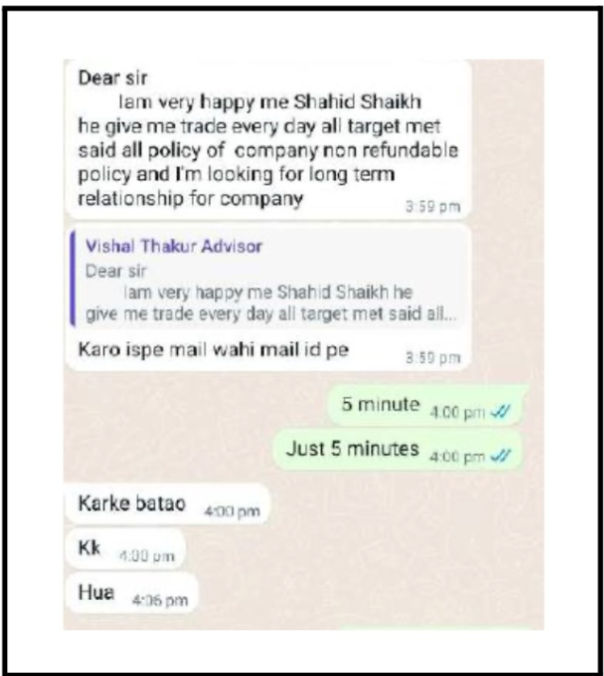
SEBI’s conclusion was direct: showcasing only winning outcomes while quietly omitting the risk, paired with claims of guaranteed daily earnings, meets the legal definition of guaranteeing returns.
Calling it marketing doesn’t change what it actually was.
Supreme Investrade Arbitration Cases: Two Real Outcomes
Beyond SEBI’s own orders, two separate BSE arbitration proceedings show how these violations played out for real clients, with real financial outcomes.
One case involved a client pressured into holding a losing trade against his own judgment. The other involved a client charged far more than the firm’s advertised pricing.
Both reached formal arbitration, and both produced binding financial awards, one partial, one a full refund.
The complete breakdown of both cases, exact figures, the recorded quotes, and how each outcome was decided is covered in full on our Supreme Investrade refund page.
Supreme Investrade Complaints: The Common Red Flags
Based on everything documented above, here are the specific warning signs worth watching for with any advisory firm, not just this one.
- Profit screenshots shown to convince you to subscribe.
- Recovery promises after a loss, “add more capital, we’ll recover it.”
- Exact trading instructions, “buy now, sell at this time.”
- Pressure tactics stopping you from exiting a losing trade.
- Non-refundable policies that, while legal, mean your money won’t come back regardless of service quality once signed.
I Paid Supreme Investrade and Lost Money, What Now?
Recovery is possible, and SEBI’s own orders specifically strengthen your position if what happened to you matches what SEBI already found.
If you were shown profit screenshots, told your losses could be recovered with an upgrade, or pressured to invest more after losses, those exact patterns are what SEBI already penalised.
Your documentation is where your case starts. WhatsApp chats, emails, payment receipts, call recordings, advertisements, research reports, and screenshots can all help establish what was actually communicated to you.
How to Recover Money From Supreme Investrade?
Every investor on this page is at a different stage; some are still deciding whether to subscribe, others already have a complaint they’re not sure how to escalate.
If you’re in the second group, a defined path exists, and it’s worth following in order rather than skipping straight to the loudest option.
Start with direct written notice to the firm. If that doesn’t resolve things, escalate through a SEBI SCORES complaint.
If SCORES doesn’t resolve the matter, register through the SMART ODR portal for structured mediation.
Should that also fail, stock market arbitration is the final, binding stage.
The complete, detailed walkthrough of every documented violation and the full step-by-step reporting process is covered in our guide: Supreme Investrade refund.
Facing issues with Supreme Investrade or any other research analyst firm?
We will help you draft effective complaint letters, compile and organise supporting documents, and represent you throughout the complaint resolution process.
What You Must Verify Before Paying Any Advisor?
Many disputes with research and advisory firms arise because investors fail to verify important details before making a payment.
A few minutes on these checks can help you avoid unnecessary problems later.
- Verify the SEBI registration directly on SEBI’s own website.
- Understand the fees and refund policy in writing before paying anything.
- Get a written service agreement, not verbal assurances.
- Check whether risks are properly explained, in writing.
- Confirm the complaint resolution process before signing up.
Conclusion
Supreme Investrade holds a genuine SEBI registration.
What surrounds it, two SEBI penalty orders totalling ₹7,00,000, real WhatsApp chat evidence of profit guarantees and trade interference, and two arbitration cases with real financial outcomes, deserves equal weight before you pay anything.
A SEBI registration is the bare minimum, not an endorsement of performance or a shield from regulatory issues.
Report. Recover. Stay Fraud Free.
Frequently Asked Questions
Yes, under registration number INH000008747, held by proprietor Abhishek Kumar Singh, granted September 9, 2021, with perpetual validity. Verify it directly on SEBI's official portal.
It's a real, existing, SEBI-registered entity. The more useful question isn't whether it's real, but whether you have enough verified information about its conduct before you pay anything.
Registration alone doesn't confirm safety. Two separate SEBI penalty orders, real WhatsApp evidence of prohibited conduct, and two arbitration cases suggest real, documented risk worth weighing before you commit money.
Two separate orders total ₹7,00,000, ₹5,00,000 in the December 2024 order and ₹2,00,000 in the second order.
Possibly. Two documented arbitration cases show different outcomes, one partial compensation, one a full fee refund, depending on what misconduct could actually be proven.
It refers to an RA giving real-time trade instructions, managing funds, or interfering with a client's exit decisions, activities outside what a Research Analyst registration permits. SEBI's orders found Supreme Investrade did exactly this.





 Add us as a preferred source on Google »

