
Quick Summary
Supreme Investrade holds a documented SEBI enforcement history, a ₹5,00,000 penalty, and two separate arbitration cases with real financial outcomes. Six specific violations give you formal grounds to complain: fake profit screenshots, guaranteed return promises, pressure to add money after losses, real-time trade interference, overcharging beyond the advertised rate, and attempts to falsely close SEBI complaints. Ms. Shikha Sharma recovered a full ₹1,97,000 refund. Mr. Mukul Singh was awarded ₹25,000 in compensation. The firm’s non-refund clause does not protect it when its conduct contradicts its own paperwork. This page covers every violation, both cases in full, and the complete five-step process through SCORES, SMART ODR, and arbitration.
You paid for Supreme Investrade tips and followed the calls. You lost money. Now you want it back.
That is the exact moment most people get stuck, not because recovery is impossible, but because nobody tells them what to do next.
Have you ever paid for a stock advisory service and felt something was not right, but did not know where to start or who to tell?
That frustration is more common than you think. Hundreds of traders across India subscribe to research advisory services with genuine hope, only to find themselves misled, pressured, or left with losses they were never warned about.
Supreme Investrade and Research Services is one firm that has found itself at the centre of multiple such complaints.
SEBI action against Supreme Investrade for misleading services has resulted in two separate penalty orders, and two separate clients have won arbitration cases against it.
This page explains Supreme Investrade refund eligibility, every documented violation, both real arbitration outcomes, and the complete five-step process to report the firm and pursue your money back.
Can You Get a Supreme Investrade Refund?
This is the question at the centre of everything. The honest answer: it depends, but it is more possible than the firm wants you to believe.
Supreme Investrade uses a User Consent Form with a non-refundable clause. That document is real. It is signed by clients before services begin.
But a signed agreement does not protect a firm from everything. When the firm’s actual conduct contradicts what that document promises, the clause loses its protection.
Here is what that looks like in practice:
- The form says “no guaranteed returns.” The representative’s WhatsApp messages say otherwise.
- The form says “research recommendations only.” The representative pushed you not to exit your own trade.
- The form says “all market risks are yours.” The representative showed you other clients’ profits to convince you that the risk was practically zero.
In each of those cases, the firm’s conduct undermines its own paperwork.
Six Documented Violations by Supreme Investrade
Not every bad experience automatically qualifies as a regulatory violation.
But certain specific behaviours cross the line defined by SEBI and can be formally reported. These are not speculation; they are findings from formal regulatory proceedings and arbitration records.
1. They Showed Other Clients’ Profits to Pull You In
Representatives sent WhatsApp screenshots of profits earned by existing subscribers. The message was clear: you can earn like this too.
This practice is specifically prohibited under SEBI’s Research Analyst regulations. Using cherry-picked profit data to attract new clients is a form of inducement. It creates a false picture of typical outcomes.
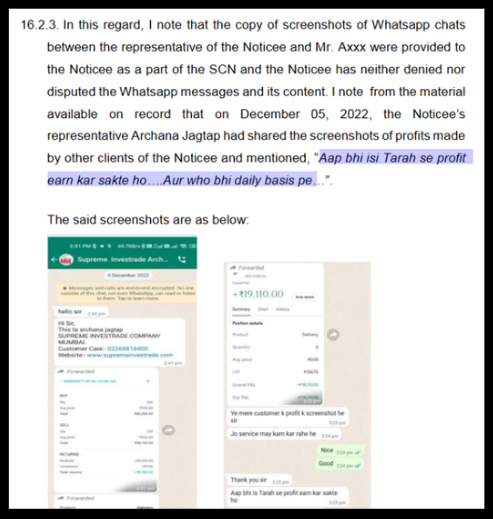
Many investors later wonder how research analysts in India mislead investors. One recurring pattern involves using carefully selected profit screenshots to build trust before a paid subscription is sold.
You can file a complaint if you were shown profit screenshots before you subscribed and that influenced your decision.
2. They Let You Believe Profits Were Almost Certain
Nobody handed you a written guarantee. They were too careful for that.
Instead, the language was designed to imply certainty without stating it explicitly. Phrases like “profit toh hoga hi” or “hum recover karwa denge” carried the weight of assurances, even when the disclaimer on your form said the opposite.
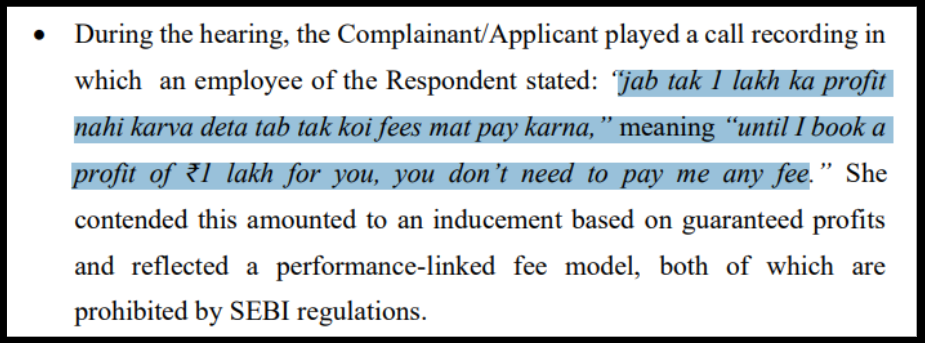
In the Shikha Sharma arbitration case, a voice recording captured a firm employee saying, until they book you a profit of ₹1 lakh, you do not need to pay any fees.
SEBI’s adjudication findings confirmed this pattern across multiple client interactions.
No research analyst in India is legally permitted to promise assured returns or link fees to profit delivery. This is explicitly banned under SEBI regulations.
You can file a complaint if you were verbally or over WhatsApp told that profits are assured, daily earnings are expected, or that fees are linked to your trading results.
3. They Pushed You to Add More Money After Losses
This is the pattern that hurts the most in hindsight. After your initial plan failed to deliver, you were offered an upgrade. A higher tier. A premium plan. With the suggestion that better calls and better results would follow.
What actually followed was more fees paid from the same pocket that had already bled.

If you suffered trading losses and the firm’s representative then urged you to deposit additional funds, promising the next set of calls would recover everything, that is classified as inducement under SEBI’s PFUTP Regulations.
SEBI’s order documented this exact pattern: clients already in the red were pushed to arrange more capital, with the implicit or explicit promise of loss recovery.
Using loss anxiety to pitch an upsell is a documented mis-selling tactic. SEBI’s orders against the firm noted this explicitly.
You can file a complaint if, after incurring losses, a representative contacted you to add more capital and assured you of recovery through upcoming trade calls.
4. They Told You Not to Exit When You Wanted To
This one is particularly damaging. A research analyst can give you a buy or sell recommendation. They can tell you the target price and the stop-loss.
What they cannot do is intervene when you decide to exit.
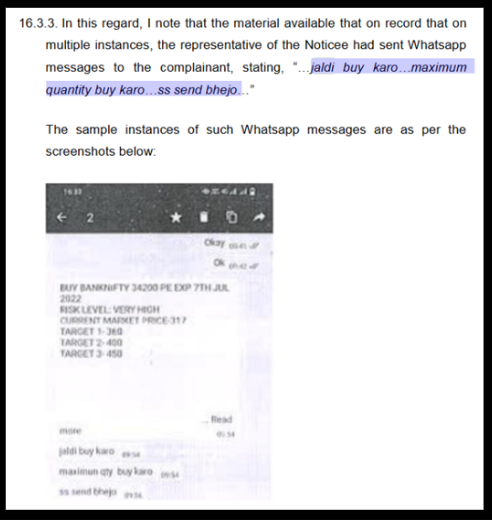
Your exit decision belongs to you. When a representative urges you to hold a losing position, promising recovery, asking you to wait one more session, they have crossed a clear regulatory line.
SEBI’s order documented messages where the firm sent urgent real-time commands during live market hours: “buy now, buy maximum quantity, do not exit yet.”
That is active trade execution pressure, not research. The arbitration cases also confirmed that voice calls were made, giving specific timing-based trading instructions.
This is precisely the violation at the heart of the Mukul Singh case, covered in full detail below, where a representative’s instruction not to exit a losing position directly caused additional, quantifiable financial harm.
You can file a complaint if you received live messages or calls telling you exactly when to enter or exit a trade, how much quantity to buy, or advising you not to exit a position when you wanted to.
5. They Charged You More Than the Advertised Package Rate
The Shikha Sharma arbitration case revealed she was charged ₹1,97,000 for less than three months of service, while the firm’s own website listed its highest annual package at ₹1,78,180.
That is more than the full-year price, charged in under 90 days.
The arbitrator found that the firm retroactively constructed a fictitious package worth ₹5,66,667 and applied a fake discount to justify the charge.
This is a non-transparent fee structure that violates SEBI’s informed consent requirements.
You can file a complaint if you were not shown a predefined package upfront, were charged incrementally, or ended up paying more than the rates publicly listed on the firm’s website.
6. They Tried to Close Your SEBI Complaint From the Inside
This is the violation that should concern every current and former client most.
In at least one documented case, a firm employee drafted a complaint satisfaction letter on behalf of a client, with language like “I am very happy with the resolution,” and asked the client to send it to SEBI to close their active SCORES complaint.
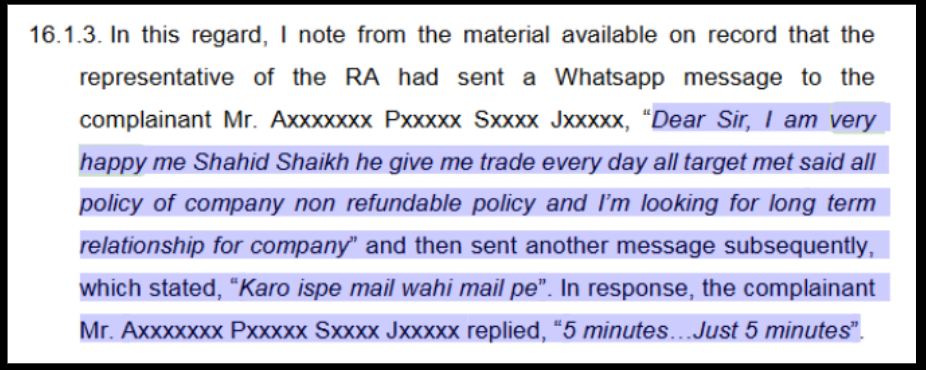
Fabricating a complaint closure to mislead the regulator is not a grey area. It is a direct subversion of the system designed to protect you.
If this has happened to you, if someone from Supreme Investrade sent you a ready-made satisfaction message and asked you to forward it to SEBI, do not do it, and report the attempt immediately.
You can file a complaint if you were given a pre-written satisfaction statement by the firm to send to SEBI in order to close your complaint.
SEBI Penalty Against Supreme Investrade
As part of its formal order, SEBI imposed a monetary penalty of ₹5,00,000 on the entity.
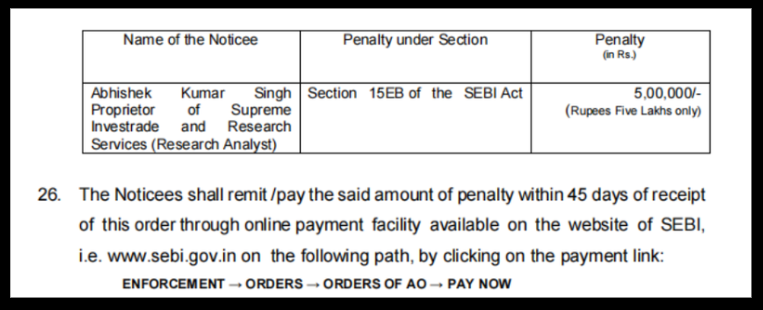
The order also included provisions for recovery proceedings in the event of non-payment.
The significance of this order is that it demonstrates how properly documented complaints, especially those supported by WhatsApp chats, call recordings, screenshots, and transaction evidence, can lead to formal regulatory action.
Real Cases of Supreme Investrade Refund
At this point, you might be asking yourself a simple question: “Has anyone actually recovered money from Supreme Investrade?”
The answer is yes.
While every situation is different, there have been investors who decided not to give up and successfully recovered compensation or refunds through legal proceedings.
Here are two examples that show why you should not assume your money is gone forever.
Case 1: ₹1,97,000 Recovery, Shikha Sharma
Losing money to an advisory firm can make it feel like you have no way forward, but Ms. Shikha Sharma’s case tells a different story.
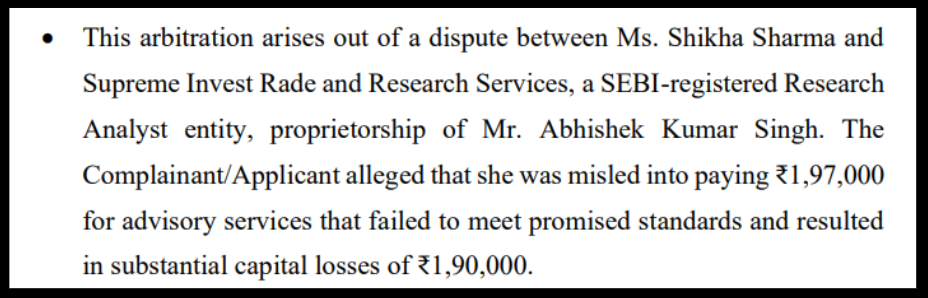
Within less than three months, Shikha had paid ₹1,97,000 to Supreme Investrade and Research Services.
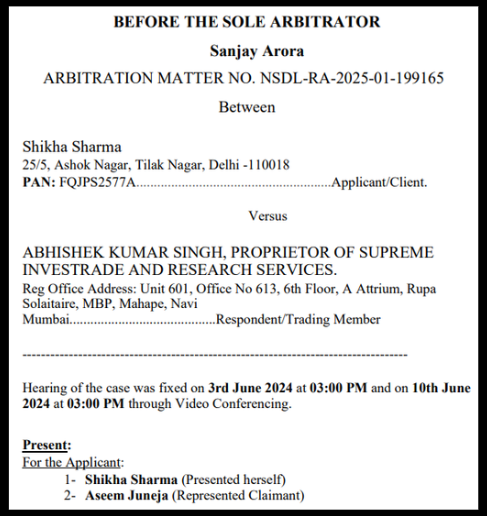
She later became concerned that the fees charged to her were far higher than the firm’s publicly advertised package pricing and decided to challenge the matter.
After she registered her case with us, our team reviewed the evidence, prepared her claim, and represented her throughout the arbitration proceedings.
The dispute examined the firm’s fee collection practices and the representations made during the client relationship.
After reviewing the evidence, the arbitrator directed Supreme Investrade and Research Services to refund the entire ₹1,97,000 to Ms. Shikha Sharma.
This case is a reminder that the right legal action can lead to real results.
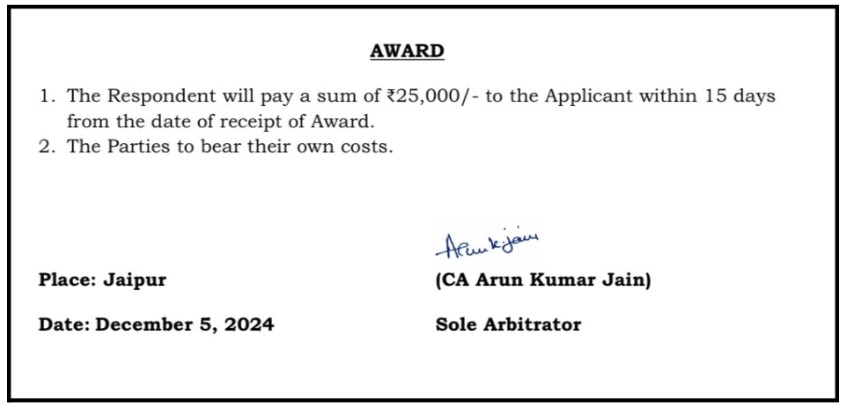
Case 2: ₹25,000 Recovery, Mukul Singh
Now consider a different situation. You enter a trade based on professional advice.
The trade starts going against you, and you decide you want to exit with a manageable loss of ₹15,000.
Then you’re told to stay in, because the trade may recover.
That is what Mr. Mukul Singh alleged happened to him.
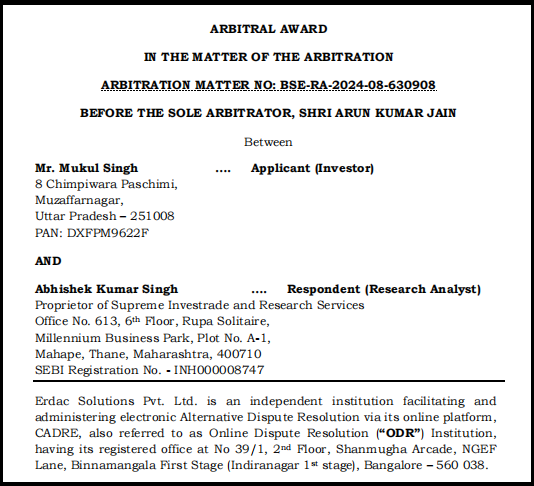
He had already paid ₹70,000 for trading tips and research services. Trusting the advice he received, he remained in the trade.
Instead of recovering, his loss increased to ₹40,000.
Mukul eventually took the dispute to arbitration, arguing that the firm’s advice had contributed to the additional loss.
While the arbitrator did not order a refund of the ₹70,000 fee, it was found that the advice had contributed to an extra ₹25,000 loss, and he was awarded that amount in compensation.
If you’re reading these cases because you’re worried about your own situation, here’s the key takeaway: recovery is possible.
The amount depends on your evidence, your documents, and the facts of your case, but these examples show that investors do not always walk away empty-handed.
Is There a Time Limit to Claim a Refund or File a Complaint?
You might be sitting on this for months, wondering if it’s already too late.
It usually isn’t, but the clock does matter, and not knowing the actual rules is exactly what makes people give up too early.
Yes, and this is where many clients lose their chance.
For BSE arbitration, the window is generally three years from the date of the disputed transaction or the point the loss became clear.
For SEBI SCORES, there is no fixed hard deadline. That said, the older your complaint, the harder it becomes to preserve and present evidence effectively.
Here is what actually drives urgency: evidence expires before deadlines do. WhatsApp conversations get deleted. Call recordings get overwritten. Screenshots sit in cloud backups until the account is reset.
The longer you wait, the thinner your case becomes.
If your experience with Supreme Investrade happened in the last one to two years, your evidence is still recoverable. Act now.
If something happened longer ago, do not assume it is over. Check what you still have.
Even partial documentation can form a valid complaint.
How to Report Supreme Investrade and Get Your Refund?
If you have lost money following the aggressive tactics or misleading assurances of an advisory firm, recovering your funds requires a structured, legally sound approach.
By taking immediate action and following the formal regulatory channels established for investor protection, you can build a strong case to demand your money back.
If you wonder how to file a complaint against a Research Analyst, here are the steps to follow:
Step 1: Lock Down Every Piece of Evidence Today
Open every channel you have: WhatsApp, email, Telegram, any chat platform, and save everything.
Keep the profit screenshots shared by the representative.
Preserve messages advising you to stay invested. Save payment receipts for every transfer and store all audio clips and voice messages.
Screenshot. Download. Back up in two locations minimum.
Evidence gathered today is ten times more useful than evidence gathered after a complaint is filed.
Step 2: Write to the Firm’s Compliance Officer
Send a formal written complaint to Supreme Investrade at their registered email address. Put everything on record.
State the dates, the amounts, the specific conduct that caused you harm, and the resolution you want. This is not about hoping they respond well.
It is about creating a paper trail that shows you attempted resolution before escalating.
Give them 7 to 10 working days.
Step 3: Register a Complaint With SCORES
If the firm does not resolve your complaint, escalate to SEBI’s investor grievance portal. Select the Research Analyst category. Upload your complaint letter, payment records, and all supporting evidence.
Once filed, the complaint carries formal regulatory weight. The firm must respond. Unresolved SCORES complaints attract direct scrutiny.
Do not allow anyone from the firm to draft a satisfaction statement for you. That tactic has been documented and used against clients.
You can file complaint in SCORES directly through SEBI’s own official portal.
Step 4: File a Complaint With SMART ODR
If SCORES does not produce a satisfactory outcome, move to SEBI’s SMART ODR platform.
This is a structured online dispute resolution process. A neutral expert reviews your case within a defined time frame. No lawyer is required. You need organised evidence presented clearly.
Step 5: Share Market Arbitration
For cases involving meaningful financial amounts, stock market arbitration is a formal legal route that produces a binding, enforceable award.
Arbitration is faster than civil court. It is accessible to retail investors.
And it carries real legal force. Under arbitration, an independent authority reviews the evidence submitted by both parties and issues a legally enforceable decision.
An arbitration award has the same effect as a court decree.
If the adviser fails to comply with the award, SEBI may begin recovery action under Section 28A of the SEBI Act, treating the unpaid amount similarly to government dues recoverable through legal enforcement mechanisms.
Feel like you don’t even know where to start with Supreme Investrade?
We will go through your case honestly, tell you what’s recoverable and what isn’t before you commit to anything, build your complaint with the specific violations identified, and represent you end to end through SCORES, SMART ODR, and arbitration.
Conclusion
Supreme Investrade’s case is well-documented: two SEBI orders, two arbitration wins, multiple confirmed violations. That gives you a stronger foundation than most advisory disputes.
The non-refund clause doesn’t always hold. Where profit assurances were made, or fees were mis-sold, Mukul and Shikha’s cases already proved it in formal proceedings.
Preserve your evidence first. Never send a satisfaction statement to SEBI on the firm’s behalf. Use SCORES, SMART ODR, and arbitration, in order.
Report. Recover. Stay Fraud Free.
Not necessarily. The non-refund clause holds when the firm delivered what it promised within the bounds of SEBI regulations. When the firm made profit assurances, used other clients' gains to attract you, or interfered in your trade decisions, that conduct overrides the paperwork. It helps. UPI transaction records are clean, traceable, and date-stamped. They confirm exactly when you paid, how much, and to which account. Preserve every screenshot and retrieve your bank statement showing the transfers. This is some of the strongest evidence you can present. Yes. If you have call recordings, voice notes saved on WhatsApp, or any audio of the conversation, those carry evidentiary weight in regulatory proceedings. Even if you do not, WhatsApp text messages, screenshots of profit claims, and payment records together form a credible case. You do not need a recorded confession to file. Do not accept it verbally or informally. If they are offering something, get it in writing first. Understand what you are giving up in exchange; often, these offers come with a request to close your SEBI complaint or sign a satisfaction statement. Do not sign anything that closes your complaint before you have received the full settlement and it has been paid.Frequently Asked Questions





 Add us as a preferred source on Google »

