
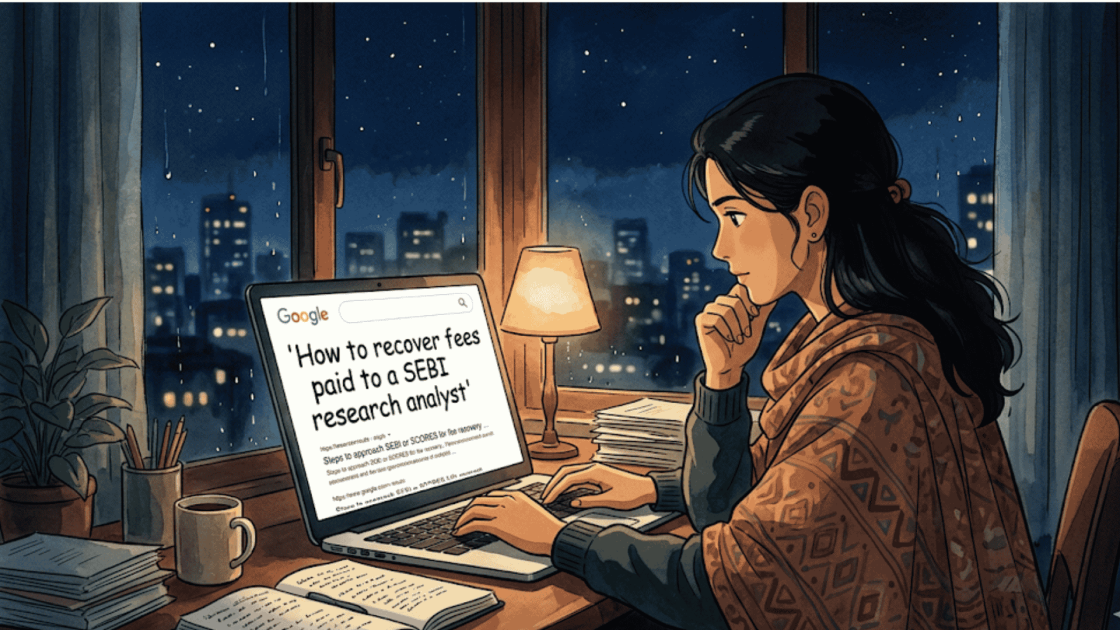
Quick Summary
Recovering fees from a research analyst is possible, but only in certain cases. A trading loss alone is not enough. If the analyst promised guaranteed returns, overcharged you, took cash, skipped an invoice, or gave personalised advice they are not allowed to, you have a real basis to claim. The route runs in stages: complain to the analyst first, then SCORES, then SMART ODR, and arbitration if needed. This page shows you exactly how, step by step.
So you paid fees to a research analyst, and now something feels off.
Maybe the tips were wrong, and the analyst has gone silent. Maybe you’ve realised they weren’t even registered with SEBI.
Whatever brought you here, you have questions. And when navigating stock market fraud recovery, you deserve straight answers.
Here’s everything you need to know about how to recover fees paid to a SEBI research analyst.
Can I Get Refund From SEBI Registered RA?
The short answer: it depends on why you’re asking.
SEBI does give you the right to complain against a registered research analyst, and in certain situations, you may be entitled to a refund.
But SEBI’s role is primarily regulatory. It can direct an analyst to refund fees, but it is not a compensation fund. That said, you are not powerless.
While fee recovery is never guaranteed, depending heavily on your evidence and the analyst’s registration status, you realistically stand little to no chance of a refund unless you actively initiate a grievance process.
The SEBI (Research Analysts) Regulations, 2014, along with subsequent circulars, give retail investors real tools to seek accountability.
If they’re not SEBI-registered, the rules change significantly.
But more or less, you can get a refund for the fees you paid to the research analyst.
When Can I Recover Fees From A Research Analyst?
Not every bad investment tip gives you grounds for a refund. But there are specific situations where you have a strong case.
You can likely complain and seek a refund if:
- The analyst promised guaranteed returns.
- They charged you more than the legal limit allowed for SEBI registered research analyst fees (currently, an individual analyst can charge a maximum of ₹1,51,000 per year per family of the client) or they charged fees before completing the KYC process or the analyst collected fees in cash.
- They did not provide a proper invoice or receipt for the fees collected or they did not disclose conflicts of interest.
- They offered personalised advice without the necessary permissions (research analysts are only allowed to give general recommendations, not tailored portfolio advice).
- They refused to address your grievance through their own internal complaint process within the stipulated time.
If any of the above happened to you, you have a legitimate basis to file a complaint.
Be honest with yourself about which situation applies. That clarity will help you build a stronger complaint.
How To Recover Fees From A SEBI Research Analyst?
Now, onto the main point of this blog: how will you recover fees from a SEBI research analyst?
Here is the practical, step-by-step path you can follow:
Step 1: Raise A Complaint With The Analyst First
Before going to SEBI, you must give the analyst a chance to resolve the issue. This is a required step.
Send a written complaint (email works) clearly stating what you paid and when, what you expected, what went wrong and what resolution you are seeking (refund, explanation, etc.)
Keep a copy of everything. They are required to respond within 21 days.
Step 2: File A Complaint On SCORES
If the analyst does not resolve your complaint, or does not respond within 21 days, go to SCORES.
It is SEBI’s official online complaint portal.
SCORES stands for SEBI Complaint Redress System. It is free to use. SEBI tracks every complaint filed here, and the analyst is obligated to respond.
What you’ll need when filing:
- Your name, PAN, and contact details.
- The name and SEBI registration number of the analyst.
- A clear description of your complaint.
- Supporting documents like receipts, bank statements, emails, screenshots.
SEBI will forward your complaint to the analyst and monitor the response.
If the analyst fails to respond or their response is unsatisfactory, SEBI can escalate the matter.
Step 3: Raise a Complaint with Smart ODR
If your complaint on SCORES remains unresolved, you can file a dispute on SEBI’s Smart ODR portal.
The platform first attempts an informal pre-conciliation, where both parties are contacted and nudged toward an early resolution.
If that does not work, a neutral conciliator is assigned to facilitate structured discussions between you and the analyst. The entire process is digital and no lawyer is required.
Step 4: Arbitration in the Stock Exchange
If conciliation does not produce a satisfactory outcome, you can escalate to online arbitration through the same Smart ODR portal.
An arbitrator is assigned to hear both sides and deliver a decision. Unlike conciliation, the arbitrator’s decision is binding on both parties and brings the dispute to a definitive close.
Sitting on losses after paying a research analyst, and not sure how to get your fees back?
We will look at what happened, pinpoint exactly where the analyst broke SEBI’s rules, and take your fee recovery through the full process, from the first complaint to the analyst, through SCORES and SMART ODR, and on to arbitration if that is what it takes.
Conclusion
Losing money is painful. Feeling cheated is worse.
But you do have rights as an investor and SEBI has put in place a clear process for you to use.
To sum it up simply:
- If the analyst violates regulations, file on SCORES, then escalate to ODR or arbitration if needed
- Always keep records: payment receipts, bank statements, emails, and chat messages
- Never pay in cash, and always verify SEBI registration before engaging any analyst
The most important thing? Act quickly.
The sooner you file, the stronger your case.
Frequently Asked Questions
No, SEBI regulations state that recommendations are subject to market risks, meaning trading losses alone are not valid grounds for a fee refund.
For individual and HUF clients, the maximum legal fee cap is ₹1,51,000 per year per family of the client.
Yes, you must lodge your complaint on the SCORES 2.0 platform within exactly one year from the date the dispute or regulatory violation occurred.
SEBI strictly prohibits cash payments for research services, making it nearly impossible to claim a refund without an electronic banking trail.
Under the SCORES 2.0 framework, the analyst is legally mandated to resolve the issue and upload an Action Taken Report within 21 calendar days.





 Add us as a preferred source on Google »

