
Quick Summary
A refund from a SEBI registered research analyst is never automatic, and a trading loss alone will not get you one. What builds a real claim is a breach: personalised trade calls the analyst was not licensed to give, promises of guaranteed returns or loss recovery, fees collected outside the rules, or missing risk disclosures. Any of those can turn a loss into a case. The deciding factor is your evidence, not the size of your loss. This page explains when a refund is justified, the red flags that make your claim strong, and what recovery has looked like for real investors.
You paid the fees, followed the calls, and trusted the registration number. Then the losses came.
Now you are sitting with a drained account, messages that go unanswered, and one question circling in your head: can I actually get my money back from a SEBI registered research analyst?
Here is the straight answer, and what your rights really are.
Can I Get Refund From SEBI Registered RA or Not?
The honest answer: yes, a refund is possible, but only in specific situations, and never on its own.
Many investors pay thousands of rupees to a registered analyst expecting professional guidance.
When the calls lead to losses instead, the fee itself starts to feel like a second loss on top of the first. The instinct is to write it off. Often, you should not.
The thing that decides whether you have a claim is not the loss. It is whether the analyst broke a rule.
You may have a genuine case if any of these apply to you:
You were promised assured or guaranteed returns. The service you paid for was never actually delivered. Important risks were hidden from you before you paid.
You were pushed into paying additional fees under false pretexts. Or the analyst breached SEBI’s rules in some other documentable way.
But a refund does not arrive just because you are unhappy.
The outcome rests on the facts of your case and the evidence you can produce: payment receipts, WhatsApp chats, emails, call recordings, and the advisory reports themselves.
So before you write that money off, it is worth looking hard at what actually happened.
What feels like a bad investment decision today may, on closer inspection, be misrepresentation, deficient service, or a regulatory breach, and any of those can support a refund.
The Red Flags That Make Your Refund Claim Valid
Not every disappointed client has a claim.
But certain signals turn a vague grievance into a documentable case, and if your experience matches them, your position is stronger than you think.
These five patterns are the ones that carry real weight. Read each against what happened to you.
1. The Calls Were Personalised and Tied to Your Portfolio
General research says “the XYZ sector looks strong.” Personalised advisory says “buy ABC today, 500 shares, target ₹240, stop loss ₹195.”
If your calls sounded like the second kind, the analyst crossed a regulatory line on every single one, because that is advisory work their registration does not permit.
2. You Were Told to Follow Calls to Recover Earlier Losses
This retention tactic is explicitly banned.
The moment an analyst uses the promise of recovering your losses to keep you subscribed, they have breached SEBI’s rules, usually in a written message you still have saved.
3. The Fees Went to a Personal Account
Legitimate registered analysts collect fees transparently, through a registered business account.
Personal UPI IDs, accounts in an individual’s name, or several different accounts for the same service are red flags about the fee structure itself, and each one supports your complaint.
4. You Got No Risk Disclosure or Client Agreement
If your entire onboarding was a WhatsApp chat and a payment link, with no signed agreement and no risk disclosure, the analyst skipped mandatory procedural steps.
That gap, on its own, strengthens your claim before you even reach the substance.
5. Your Complaint Was Waved Away as “Market Risk”
Your complaint about a specific violation is not a market-risk matter.
If the analyst answered your concern about personalised calls or false promises with generic “markets are risky” language, document that reply.
It becomes evidence that they refused to engage with a legitimate grievance.
Real Recoveries That Prove It’s Possible
You may be quietly asking whether any of this is worth it.
Maybe you have already filed the loss away in your head as a mistake to forget.
Maybe someone told you that once the market takes your money, chasing it is pointless, and the chats and receipts on your phone are just clutter now.
Hold that thought against what actually happened to the investors below.
None of them had a special advantage. What they had was a reason not to walk away, and evidence that turned out to be worth far more than they assumed.
Each of these three cases proves a different point about how refunds actually get won.
1. The Fee and the Loss Are Two Separate Fights
The first principle is one most investors never realise: your trading loss and your fee are judged separately.
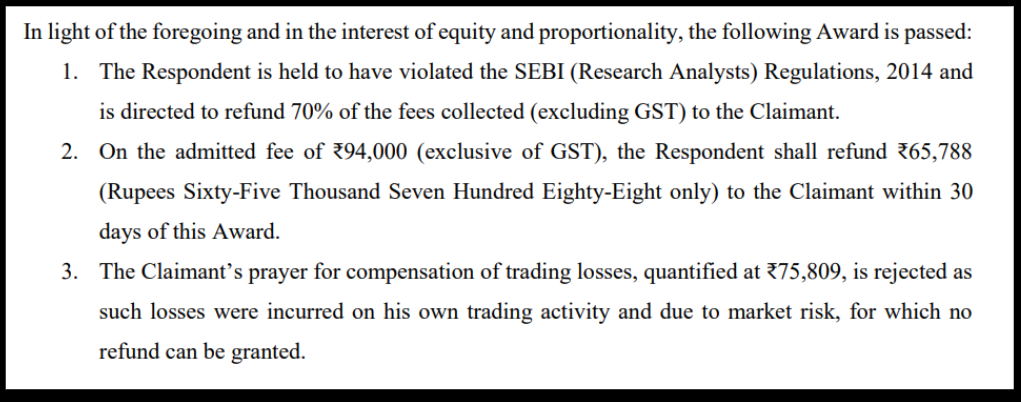
An investor had paid ₹1,10,900 to Alpha Wealth Research, handed over in stages, each new charge justified by yet another reason to pay.
When the results never came, the money felt entirely lost, losses and fees together, one big write-off.
It was not.
When the matter was examined, the trading losses and the fees were treated as two different questions. The losses stayed with the investor, counted as his own market risk.
But the fees were another matter, because the firm’s fee collection and conduct had crossed regulatory lines, and a firm cannot keep money it earned by overstepping its role.
The result was a directed refund of ₹65,788.
The full findings are laid out on our Alpha Wealth Research review.
The takeaway for you is liberating: even when your losses are genuinely gone, the fees you paid can be a separate, winnable claim.
2. Strong Evidence Can Settle a Case Before It Reaches a Verdict
The second principle is that you do not always need a final ruling to get money back. Sometimes the evidence does the work on its own.
This investor was reeled in familiarly, shown winning demo trades, given a small early profit, and convinced he had found a real advisor.
He paid ₹56,000 to Insight Research.
Then the losses started. The guidance on risk and stop-losses thinned out, and almost everything stayed on WhatsApp, where it felt deniable.
But feeling cheated is not a case. Proving it is.
Instead of arguing over promises, the claim was built entirely on the record, the payments, the chat histories, the numbers used, the full trail, and presented during conciliation.
Faced with that, the firm chose not to fight to a verdict. It settled, refunding ₹50,000 before any binding award was passed.
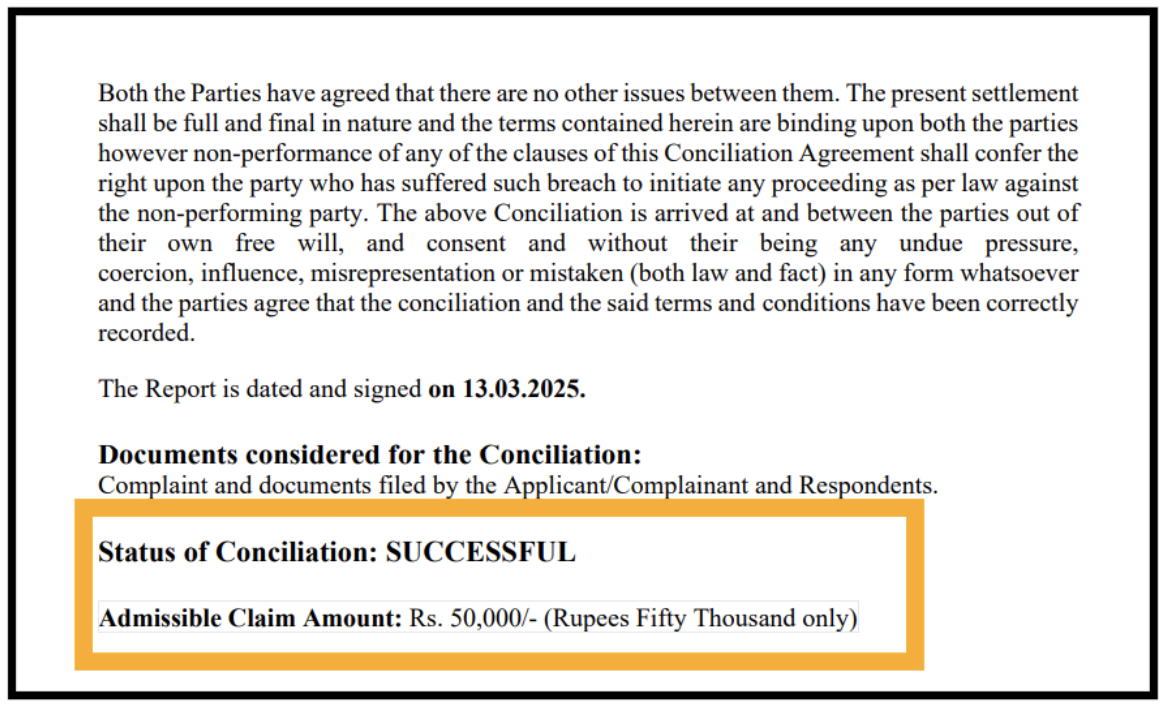
That route, conciliation rather than a full fight, is one many investors never know exists.
Well-organised evidence can apply enough pressure that the other side would rather settle than continue, which often means your money comes back sooner.
3. The Size of Your Loss Doesn’t Decide Whether You Have a Case
The third principle dismantles the belief that stops most people before they start: that a big loss is a hopeless one.
One investor refused to accept that. He had committed substantial funds and securities to a trading arrangement built on assurances of attractive returns.
When the way his account was being handled began to trouble him, he did not push the worry aside. He put it in front of a formal tribunal and let the records speak.
A three-member NSE Arbitral Tribunal went through the account activity and communications, concluded that unauthorised trading had taken place, and awarded him ₹1,40,93,159.
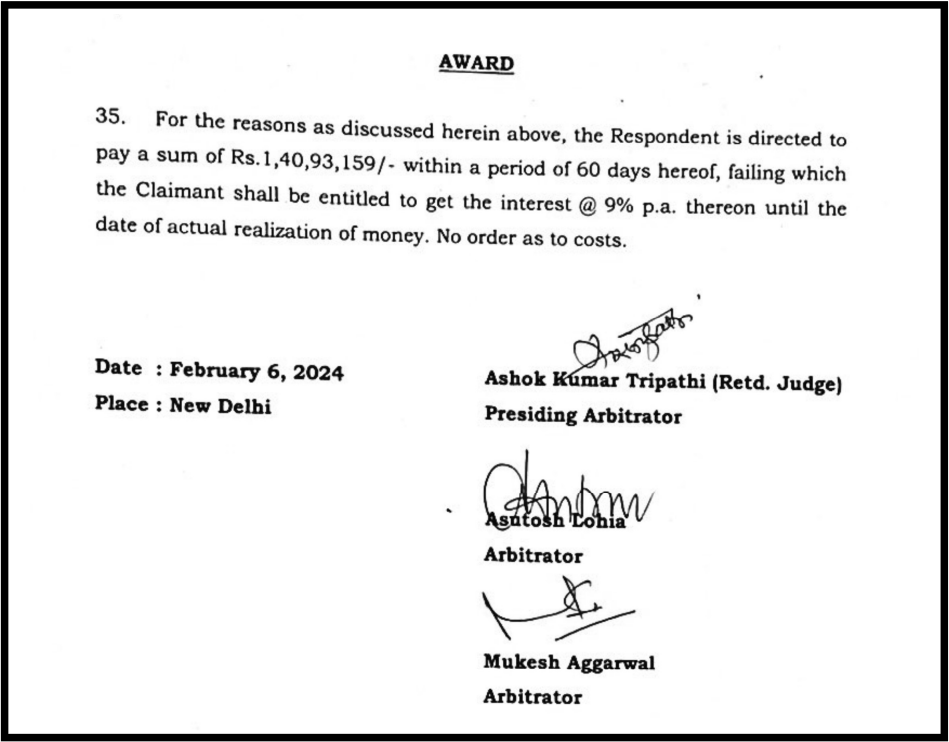
An outcome of this size is rare and not something to expect as standard, so read it as proof of a principle, not a promise.
The full account, alongside other recoveries, sits on our page: arbitration against research analyst India.
What it settles for good is this: the amount you lost has no bearing on whether you have a claim. Your evidence does.
That is exactly why the chats, invoices, recordings, and payment proofs on your phone right now may be worth far more than they look.
If you feel a SEBI registered RA cheated you, that evidence is where your case begins.
How Registration Actually Helps You Claim Your Money?
There is a cruel irony many investors feel: they trusted the registration, and it did not save them. But registration is not useless to you now. It is the opposite.
A registered analyst’s registration does not block recovery. It creates the path to it, because it places the analyst under SEBI’s oversight and binds them to a set of rules.
The very rules they agreed to follow when they registered become the foundation of your complaint the moment they break them.
An unregistered tipster leaves you with almost no formal route.
Do you have the chats and receipts, but no idea whether they add up to a refund?
We will look at exactly what happened, work out where your case is strongest, and take it forward through the right channels until it resolves.
How to Actually Claim Your Refund?
Once you decide to act, the process is more straightforward than it looks, and because you dealt with a registered analyst, it runs entirely inside SEBI’s system.
It starts with your own records. Before you contact anyone, save everything: every trade call, recovery promise, fee payment, and message, and store it in two places, because evidence disappears faster than you expect.
Next, send a written refund demand to the analyst’s compliance officer, not a WhatsApp reply, naming each violation, listing the fees you paid, and attaching your evidence, with a request to respond within 21 days.
If that response is inadequate or never comes, the formal escalation begins, and each stage builds on the same evidence you have already gathered.
We walk through that entire pathway, from the first complaint to SCORES, then SMART ODR, and finally arbitration, along with what each stage can realistically return to you, in our guide: how to file a complaint against research analyst?
Don’t Let a Bad Experience Be the End of It
You paid for a service that was meant to operate within SEBI’s framework.
If what you received instead involved personalised trade calls, recovery promises, assured returns, or fees for work outside the analyst’s scope, this is bigger than a bad investment outcome. It is a regulatory matter with a real remedy.
Your evidence may already be sitting on your phone. The complaint process is open right now. And the longer you wait, the harder a strong case becomes to build.
So do not treat the refund denial as final, and do not let a “non-refundable” clause be the last word.
The regulatory process does not care how their terms of service were written. It cares whether they followed the rules. If they did not, your money may still be within reach.
Frequently Asked Questions
No. A non-refundable clause in a private contract cannot override SEBI's regulations. If the analyst breached their obligations through personalised calls, recovery promises, or missing disclosures, the fees stay challengeable regardless of what you signed. File citing the specific violations, not the contract.
No. General research covers sectors or companies without being tied to your capital, quantity, or stop-loss. A call telling you exactly how many shares to buy, at what price, with what stop loss, is personalised advice, which exceeds a research analyst's permitted scope. Each such call is a documentable violation.
Yes. Fee collection through a personal account rather than a registered business channel is itself a compliance concern. Include the payment details showing the personal account in your complaint, because it forms part of a broader pattern of regulatory non-compliance the regulator takes seriously.
Yes, an explicit one. SEBI prohibits registered analysts from promising returns or assuring loss recovery in any form. If that promise exists in writing, a WhatsApp message, an email, a screenshot, it is direct evidence of a breach and often your single strongest document.
The opposite. A registered analyst must execute a proper client agreement with risk disclosures before providing any service. If they skipped that, they breached their mandatory onboarding obligations. That procedural failure is a specific violation you cite alongside the substantive ones.





 Add us as a preferred source on Google »

