

Quick Summary
If a SEBI registered research analyst cheated you, the registration you trusted was never the shield you believed it was, and the loss is not your fault. A registration only confirms someone met SEBI’s criteria on the day they applied. It does not promise they will behave afterward, and SEBI does not monitor every call they make to you. What it does give you is a way to hold them accountable. This page explains why the badge failed to protect you, the exact rules a cheating analyst breaks, and how real investors got their money back.
You checked the SEBI registration. You verified the certificate number. You did everything a careful investor is supposed to do.
And you still lost your hard-earned money.
Now you are sitting with losses you never expected, calls that go unanswered, and one question that keeps circling back: if they were SEBI registered, how did this happen to me?
This page answers exactly that. What the analyst did wrong, why the registration did not protect you, and the precise steps you can take to fight back.
Does SEBI Registration Guarantee Safety?
Let us deal with this first, because it is the thought that keeps most victims stuck.
You trusted the registration, so now you blame yourself.
You feel the registration should have meant safety, and since you checked it, the fault must somehow be yours.
It is not.
A SEBI registration confirms that an entity met the eligibility criteria at one specific point in time.
It confirms a qualification was passed and documents were submitted. That is all it confirms.
It does not confirm the entity will behave ethically after receiving the certificate. It does not mean SEBI listens to every call, reads every WhatsApp message, or checks every promise they make to every client.
Registration is a licence to operate, not a character certificate.
Think of it like a restaurant with an FSSAI licence.
That licence confirms they met food safety standards on the day of inspection. It does not guarantee every meal they serve afterward is safe.
Your analyst held a SEBI certificate.
What they chose to do with your trust after receiving it is a separate question entirely, and that question has a formal complaint process attached to it.
How a Careful Investor Got Cheated by a Registered Analyst?
To see how easily this happens to sensible people, look at how it unfolded for one of them.
Priya (name changed), a thirty-eight-year-old teacher from Nagpur, had saved carefully for years. She wanted to invest but felt she did not know enough to trade alone, so she looked for professional help.
She found a research analyst on Telegram. The profile displayed a SEBI registration number prominently, backed by a website with client testimonials, a pricing page, and a polished explainer video.
Everything looked legitimate, because she had checked.
Priya paid ₹18,000 for a three-month premium advisory plan.
The calls came daily. Buy this stock at this price. Exit this position here. Hold this option through expiry. The first week produced one winning call, and she felt she had chosen well.
Then the losses started stacking up.
After each failed call came a new one, with the same reassurance: “The next call covers this loss. Trust the process.”
Soon the analyst told her she needed the “Elite Plan” at ₹44,000, promising a dedicated manager and higher-accuracy calls.
She had already lost ₹19,000 following the first plan’s calls, and she did not want to walk away from recovering it. So she paid.
The Elite Plan calls failed too.
The dedicated manager stopped replying after two weeks. When Priya asked for a refund, she got a standard line: fees are non-refundable, market losses are the client’s responsibility.
By the time she added it all up, subscription fees plus the market losses on those calls, Priya had lost over ₹62,000. She felt angry, embarrassed, and foolish for trusting a certificate.
She should not have. What happened to her was not bad luck. It was a series of documentable violations.
The Rules a Cheating Analyst Actually Breaks
From the outside, Priya’s story looks like bad investment advice.
From the inside, it is a stack of specific regulatory breaches, and each one is a reason a refund claim has teeth.
The violations tend to follow a pattern: acting outside the licence, promising things that are banned, and skipping the paperwork that protects you.
Read each one below against your own experience, because the ones that match are the foundation of your case.
1. Personalised Trade Calls Outside the Analyst’s Scope
A registered research analyst publishes general research, covering companies, sectors, and market trends for a broad audience.
What they cannot do is hand you a call like “buy 200 shares of X at ₹340, stop loss ₹310, target ₹390” tied to your specific account. That is personalised investment advice, which needs an entirely different SEBI registration.
Whether an analyst can cross that line is covered on our page: research analyst give personalized tips.
Every such tailored call your analyst sent you was a breach of the SEBI Research Analysts Regulations, 2014.
2. Promising That Future Calls Will Recover Past Losses
Priya heard “the next call covers this loss” again and again. That is not market analysis. It is a prohibited assurance.
SEBI explicitly bars registered analysts from promising returns or assuring loss recovery in any form.
Every recovery promise your analyst made is a documented breach, and if it exists in writing, it is among your strongest evidence.
3. Using Upgrade Pressure to Extract More Fees
The moment Priya’s analyst pushed a higher-priced plan after her losses, framing the upgrade as the way to make the money back, that pitch crossed into prohibited conduct.
Using a client’s loss to extract additional fees is not clever salesmanship. It is a violation.
4. Collecting Fees for a Service They Are Not Registered For
Your analyst collected subscription fees for personalised advisory. They hold a research analyst registration. Those are two different things.
Charging for a service you are not registered to provide is a regulatory matter, not a contractual one.
That is what puts your refund claim on regulatory ground, not mere dissatisfaction.
5. Skipping Mandatory Onboarding
Before advising any client, a registered analyst must execute a formal client agreement, provide a risk disclosure document, and carry out proper risk profiling.
If your onboarding was a WhatsApp chat and a payment link, with no signed agreement, no risk disclosure, and no suitability check, the analyst broke their procedural obligations on day one.
6. Going Silent on a Formal Grievance
A registered analyst carries a SEBI-mandated grievance redressal duty.
When Priya’s analyst stopped responding after she asked for a refund, that silence was not a business decision.
It was a failure to meet a regulatory obligation. Document every unanswered message, because that silence becomes evidence in its own right.
Can You Recover Money Lost to a Registered Analyst?
Yes. Recovery is possible, and it comes down to two things: your documentation and your speed.
SEBI’s process has directed registered entities to return fees in situations like Priya’s, and the adjudication route has produced real financial outcomes for investors who arrived with organised, well-documented cases.
The system works, but only when a case is built correctly. That is the difference between a complaint that gets dismissed and one that gets you paid.
What you have saved is the line between a case and a mere complaint.
Two real examples show what that looks like in practice:
1. 3i Research Recovery Case
Arjun (name changed), a first-time investor, took a call from a representative of 3i Research, a SEBI-registered entity.
The caller sounded confident, shared screenshots of alleged client profits, and assured him strong opportunities were waiting.
Trusting that, Arjun followed the recommendations. Instead of profits, losses piled up.
Each time he questioned them, he was told everything would be recovered soon, and pushed to stay invested and pay more to speed up that recovery.
By the time he realised what was happening, he had lost more than ₹64,500.
When Arjun brought his evidence to our team, we reviewed it, identified multiple violations, and pursued the matter through the right channels.
The result was a documented recovery of ₹50,000, with the first instalment of ₹25,000 received.
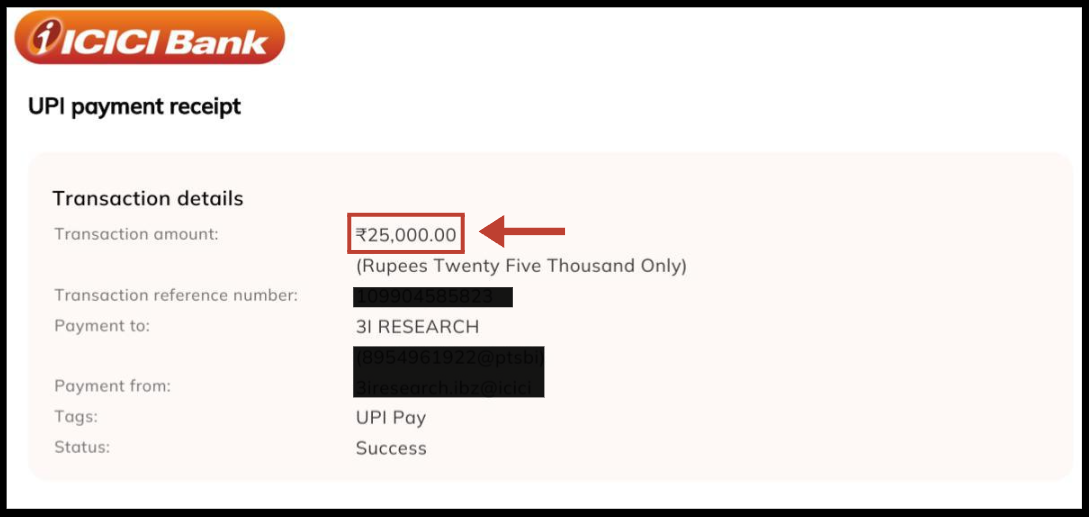
Even a situation that felt hopeless turned, because the evidence and the timing were right.
2. ₹3.12 Lakh Recovery From Mir Uniserv
A retail investor from Rajkot subscribed to Mir Uniserv, a SEBI-registered research analyst. What began as a search for guidance became a cycle of losses, recovery promises, and pressure to upgrade to costlier plans.
Every failed trade brought fresh assurances that the losses would be recovered, and more pressure to arrange additional funds.
This investor, though, had preserved what most people overlook: call recordings, payment receipts, trade records, and written messages.
With our help, more than 160 pieces of evidence were organised into a structured claim and presented before an Arbitral Tribunal through the CORD ODR platform.
After examining the recordings and documents, the Tribunal found multiple violations and awarded ₹3.12 lakh in compensation.
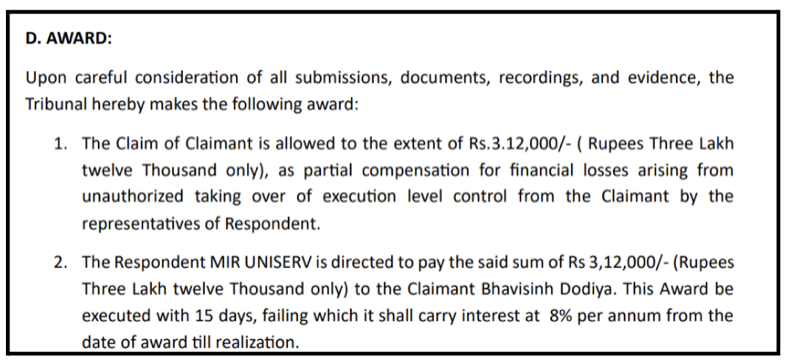
The lesson runs through both cases: when misleading promises are backed by evidence, you are not powerless.
Did a registered analyst take your fees and break these exact rules?
We will go through everything you have, match each document to the rule your analyst broke, and carry your claim forward through the right channels until it reaches a resolution.
What to Do Before You File Anything?
Before the formal complaint machinery, there is one step that matters more than any other, and getting it right early is what makes everything after it work.
Lock down your evidence immediately.
Open every platform where you dealt with this analyst. Screenshot every trade call with the date and time visible. Save every recovery promise word for word, with its date.
Capture every fee payment confirmation, every refund request you sent, and every reply you received. Then store all of it in two separate places right now, because evidence disappears faster than you expect.
Once your proof is safe, the formal route is straightforward, and because you dealt with a registered analyst, it runs entirely within SEBI’s system.
You begin with a written complaint to the analyst’s compliance officer, naming each violation and the fees involved, and giving them 21 days to respond, the window SEBI sets for grievance resolution.
If that response is unsatisfactory or never comes, one round is enough to escalate. Your next step is SEBI SCORES registration, where the grievance is lodged formally and the analyst is put on notice.
From there, the matter can move to SMART ODR for a neutral review, and on to arbitration if it stays unresolved.
We set out the whole pathway, and what each stage can realistically return to you, in our guide: how to lodge complaint against research analyst.
Conclusion
Priya stopped blaming herself the day she stopped asking “how did this happen” and started asking “what can I do about it.”
That shift, from victim to claimant, is what got her money back.
Your analyst held a registration number, and that number earned your trust.
They used it to collect fees for services they were not allowed to sell, make promises they were not allowed to make, and ignore duties they accepted when they applied for that certificate.
None of that is your fault. All of it is their regulatory liability.
So do not accept the refund denial as final, and do not let a non-refundable clause be the last word. The regulatory process does not care about their terms of service. It cares about whether they followed the rules.
They did not, and your next step is the one that holds them to it.
Report. Recover. Stay Fraud Free.
Look at the calls themselves. If a call named a specific stock, a specific entry price, a quantity, and a stop loss tied to your trade, that is personalised advice, whatever the analyst labels it. Save those screenshots, the specific content is your proof. Yes. Fees collected by promising that a higher plan will recover your losses involve a prohibited assurance. Every upgrade pitch that used loss recovery as its hook was a violation the moment it was made. Include every payment, original and upgrade, with dates and amounts. Significantly. A registered analyst must execute a formal client agreement and provide a risk disclosure before advising you. Skipping those steps is a mandatory procedural violation, and it shows the analyst was operating outside the compliance framework from your very first day. Yes. A registered analyst has a grievance redressal duty under SEBI's rules. Going quiet when you raise a formal refund request is a failure to meet it. Screenshot every unanswered message with its date, the silence is a second layer of violation on top of the original conduct. Yes. A non-refundable clause in a private contract cannot override SEBI's regulatory requirements. If the analyst charged for services outside their scope, made prohibited assurances, or skipped mandatory onboarding, those breaches stand regardless of what you signed. Do not let that clause stop you from filing.Frequently Asked Questions





 Add us as a preferred source on Google »

