

Quick Summary
Arbitration is the last step in SEBI’s complaint process, and it is often where investors finally get their money back from a research analyst. It will not refund normal market losses. But when a firm hid its fees, kept telling you to hold losing trades, or traded without your permission, arbitrators have ordered real money back, anything from a part of your fees to more than a crore in one case. What decides it, every single time, is your evidence. This page walks you through five real recovery cases and the exact path to file your own.
“I Thought the Loss Was Just Bad Luck”
Amit took the plunge and subscribed to a research service he spotted through their market calls and detailed stock recommendations.
For a couple of weeks, there were no signs of trouble. Still, gradually, he started losing money.
Initially, he thought it was the market’s fault.
But when he examined the messages, promises, payment records, and recommendations in detail, he started contemplating another question: Can I file an arbitration against a Research Analyst in India?
In case you are looking for Arbitration against research analyst India, it can be assumed that you are encountering similar situations.
The bright side is that investors are not always compelled to accept losses and forget about them.
Given the facts and evidence, dispute resolution methods, including arbitration, may be available to you.
When Can Arbitration Against a Research Analyst Become Relevant?
Arbitration is the final formal step in SEBI’s investor grievance ladder, and it’s binding.
Not every trading loss leads to arbitration.
However, investors often explore arbitration when:
- Service representations appear significantly different from actual delivery.
- Important communications and promises become disputed.
- Fee-related disagreements arise.
- Research services allegedly fail to follow expected standards.
- Documentation suggests potential regulatory concerns.
- Grievance mechanisms have already been exhausted without resolution.
The key factor is evidence.
The stronger the documentation, the stronger the investor’s position becomes.
When dealing with a dispute, the first step is to confirm the registration status and validity of the SEBI registered research analyst.
Once confirmed, you must first raise the issue directly with them. If unresolved within 30 days, you can escalate the matter to SEBI SCORES.
The entire process, conciliation and arbitration, happens online. No courtroom, no years-long litigation. Just documented evidence, a virtual hearing, and a decision.
How Investors Fought Back: Real Arbitration Success Stories
The following matters demonstrate an important lesson:
Authorities and dispute-resolution mechanisms can act when investors present strong evidence.
Case 1: Investor Recovered ₹65,788 Following Fee Dispute
One investor approached our team after paying substantial fees to Alpha Wealth Research and experiencing significant financial losses.
After an initial small profit, he was asked to pay a processing fee, and over time, his total payments reached ₹1,10,900, collected in multiple stages without clear documentation of the service plan, fee structure, or duration.
Initially, the investor believed there was no practical remedy available.
However, after reviewing payment records, communications, and service-related documents, a structured recovery strategy was developed.
The matter eventually moved through the dispute-resolution process with detailed documentation supporting the investor’s position.
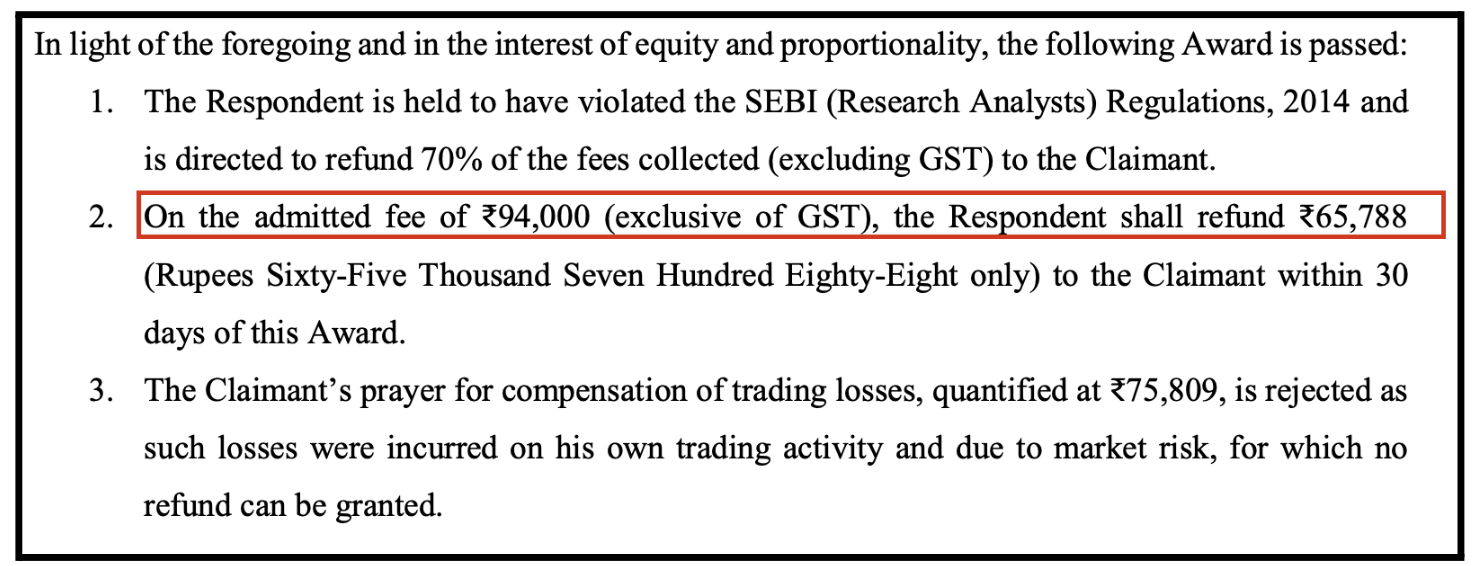
The arbitrator who looked into the matter held that the investor, to some extent, kept investing without strong questioning of the conditions.
Then again, the firm’s acts concerning fees were not transparent and even went beyond what the regulators allow.
Eventually, the judge instructed the firm to reimburse 70% of the fees obtained, ₹65,788, but the loss trading was disallowed since it was a market risk, and the trading decisions were the investor’s own.
The case highlights how proper evidence collection can become the foundation of a strong arbitration claim.
Most importantly, it shows that investors should not assume that every loss automatically ends their options.
Case 2: The ₹50,000 Settlement With Insight Research
This case involved an investor who paid ₹56,000 in service fees to Insight Research, a SEBI-registered Research Analyst, after being shown demo trades that generated a small initial profit of around ₹5,000 to build confidence.
Following onboarding, the investor incurred losses of ₹2,30,000, which he attributed to a complete absence of stop-loss or target guidance, alongside allegations that the firm conducted business primarily over WhatsApp
After a conciliation process, both parties reached a mutually acceptable settlement: the firm agreed to refund ₹50,000, paid in two UPI instalments, in exchange for the investor agreeing not to pursue further complaints, court cases, or arbitration on the matter.
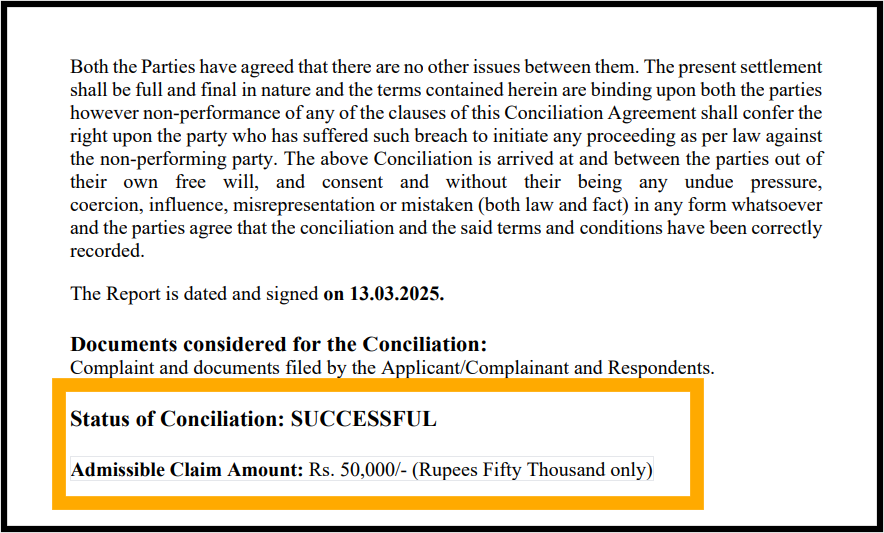
The case demonstrated that detailed documentation, verified phone numbers, WhatsApp chat records, and communication trails played a decisive role in the outcome.
Case 3: The ₹25,000 Arbitration Award Against Supreme Investrade
In another matter, an investor contacted our team with only a handful of screenshots and payment receipts. At first, the documents appeared incomplete.
However, after reconstructing communications, subscription records, and transaction history, a much clearer picture emerged.
The investor was offered a demo period during which he was repeatedly told to hold losing positions, including one trade where his loss grew from ₹15,000 to ₹40,000 after he was told not to exit because “it will bounce back.”
The matter proceeded to arbitration after an initial complaint on SEBI SCORES did not produce a satisfactory result.
The arbitrator’s ruling was a partial one: the fee refund claim was rejected because the investor had signed documentation stating fees were non-refundable, but ₹25,000 was awarded specifically as compensation for the additional losses caused by the firm’s repeated advice not to exit a deteriorating position.
This demonstrates why investors should never delete WhatsApp chats, invoices, emails, or promotional messages. Sometimes a single screenshot becomes an important piece of evidence later.
Case 4: From Massive Trading Losses to an Arbitration Award of ₹1.40 Crore
One of the most significant arbitration matters involved investor Sunil Kumar Narang and a trading account dispute.
This case, decided by a three-member NSE Arbitral Tribunal in February 2024, involved an investor who had deposited ₹90 lakhs and later transferred mutual funds and non-convertible debentures worth over ₹1.07 crore into a DEMAT account opened on the assurance of a minimum 24% annual return through Futures & Options trading.
During the proceedings, the tribunal closely examined account records, communications, and evidence relating to trade authorisation requirements.
After reviewing the material on record, the tribunal concluded that the actions constituted unauthorized trading by research analyst networks and awarded ₹1,40,93,159 in favour of the investor.
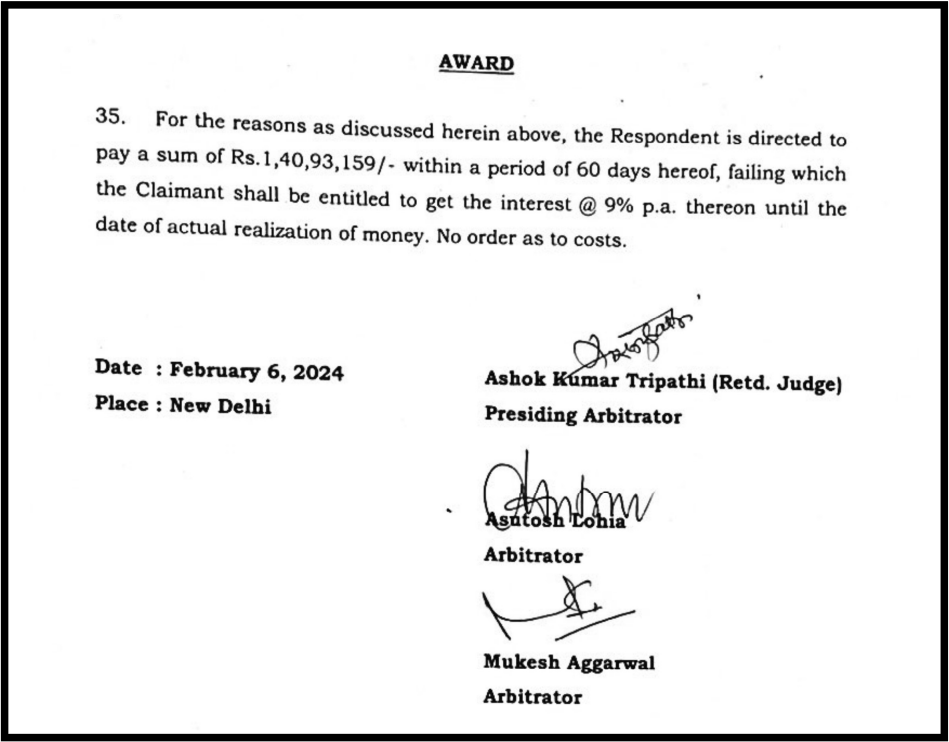
This case serves as a powerful reminder that properly documented disputes can result in substantial relief through arbitration.
Case 5: Documentation Helped an Investor Recover ₹1,09,625
In another matter handled by our team, an investor approached us seeking a financial recovery from Capital Craft Research after suffering significant losses while following their recommendations.
The representative allegedly assured daily earnings of ₹10,000 and a monthly return of ₹2,00,000.
Things went very wrong. Instead of steady profits, the so-called “expert advice” led Arbind to make a series of loss-making trades. Within a few weeks, he was left with depleted capital and losses amounting to ₹1,09,625. The arbitration verdict was delivered on August 19, 2025.
The Claimant wanted the Tribunal to give him ₹1,49,625. Yet, what happened was not a mere formal approval. Instead, the claims were subjected to a detailed and systematic review.
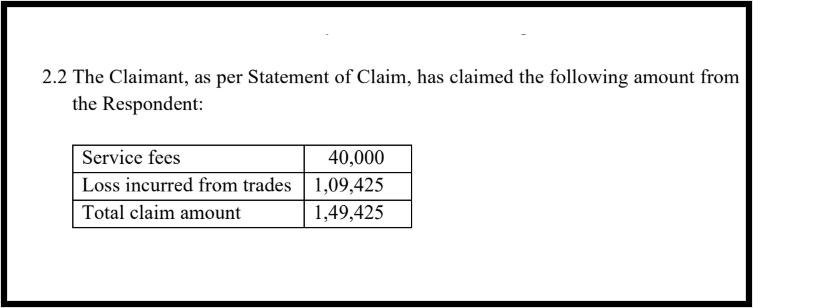
The Arbitrator, after checking the actual loss and service charges, came to the conclusion that the loss was 1,20,061 only.
Advisory Red Flags: Spot the Signs of a Fraud Analyst
If you’re currently subscribed to a Research Analyst or evaluating one, these are the patterns that, in case after case, preceded a dispute.
- Demo trades or screenshots are used to build trust before payment. In more than one of the cases above, the relationship began with a small, real or shown profit, used specifically to lower the investor’s guard before larger payments were requested.
- Fees collected in multiple unexplained instalments. When a firm collects money in stages, “processing fee,” then “premium upgrade,” then “renewal”, without a single clear agreement covering the total cost, duration, and refund terms, that pattern itself becomes evidence of a lack of transparency, as seen in the Alpha Wealth Research case.
- Advice to “hold” a losing position with assurances of recovery. This is one of the most consequential red flags. In the Supreme Investrade case, this single pattern became the basis for a ₹25,000 arbitration award.
- Business conducted primarily over WhatsApp with no formal documentation. This was a central allegation in the Insight Research case. The SEBI registered research analyst regulations require formal research reports, written agreements, and proper disclosures, not just chat-based “calls.”
- “Non-refundable” clauses are used to deny all recourse. Several firms point to signed agreements stating fees are non-refundable as their primary defence. As the Supreme Investrade case shows, this defence can still be partially overcome, particularly where losses were demonstrably worsened by the advisor’s specific conduct, separate from the general “no guarantee” language.
If your experience involved demo trades, multiple fee payments, recovery promises, or WhatsApp-only communication, preserve all records immediately. Early review of your evidence can make a significant difference later.
If one or more of these feels familiar, here’s exactly what the path forward looks like.
How Do You Take an Analyst to Arbitration?
Many investors assume arbitration is a complicated legal process reserved only for large disputes.
In reality, it is simply the final step of a clear, mostly online ladder that starts with your own records and ends with a binding award.
It begins with gathering your documents and raising a written complaint with the analyst first.
If that goes nowhere, you can complete SEBI SCORES registration to lodge the grievance formally, move to SMART ODR India for online conciliation if it stays unresolved, and finally reach arbitration, where an independent arbitrator reviews the evidence and issues a binding decision.
Arbitration sits at the end of that chain, and as every case above shows, the strength of your evidence at the start is what carries you through to it.
For the complete step by step process and what each stage can realistically recover, see our full guide on filing a SEBI complaint against research analyst.
Need help filing a complaint but not sure where to begin?
We will go through your documents, identify where your case is strongest, and take it forward through the right channels until it resolves.
Conclusion
In India, arbitration against a research analyst is not the same thing as getting back every loss in the market.
Rather, it’s about solving real issues through a formal, fair process based on proof.
Usually, it’s investors who keep their documentation, respond on time, and adhere to the proper complaint procedure who find themselves in a better position compared to those who delay.
A common question investors raise after advisory disputes is, can I get refund from SEBI registered RA?
While SEBI registration itself does not guarantee a refund, investors may have remedies available where regulatory violations or misleading practices are established.
So, if you feel there is a disagreement about the services you have been provided, the first thing you need to do is to get your papers in order.
Your case’s merits largely hinge on the quality of your evidence.
Frequently Asked Questions
Yes. Under the SEBI (Alternative Dispute Resolution Mechanism) (Amendment) Regulations, the regulator explicitly extended the online conciliation and arbitration framework to all registered intermediaries. If your RA is registered with SEBI, they are legally bound to participate in the SMART ODR process if you escalate a dispute against them
Generally, arbitrators distinguish between losses caused by normal market risk (not typically compensated) and losses that were specifically worsened by an advisor's conduct, such as being instructed not to exit a deteriorating position.
A non-refundable clause can limit a straightforward fee-refund claim, as seen in at least one documented case where this defence was upheld. However, it does not necessarily prevent arbitration from addressing other issues, such as a lack of transparency in fee collection, misleading claims made before onboarding, or losses worsened by specific advisory conduct.
Start by organising your documentation, payments, communications, agreements, and any complaint correspondence into a single chronological record. Then send a formal written complaint to the RA if you haven't already, giving them 30 days to respond.





 Add us as a preferred source on Google »

