

Quick Summary
A SEBI research analyst’s registration no longer expires on a fixed date. It stays valid for life, as long as the analyst keeps following SEBI’s rules, the old five-year renewal is gone. But one thing still expires: their NISM certification, which lasts three years and needs renewing. So checking validity means checking both. This page shows you what to look for, how to confirm an analyst is active, and what to do if their registration has lapsed.
You followed a stock tip, and afterwards a small doubt crept in: was that person even authorised to give it?
That doubt is worth acting on, because a registration you never checked is worth nothing.
Whether an analyst is currently valid decides whether you have any real protection if their advice goes wrong.
Here is the part most investors get wrong: they assume a registration, once granted, is either permanent or on a fixed clock.
The truth sits in between, and knowing exactly how it works is what lets you check an analyst properly before you trust a single recommendation.
Validity of SEBI Registered Research Analyst in India
Validity simply tells you whether an analyst is officially recognised by SEBI and authorised to provide research services right now. But two separate clocks are running, and people constantly confuse them.
Getting this distinction right is the whole point, because an analyst can be fine on one and a problem on the other.
The SEBI registration itself is now perpetual. It does not expire on a set date. Once granted, it stays valid for as long as the analyst keeps complying with SEBI’s rules.
The old requirement to renew registration every five years has been abolished, so a registration does not simply “run out.”
The NISM certification is separate, and it does expire. The NISM Research Analyst certification, which proves the analyst has cleared the required exam, is valid for three years.
To keep practising, the analyst must renew it, either by clearing the exam again or through the renewal route.
So when you check “validity,” you are really checking two things: that the registration is active and not suspended or cancelled, and that the analyst remains genuinely compliant behind it.
A registration that is technically active but sitting on top of lapsed certification or broken rules is exactly the situation worth spotting early.
How to Check Validity of SEBI Registered Research Analyst Online?
Confirming an analyst’s validity takes only a few minutes on SEBI’s own records, and it is the single most useful check you can run before acting on any recommendation.
Here is how to do it, step by step:
- Find SEBI’s official research analyst records. Go to SEBI’s official website and open its list of registered research analysts. Only ever verify through SEBI’s own portal, never a screenshot or a link the analyst hands you.
- Search by name or registration number. Look the analyst up using their name or their INH registration number. Searching by the registration number usually gives you the most precise match.
- Match every detail. When the record appears, check that the name, registration number, address, and other details line up exactly with what the analyst told you. A mismatch anywhere is a reason to pause.
- Read the validity and status. Finally, check the status shown in SEBI’s records: that the registration is active and not suspended or cancelled. This is the field that tells you whether the analyst can legally operate right now.
If everything matches and the registration is active, you can proceed with far more confidence.
If it does not, that is your signal to stop before any money moves.
What If the Registration Has Expired or Been Cancelled?
Since the registration itself no longer expires on a timer, a registration that shows as inactive means something more serious: it has been suspended, cancelled, or surrendered, or the analyst was never properly registered to begin with.
Either way, treat it as a firm warning.
An analyst without a valid, active registration may not be authorised to provide research services at all, and relying on them carries real risks:
- No regulatory accountability. Without valid registration, there is no SEBI oversight, so no formal accountability if the advice is wrong or misleading.
- No grievance route. You lose access to the structured complaint and dispute-resolution system that protects registered investors, making losses far harder to recover.
- Higher risk of exaggerated claims. Unregistered or lapsed operators are far more likely to promise inflated returns with no verified research behind them.
- Hidden conflicts. Without disclosure obligations, an analyst may push stocks for their own gain or run undisclosed conflicts of interest.
Whether a registration has been cancelled, and why registrations get cancelled or surrendered in the first place, is something we cover in detail on our page on SEBI research analyst registration cancellation.
The short version for you as an investor: if the status is anything other than active, do not pay and do not act until you have verified it independently.
A Real Case: When Expired Compliance Met Regulatory Action
Validity is not a paperwork technicality.
A real SEBI order shows what happens when an analyst operates without the compliance that validity depends on.
During an inspection of Manas Jaiswal, a research analyst, SEBI found a pattern of exactly the failures this page warns about.
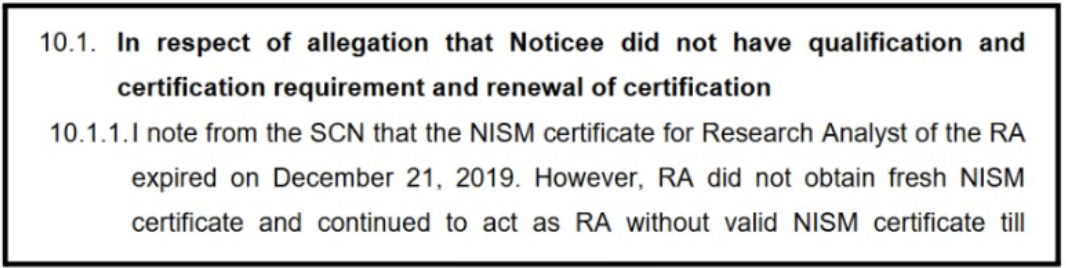
What SEBI found: the analyst had operated without valid NISM certification for three years, and kept issuing research recommendations despite the compliance lapse.
There was no documented research or analytical backing for the stock calls, no disclosure of financial interests or conflicts across public platforms, and vague framing such as a “risk and reward ratio 1:2” with no real explanation.
The analyst also classified advice as “trading” to sidestep research obligations.
The penalty: SEBI directed payment of ₹5,00,000 within 45 days, warning that failure could trigger recovery proceedings, including attachment of assets.
The case makes the lesson concrete. Expired certification, missing disclosures, and no research backing do not stay hidden, they add up to serious regulatory action.
You can read the full order on our Manas Jaiswal page.
Found an analyst whose registration or certification does not check out?
We will verify their exact status against SEBI’s records, work out whether their conduct breached the rules, and help you file if it did.
What to Do If a Research Analyst Broke the SEBI Rules?
If an analyst gave you advice while their compliance had lapsed, or misled you in any way, and they fall under SEBI’s framework, you have a formal route to act, no lawyer required.
Start by gathering your evidence: payment receipts, chats, emails, subscription details, and any reports or calls you received, into one clear file.
Then raise it in writing with the analyst first.
If that goes nowhere, you can file complaint in SEBI SCORES, the official grievance system.
From there, SMART ODR portal registration opens the next stage of dispute resolution, with arbitration as the final step if needed.
For the complete reporting process, see our guide: SEBI research analyst complaint portal.
Conclusion
Checking validity is one of the simplest ways to protect your money from misleading advice, and it takes only minutes.
Remember the two clocks.
The registration itself is now perpetual, valid until SEBI suspends or cancels it, while the NISM certification behind it expires every three years and must be renewed.
A genuinely valid analyst is active on both and compliant across both.
Verify the registration, confirm the status is active, and never act on a recommendation from someone whose validity you have not checked.
A few minutes of checking today can save you from a far bigger loss tomorrow.
Frequently Asked Questions
The registration is now perpetual, so it does not expire on a fixed date as long as the analyst keeps complying with SEBI's rules. However, SEBI can suspend or cancel it for non-compliance or misconduct, so "perpetual" is not the same as untouchable.
No. The older requirement to renew SEBI registration every five years has been abolished. Registration is now perpetual. What still needs renewing is the separate NISM certification, which is valid for three years.
SEBI registration is the authorisation to work as a research analyst and is now perpetual. NISM certification proves the analyst has cleared the required exam and stays valid for three years. An analyst needs both to operate legitimately.
If the status shows suspended, cancelled, or inactive, the analyst may not be authorised to provide research services. You lose SEBI oversight and grievance protection, so avoid paying or acting on their advice until you verify the status independently.
Search SEBI's official records by the analyst's name or INH registration number, and check that the status reads active, not suspended or cancelled. Match the name, number, and address to what the analyst told you before trusting any recommendation.





 Add us as a preferred source on Google »

