

Quick Summary
Insight Research is a SEBI registered Research Analyst under registration number INH000011343, led by principal officer Saweety Saharan. Beyond that registration number, four separate Google reviews describe similar experiences with the firm. One reviewer reports gains during a demo period that reversed after payment. Another describes an overnight scalping call that erased their capital. A third reports a loss near four lakh rupees and warns against paying the full fee upfront. A fourth alleges no response after repeated emails. This page goes through each review in detail and checks it against the firm’s own SEBI SCORES numbers.
Insight research reviews on Google carry a detail that a registration number alone will never tell you: what actually happened after the payment cleared.
Four different users describe four different problems, from a demo period that showed profits to a fee that disappeared without a single reply.
One review alone could be dismissed as bad luck. Four independent accounts describing similar patterns are harder to explain away.
This page goes through what each reviewer said, then checks that story against Insight Research’s own complaint disclosures.
What Do Insight Research Reviews Reveal About the Firm?
The short answer is that these reviews describe a consistent sequence, not four unrelated complaints.
A user is shown a demo that performs well. Once real money is committed, the outcome changes and the explanation shifts to market conditions rather than the advice given.
Two of the four reviewers describe losses they were unable to recover, and a third describes a firm that stopped responding once the losses appeared. That pattern, more than any single review, is what an investor evaluating Insight Research should weigh carefully.
These are user accounts posted publicly. They have not been verified by SEBI and do not carry the weight of a regulatory order. What they do offer is a firsthand account of what four different people say they experienced.
Each review below covers a different stage of the client relationship, from the first demo call to the point where communication stopped entirely.
Reading them in order shows how a relationship with this kind of research service can move from confidence to loss.
Recognise which one matches your own experience before deciding what to do next.
1. Trust Built on Demo Profits, Then Real Losses Begin
According to a review posted on Google, the reviewer was shown consistent gains during a demo period before subscribing.

Once the paid subscription began, the outcome reversed. When the reviewer questioned the losses, the response pointed to market manipulation rather than the calls that were given.
Building confidence on demo results that do not repeat once money is on the line is a pattern SEBI’s Code of Conduct for research analysts treats seriously, because recommendations must be communicated truthfully whether or not the client has paid yet.
The same reviewer raised a separate concern, suggesting that some positive reviews visible on the platform may have come from people connected to the firm rather than independent clients.
2. Scalping Advice That Wiped Out an Entire Position
A second reviewer describes being advised on a scalping trade, an intraday strategy that is not meant to be held past the trading session.
Despite that, the reviewer reports being encouraged to hold the position overnight and to add more capital while it moved further into loss.
Holding an intraday call overnight changes its entire risk profile, and encouraging additional capital into a position already losing money is a pattern that deserves scrutiny regardless of which firm gives the advice.
The reviewer states the result was a complete loss of the capital committed to that trade.

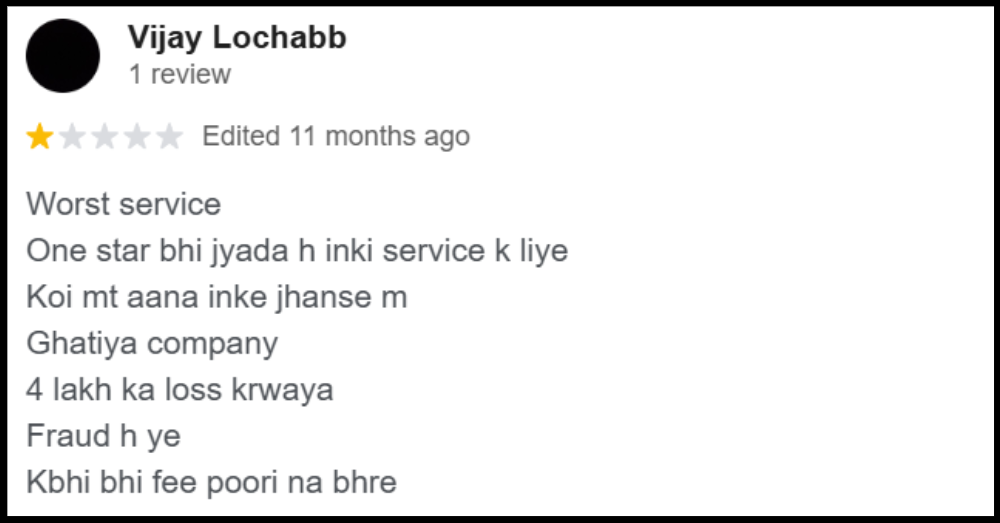
3. A Rs 4 Lakh Loss and a Warning About Fees
A third reviewer reports a loss of close to four lakh rupees, a significant sum for any retail investor working with a research subscription.
The review ends with a specific piece of advice for other users: never pay the full subscription fee upfront.
That line matters beyond this one case. If a plan’s value is uncertain until the calls have been tested, paying the full term in advance removes your ability to walk away once a pattern of losses appears.
4. Support Went Silent After the Losses Began
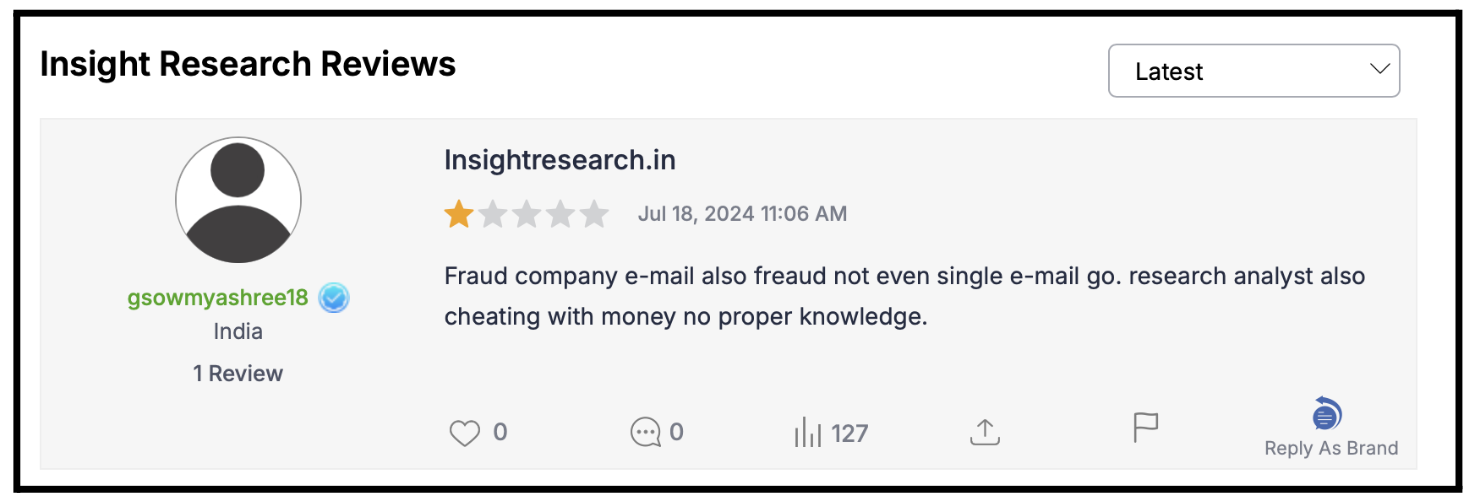
A fourth reviewer describes sending emails that never received a response.
According to this review, the silence came after losses had already occurred, at the point when the client most needed the firm to engage.
The reviewer went further and used strong language to describe the experience. We are reporting what this reviewer said on a public platform. We are not independently verifying this account, and no SEBI order confirming this conduct has been issued as of August 2026.
What is verifiable is the underlying compliance point. SEBI requires registered research analysts to handle investor grievances fairly and within defined timelines.
A firm that stops responding once a client raises a loss is not meeting that standard, regardless of what caused the original loss.
How Do These Reviews Line Up Against Insight Research’s Official Complaint Numbers?
Insight Research’s own SEBI SCORES disclosure lists 22 complaints in its most recent reporting period, all marked resolved with none pending beyond three months.
Twenty-two complaints in one reporting cycle is not a small number for a firm this size, even with a full resolution record on paper.
For the complete complaint breakdown by year and by source, the Insight Research page on this site carries the full disclosure data.
A resolved complaint on SEBI’s dashboard does not always mean the underlying issue matched what the client expected. The reviews above give a sense of what some of those 22 complaints may have actually involved.
Also Read: 257 complaints since 2021 & reviewers naming the staff who told them to hold losing positions, in OnePaper Research Analysts Reviews.
The ₹50,000 Recovery Case: A Real Dispute Against Insight Research
This isn’t a hypothetical scenario. It’s a documented conciliation case, Yogesh Gupta vs. Insight Research, resolved through SEBI’s Online Dispute Resolution (ODR) platform, Webnyay, empanelled by NSDL. Here’s what happened.
Yogesh Gupta subscribed to Insight Research’s services and paid a fee of ₹56,000. What followed was a trading loss of ₹2,30,000. His complaint wasn’t just about losing money; it was about how that money was lost.
The specific allegations raised included:
- Representatives initially showed demo trades generating small profits (around ₹5,000) to build trust before any real money was involved.
- After the fee was paid, recommendations came primarily through WhatsApp, a channel that lacks the transparency and traceability expected under SEBI regulations.
- No proper stop-loss or target guidance was provided, leaving the client exposed to unlimited downside risk.
- The firm’s communication style crossed from research recommendations into specific trade execution instructions, which goes beyond what a Research Analyst is permitted to do.
Insight Research defended itself by pointing to their Research Recommendation Agreement, which states that the firm cannot be held responsible for trading losses. They maintained they never guarantee profits and provide research, not assurances.
However, through the conciliation process, with Aseem Juneja representing Yogesh Gupta, the case reached a successful resolution on March 13, 2025.
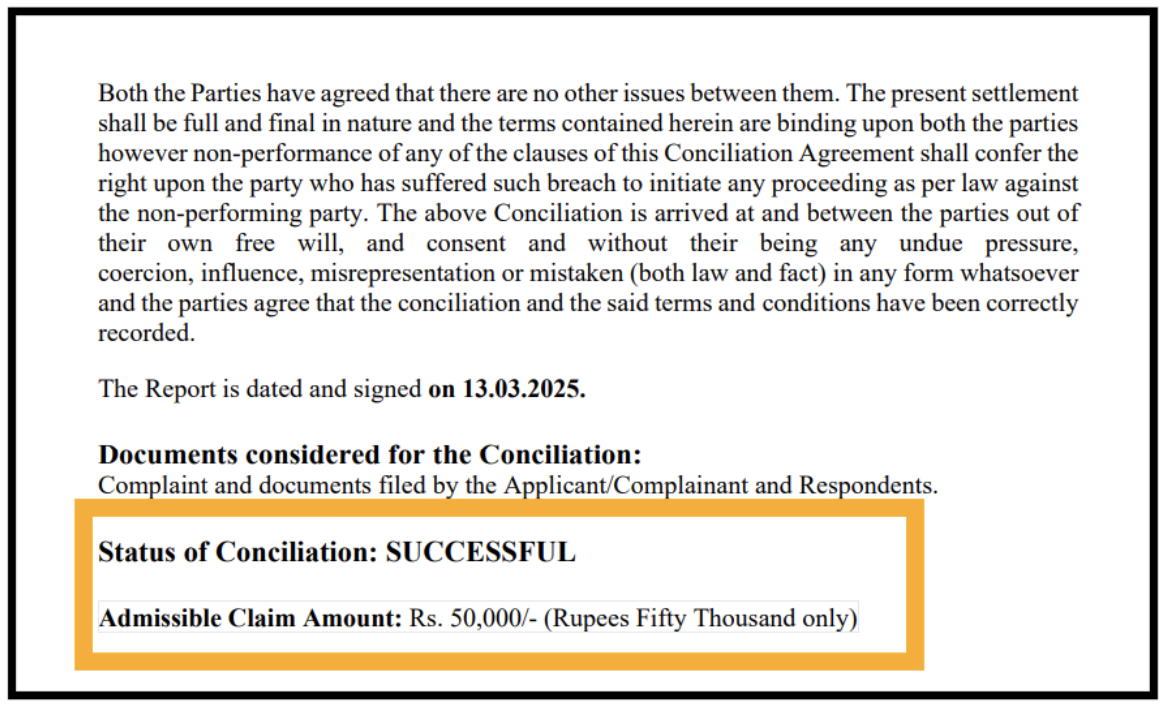
The Respondent agreed to refund ₹50,000 to the investor, paid in two instalments via UPI on March 3 and March 7, 2025. Upon receiving the amount, the matter was settled as full and final.
This case proves that when investors document their experience properly and get the right representation, recovery is possible.
Also Read: Shreeji Research Reviews where one reviewer said that after losses, they were encouraged to add more capital in an attempt to recover, but lost it too.
What Should You Do If Your Own Experience Matches These Reviews?
If any of the four situations above sound familiar, treat it as a starting point rather than the end of the process.
Two things matter before you decide what to do next. Confirming the firm’s registration status, and understanding which of your specific experiences give you formal grounds to complain.
Insight Research holds SEBI registration INH000011343, and confirming the Insight Research SEBI registered status is still active takes about two minutes on SEBI’s own database.
Once you have confirmed the registration, the next question is whether your specific experience, a fee cap breach, a demo trap, missing stop-loss guidance, or an unanswered complaint- qualifies under SEBI’s rules.
The complaint against Insight Research page on this site walks through the full evidence checklist and the five-step escalation process, including the case where one investor recovered Rs. 50,000 through SMART ODR.
If your issue involves a different research analyst entirely, the same evidence and escalation logic applies.
The complaint against SEBI registered research analyst page covers that broader process, starting with a written complaint to the firm and moving through SEBI SCORES.
SEBI gives the firm a fixed window to respond directly to your complaint through this route. Keep a record of the response, or the lack of one, since that becomes part of your file at the next stage.
If that doesn’t resolve it, SMART ODR conciliation is the next step.
Not sure if what you experienced with Insight Research counts as a valid complaint?
We review your documentation, match it against the specific SEBI violation it falls under, and prepare your SCORES filing from start to finish. Register with us for a free consultation.
Conclusion
Four independent reviews describing a demo trap, an overnight scalping loss, a four lakh rupee loss, and an unanswered complaint do not prove a regulatory violation on their own.
What they do is give you a way to check your own experience against what other Insight Research clients report going through.
If your situation matches even one of these patterns, start documenting it today. Screenshots, payment receipts, and call records lose value the longer you wait to collect them.
Verify the registration, gather your evidence, and use the formal complaint route rather than relying on a review alone to make your case.
Report, Recover, Stay FraudFree
No. These are user accounts posted publicly on Google and have not been confirmed by SEBI or by an independent investigation. They are reported here as reviewer statements, not as established fact. Not directly. SEBI needs your own documentation, such as payment receipts, WhatsApp messages, and trading statements. A public review can support your understanding of a pattern, but your complaint must rest on your own evidence. Not necessarily. A complaint marked resolved on SEBI's dashboard means the firm responded within the required timeline. It does not confirm the client agreed with the outcome or received the resolution they wanted. That decision depends on your own risk comfort. The reviews are worth weighing alongside the firm's SEBI registration, its fee structure, and its complaint disclosure before you subscribe to any plan. Start by collecting your payment receipts, SMS records, and any written communication with the firm. Then confirm the registration status and follow the formal complaint process rather than posting a review alone.Frequently Asked Questions





 Add us as a preferred source on Google »

