

Quick Summary
OnePaper Research Analysts carries a 2.6 star average across 111 Google reviews, with several detailed accounts describing large trading losses following specific instructions from firm staff. Its own complaint disclosure records 257 complaints received since 2021, with 248 resolved and 9 still pending as of August 2026. Complaint volumes rose sharply from 2024 onward, and August 2026 alone brought 12 new complaints against a monthly average closer to 2 or 3. This page covers that record in full. Registration and pricing are covered on our OnePaper Research Analysts page. The full SEBI adjudication order against the firm runs to 28 pages and is worth reading in its own right, which is why it has its own dedicated page rather than a summary here. Our OnePaper Research Analysts SEBI Order page works through the evidence, the firm’s defence, and the penalty in full.
OnePaper Research Analysts carries a 2.6-star average across 111 Google reviews, and its own mandatory disclosure records 257 complaints received since 2021, with 9 still unresolved as of the most recent reporting month.
A pattern the regulator already found, described from the client side rather than the inspection side.
Read it in the SEBI adjudication order covered on our OnePaper Research Analysts SEBI Order page, this complaint and review record is not a separate concern.
This page works through the full complaint disclosure, the reconciliation problems inside it, and five detailed Google reviews that describe experiences consistent with what SEBI’s own order documents.
OnePaper Research Analysts Reviews: What Does The Data Say?
The reviews of this firm split into two sources that agree with each other more closely than is usual: independent Google reviews, and the firm’s own mandatory complaint disclosure.
Where other firms on this site show a gap between a polished public rating and a messier underlying record, here the two point in the same direction.
The Google average is low, and the complaint volume is high and rising, and neither is out of step with the other.
What Does OnePaper’s Complaint Disclosure Show?
Every SEBI-registered Research Analyst must publish complaint data.
OnePaper’s is unusually high in volume compared to every other firm reviewed on this site, and it deserves to be read in full rather than summarised away.
Yearly complaint data
| Period | Received | Resolved | Pending at Year End |
|---|---|---|---|
| 2021-2022 | 34 | 32 | 0 |
| 2022-2023 | 44 | 44 | 0 |
| 2023-2024 | 38 | 40 | 0 |
| 2024-2025 | 75 | 64 | 11 |
| 2025-2026 | 44 | 46 | 9 |
| 2026-2027* | 22 | 22 | 9 |
| Total | 257 | 248 | 9 |
Current complaint position as of 31 August 2026
| Source | Pending From Previous Month | Received | Resolved | Total Pending |
|---|---|---|---|---|
| Support | 0 | 1 | 1 | 0 |
| SEBI SCORES | 0 | 11 | 7 | 4 |
| Other Sources | 5 | 0 | 0 | 5 |
| Grand Total | 5 | 12 | 8 | 9 |
What the Numbers Show
1. Volumes Rose Sharply from 2024 Onward
The firm received 34, 44 and 38 complaints in its first three years, then jumped to 75 complaints in 2024-25, its highest annual figure.
That timing lines up closely with the period SEBI’s own inspection covered, April 2022 to March 2024, and the SCN that followed in November 2024.
2. August 2026 was an Unusually Heavy Month
OnePaper received 12 complaints in August 2026 alone, against roughly 2 in each of the two preceding months.
That is the highest monthly figure since July 2024, when 6 were received.
3. Most of the Recent Spike came through SEBI SCORES rather than Direct Contact
Of the 12 complaints received in August, 11 arrived through SEBI SCORES, with 7 resolved and 4 left pending.
Only 1 complaint that month came through the firm’s own support channel.
A complaint file weighted this heavily toward the regulator’s own platform, rather than toward direct contact with the firm.
This is the same pattern this site has flagged on other firms as a sign that clients do not expect a useful response from the firm itself.
4. Nine complaints Remain Pending, and five have been Open Long Enough to lose their Origin
The total pending figure of 9 includes 5 carried forward from “Other Sources” with no further detail on how long they have been outstanding, and 4 from SCORES received in the same month.
Also Read: Niveshartha Private Limited Reviews, where 79 complaints were reported in just 1 year.
Do the Yearly Figures Actually Reconcile?
Not entirely, and the gap sits inside individual years rather than between tables, which is a different kind of problem from what shows up on most other firms’ disclosures.
The 2021-22 row shows 34 received, 32 resolved, and 0 pending.
That leaves 2 complaints unaccounted for within the row itself; if they were not resolved and nothing was pending, there is no explanation for where they went.
The 2023-24 row shows 38 received but 40 resolved, meaning more complaints were closed that year than were opened in it.
That can happen if complaints carried over from an earlier year, but this table has no carried-forward column to show that, and the 2021-22 shortfall of 2 is never explicitly picked up anywhere later in the table.
This is not proof that any specific complaint went unaddressed.
It is a gap in how the disclosure is presented, and it means the table on its own cannot answer a plain question: how many complaints from OnePaper’s first three years were genuinely resolved, and how many simply stopped appearing in the count.
What Do Google Reviews of OnePaper Research Analysts Say?
OnePaper holds a 2.6-star average across 111 reviews, and the negative reviews are detailed rather than generic, several running to several hundred words describing a specific sequence of events.
Read alongside the SEBI order, the pattern these reviewers describe- being told to hold losing positions, being promised recovery, being pressured to add more funds- matches what the regulator’s own inspection documented almost exactly.
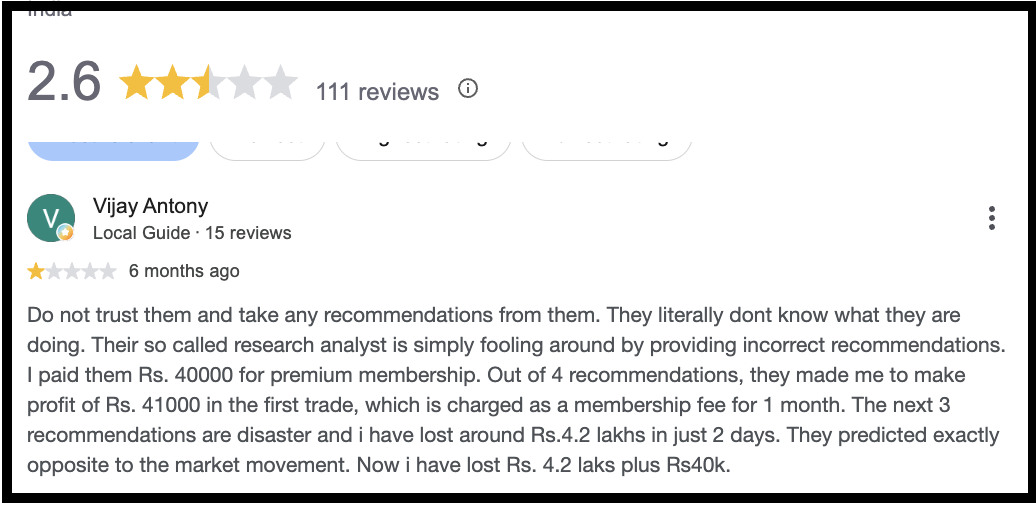
1. Reviewer Describes an Initial Profitable Trade Followed by a Run of Losses
This reviewer describes paying ₹40,000 for a premium membership, profiting on the first of four recommendations, then losing roughly ₹4.2 lakh across the remaining three within two days.
They state the recommendations moved in the opposite direction to the market on each occasion.
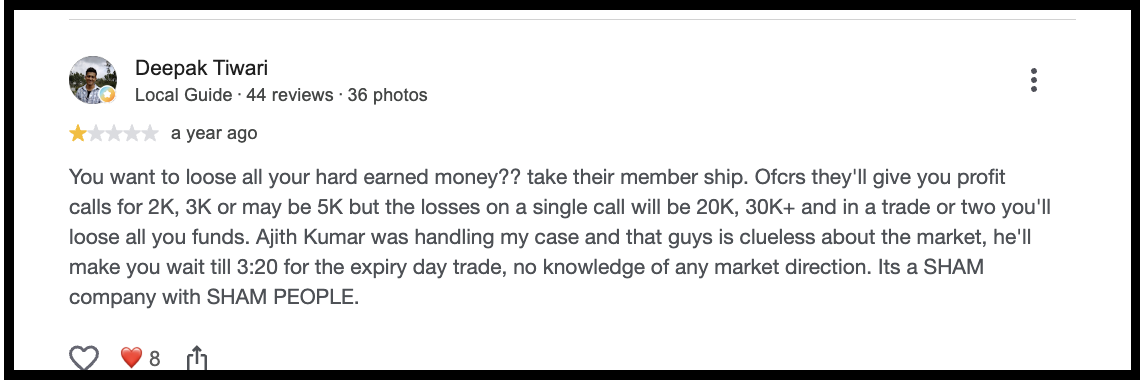
2. A Reviewer Names a Staff Member and Describes Being Kept Waiting Until Expiry
This reviewer describes being handled by a staff member they name, and states this person showed little market knowledge, kept the client waiting until close to expiry on option trades, and gave no clear sense of market direction.
They describe losses substantially larger than the profit calls initially offered.
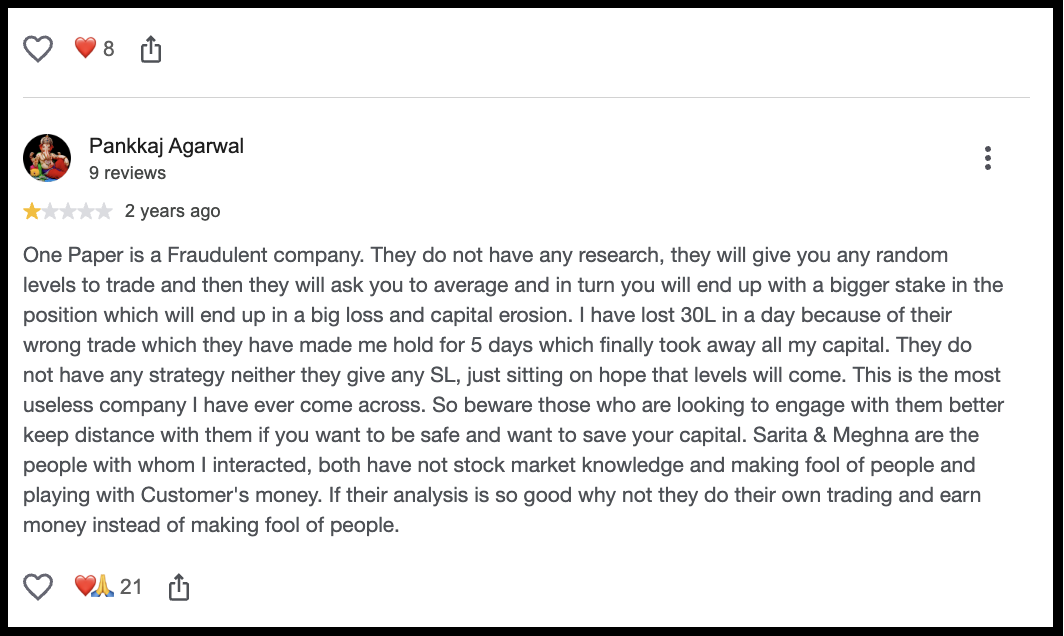
3. A Reviewer Describes Being Told to Average Into a Losing Position Over Several Days
This reviewer describes receiving levels to trade without a defined strategy, then being told to average into the position as it moved against them, eventually holding it for five days before it closed out a very large loss.
They name two staff contacts and state neither demonstrated market knowledge.
This account matches the pattern SEBI’s own order documents directly: staff instructing clients to hold and average losing positions rather than exit them.
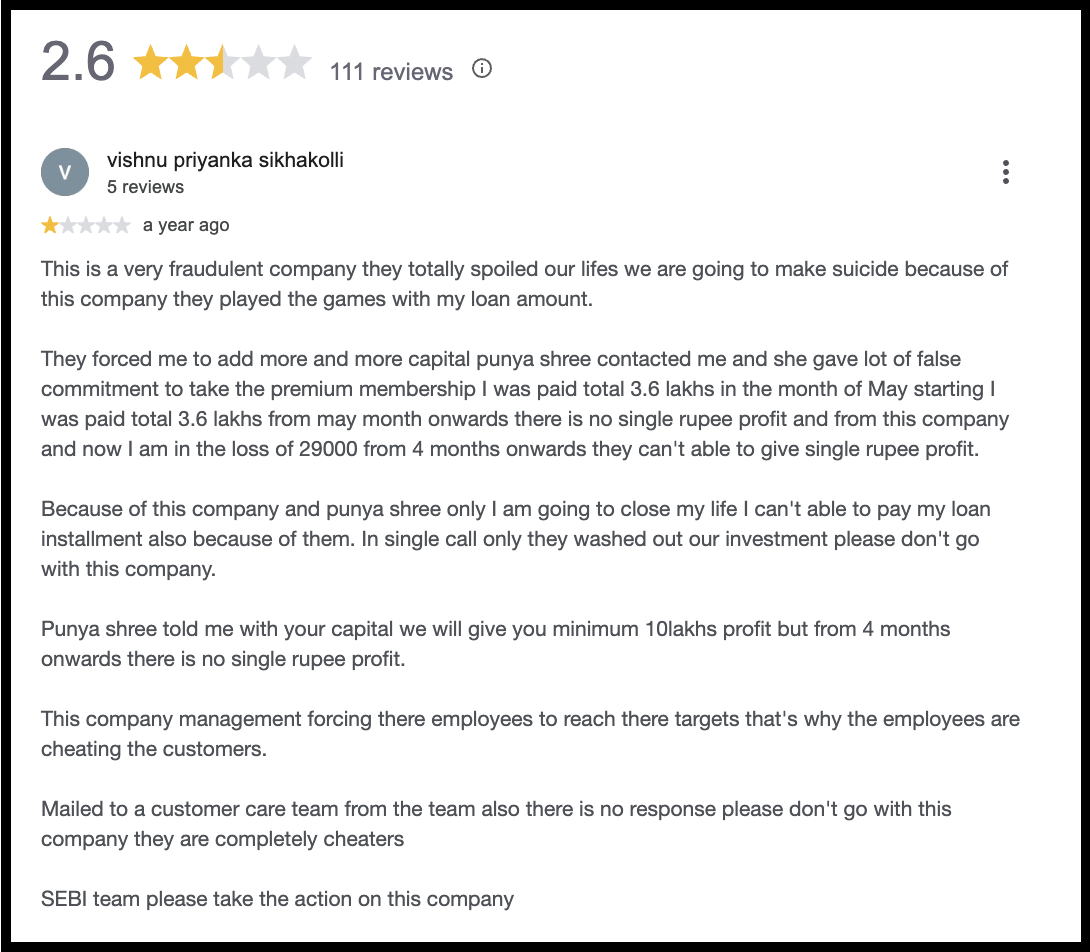
4. A Reviewer Describes Severe Financial Strain Following Repeated Payments With No Returns
This reviewer describes paying a total of ₹3.6 lakh from May onward on the assurance of a staff member they name, receiving no profit across four months, and states the financial pressure this created has been severe.
They describe the staff member promising a specific minimum profit figure that did not materialise, and state they received no response from the firm’s customer care team after raising the issue by email.
Given the severity of what this reviewer describes about their own state of mind, this account is reported here in summary rather than in detail, and it is not being reproduced in full.
If you or someone you know is in a similar situation and struggling with the financial and emotional weight of a trading loss, please reach out to a mental health professional or a crisis helpline in addition to pursuing any financial complaint.
5. A Reviewer Describes an Escalating Pattern of Profit Followed by Pressure to Reinvest
This reviewer describes a repeating cycle: an initial small profit used to encourage a further, larger subscription, followed by losses that erased the account, followed by pressure to add more funds.
They describe the firm’s approach as more like gambling than research and state they would rate the experience negatively if the platform allowed it.
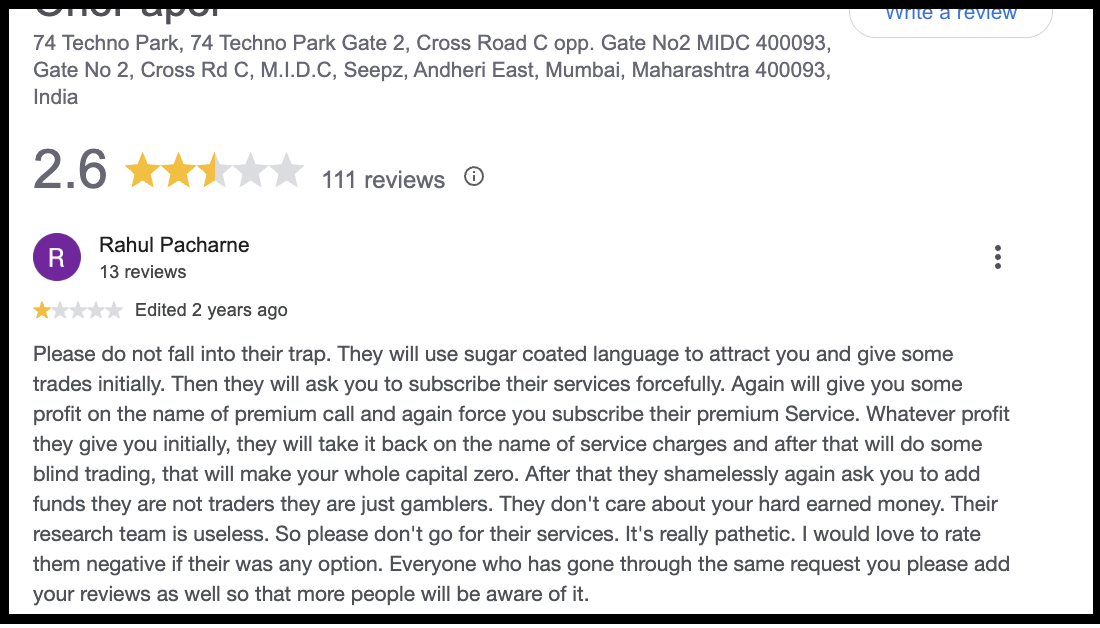
We are reporting what these users said on a public platform. We are not independently verifying these specific accounts.
Unlike the conduct described on our OnePaper Research Analysts SEBI Order page, which is drawn from a formal SEBI order.
These reviews are third-party accounts, and no SEBI order has been issued in relation to these specific complaints as of this writing.
Also Read: Homepage shows 1 complaint while its own table shows 2, along with users claiming losses & no support, in Modern Algos Pvt Ltd Reviews.
What Other Details Are Worth Knowing?
A few smaller points on the site add context to the reviews and complaint data above.
The website describes “consistent results” through its research and analysis, language that can create expectations around outcomes that no research service can guarantee, and which sits awkwardly against both the complaint volume above and the specific findings in SEBI’s order about staff promising returns.
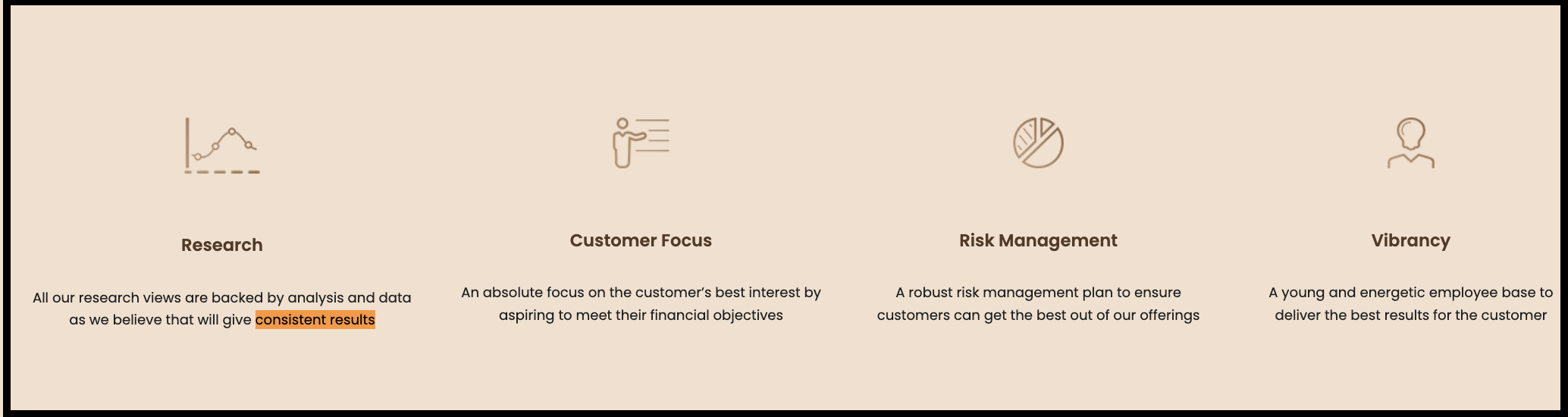
It also describes “40 years of combined corporate experience” across its team without breaking down which individuals contribute to that figure or in what roles, making the claim unverifiable from the outside.

The firm states it maintains extensive client records, without describing what information is retained or for how long, a gap worth asking about directly given how central record-keeping was to SEBI’s own findings against the firm.
How to File a Complaint Against OnePaper Research Analysts?
If your experience matches any of the patterns described above or in SEBI’s own order, you are not building a complaint from scratch. A regulatory finding already exists that can be cited directly.
Start by gathering everything in writing: chat records with any staff member, payment receipts, and a clear timeline of what you were told before and after each trade.
If a staff member promised a specific return or loss recovery, that promise itself is the core of a strong complaint regardless of how the trade performed.
Send your grievance to the firm in writing, and keep the sent record.
Given the SEBI order’s finding that this firm did not adequately monitor its own staff, do not assume an internal response will be sufficient on its own.
If the response is not satisfactory, escalation runs through a specific set of channels, and each one exists for a different stage of the dispute rather than as alternatives to pick from.
1. SEBI SCORES for the Formal Regulatory Complaint
Once a direct grievance goes unresolved, the complaint moves onto the regulator’s own platform.
The SEBI SCORES portal is where that filing happens, and citing the June 2026 adjudication order by name in your complaint gives it added weight, since it establishes that this firm’s conduct has already been formally examined.
2. SMART ODR for Conciliation if SCORES does not resolve it
Where SCORES closes without a satisfactory outcome, the next stage is structured conciliation rather than a repeat complaint.
The SMART ODR login page covers how a conciliator gets assigned and what documents to bring into that session.
3. Stock Market Arbitration if Conciliation does not Settle it
When conciliation still does not produce a settlement, arbitration is the stage that ends in a binding outcome.
Stock market arbitration results in an award enforced through the exchange rather than negotiated with the analyst directly.
That covers each channel on its own, but none of them explain how to actually build and sequence a case from the first email onward.
If you want to know the full process in detail, check our guide complaint against SEBI registered research analyst.
Told to hold a losing position, or promised recovery?
We build your case around your own chat records and payment trail, and reference the June 2026 SEBI order directly where it applies, putting your complaint on record in a form the firm cannot dismiss as an isolated incident. Register with us for a free read on your case.
Disclaimer
This page is based on OnePaper’s own published complaint disclosure and named public Google reviews, reported rather than independently verified, current as of September 2026.
The formal findings against the firm are set out separately on our dedicated SEBI order page.
Verify current figures at source before acting, and treat this page as research, not legal or investment advice.
Conclusion
OnePaper Research Analysts carries a 2.6-star Google average and 257 disclosed complaints since 2021, with volumes rising sharply from 2024 and a further spike in August 2026.
Several detailed Google reviews describe exactly the pattern SEBI’s own order documents on the regulator’s side: staff instructing clients to hold losing positions, promising recovery, and pressing for more funds.
If you have experienced anything similar, you are not dealing with an isolated dispute over research quality.
A formal SEBI finding already exists, and your own chat records and payment trail can be built into a complaint alongside it.
Report. Recover. Stay Fraud Free.
Frequently Asked Questions
Yes, closely. Several detailed reviews describe staff instructing clients to hold or average losing positions and promising recovery, which matches the specific WhatsApp evidence SEBI's June 2026 order documents from named client complaints.
Its own disclosure shows 257 complaints received since 2021, with 248 resolved and 9 pending as of August 2026, including a sharp rise from 2024 onward.
Not entirely. The 2021-22 year shows 2 complaints unaccounted for between what was received and resolved, and the 2023-24 year shows more resolved than received, which the table's format cannot fully explain.
Named, detailed reviews describing specific dates, amounts and staff names carry more weight than a firm's general marketing language, particularly where a regulator has already found a matching pattern of conduct through its own inspection.
Yes. A published SEBI adjudication order is public record, and referencing it by order number strengthens a complaint by showing the firm's conduct has already been formally examined and found to violate specific regulations.





 Add us as a preferred source on Google »

