Quick Summary
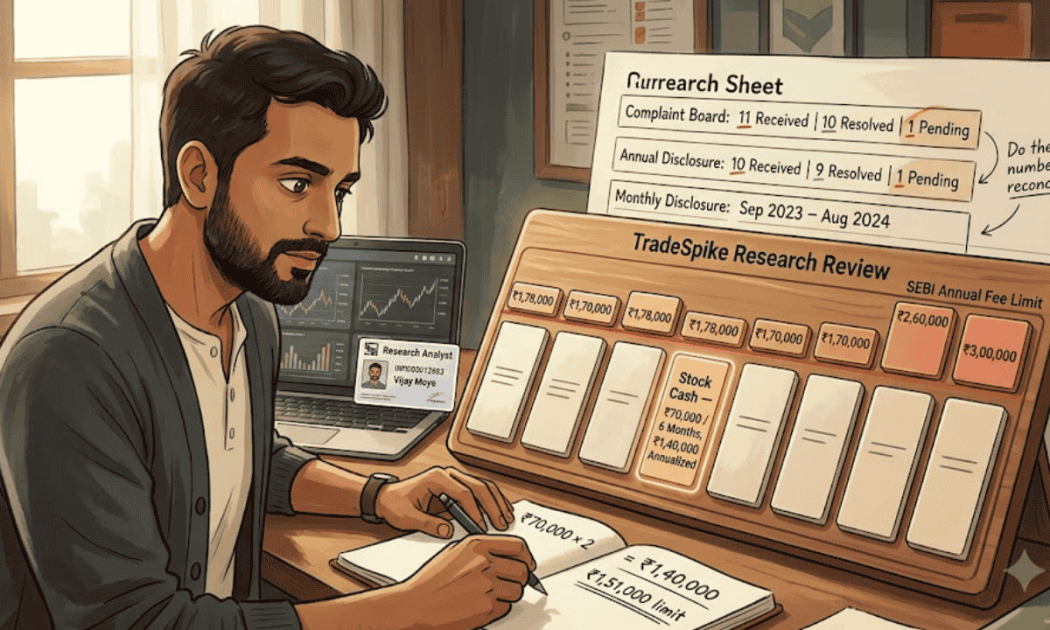
TradeSpike Research Services is a SEBI Research Analyst business, registration INH000012883, run by Vijay Moye from Indore since September 2023. Checked properly, across every service and every billing cycle it publishes, 18 of 19 price points cost more per year than SEBI actually allows. Its complaint board also can’t seem to agree with itself. One table shows 11 complaints. A second shows 10. A third contradicts its own pending count.
Have you ever checked the pricing page of your stock advisory service against actual regulatory limits?
If you do the math on TradeSpike Research, out of nineteen listed plans, exactly one complies with SEBI fee rules when annualized.
Sure, the firm holds a genuine research analyst registration, but its pricing model tells a completely different story.
Combine that with a complaint dashboard where the numbers contradict themselves across three separate tables, and you have plenty of reasons to double check before paying.
Let us walk through their registration, real annual pricing, and disclosure discrepancies so you can protect your capital.
TradeSpike Research Review
TradeSpike Research Services offers stock and commodity market research out of Indore, Madhya Pradesh, covering stock cash, stock futures, stock and index options, BTST trades, and both short and long-term investment calls.
The firm describes its process as built on data, analytics, market trends, and technology, with stock recommendations and wealth strategies as its central offering.
It also gives investors a genuinely sound piece of advice directly on its site: to maintain a strict stop-loss from the entry price on every recommendation.
That’s worth acknowledging plainly before anything else on this page.
None of this tells you whether the specific numbers behind the service actually add up. That’s what the rest of this page checks.
Is TradeSpike Research SEBI Registered or Not?
Yes. Vijay Moye holds SEBI Research Analyst registration INH000012883, valid on a perpetual basis since 5 September 2023.
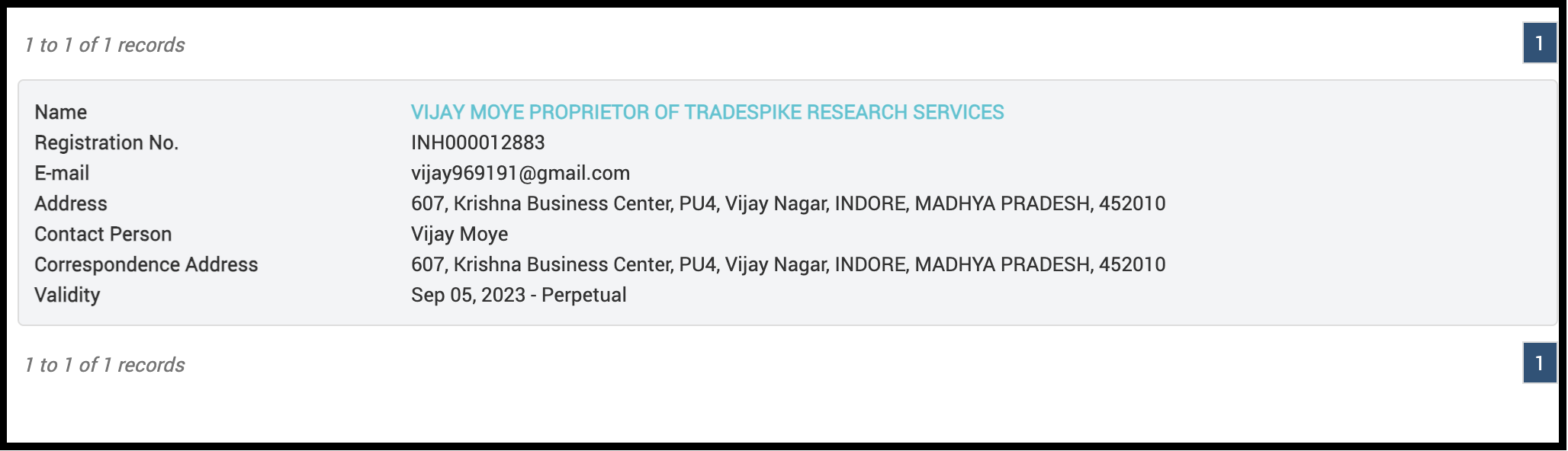
The same registration number appears independently on SEBI’s own published Research Analyst list, and again on the firm’s own grievance redressal page, so this one checks out cleanly from more than one direction.
His office and correspondence address is 607, Krishna Business Center, PU4, Vijay Nagar, Indore, Madhya Pradesh 452010. He can be reached at [email protected].
An INH number marks this as a Research Analyst registration, not an Investment Adviser or Portfolio Manager one. It permits publishing research and recommendations to subscribers generally.
It doesn’t extend to building a plan around one client’s own money, or placing trades on someone’s behalf.
Before paying anyone claiming this kind of registration, check SEBI registered research analyst status yourself, directly against SEBI’s own list, rather than taking a website’s word for it.
TradeSpike Research Owner
Vijay Moye isn’t just the named analyst here. His own site’s grievance page shows him holding three separate positions at once, Compliance Officer, CEO, and Principal Officer, each listed with the same email address.
A second person, Rahul Singh, is named separately as both Customer Care and Head of Customer Care, using a different phone number and email from Vijay Moye’s own.
For a small, individually registered practice, having one person cover the compliance, leadership, and oversight roles isn’t unusual on its own.
It does mean the person handling your complaint at the first stage, Rahul Singh, is answering to the same person, Vijay Moye, who’d be reviewing that complaint from the compliance side too.
Also Read: Vikash Bagaria, ₹60,000 for half a year. ₹24,000 for the full year. No explanation.
TradeSpike Research Pricing
This is the section worth spending real time on, because the picture here is more severe than a glance at any single plan would suggest.
SEBI allows a Research Analyst to charge at most ₹1,51,000 a year, per client family
. Checked plan by plan, across every cycle TradeSpike actually offers, here’s what that limit runs into.
The Published Price List
TradeSpike sells nine separate services, and most of them come with more than one billing cycle to choose from. Before any of it gets checked against the SEBI limit, it’s worth seeing exactly what’s actually on offer.
Here’s every price, exactly as TradeSpike Research publishes it:
- Stock Cash: ₹15,000 monthly, ₹40,000 quarterly, ₹70,000 half-yearly.
- Stock Cash Premium: ₹85,000 quarterly, ₹1,78,000 yearly. No monthly or half-yearly option is offered.
- Stock Futures: ₹20,000 monthly, ₹50,000 quarterly, ₹1,00,000 half-yearly.
- Premium Futures: ₹1,00,000 quarterly, ₹1,70,000 yearly. Like its Stock Cash Premium counterpart, no monthly or half-yearly option exists.
- Stock Options: ₹15,000 monthly, ₹40,000 quarterly, ₹80,000 half-yearly.
- Index Options: ₹20,000 monthly, ₹50,000 quarterly, ₹1,00,000 half-yearly.
- Index Futures: ₹25,000 monthly, ₹70,000 quarterly, ₹1,30,000 half-yearly.
- Short-Term Investment: ₹44,000, billed as a single one-time fee.
- Long-Term Investment: ₹45,000, also a single one-time fee.
A few things stand out just from this list, before any of the annualised math below.
- Seven services renew on a cycle; two are a single one-time fee. Stock Cash through Index Futures all renew monthly, quarterly, or half-yearly. Short-Term and Long-Term Investment don’t renew at all, at least not on paper.
- Stock Cash Premium and Premium Futures skip the monthly and half-yearly options entirely. They’re only sold quarterly or yearly, both at a noticeably higher price than the standard tier’s equivalent cycles.
- The two one-time plans carry no visible time frame. ₹44,000 and ₹45,000 are both listed as flat fees, with nothing on the page saying whether that buys a month of access, a year, or something else entirely.
Annual Fee Analysis: 18 TradeSpike Plans Breach Regulatory Limits
Take every price above and work out what a genuine full year would cost, renewing each plan on its own stated cycle, and the results are stark.
Every single Stock Futures, Index Options, and Index Futures price breaches the limit, on every cycle offered. Index Futures alone is the worst of the three; its half-yearly price comes to ₹2,60,000 a year, and its monthly price comes to ₹3,00,000, almost double the ceiling.
Stock Options breaches on all three of its cycles too, though by smaller amounts each time. Even its half-yearly plan, at ₹80,000, comes to ₹1,60,000 renewed for a year, ₹9,000 over.
Stock Cash Premium and Premium Futures both breach on their yearly price alone, ₹1,78,000 and ₹1,70,000 respectively, and breach far more severely if paid quarterly instead.
Only Stock Cash’s half-yearly plan, at ₹70,000, stays under the ceiling, coming to ₹1,40,000 for the year. Out of nineteen separate price points published across the site, that’s the single one that actually complies.
Hidden Duration Traps in TradeSpike’s One-Time Investment Plans
Short-Term Investment, at ₹44,000, and Long-Term Investment, at ₹45,000, are both sold as one-time fees with no validity period attached anywhere on the page.
Without knowing how long either plan actually runs, there’s no way to check them against the annual limit at all.
Ask TradeSpike Research directly how long each one lasts, in writing, before paying either fee.
TradeSpike Research Pricing Red Flags
Beyond the raw numbers, a few patterns in how this pricing is presented are worth naming directly.
- Nearly every service breaches the cap on every cycle it offers. This isn’t one plan slipping over the line. It’s the overwhelming majority of what’s actually for sale.
- The “Premium” tier makes the problem worse, not better. Stock Cash Premium and Premium Futures are positioned as upgrades, yet both cost dramatically more than the standard tier and breach the limit by a wider margin.
- Two plans can’t be checked at all. The one-time Short-Term and Long-Term Investment fees carry no stated duration, which makes it impossible to know whether they’re compliant.
If you’re already subscribed to any plan here, work out your real annual cost yourself, using your actual billing cycle, and compare it to ₹1,51,000 directly rather than trusting the sticker price on any single page.
Paying for a plan that already breaches the SEBI limit without realising it?
We’ll work out your real annual cost across everything you’re subscribed to, and help you put your case on record properly if TradeSpike Research won’t give you a straight answer.
Register with us for a free consultation.
TradeSpike Research Complaints
This is the second area worth real attention, and it needs tracing carefully, because three separate tables on the same site tell three different stories.
The Current Complaint Board
Here’s the live snapshot TradeSpike Research itself publishes, broken down by where each complaint actually came from.
| Source | Received | Resolved | Pending | Avg. Resolution |
|---|---|---|---|---|
| Directly from Investors | 0 | 0 | 0 | — |
| SEBI SCORES | 10 | 9 | 1 | 11.5 days |
| SMART ODR | 1 | 1 | 0 | 11 days |
| Other Sources | 0 | 0 | 0 | — |
| Grand Total | 11 | 10 | 1 | — |
Ten complaints through SEBI SCORES alone is a genuinely notable volume for a firm this size, and worth factoring into your decision on its own, separate from the disagreements below.
The Annual Table Tells a Different Number
TradeSpike’s separate annual disposal table doesn’t match the current board above.
| Financial Year | Received | Resolved | Pending |
|---|---|---|---|
| 2022-23 | 0 | 0 | 0 |
| 2023-24 | 0 | 0 | 0 |
| 2024-25 | 5 | 5 | 0 |
| 2025-26 | 3 | 3 | 1 |
| Grand Total | 10 | 9 | 1 |
The current board’s Grand Total says 11 received and 10 resolved. This annual table’s Grand Total says 10 received and 9 resolved. Both claim to cover the same overall history, and neither matches the other.
The most likely explanation is the missing SMART ODR complaint. The current board separately tracks 1 complaint through SMART ODR, on top of the 10 through SCORES.
The annual table’s total of 10 looks like it only captures the SCORES figure, leaving that one SMART ODR case out entirely.
TradeSpike Complaint Report Errors: Conflicting Resolution Stats
Look at the 2025-26 row on its own, and there’s a second, separate problem sitting inside the same table.
It states 3 complaints received and 3 resolved, which on its face should leave nothing outstanding. The same row then reports 1 complaint still pending. Three received, three resolved, and one pending simply can’t all be true for the same twelve months, and the site offers no explanation for how a fully resolved count still leaves one case open.
Frozen Disclosures: Monthly Records Fail to Show Recent Complaints
TradeSpike’s monthly complaint disclosure adds a third layer of confusion, rather than clearing anything up.
| Period | Received | Resolved | Pending |
|---|---|---|---|
| September 2023 to August 2024 | 1 | 1 | 0 |
That’s the only window shown, a full year that ended well over a year ago.
Nothing from FY2024-25 or FY2025-26, the years actually carrying the bulk of the complaint activity above, appears in this monthly breakdown at all.
SEBI requires a Research Analyst to update this data monthly, by the 7th of the following month.
A table frozen more than a year in the past falls well short of that, and it means the ten SCORES complaints shown elsewhere have no month-by-month record a reader can actually check.
Given how many separate figures don’t reconcile here, our guide on how to file complaint against SEBI registered research analyst is worth reading before you decide how seriously to weigh any of these numbers.
Also Read: JustResearch, one man handles the research, the pricing, and every single complaint.
What Do TradeSpike Research’s Terms & Conditions Say?
A regulated research service and a plain “not financial advice” disclaimer don’t usually sit well together, and that’s exactly the tension inside TradeSpike’s own Terms.
Two clauses specifically are worth reading before you rely on anything the service sends you.
TradeSpike Research Terms & Conditions Red Flags
While TradeSpike Research is a registered SEBI Research Analyst, its terms and conditions try to shield the firm from standard professional accountability.
Before paying for any stock recommendations, you should review how these legal disclaimers limit your protections as a subscriber.
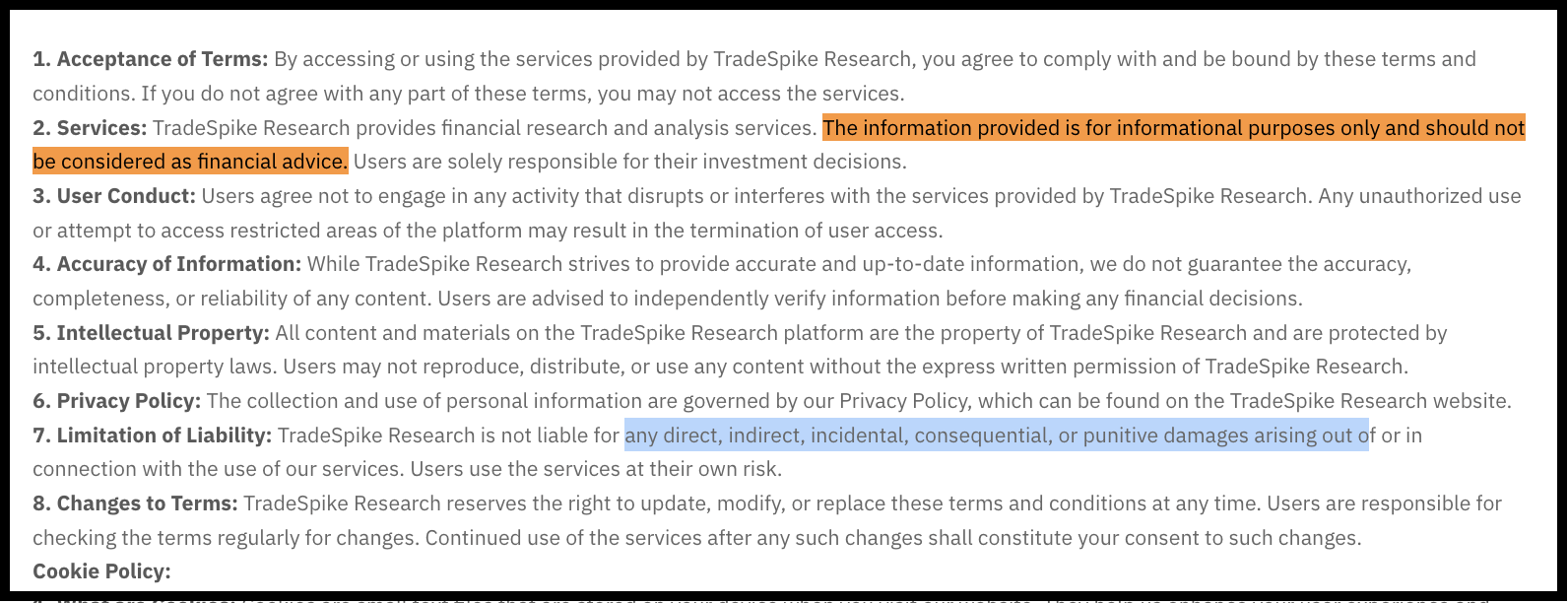
- The Terms call the service “informational purposes only.” They separately state it “should not be considered as financial advice.” TradeSpike is a paid, SEBI-registered Research Analyst selling stock recommendations for money, and calling that same output merely informational creates real ambiguity about what you’re actually entitled to rely on after paying for it.

TradeSpike Research terms and conditions clauses attempting to classify paid stock recommendations as informational content and excluding legal liability. - The liability clause is unusually broad. It excludes direct, indirect, incidental, consequential, and punitive damages from the use of its services, about as wide a shield as a clause like this can offer. Understand exactly how far it reaches before you act on a paid recommendation, particularly given the fee cap and complaint issues already covered above.
Ask TradeSpike Research directly how it reconciles “not financial advice” with a paid subscription sold specifically for financial recommendations, and get the answer in writing.
Also Read: Hedge360, the complete breakdown, pricing, complaints, and every real inconsistency.
TradeSpike Research Website Warning Signs: Promotional Language vs SEBI Regulatory Rules
Beyond the pricing and the paperwork, the language TradeSpike uses to describe itself leans heavily toward outcomes it can’t actually promise.
None of these phrases cross into an outright guaranteed-return claim. Together, they build a tone of confidence that sits oddly next to a fee structure this far out of line with SEBI’s own limit.
1. “Create Wealth With Confidence”
Paired with “Market Mastery With A Click” and “Smart Investments with Precision Insights,” this framing sells certainty and ease around something that’s neither certain nor simple.

2. “Solid Returns” on the Stock Cash Page
The Stock Cash service describes what it’s aiming for on behalf of clients as “solid returns.”
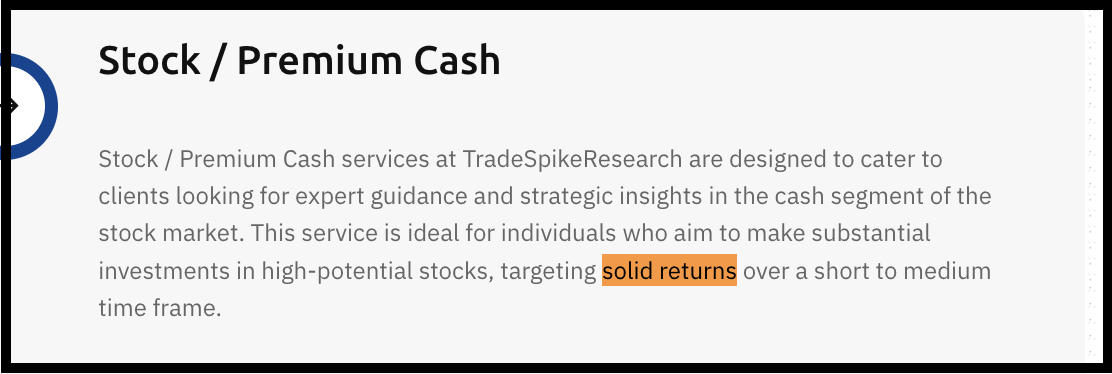
Describing a research service’s own target outcome in terms of the return it delivers, rather than the process behind the call, is promotional language dressed up as a service description.
3. “The Finest Stock and Commodity Market Tips”
The site claims to provide “the finest Stock and Commodity market tips,” alongside “wide-ranging, secured and finest financial solutions.”

Both are broad superlatives with nothing on the page to actually back them up.
4. “Commitment to Client Success” and “Trustworthy, Expert Guidance”
Both frame the service in terms of character and outcome rather than what the research process actually involves, the kind of language a reader should treat as marketing, not a factual claim about performance.
How to File a Complaint Against TradeSpike Research?
Everything above points toward the same next step: get a straight, written answer from Vijay Moye before you pay for, or renew, anything.
Ask him directly which of the three complaint totals is correct, how the 2025-26 row can show three resolved and one still pending, and what the actual duration is on either one-time investment plan.
If his answer doesn’t resolve things, here’s where the matter goes from there:
- File a SEBI SCORES complaint. This puts your own grievance directly on record with the regulator, separate from whatever TradeSpike Research chooses to publish about itself.
- Move to SMART ODR registration if SCORES alone doesn’t settle it. A neutral conciliator reviews both sides at this stage.
- Take it to Share Market Arbitration as the final stage, which ends in a binding decision rather than a request either side can simply ignore.
Disclaimer: This page is based on TradeSpike Research’s own published material, cross-checked directly against SEBI’s own public register. Nothing here accuses the firm of wrongdoing, and no SEBI order currently stands against it. Confirm every detail yourself before acting on it. This page is meant to help you ask better questions, not to replace a lawyer or a financial adviser.
Conclusion
Vijay Moye’s TradeSpike Research Services holds a genuine SEBI registration, INH000012883, active since September 2023.
Out of nineteen published prices, only one, the Stock Cash half-yearly plan, actually stays under the SEBI fee cap once you work out the real annual cost.
Its complaint disclosure gives three different totals across three separate tables, one of which contradicts itself within a single row.
Its own Terms describe a paid research service as merely informational, alongside a liability clause built to exclude nearly everything.
Work out your real yearly cost on any plan you hold, and get a written answer on the complaint numbers before you subscribe to anything further.
Report. Recover. Stay Fraud Free.
Yes, under INH000012883, held by Vijay Moye since September 2023. It's confirmed both on SEBI's own published Research Analyst list and on the firm's own site. Only one, the Stock Cash half-yearly plan at ₹70,000, which comes to ₹1,40,000 a year. Every other published price, eighteen in total, breaches the ₹1,51,000 limit once annualised. It depends which table you read. The current complaint board says 11. The annual table says 10. Neither explains the gap, though it appears to trace back to a SMART ODR complaint missing from the annual figures. Not entirely. The 2025-26 annual row shows 3 received and 3 resolved, yet still reports 1 complaint pending, figures that can't all be true at once for the same year. No, and its own Terms go further, describing the service as informational only and excluding broad categories of liability. Get clarity on what you're actually entitled to before paying.Frequently Asked Questions