

Quick Summary
Shreeji Research’s own SEBI SCORES complaint records add up correctly across every table, 11 complaints since December 2024, 10 resolved, 1 pending. But a separate table for August 2026 alone shows 6 more complaints from “Other Sources,” a channel that never appears anywhere in the yearly totals. Nobody knows how many complaints that channel has produced over the firm’s full history. Google shows a 3.4 star average, and underneath that sit four detailed reviews describing serious problems, including one describing a demand for a large upfront fee tied to a guaranteed monthly profit promise.
Shreeji Research’s Google listing carries a 3.4 star average, and its SEBI complaint disclosure shows 11 complaints since late 2024.
Both numbers are worth reading in full rather than taken at face value.
This page works through the complaint tables, a real gap inside them worth understanding, and every named Google and Facebook review available.
Registration and pricing are covered separately on our Shreeji Research page.
Shreeji Research Bangalore Reviews
The complaint data here is the firm’s own regulatory disclosure.
The Google and Facebook reviews are independent accounts from people who actually paid for the service, posted on platforms the firm doesn’t control.
Neither source is perfect on its own.
Regulatory disclosure only captures what’s formally reported through official channels, and individual reviews reflect one person’s specific experience rather than a full statistical picture.
Reading both together gives a more honest sense of what actually happens than relying on either alone.
Read together, they tell a more complete story than either one alone.
Does Shreeji Research’s Complaint Data Actually Add Up?
Checked carefully, one part of this disclosure reconciles cleanly. A separate part doesn’t track anything close to the full picture.
The SEBI SCORES Annual Trend
| Year | Received | Resolved | Pending |
|---|---|---|---|
| 2024 | 1 | 1 | 0 |
| 2025 | 5 | 5 | 0 |
| 2026 | 5 | 4 | 1 |
| Total | 11 | 10 | 1 |
SEBI SCORES Monthly Trend Agrees With It Exactly
Adding up every month in the firm’s own monthly SCORES table, year by year, gives 1 received in 2024, 5 in 2025, and 5 in 2026, with 1, 1, and 4 resolved, respectively.
That matches the annual table precisely, for all three years.
This is worth crediting plainly. Where these two tables can be checked against each other, they agree.
A firm whose regulatory numbers hold up under scrutiny deserves that credit, even when other parts of its disclosure raise real questions.
The Real Gap Sits Somewhere Else Entirely
A separate table, covering August 2026 specifically, shows 6 complaints received in a single month from “Other Sources.”
That channel, Other Sources, doesn’t appear anywhere in the annual or monthly SCORES tables at all.
Those two tables only ever track complaints that went through SEBI SCORES directly.
Six complaints from a different channel, in one month alone, simply aren’t part of the 11-complaint total anywhere.
This means the true number of complaints Shreeji Research has actually received, across its full history, cannot be worked out from what’s published.
The SCORES total is accurate for SCORES complaints specifically.
It was never meant to capture the other channel, and there’s no historical record showing how many complaints that channel produced in any month before August 2026.
If you’re weighing this firm’s complaint history, 11 is the wrong number to compare it against.
The real total includes whatever “Other Sources” has produced across every month, which isn’t shown anywhere on the site.
That doesn’t mean the true total is necessarily dramatic.
It means there’s no way to know either way from what’s currently published, and that gap itself is worth asking the firm to fill in directly.
Also Read: Shyam Advisory Limited reviews, “no real trading knowledge.” One reviewer’s own blunt words.
What Do Google Reviewers Say About Shreeji Research?
Shreeji Research holds a 3.4 star average on Google. Four detailed reviews sit underneath that number, each describing a different problem.
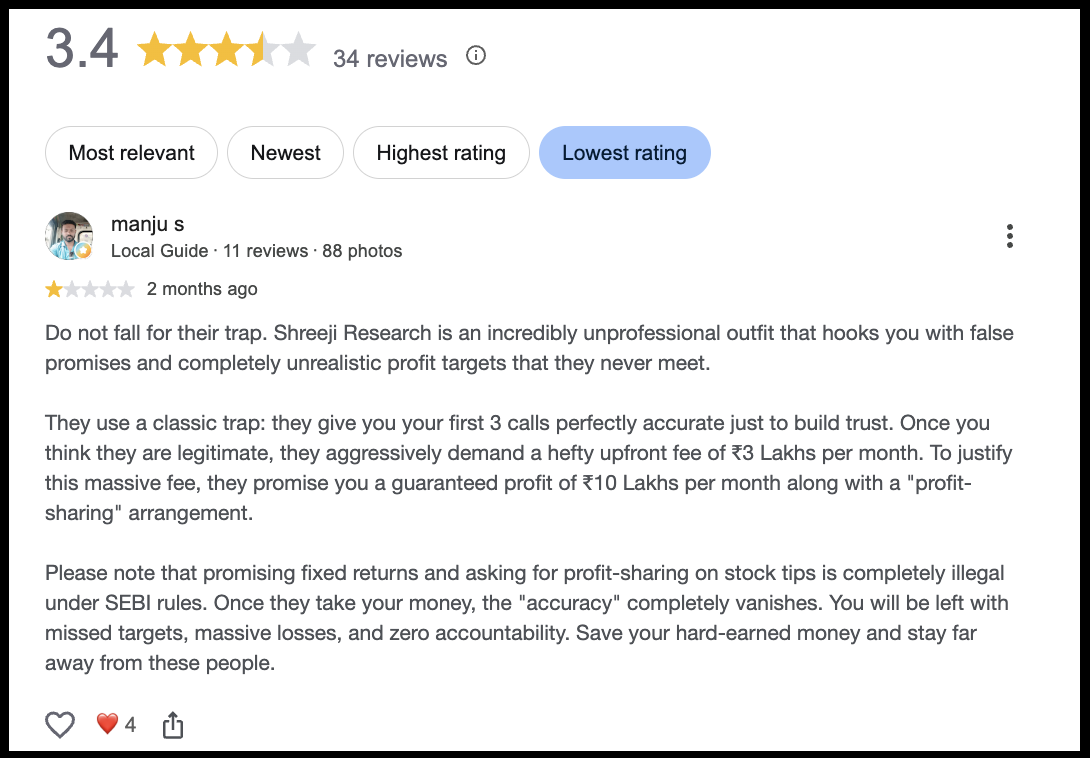
1. A Review Describing A Large Upfront Fee Tied To A Guaranteed Monthly Profit Promise
One reviewer describes an early pattern of accurate calls, followed by a demand for a substantial upfront fee, paired with a specific promised monthly profit figure and a profit-sharing arrangement.
We’re reporting only that this review exists and describes this sequence of events. We haven’t independently verified it, and no SEBI order confirms any of it as of this writing.
If you have direct, relevant knowledge here, the right step is a formal SEBI complaint, not further discussion in reviews.
The same review states that once payment was made, the accuracy of the calls dropped off sharply.
2. A Reviewer Describing An Accurate First Trade Followed By Losses
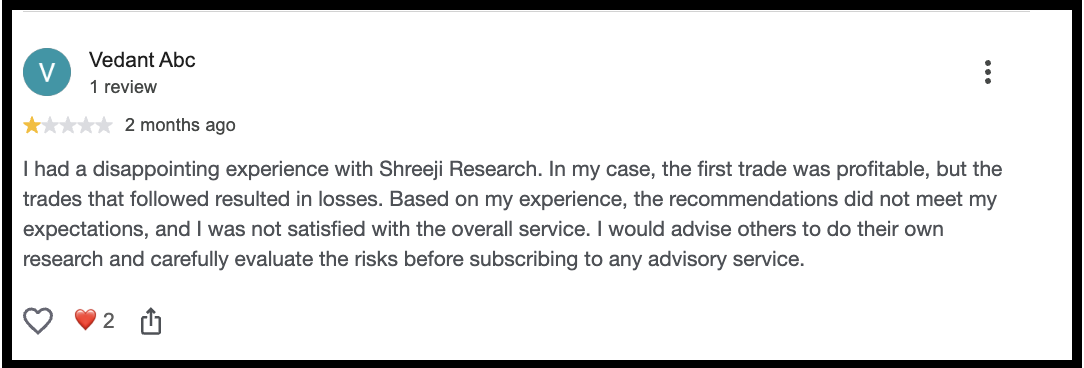
A second reviewer describes their first trade as profitable, with the recommendations that followed resulting in losses.
They describe the overall service as not meeting their expectations, and recommend others do their own research before subscribing to any advisory service.
3. A Reviewer Naming A Specific Advisor And Describing A Loss Of Nearly ₹40,000
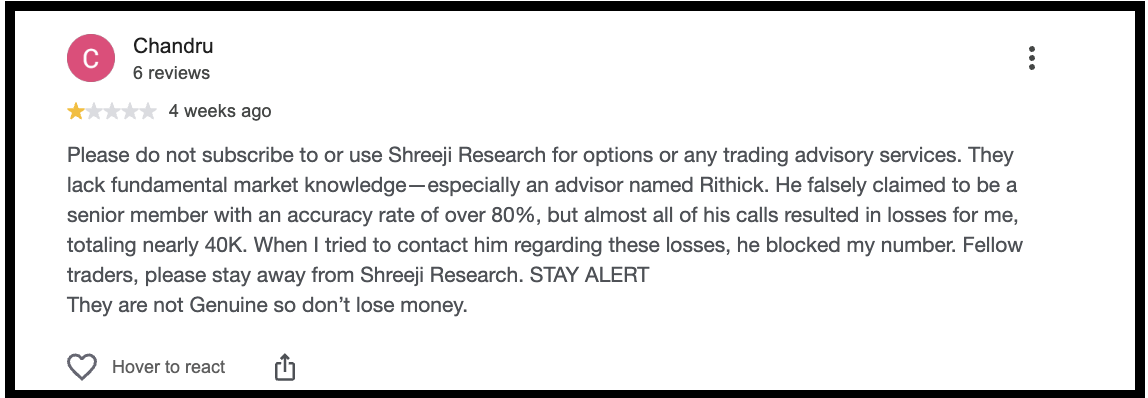
A third reviewer names a specific advisor by first name, describing calls that resulted in losses totalling close to ₹40,000, and states they were blocked when they tried to follow up about those losses.
We’re reporting what this reviewer states. We haven’t independently verified the specific claims about this individual advisor, and no SEBI order confirms them.
4. A Reviewer Describing Pressure To Increase Capital After Early Losses
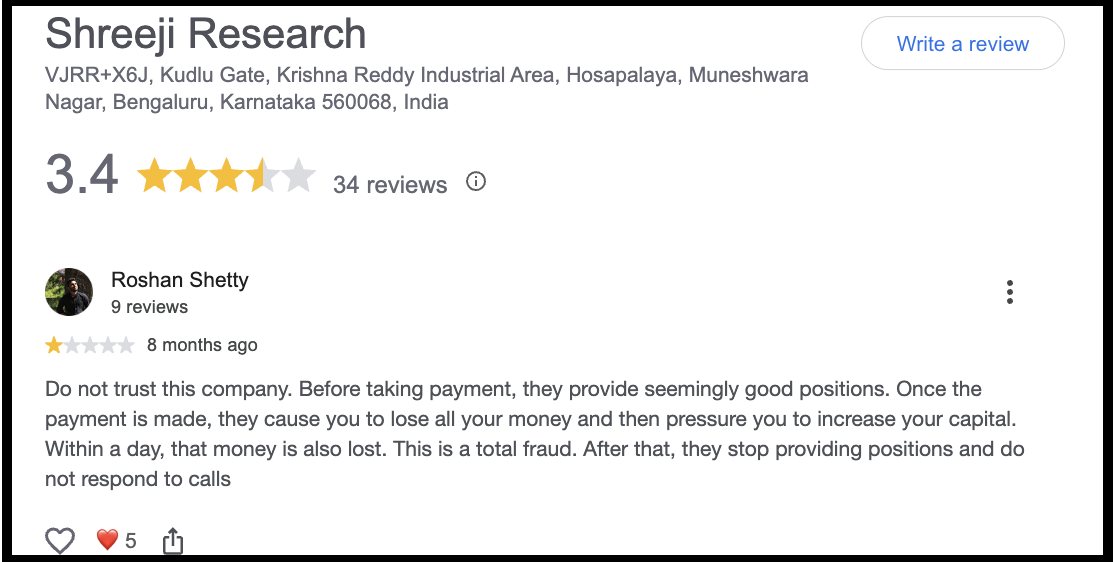
A fourth reviewer describes a pattern of encouraging positions before payment, followed by losses after payment, and states they were then encouraged to add more capital, which was also lost.
Four separate reviewers describe a broadly similar pattern: early results that build confidence, followed by a shift once payment or additional capital is involved.
That consistency across unrelated accounts is worth taking seriously, separate from whether every specific detail in each individual review can be confirmed.
None of these reviewers appear connected to each other, and each describes their own specific numbers, dates, and interactions, which makes the shared shape of the pattern harder to dismiss as coincidence.
What Does the Facebook Review Say On Shreeji Research’s Service?
Shreeji Research’s Facebook page carries one visible rating, describing the service as poor and not worth the cost.
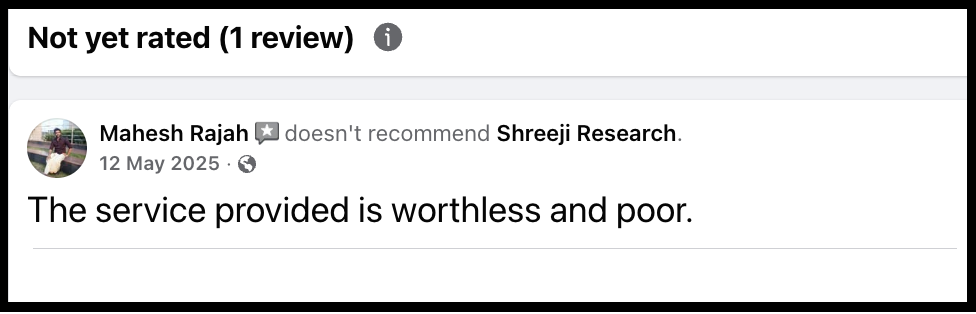
One review on a single platform is a limited sample on its own.
It’s still worth reading alongside the Google reviews above rather than in isolation.
A single rating can be an outlier, or it can be an early warning that more reviews would confirm over time.
Given how closely it echoes the tone of the Google reviews, it’s worth treating it as the latter rather than dismissing it outright.
Also Read: SNM Value Educator Research Services LLP complaints, the full breakdown, year by year, month by month, checked closely.
How to File a Complaint Against Shreeji Research?
If your own experience matches any pattern described above, a written, dated record gives you firmer ground than a general complaint about service quality.
Write to the RA firm’s email ID directly, describing exactly what you were told, what you paid, and what you want resolved.
If a specific advisor was involved, name them in your email the same way the reviews above do.
Attach screenshots of any messages or call records if you have them, since specific detail is what turns a general complaint into something SEBI can actually act on.
If the issue remains unresolved, you can move through these options in order.
- Submit your complaint through the SEBI SCORES complaint page.This gives you a formal channel to register the grievance and seek a response.
- If the matter is not resolved, proceed through the SMART ODR registration platform.This provides a structured process for attempting to resolve the dispute through conciliation.
- If the dispute continues, you can take it to share market arbitration.This provides another formal route for dispute resolution, with the process resulting in a ruling that the parties are required to follow.
For the complete process and a step-by-step explanation, read our guide on how to make a complaint against a SEBI-registered research analyst.
Told you’d get guaranteed profits if you paid a large upfront fee?
We document exactly what you were promised and what actually happened, and put your case on record in a form the firm has to respond to. Register with us for a free look at your situation.
Disclaimer
This page is based on Shreeji Research’s own complaint disclosure and public reviews, reported but not independently verified.
No SEBI order stands against the firm as of this writing. Treat this page as research, not legal advice.
Conclusion
Shreeji Research’s SEBI SCORES complaint tables genuinely reconcile with each other: 11 complaints since December 2024, 10 resolved. That much of the disclosure holds up.
What it doesn’t show is the full picture.
A separate “Other Sources” channel produced 6 complaints in August 2026 alone, and that channel isn’t tracked anywhere in the yearly totals.
Alongside that, four detailed Google reviews describe a consistent pattern of early trust followed by losses once real money is involved, including one describing a guaranteed profit promise tied to a large upfront fee.
If you’re considering this firm, read the reviews above in full, and don’t treat the 11-complaint SCORES total as the complete count.
Report. Recover. Stay Fraud Free.
Frequently Asked Questions
Its SEBI SCORES disclosure shows 11 since December 2024, and that figure is internally consistent. A separate channel, Other Sources, produced 6 more complaints in August 2026 alone, and isn't included in that 11-complaint total anywhere.
Yes, for the SCORES-specific figures. Summed by year, the monthly table matches the annual table exactly for 2024, 2025, and 2026.
No. It's an account from a single public review. No SEBI order or other regulatory finding confirms it as of this writing.
Treat it as one unverified account. It's specific and detailed, which carries more weight than a vague complaint, but it isn't independent confirmation on its own.
That's covered in full on our separate Shreeji Research page, including the full breakdown of which plans breach the SEBI fee cap.





 Add us as a preferred source on Google »

