

Quick Summary
Shyam Advisory’s own complaint tables contain two separate arithmetic errors, one in the current month’s total, one in the yearly summary. Its app holds a 2.9 star rating from 50 users, with several detailed reviews describing losses and delayed calls. Its Google reviews sit higher at 4.3 stars, but several of the most detailed ones describe serious, specific problems, including named staff and large losses. None of what’s below has been independently verified. It’s reported here as what real users say on public platforms, not established fact.
Before you pay for any advisory service, you probably want to know one simple thing: what are other investors saying about it? That is where Shyam Advisory Limited Reviews become worth a closer look.
The Play Store shows 2.9 stars from 50 users, while Google shows 4.3 stars, but the detailed reviews tell a more mixed story.
Let’s look at what users have actually reported, along with the complaint figures published by the firm itself.
Shyam Advisory Complaints
Every SEBI registered firm has to publish how many complaints it gets and how it handles them. It sounds simple, but here the numbers don’t actually add up when you check them by hand.
Checking these tables closely turns up two separate mistakes, not one.
The Current Complaint Summary, August 2026
| Source | Received | Resolved | Pending |
|---|---|---|---|
| SEBI SCORES | 1 | 0 | 1 |
| Other Sources | 1 | 0 | 1 |
| Stated Grand Total | 1 | 0 | 1 |
Add the two source rows together, and you get 2 complaints received, not 1. The table’s own Grand Total doesn’t match the two rows sitting directly above it.
The Annual Disposal Trend
| Year | Received | Resolved | Pending |
|---|---|---|---|
| 2024-25 | 7 | 7 | 0 |
| 2025-26 | 1 | 1 | 0 |
| 2026-27 | 1 | 0 | 1 |
| Stated Grand Total | 8 | 8 | 0 |
Add up the three years, and the real total is 9 complaints received, not 8.
The Grand Total’s pending figure is also wrong. FY2026-27 alone shows 1 complaint still pending, so the overall total should show 1 pending too, not 0.
Two separate tables, two separate arithmetic mistakes.
Neither one changes the underlying story much, but a firm that can’t correctly total its own complaint figures is worth double-checking on every other number it publishes too.
Nine complaints since the registration’s earlier form began, all but one resolved, is a light record on its own terms. It’s worth reading that way while also noting the totals themselves don’t add up as published.
Light doesn’t mean spotless. It means the volume is small enough that each individual complaint is worth taking seriously on its own, rather than lost in a larger number.
For the registration itself and the full pricing breakdown, our separate Shyam Advisory page covers that in detail.
Also Read: StockAce complaints, why a consistent record still leaves the real reasons unanswered.
Shyam Advisory Reviews
A star rating alone doesn’t tell you much. It’s what people actually write underneath it that shows you what really happens once you pay.
Two places give a real, detailed picture here: the app’s own Play Store page and Google. Both are written by real users, not the firm, so read them as personal accounts, not proven facts.
What Play Store Users Say
The app is rated 2.9 out of 5 by 50 users.
That’s a low score, and the reviews underneath explain why.
1. Late Calls & Subscription Fees Exceeding Profits
One user reports that advice frequently arrives after a stock has already moved 4% or more, causing them to miss the profitable entry, while trades are exited prematurely or left open to incur further losses.
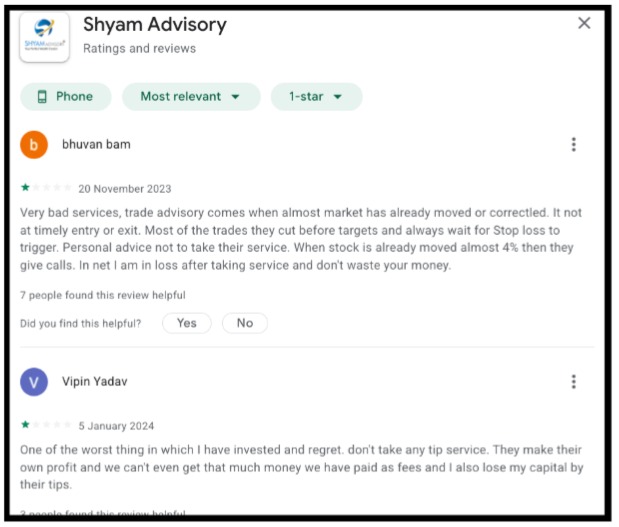
Another user highlights that following these delayed tips led to direct capital losses, with total trading returns failing to even cover the initial advisory subscription fees paid.
2. No Real Trading Knowledge Behind the Calls
A third user calls the whole service unprofessional and questions how a firm with no real trading knowledge or experience is allowed to run an advisory business at all.
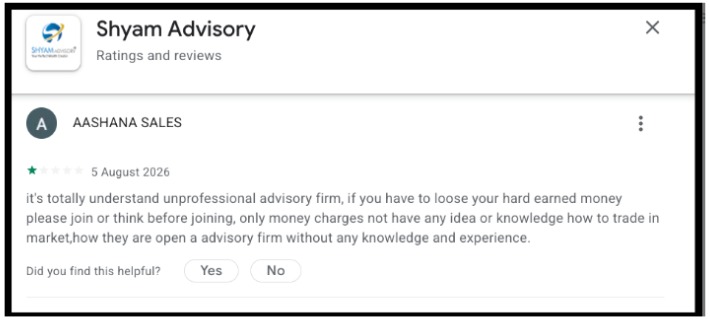
They say the only thing that seemed clear was the fee being charged, not any actual plan behind the calls.
3. Good Calls Before Payment, Bad Calls After
A fourth user, writing in a mix of Hindi and English, says the calls looked genuinely good during the period before they decided to pay, which built their trust in the service.
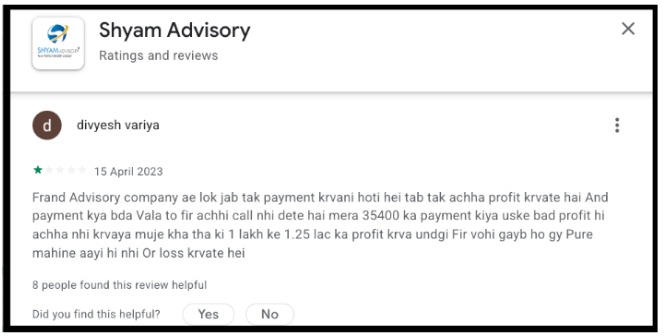
After they paid around ₹35,400, that quality dropped sharply.
They say the specific profit figure they were promised, turning their money into a much larger amount, never showed up, and the calls that followed lost money instead.
We’re reporting what these users wrote in public reviews. We haven’t checked any of these accounts ourselves.
Also Read: ResearchInn Investment Advisor Reviews shows a 3.9-star rating backed by specific reports of early profits followed by losses and concerns over staff responsiveness.
What Google Reviewers Say
Shyam Advisory’s Google rating is 4.3 out of 5. That looks good on the surface.
A few long, detailed reviews underneath it describe real problems.
1. No Support After Payment
One reviewer names a specific advisor and describes what they call a “pay and disappear” pattern.
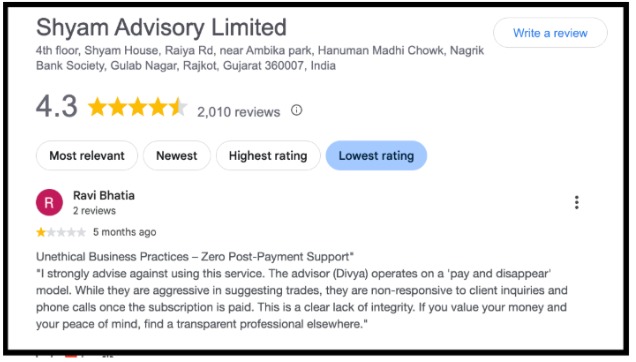
The advisor was pushy about suggesting trades before payment, but stopped answering calls and messages entirely once the subscription was actually paid for.
The reviewer calls this a clear lack of honesty, and advises anyone reading to find a more transparent service elsewhere.
2. Accuracy Dropped Sharply After a Bigger Payment
A second reviewer says the calls were accurate at first. After a larger payment, accuracy dropped, and they lost around ₹1 lakh.
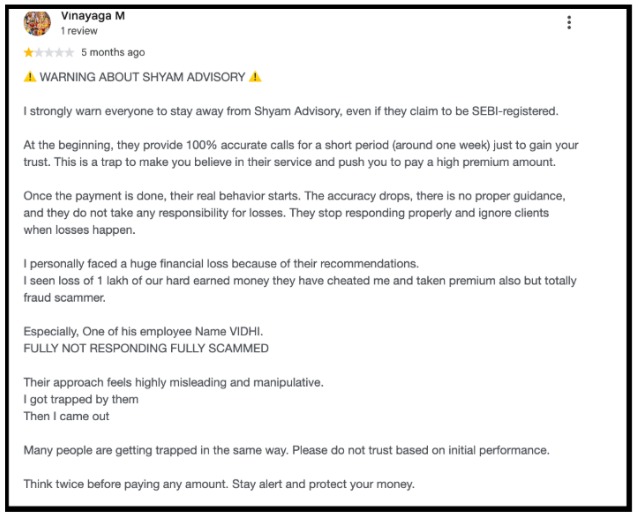
This review names a specific staff member and uses strong language to describe what happened.
We’re only reporting that this review exists and what it describes. We are not repeating the exact words used, and we have not checked if any of it is true.
No SEBI order confirms any of this.
3. Delayed Entries and a Push to Upgrade
A third reviewer bought the Index Options Basic plan and says the first interactions felt promising and convincing.
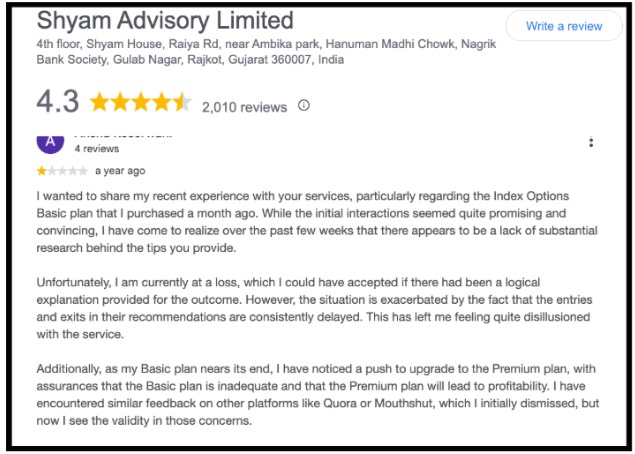
Over the following weeks, they noticed the actual research behind the tips seemed thin, and that the buy and sell timing was consistently late.
As their Basic plan neared its end, they were pushed to upgrade to Premium, with assurances that Basic simply wasn’t good enough and Premium would finally bring profits.
4. ₹2.6 Lakh Lost in 45 Days
A fourth reviewer says they paid ₹60,000 a month for three months and lost about ₹2.6 lakh in just 45 days.
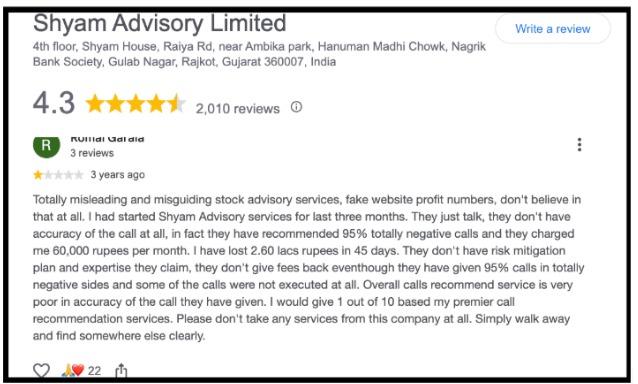
They say roughly 95% of the calls went the wrong way, that the firm had no real risk management plan despite claiming one, and that no refund was offered even after that many calls failed.
If any of this matches something that actually happened to you, the right move is a formal SEBI complaint, not writing more reviews online.
Recognise your own experience in any of the reviews above?
We’ll help you document it properly and put your case on record in a form the firm actually has to respond to.
Register with us for a free look at your situation.
From Google to Play Store: The Repeating Shyam Advisory Complaint Pattern
One bad review can just be one unhappy customer. It’s a different thing when strangers, on two different platforms, with no connection to each other, keep describing the same sequence of events.
That’s what’s happening here.
Across both sets of reviews, the same three things keep coming up:
- The calls look good at first. Early recommendations build trust, sometimes for a week or two.
- Something changes once a bigger payment is made. Accuracy drops, or the plan being pushed gets more expensive.
- Support goes quiet afterward. Several reviewers say calls and messages stopped getting answered right when they needed help most.
That pattern showing up independently, on separate platforms, from people who don’t appear to know each other, is harder to write off as coincidence, even though no single detail in any one review has been independently confirmed.
Also Read: SNM Value Educator Research Services LLP complaints, the exact registration date, checked against the complaint timeline.
How to File a Complaint Against Shyam Advisory?
If your own experience lines up with anything described above, write down exactly what you were told, what you paid, and when things changed, before you contact the firm.
Send that account to [email protected] directly, and ask for a written response. Keep whatever comes back. A dated email is worth more than a phone call you can’t produce evidence of later.
Where a direct approach doesn’t resolve things, SEBI’s own channels take over. The SEBI SCORES complaint portal is the right first stop, and naming the specific plan and amount involved gives the platform something concrete to work with.
If SCORES doesn’t resolve it, the SMART ODR registration platform moves the matter into structured conciliation instead. This stage brings in a neutral party specifically to look at both sides of the dispute.
Beyond that, Share Market Arbitration produces a binding decision rather than a response either side can simply walk away from.
Our full guide on how to file a complaint against SEBI registered research analyst walks through how to build and sequence a case like this properly.
Disclaimer: This page is based on Shyam Advisory’s own complaint disclosure and public reviews, reported but not independently verified. No SEBI order stands against the firm as of this writing. Treat this page as research, not legal advice.
Conclusion
Shyam Advisory’s own complaint tables contain two separate arithmetic errors, understating both its current month total and its overall yearly total by one complaint each.
Its Play Store rating sits at 2.9 stars, and its Google rating at 4.3, with a cluster of detailed reviews underneath both describing a similar pattern, early promise followed by a shift once real money is committed.
If you’re weighing this firm, read the reviews above in full rather than the star rating alone, and don’t assume the published complaint totals are the complete count.
Report. Recover. Stay Fraud Free.
Its annual table states 8, but adding up the three years shown gives 9. The current month table has the same kind of error, stating 1 received when the two source rows above it add up to 2. No. These are accounts from individual public reviews. No SEBI order confirms any of the specific claims as of this writing. 2.9 stars on the Play Store from 50 users, and 4.3 stars on Google. Several detailed negative reviews sit underneath both averages. Treat it as one unverified account. It's specific, which carries more weight than a vague complaint, but it isn't independent confirmation on its own. That's covered in full on our separate Shyam Advisory page, including why two of its plans are priced at exactly the SEBI fee limit.Frequently Asked Questions





 Add us as a preferred source on Google »

