

Quick Summary
SEBI caps what a registered research analyst can charge you at ₹1,51,000 a year per family, for individual and HUF clients, before GST. The analyst can bill you monthly or take up to a year’s fee in advance, but the yearly total cannot cross that line, and every rupee needs a proper invoice. Profit-sharing is banned, cash is not allowed, and if you leave early you get a refund for the unused period. Charged above the cap? The analyst has to give it back, and one investor used exactly this rule to recover ₹59,000. This page is the full fee rulebook, so you can check any amount before you pay.
Paying a research analyst for stock tips feels normal now.
The real question is how much you should actually be paying.
SEBI sets one hard ceiling: ₹1,51,000 a year, per family, for individual and HUF clients.
Not per tip, not per package, per year, in total.
Most overcharging happens for one simple reason: the investor never knew that number existed.
This page gives you the whole rulebook, so you can check any fee against it before your next payment, and claim back anything charged above it.
How Much Can a Research Analyst Actually Charge?
SEBI keeps a tight grip on research analyst fees, and the headline rule is easy to remember.
A registered analyst can charge you a maximum of ₹1,51,000 per year, per family.
This is for individual and HUF clients who are not accredited investors, and it does not include GST or other statutory charges.
The same ceiling applies to every analyst, whether they work as a one-person outfit, a partnership, or a company. No “premium” registration legally lets someone charge more.
A quick word on two phrases in that rule, because people get tripped up by them.
- “Per family” means the cap is not just per person. SEBI counts you and your dependents together, so an analyst cannot get around the limit by billing your spouse or dependent family members separately for the same service.
- “Per year” means the total across the whole financial year. It does not reset with each new package or plan. If everything you paid in twelve months adds up to more than ₹1,51,000, the cap is breached, no matter how the payments were labelled.
One more point. This cap protects individual and HUF investors. Companies, institutions, and accredited investors sit outside it and negotiate their own fees directly.
Every three years, RAASB, the body that supervises research analysts, reviews this figure and adjusts it using the Cost Inflation Index, with SEBI’s input.
So the number can rise over time, but only through that formal review, never because an analyst decides their tips are worth more.
Research Analyst Fee Rules Every Analyst Must Follow
SEBI rewrote these rules in its December 2024 amendments and the circulars that followed, replacing vague wording with a clear framework.
Six rules matter most, and each one gives you a way to test a fee before you hand over money.
- The annual cap holds no matter how it is split. An analyst can bill you monthly, but if you add up all twelve months and it crosses ₹1,51,000, that is a breach.
Always ask for the yearly figure, not just the monthly one. - Advance fees are limited to one year. SEBI’s April 2025 circular raised the advance limit to one year (it used to be just one quarter).
So an analyst cannot demand more than a single year’s fee upfront. - Leave early, get money back. If you stop the service before the paid period ends, the analyst must refund the unused portion on a proportionate basis.
They also cannot charge you a “breakage” or cancellation penalty for leaving. - No fee without an invoice. The analyst has to disclose the fee in writing, get your agreement before charging, and give you a proper GST tax invoice for every payment.
A payment taken with no invoice is not allowed, which we cover fully in our guide: can research analyst charge fee without invoice? - No cash. Fees have to move through a traceable channel, cheque, NEFT, RTGS, or UPI, into the analyst’s own registered account.
If someone asks for cash or for payment into a personal account, treat it as a warning sign. - No profit-sharing. An analyst earns only the disclosed, capped fee, never a cut of your trading gains.
Why SEBI treats this as a serious breach is set out in our guide: can a research analyst share profit?
Together, these give you a clear checklist. If a fee fails any one of them, you have solid grounds to push back.
Can You Get Back Fees Charged Above the Cap?
Yes, and SEBI put this beyond doubt in its June 2025 master circular.
The regulator confirmed the ₹1,51,000 cap applies to every individual and HUF client, including anyone who signed up before January 8, 2025.
So an analyst cannot hide behind an older agreement to justify charging more.
Any amount collected above the cap, or any advance held longer than a year, has to be refunded. This is not a soft guideline.
There is a real arbitration case that proves the rule bites.
The Dealwise Pro Case: ₹59,000 Recovered
A West Bengal investor paid ₹84,000 in fees to a Dealwise Pro Research Analyst.
The arbitration record noted the familiar pattern, guaranteed daily-return promises and trade-quantity instructions, but the decisive point was simple: the firm’s own website listed a fee structure that went past SEBI’s ₹1,51,000 cap.

Our team helped the investor gather his evidence, escalate through SEBI SCORES and SMART ODR conciliation, and represent him through arbitration.
The Sole Arbitrator ordered Dealwise Pro to refund ₹59,000 within 15 days.
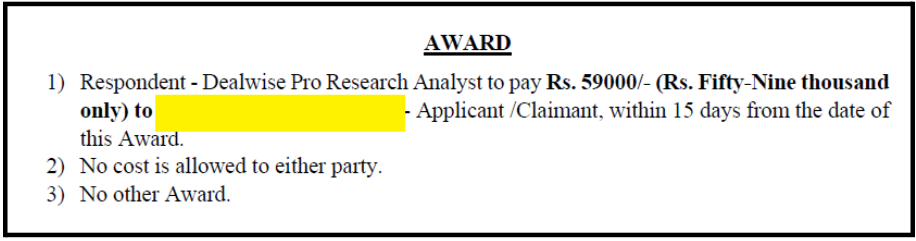
The case is a clean template.
The cap is a bright line, and when a firm’s own paperwork shows it crossed that line, the breach proves itself.
What to Do If a Research Analyst Overcharged You?
Getting your money back follows a clear path once you know the cap and keep your records straight.
Start with the arithmetic, because it is the fastest check you can run.
Add up everything you paid the analyst across the financial year and hold it against ₹1,51,000. Anything above that, or any advance held longer than a year, is your overcharge.
Keep every payment receipt, the fee agreement, and any chat or email about what you were promised.
From there, you write to the analyst’s compliance contact stating the exact overcharged amount, and escalate your grievance through the official SEBI SCORES portal or SMART ODR conciliation if they refuse to issue a refund.
The complete step-by-step, with the evidence checklist and what each stage can realistically recover, is set out in our guide: how to file a complaint against research analyst.
Paid more than ₹1,51,000 to an analyst in a year?
We total up what you were charged, measure it against the cap, and take the refund claim through SCORES and arbitration for you.
Conclusion
SEBI registered research analyst fees are not open to negotiation beyond what the regulator allows.
One number protects you: ₹1,51,000 a year, per family, for individual and HUF clients.
Add the ban on profit-sharing, the one-year advance limit, the proportionate refund if you leave early, the no-cash rule, and the mandatory invoice, and you have a full check on any fee you are asked to pay.
Learn these rules before your next instalment, and push back the moment an analyst crosses one.
As the Dealwise Pro refund shows, the cap is not just a number on paper; it is enforceable.
Frequently Asked Questions
₹1,51,000 per year, per family, for individual and HUF clients, excluding GST. The ceiling is the same whether the analyst is a solo proprietor, a partnership, or a company.
Yes, but the twelve-month total still cannot cross ₹1,51,000. Ask for the annual figure before you sign up, not just the monthly amount, so you can check it against the cap.
Up to one year, following SEBI's April 2025 circular, which raised it from one quarter. If they collect more than a year's fee, or cross the annual cap, they must refund the excess.
Yes. The analyst must refund the unused portion of the period you paid for, on a proportionate basis, and cannot charge you any breakage or cancellation penalty for leaving.
No. Fees must go through cheque, NEFT, RTGS, or UPI into the analyst's registered account. A request for cash, or for payment into a personal account, is a warning sign worth stopping for.





 Add us as a preferred source on Google »

