Can Research Analyst Charge Fee Without Invoice: SEBI Regulations & Guidelines

Can Research Analyst Charge Fee Without Invoice

Can research analyst charge fee without invoice in IndiaMany traders ask this question after paying for stock market services.

Often, traders transfer money and receive only WhatsApp tips or Telegram calls afterwards.

However, they never receive invoices, receipts, or formal payment records.

This problem is more common than most investors realise. Consequently, many traders struggle later when disputes arise or refunds get denied.

An invoice is not just paperwork. Instead, it acts as proof of payment and establishes the service relationship legally. Without documentation, recovering money becomes much harder.

Therefore, understanding SEBI’s compliance requirements is extremely important before paying any research analyst.

In this blog, we explain SEBI rules on analyst fees, invoice requirements, regulatory obligations, and investor rights. We also discuss real SEBI actions against analysts who ignored compliance procedures.

What Can a SEBI Registered Research Analyst Do?

Before jumping to the main question: Can research analyst charge fee without invoice, it helps to understand what a research analyst is, and what they are legally allowed to do.

A SEBI-registered Research Analyst (RA) publishes reports and gives buy, sell, or hold recommendations on stocks and securities.

They study companies, track market trends, and share their analysis with clients. That is their job.

What they cannot do is execute trades on your behalf.

They also cannot guarantee returns. Furthermore, they cannot collect fees in whatever way they like, whenever they like, without documentation.

SEBI governs all registered research analysts under the SEBI (Research Analysts) Regulations, 2014.

These regulations were significantly updated through amendments in August 2024 and December 2024, with operational guidelines issued in January 2025.

Under these updated rules, a research analyst must:

  • Issue proper documentation for every fee collected.
  • Stay within the prescribed fee cap of ₹1,51,000 per annum per family for individual and HUF clients.
  • Collect fees only through regulated and verifiable payment channels.
  • Disclose all terms and conditions before charging any client.
  • Maintain records of all client interactions and fee transactions.

Every single one of these requirements points to the same conclusion: a fee without an invoice is not just informal; it is non-compliant.

Can a Research Analyst Charge Fee Without Invoice or Not?

No. A research analyst cannot legally charge fees without issuing a proper invoice or receipt.

This is not a grey area. SEBI’s regulatory framework makes documentation a core compliance requirement, not an optional courtesy.

Here is the regulatory picture, step by step, as laid down by the official SEBI guidelines for research analyst in India:

1. SEBI Mandates Verifiable Payment Channels

From October 1, 2025, SEBI required all registered intermediaries, including research analysts, to adopt validated and exclusive UPI handles (the “@Valid” UPI system).

These are special UPI addresses linked to the intermediary’s SEBI registration.

The purpose is simple: every payment to a registered RA must go through a traceable, verified channel.

A payment without a receipt or invoice defeats this entire system.

2. SEBI Requires Written Terms and Conditions with Consent

Under the updated RA regulations, every research analyst must disclose their Most Important Terms and Conditions (MITC) to each client before charging fees.

The client must formally consent to these terms.

This process itself generates a documented record, and a fee collected outside this process lacks compliance.

3. SEBI Mandates Record Maintenance

Research analysts must keep records of all client interactions, fee agreements, and service details. Charging fees without an invoice leaves no paper trail.

That directly violates the record-keeping obligations under the RA Regulations.

4. An Invoice is Proof of a Legitimate Transaction

When a registered RA charges you a fee, they are providing a regulated financial service.

Just like GST invoices protect buyers in any business transaction, an invoice from an RA protects your right to complain, seek a refund, or escalate to SEBI if something goes wrong.

So, what does a fee-without-invoice situation actually look like in practice?

  • An analyst collects money through a personal UPI ID, not a registered @Valid handle.
  • Payment goes to someone’s personal bank account without any service agreement.
  • A Telegram group asks you to “transfer ₹5,000 to join premium tips” with no receipt.
  • An RA collects cash or uses a third-party account with no invoice issued.
  • Fees collected without mentioning fee caps, terms, or SEBI registration.

All of these are red flags. None of these represents legal, compliant fee collection by a registered research analyst.

The absence of an invoice is often the first sign that something is wrong.

And as SEBI’s enforcement record shows, many cases that start with informal fee collection end with serious regulatory action.

SEBI Action Against Research Analysts Who Charged Fees Improperly

SEBI has issued enforcement orders in cases where research analysts and unregistered operators collected fees outside proper channels.

If you track recent SEBI action against RA firms, two documented orders are particularly relevant here.

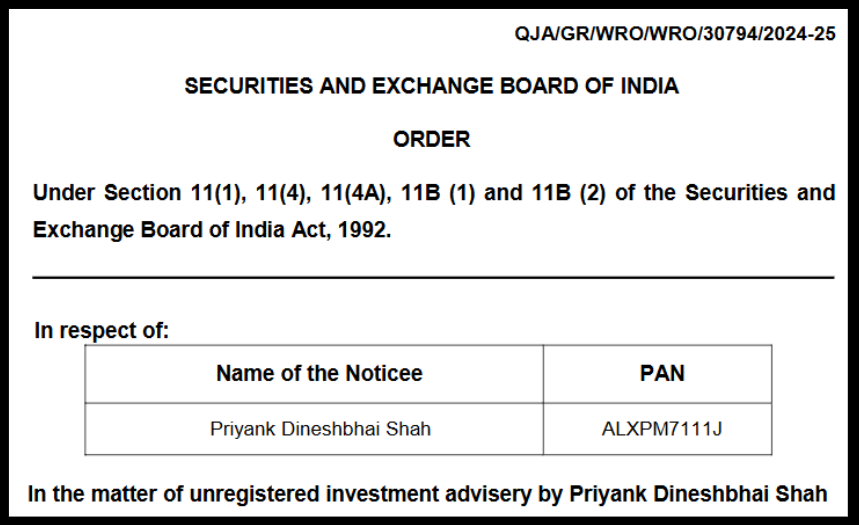
Case 1: SEBI Order Against Priyank Dineshbhai Shah

This case is a clear example of what happens when someone operates advisory services through unregistered entities, misuses another person’s SEBI credentials, and collects fees without proper documentation.

priyank dineshbhai shah SEBI order

Priyank Dineshbhai Shah was the compliance officer of Eqwires Research Analyst, a SEBI-registered entity.

However, SEBI found that he was running a parallel, unregistered investment advisory operation through two separate entities, Proworth Investment Research and Profinity.

A complaint triggered the investigation. A client had paid ₹29,000 to Proworth Investment Research for a service package. The client suffered losses and was refused a refund. SEBI’s probe revealed the full picture.

Key Violations Found By SEBI

  • Shah ran unregistered investment advisory services through Proworth and Profinity, neither of which held a valid SEBI registration as an investment adviser.
  • He misrepresented Proworth and Profinity as SEBI-registered entities to clients, falsely creating trust.
  • Fees were collected from investors by Kota Sunil Shankarbhai, who received payments on Shah’s behalf, a deliberate structural arrangement to obscure the money trail.
  • WhatsApp conversations between Shah and other parties were used as evidence of his direct involvement in orchestrating these unregistered advisory services.
  • No proper invoices or receipts were issued to clients paying for these services, leaving investors with no documentation of their payments.

The core problem here was not just that Shah lacked the right registration. It was that clients paid money into an informal system, with no invoices, no registered entity, and no paper trail to protect them.

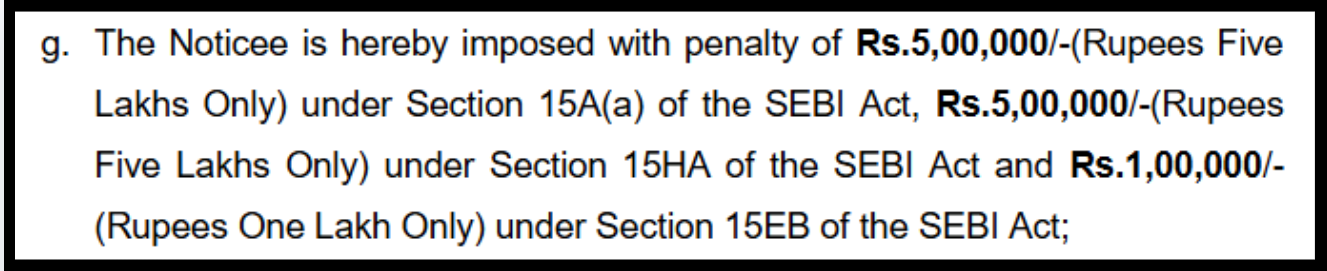
SEBI Penalty on Priyank Dineshbhai Shah

priyank dineshbhai shah penalty

  • Shah received a two-year ban from accessing the securities market.
  • Shah and Kota Sunil Shankarbhai were jointly and severally directed to refund ₹8.47 lakh collected from clients.
  • A monetary penalty of ₹11 lakh was imposed on Shah.

The case shows a direct connection between informal fee collection (no proper registration, no invoices, no documented service agreements) and regulatory punishment.

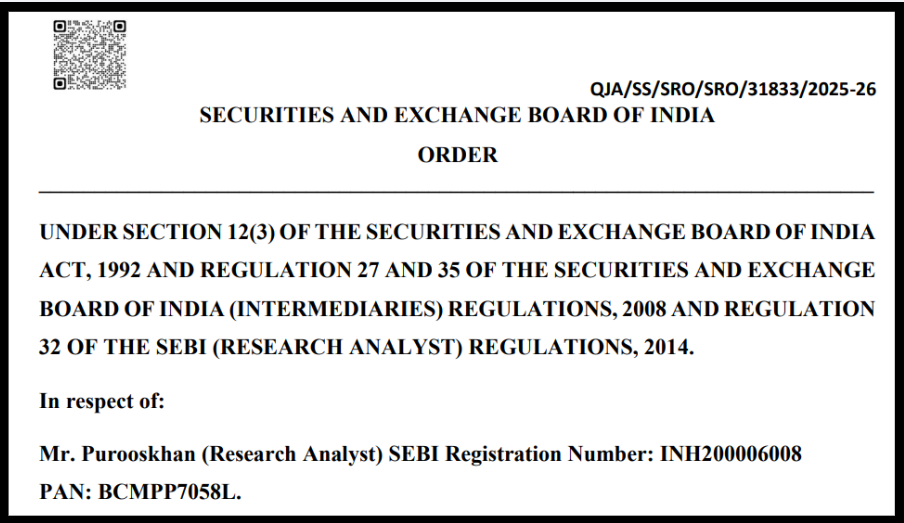
Case 2: SEBI Order Against Mr. Purooskhan, Research Analyst

This case is different, and in some ways, even more alarming. It involves a registered research analyst whose SEBI credentials were misused by an unregistered entity to fraudulently collect fees from investors.

SEBI Order Against Mr. Purooskhan

Mr. Purooskhan held a valid SEBI Research Analyst registration (INH200006008) since June 2018.

However, SEBI received two complaints, in June 2022 and February 2023, linked to a website called “www.optionresearch.in.”

This website offered investment advisory packages and claimed to be a SEBI-certified company. It even quoted Purooskhan’s registration number to appear legitimate to investors.

Fees were being collected into bank accounts held in the name of a partnership firm, M/s Option Research Consultancy (ORC), run by three separate individuals with no SEBI registration.

In other words, ordinary investors were paying fees to what they thought was a SEBI-registered entity. They were actually paying an unregistered firm that had simply stolen a registered analyst’s credentials to look credible.

Key Violations Found By SEBI

  • Purooskhan had shared his registered email ID password with another person (Faheeth Ali), one of the partners of ORC, a serious security lapse for a SEBI-registered intermediary.
  • His SEBI registration number and details appeared on ORC’s website, creating a false impression of legitimacy for investors paying fees to ORC.
  • ORC collected fees from investors without holding any SEBI registration, effectively charging fees under a false identity.
  • No invoices were issued to clients reflecting the actual fee recipient, the actual service terms, or a genuine SEBI-registered entity.
  • Purooskhan did not take adequate steps to stop the misuse of his credentials after becoming aware of it.

SEBI noted that a registered analyst sharing their credentials with a third party is a fundamental breach of the obligations placed on intermediaries. The secure, individual nature of a SEBI registration exists precisely so that investors can trust who they are paying.

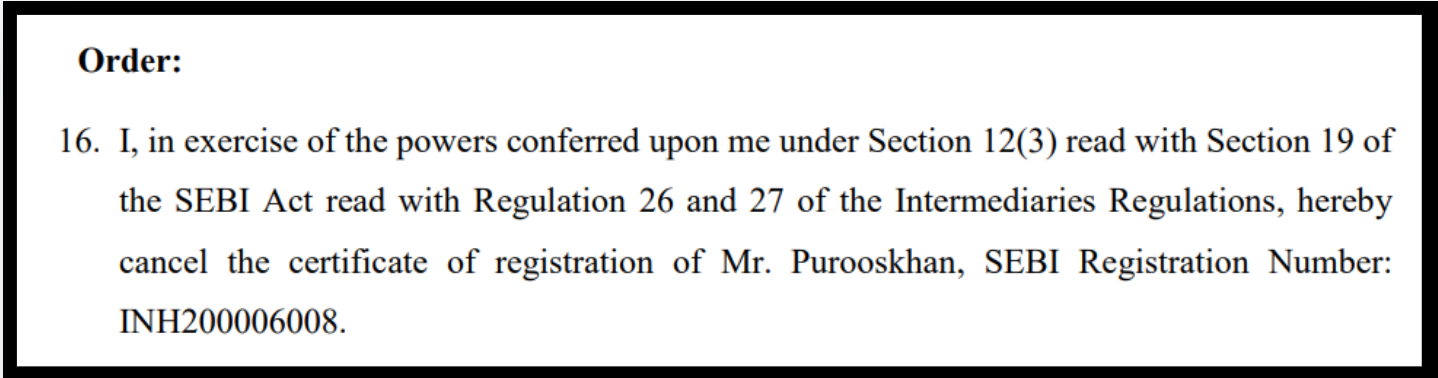
SEBI Penalty on Mr. Purooskhan

SEBI Penalty on Mr. Purooskhan

  • Purooskhan’s certificate of registration as a Research Analyst was cancelled with immediate effect (Order dated December 12, 2025)

This case is a warning in both directions. Investors who paid fees to ORC had no invoice from a legitimate SEBI-registered entity; their money went to an unregistered firm with no paper trail in their favour.

Purooskhan, despite being registered, lost his registration for enabling this situation through negligence.

What Retail Traders Must Learn from These Cases?

The pattern in both cases is clear. The absence of a legitimate invoice is not just an inconvenience.

It naturally makes many market participants wonder: can we trust SEBI registered RA individuals blindly?

The answer is no, registration is a baseline, not a blanket guarantee of ethical behaviour.

It is a signal that the person collecting your money may not be operating legally if they bypass basic rules.

Here is what every trader must take away:

  • Always ask for an invoice before paying: A registered research analyst is legally required to operate with documented, transparent fee structures. If they hesitate to give you an invoice or receipt, that is a red flag.
  • Check the payment destination: From October 2025, registered RAs must collect fees through @Valid UPI handles. If you are paying into a personal number, a random account, or a third party’s name, your payment is not reaching a registered entity, and you have no protection.
  • Verify registration independently: Do not rely on a website claiming to be SEBI-registered. You should actively check SEBI registered RA details. Visit SEBI’s official intermediary search portal or use the SEBI Check feature (launched June 2025) to verify the registration number directly. :
  • An invoice protects you legally: Without an invoice, you cannot file a complaint on SCORES, approach an arbitration forum, or demand a refund with any credibility. The invoice is your evidence.
  • Paid groups and Telegram tips are not research services: Many unregistered operators collect fees for tips on WhatsApp or Telegram without any documentation. This is not a research service. It is an unregistered advisory activity. And SEBI is actively pursuing such cases.

How to File a Complaint Against a Research Analyst?

If you have already paid a research analyst and did not receive a proper invoice, or if you suspect the fees went to an unregistered entity, take immediate action.

Here are the steps to report a research analyst in India:

  • Save All Evidence Immediately: Screenshot every message, payment confirmation, UPI transaction record, and conversation. If you have voice call recordings, save those too. Time-stamped digital evidence is essential for any complaint.
  • Check their SEBI Registration: Visit SEBI’s intermediary portal and search for the name or registration number. Also, use the SEBI Check feature to confirm whether the entity you paid is genuinely registered.
  • Demand an Invoice in Writing: Send a formal message or email asking for a proper invoice for the fees collected. Their response, or refusal, becomes additional evidence.
  • File a Complaint with SCORES: SEBI’s SCORES portal lets you lodge a formal complaint against any registered or unregistered entity. Attach all your evidence. SEBI must respond within 30 days.
  • Escalate Complaint with Smart ODR: If SCORES does not resolve the matter, escalate to SEBI’s Online Dispute Resolution platform for structured resolution.
  • Stock Market Arbitration: If the dispute remains unresolved and significant financial losses are involved, you can proceed with stock market arbitration. Arbitration provides a formal legal mechanism to resolve disputes between investors and market intermediaries under the securities market framework.
Need Help?

If you have paid a research analyst and received no invoice, or if you have reason to believe the fees went to an unregistered operator, your situation has legal remedies.

Register with us, and we will help you organise your evidence, verify the registration status, and guide you through the complaint process, from SCORES all the way to arbitration if needed.

Conclusion

The question, can research analyst charge fee without invoice, has a clear answer under Indian securities law: no, they cannot.

A registered research analyst must follow SEBI regulations strictly. Therefore, fee collection should remain fully transparent and properly documented.

Additionally, every payment must stay traceable through official channels. Clients should also receive clear records showing the amount paid, the service provided, and the agreed terms.

The SEBI orders against Priyank Dineshbhai Shah and Mr. Purooskhan both show what happens when this system breaks down: investors lose money into informal channels, get no invoices, and have no recourse.

When a research analyst collects fees without issuing an invoice, one of two things is happening: either they are not complying with their obligations as a registered intermediary, or they are not registered at all.

Neither is acceptable.

If someone asks you to pay for research services or stock tips without issuing a receipt, that is not just poor practice. It is a regulatory violation, and your money is at risk.

Verify first. Pay only through documented channels. Always demand your invoice.

Leave a Comment

Your email address will not be published. Required fields are marked *

loader

FraudFree Support

We're online — reply instantly
Scroll to Top