

A SEBI registration certificate is not a character reference. Supreme Investrade and Research Services holds one, and still found itself on the receiving end of two separate regulatory actions within a single year.
That should give every prospective subscriber reason to pause.
Operated by Abhishek Kumar Singh out of Navi Mumbai, Supreme Investrade positions itself as a research-driven platform for intraday traders focused on Nifty, Bank Nifty, and equity options.
On the surface, the credentials check out: a valid SEBI licence, a registered office address, a compliance officer, and a website carrying the required disclaimers.
But regulatory filings, a BSE arbitration award, and public commentary from a senior financial journalist together tell a more complicated story, one involving profit guarantees, client manipulation, fabricated complaint resolutions, and penalties from SEBI’s own adjudication machinery.
This blog presents those findings in full, so readers can make an informed decision before committing any capital to this platform.
Supreme Investrade
Supreme Investrade and Research Services is a sole proprietorship registered in Maharashtra. It was granted SEBI Research Analyst registration on September 9, 2021, under registration number INH000008747.
The proprietor, Abhishek Kumar Singh, also serves as the firm’s compliance officer, a structural arrangement worth noting.

The firm’s website states that its services are confined to providing independent research recommendations, with no involvement in advisory or portfolio allocation.
Its official disclosures also acknowledge that no returns are guaranteed and that all investments carry market risk.
These disclaimers are mandatory under SEBI regulations. The critical question is whether the actual client-facing conduct aligned with them. According to SEBI’s own adjudication records, it did not, on multiple counts.
Services Offered:
- Intraday research alerts for Nifty and Bank Nifty.
- Index options segment recommendations with defined target and stop-loss levels.
- Equity segment research calls.
- Subscription-based alert delivery via WhatsApp and mobile notifications.
While the surface may appear polished and professional, the regulatory reality for Supreme Investrade suggests a deeper, systemic issue.
The firm’s offerings, which include high-stakes Intraday research alerts for Nifty and Bank Nifty, index options recommendations with set stop-loss levels, and subscription-based WhatsApp delivery, were all under the microscope.
Let’s examine the regulatory findings in detail.
Supreme Investrade SEBI Orders
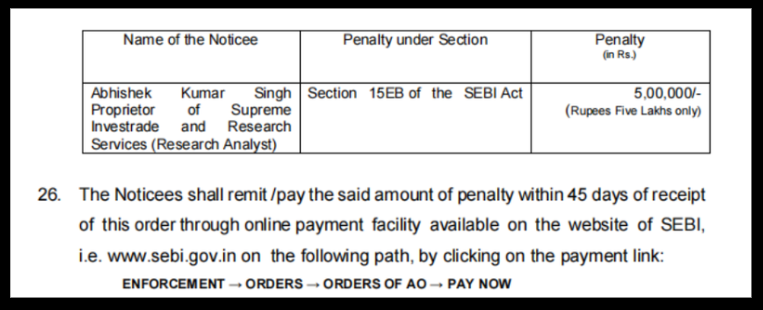
Supreme Investrade’s regulatory record is not without a single lapse. SEBI issued two separate adjudication orders against the firm: one in December 2024 and a second in December 2025.
This sustained enforcement activity over twelve months reflects a pattern, not an isolated compliance failure.
The December 2024 order attracted significant public attention.
Neil Borate, a well-regarded markets journalist, publicly summarised the order’s implications, noting that it drew clear regulatory lines for all research analysts: soliciting clients by displaying other customers’ profit screenshots is prohibited, and issuing real-time execution commands goes beyond the permissible scope of research recommendations.
What follows is a breakdown of each violation that SEBI’s adjudicating officers upheld.
Violation 1: Using Other Clients’ Profits to Attract New Subscribers
SEBI found that Supreme Investrade’s representatives shared WhatsApp screenshots of profits earned by existing clients with prospective new subscribers.
The intent was clear: create the impression that consistent, replicable returns were the norm, not an exception.
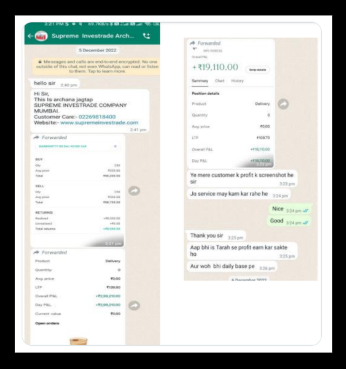
SEBI treats this as an inducement.
Under Research Analyst regulations, a registered RA may not use selective performance data, especially profits of specific other clients, to entice new subscriptions.
It manufactures a false impression of predictable outcomes. The existence of a signed disclaimer did not override this finding because verbal and WhatsApp-based assurances were independently documented.
Violation 2: Pressuring Loss-Making Clients to Inject More Capital
When clients incurred trading losses acting on the firm’s recommendations, Supreme Investrade’s representatives did not advise restraint or review.
Instead, they urged those clients to deposit fresh funds, framing it as a route to loss recovery through subsequent trade calls.
SEBI’s order documents at least one case where a client was explicitly told to “arrange more capital for trading” after already sustaining losses.
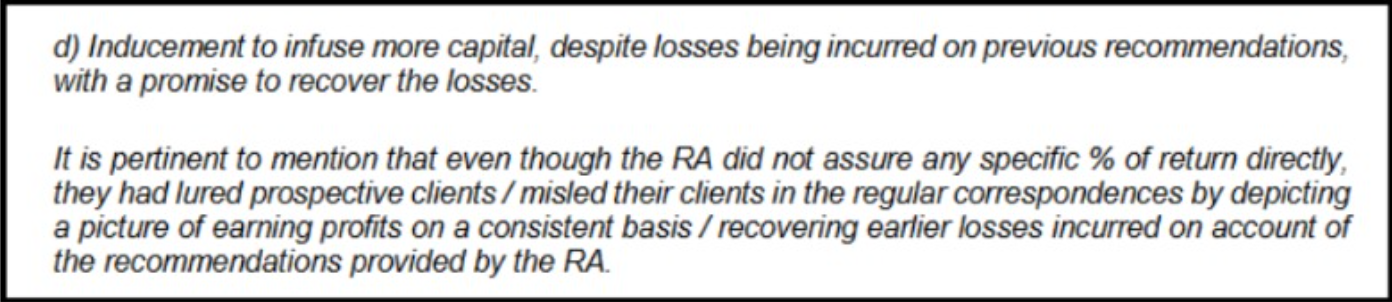
This conduct is categorically prohibited under SEBI’s PFUTP Regulations.
Inducing a client to commit further capital, particularly by invoking recovery promises after a loss, exploits financial distress and creates compounding exposure.
It does not constitute research. It constitutes a predatory sales practice.
Violation 3: Real-Time Execution Commands Beyond Research Scope
A research analyst may issue buy or sell calls with target and stop-loss parameters. What they may not do is deliver real-time instructions that cross into active trade execution.
SEBI’s order documented WhatsApp messages from the firm that crossed this line without ambiguity.
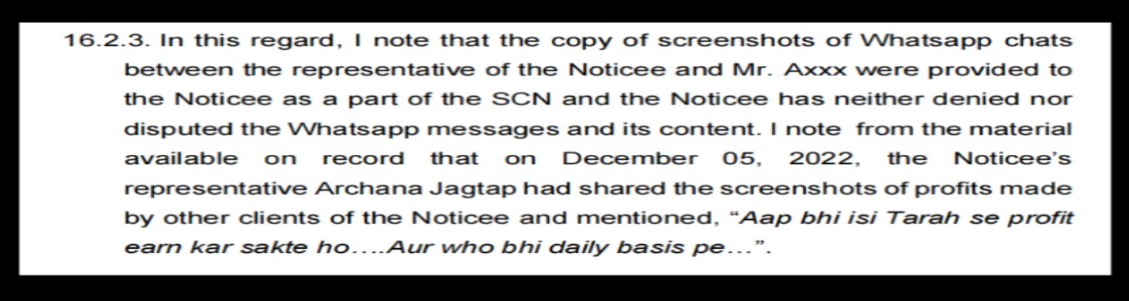
This is not research. It is execution-level pressure, delivered in real time, influencing both position size and timing. SEBI draws a clear regulatory boundary between these two activities.
Crossing it constitutes mis-selling and falls within the scope of unfair trade practices.
Violation 4: Manipulating SEBI’s Own Complaint Resolution System
The most serious finding in SEBI’s order involves the deliberate subversion of the SCORES grievance mechanism.
A firm employee drafted a satisfaction statement on behalf of a complainant, including language such as “I am very happy…”, and instructed the client to email it to SEBI to close their active complaint.

Manufacturing a false complaint resolution to shut down a SEBI SCORES grievance is not a procedural misstep; it is an attempt to deceive the regulatory system itself.
SEBI’s investigation treated this as a significant aggravating factor when assessing the firm’s overall conduct and culpability.
Violation 5: Written Disclaimers Systematically Contradicted by Verbal Conduct
Supreme Investrade’s official paperwork stated clearly that no guaranteed returns are offered and that all market risk rests with the client.
Yet across multiple documented client interactions, preserved in WhatsApp chat logs, the firm’s representatives made precisely the assurances those documents disclaimed.
SEBI’s adjudicating officer found this pattern to be evidence of systematic bad faith rather than isolated communication errors.
A signed disclaimer does not protect a firm from liability when client-facing communication demonstrably contradicts it. WhatsApp messages and audio recordings carry evidentiary weight in regulatory proceedings, regardless of what paperwork was signed beforehand.
Supreme Investrade Arbitration Case
Beyond the SEBI orders, a BSE arbitration proceeding filed by a retail investor named Mukul Singh provides granular, case-specific evidence of how the firm’s conduct played out in a real client relationship.
The award is especially instructive because the arbitrator held the firm directly liable for a specific portion of the investor’s loss.
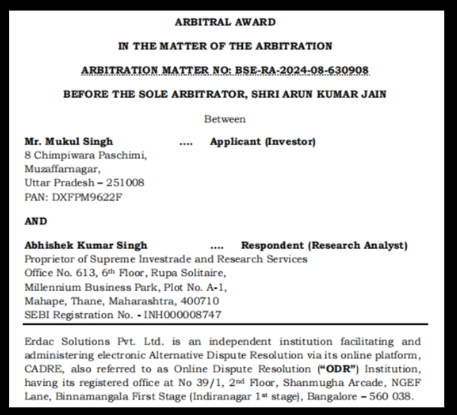
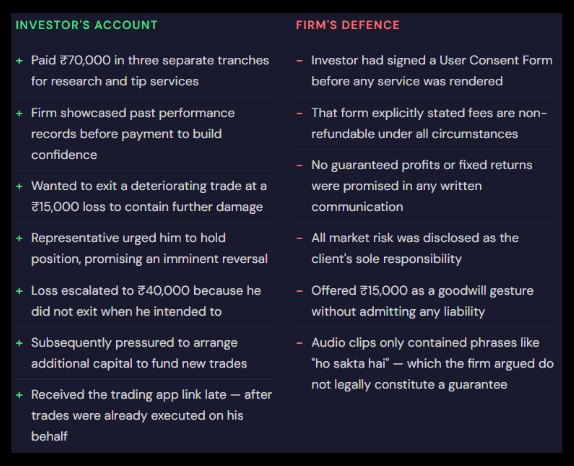
Final Arbitration Award & Penalty Imposed:
- Subscription Fee Refund (₹70,000): Not granted; the non-refund clause in the signed consent form was binding.
- Extra Loss Compensation: ₹25,000 awarded to the investor, the arbitrator found the firm directly caused the incremental ₹25,000 loss by advising the client against exiting the trade.
Key Legal Principle: The act of intervening to prevent a client from exercising their own exit decision creates compensable liability for the advisor. irrespective of disclaimers.
The arbitration outcome carries implications well beyond the rupee figure.
It establishes, through a formally adjudicated proceeding, that a research analyst’s real-time intervention to override a client’s exit decision is a breach for which the firm bears financial responsibility.
Disclaimers do not cover active interference with client autonomy.
What Investors and Traders Can Learn From This?
The combined weight of two SEBI orders, a BSE arbitration award, and documented public scrutiny creates an unusually clear picture of how certain advisory firms can exploit the gap between regulatory paperwork and day-to-day client conduct.
For many affected traders, these systematic actions cross the line from aggressive sales pitches to what they consider a Supreme Investrade fraud.
- Profit screenshots of other clients are a sales tactic, not evidence of your likely outcome. SEBI explicitly prohibits using them to attract subscriptions; their presence is itself a regulatory red flag.
- Non-refundable clauses in subscription agreements are legally binding even when the service causes you financial harm. Understand exactly what you are signing before you pay.
- Your right to exit a losing trade cannot be overridden by any advisor. A representative who urges you to hold when you have decided to cut losses is exceeding their permitted scope and may be creating legal liability for the firm.
- If a firm responds to your SEBI SCORES complaint by drafting a satisfaction statement for you to submit on their behalf, do not send it. This is an attempt to artificially close a genuine grievance.
- Always check SEBI’s enforcement section at sebi.gov.in before subscribing to any research analyst. Two adjudication orders in twelve months is not a coincidence; it is a pattern.
- Registration means a firm has met a threshold to operate. It does not mean they operate with integrity. The two are entirely separate questions.
How to File a Complaint Against Supreme Investrade?
If you have subscribed to Supreme Investrade and experienced misleading promises, pressure selling, advice to hold a losing position against your judgment, or a manipulated complaint closure, there are established regulatory channels available to you.
- Preserve All Evidence: Compile every piece of communication, WhatsApp messages, audio clips, payment receipts, screenshots of profit claims or recovery promises, before initiating any formal process. Evidence preservation is the foundation of a credible complaint.
- Submit a Written Complaint to the Firm: Write formally to Supreme Investrade’s compliance officer at [email protected], referencing your client ID, the specific conduct that caused you harm, the financial loss, and the resolution you are seeking. Allow 7–10 working days for a written response.
- File a Complaint in SCORES: If the firm’s response is inadequate or not forthcoming, escalate to SEBI’s investor grievance portal at scores.sebi.gov.in. Attach all supporting documentation. SEBI typically targets resolution within 30 days.
- File a Complaint in SMART ODR: If you are not satisfied with the outcome on SCORES, you can take the matter to the SMART ODR platform. This system enables structured online dispute resolution, including mediation and settlement for financial claims, without requiring you to engage in lengthy legal proceedings.
- Arbitration in Stock Market: For disputes involving subscription fee recovery or compensation for losses caused by specific advisory conduct, BSE’s arbitration mechanism offers a structured route, as the Mukul Singh case demonstrates. Note that BSE arbitration may involve filing fees.
Need Help
If you’re uncertain about what to do next or feel confused by the process, you don’t have to go through it alone. Simply register with us, and we’ll take care of the rest.
Once you reach out, our team will assess your case, organise the necessary details, and support you at every step. From preparing your complaint to choosing the right platform, we make the entire process easier for you.
You don’t have to handle everything by yourself; having the right support at the right time can make all the difference.
Conclusion
For anyone asking is Supreme Investrade SEBI registered: yes, it carries a valid SEBI registration under INH000008747.
That fact is not in dispute, and it is publicly verifiable.
However, after reviewing the penalties for using misleading profit screenshots, the pressure on clients to inject capital after losses, and the documented manipulation of the SCORES system, the real questionis: is Supreme Investrade safe?
A SEBI registration is the bare minimum to operate, but it is not a guarantee of ethical conduct.
The substantive violations documented with WhatsApp evidence and addressed with heavy monetary penalties suggest that a “valid license” doesn’t always equal a safe experience for your capital.
The BSE arbitration outcome adds another data point: when an advisor overrides a client’s own risk management judgment, and it costs them money, the advisor can be held liable. Documentation made that case. It can make others.
Before subscribing to any research advisory, look up their enforcement history on SEBI’s website. The information is free, public, and often revealing.
A few minutes of research can prevent a great deal of financial and emotional damage.





 Add us as a preferred source on Google »

