

Have you ever received a call promising “Almost Certain Profits” from the stock market? If you have, you’re not alone, and that call may have cost you more than just money.
Every day, thousands of traders across India receive calls from advisory firms promising consistent returns, high-accuracy calls, and premium stock tips.
The pitch feels professional. The name sounds credible. And when they mention “SEBI registered,” most people breathe a little easier and lower their guard.
But here’s what most people don’t realise: SEBI registration tells you a firm exists, not that it operates ethically.
This is exactly the story of Supreme Investrade and Research Services, a Navi Mumbai-based research analyst firm registered under SEBI, run by its proprietor, Abhishek Kumar Singh.
In this blog, we take a deep, honest look at the unauthorised trading advice by Supreme Investrade research analyst, the violations documented in official SEBI orders, the red flags you need to watch for, and exactly what you should do if you’re already caught in a situation like this.
Unauthorised Trading Advice by Supreme Investrade
Before diving into the specifics, let’s understand what “unauthorised trading advice” really means in the context of a SEBI-registered Research Analyst (RA).
A registered research analyst is legally permitted to provide independent research-based recommendations, buy or sell calls with target prices and stop losses.
That’s it. They cannot manage your funds, promise profits, interfere with your trading decisions, push you to stay in losing trades, or charge you fees beyond SEBI-prescribed limits.
When an RA does any of the above, those practices step outside the boundary of what SEBI authorises.
That’s where the concept of “unauthorised” trading advice comes in, advice that crosses regulatory lines, even if the entity holds a registration number.
In the worst-case scenarios, it goes beyond bad advice; it becomes a compliance nightmare in which an advisory service executed trades without consent, leaving the investor scrambling to fix the mess.
Supreme Investrade operated in this space between what’s permitted and what’s prohibited.
Let’s go through the violations one by one.
Major Violations by Supreme Investrade Research Analyst
Here’s a breakdown of the key violations that have been documented through SEBI orders and client complaints against Abhishek Kumar Singh Research Analyst, the proprietor of the firm:
1. Mis-Selling Through Inducement
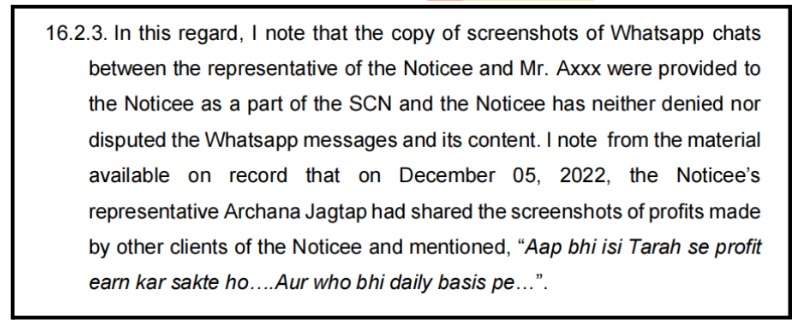
Clients were actively drawn in using high-promise language. SEBI’s December 2024 order against Abhishek Kumar Singh of Supreme Investrade specifically clarified that research analysts cannot entice customers by showing them screenshots of other customers’ profits.
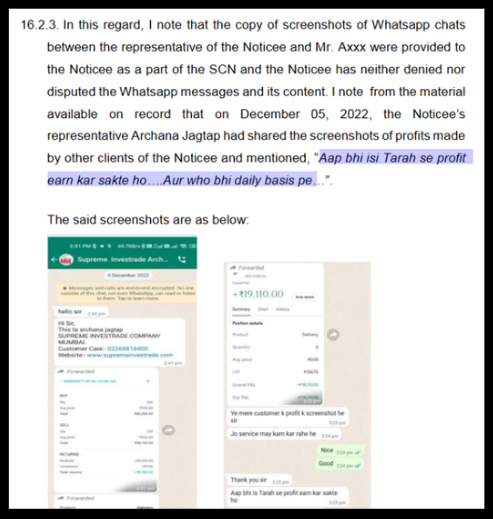
This is a form of inducement, making a prospective client believe that others have made money, creating a false impression of performance.
Under SEBI’s RA Regulations, a registered analyst must maintain independence and cannot use manipulative or misleading sales communication.
Showing cherry-picked profit screenshots is exactly that.
2. Implied Guarantees of Profit
SEBI regulations are unambiguous: a Research Analyst cannot promise assured returns or guaranteed profits, since financial markets are inherently uncertain.
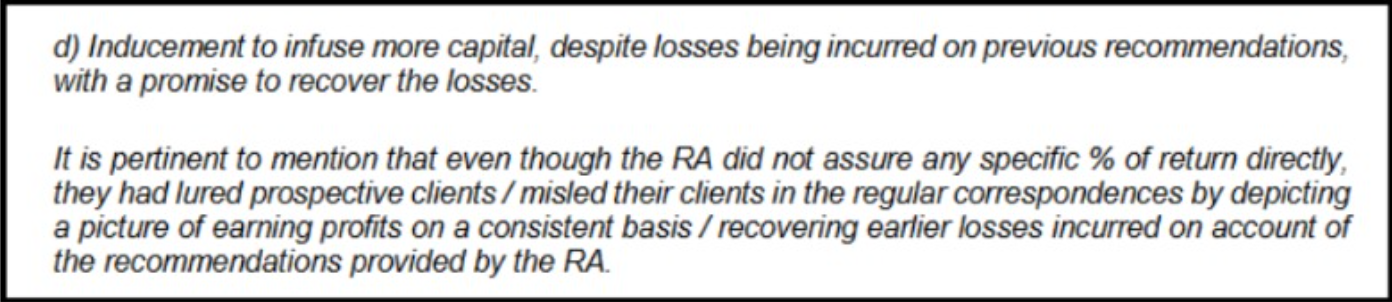
They also cannot assure recovery of losses or claim that future calls will compensate for prior losses.
However, the communication pattern used by Supreme Investrade’s representatives, phrases like “profit is almost certain” or “we’ll recover your losses”, was clearly designed to imply certainty, even when no written guarantee existed.
The verbal assurances contradicted the written disclaimers that clients were asked to sign.
3. Excess Fees and Premium Service Pitching
SEBI has set clear guidelines on fees chargeable to clients, with an annual limit of ₹1.51 lakh per family for individual/HUF clients. Charging beyond this prescribed limit is a regulatory violation.
Beyond the fee cap issue, the larger concern is how premium services were pitched.
After an initial paid plan failed to deliver, clients were pressured to subscribe to “higher-tier” plans, with the promise that a bigger investment in the service would lead to bigger and more reliable returns.
This is classic mis-selling: using loss anxiety as a sales tool.
4. Interfering With Client Trade Decisions
One of the clearest regulatory violations is when a research analyst steps beyond advice into trade interference. Advising someone not to exit a losing position and pressuring them to stay is no longer providing independent research.
It is an active interference in a client’s trading account decisions.
Under SEBI regulations, a research analyst cannot engage in aggressive or misleading sales communication, including verbal assurances that contradict written disclaimers, and cannot operate beyond the scope of research.
SEBI Order Against Supreme Investrade Research Analyst
Before trusting any SEBI-registered research analyst, it’s important to understand how regulatory actions can impact credibility.
The SEBI orders against Supreme Investrade Research Analyst offer key insights into compliance gaps and what investors should watch out for.
SEBI Order 1: December 2024
SEBI issued its first formal adjudication order against Abhishek Kumar Singh, Proprietor of Supreme Investrade and Research Services, on December 27, 2024.
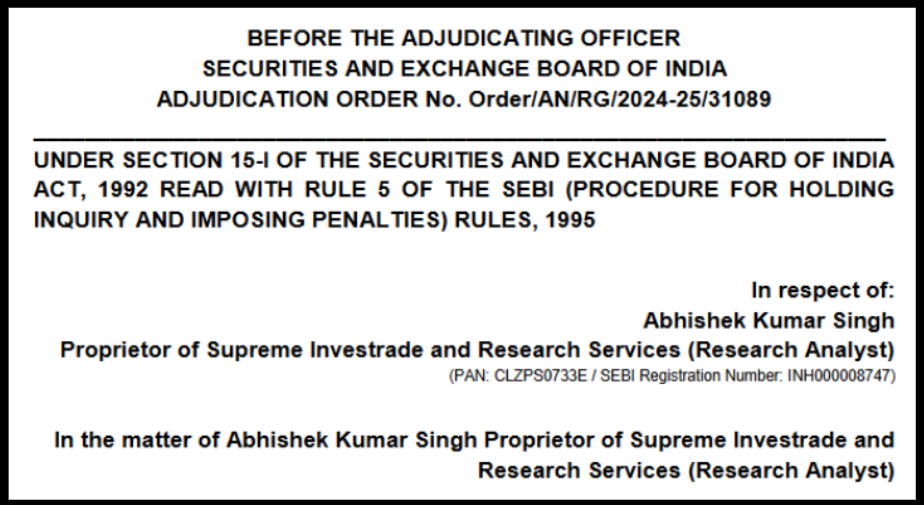
The order arose from SEBI’s inspection of Supreme Investrade’s practices.
The regulator looked into how the firm was conducting its advisory business, specifically its marketing methods and its conduct toward clients.
Key findings from this order:
- The firm was found to be using screenshots of other clients’ profits to entice new subscribers, a practice SEBI explicitly holds to violate RA Regulations. Sharing such cherry-picked proof of gains, without corresponding disclosures of losses, creates a misleading impression about typical service outcomes.
- SEBI clarified through this order that while a research analyst can issue a buy/sell recommendation and provide target prices and stop losses, they cannot go beyond this scope.
- The order found violations related to the manner in which the firm communicated with potential clients, essentially that the promotional conduct fell outside the bounds of what is permitted for a registered RA.
Penalty imposed: ₹5,00,000, with provisions for recovery action in case of non-payment.
Key Note for Traders: This order should matter to every retail trader. The fact that SEBI had to issue a specific clarification about “showing profit screenshots of other clients” to attract new customers means this practice was actively happening.
If an advisory you are considering shows you other people’s P&L to convince you to subscribe, that is a red flag, not a reassurance.
SEBI Order 2: December 2025
SEBI issued a second adjudication order against the same entity, Abhishek Kumar Singh, Proprietor of Supreme Investrade and Research Services, in December 2025.
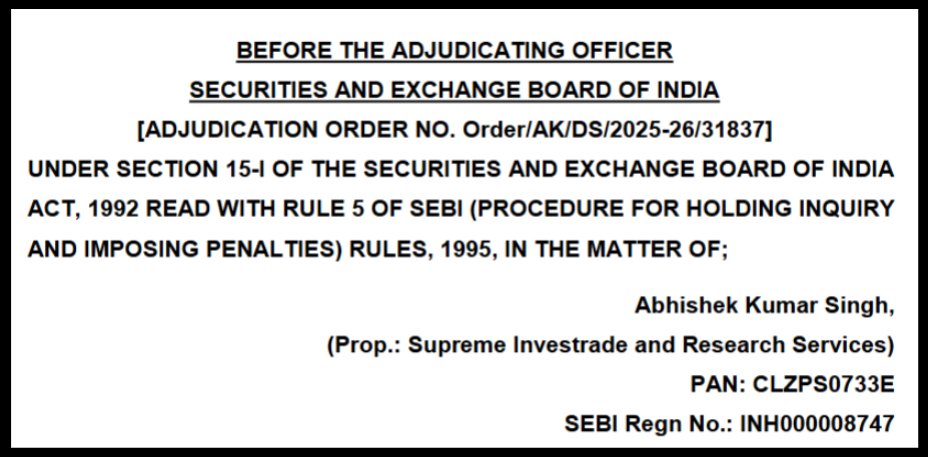
The fact that a second order was required, coming just one year after the first, is itself telling. It suggests that the corrective impact of the first order was limited, and that SEBI found further grounds to act.
Key findings from this order:
- Additional regulatory violations were recorded under the SEBI (Research Analysts) Regulations, 2014, including matters related to client communication and service conduct.
- The repeated enforcement action signals that the regulator remained unsatisfied with how the firm had responded to earlier directions.
- A monetary penalty of Rs. 2,00,000 was imposed under the SEBI Act.
Key Note for Traders: Two SEBI adjudication orders against the same firm within 12 months are not a minor compliance lapse. It reflects a pattern.
Supreme Investrade’s own disclosure page now acknowledges that an adjudication letter was issued by SEBI under the SEBI Act or regulations against the Research Analyst.
When an entity’s own disclosure contains this kind of admission, it deserves careful attention before you engage with them.
Supreme Investrade Research Analyst Arbitration Case
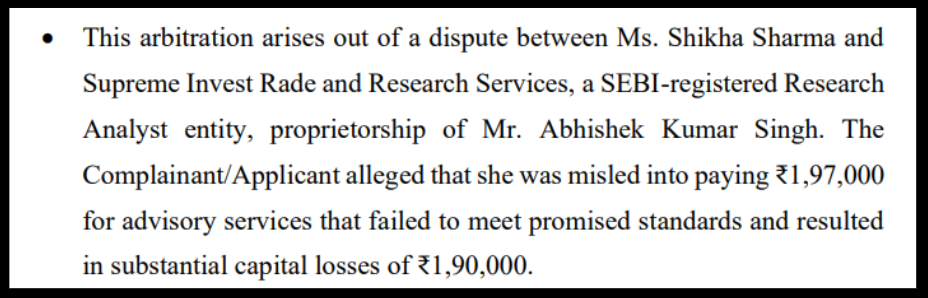
In the case of Shikha Sharma vs. Abhishek Kumar Singh (Supreme Investrade and Research Services), the arbitration highlights how regulatory violations can directly impact retail investors.
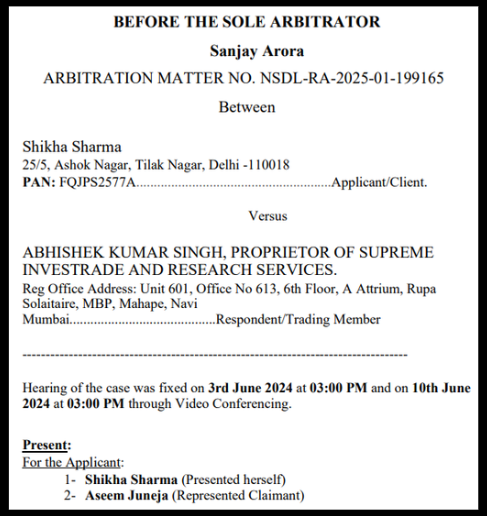
A client, Shikha Sharma from Delhi, came across Supreme Investrade through social media and was onboarded for their advisory services.
She paid a total of ₹1,97,000 over multiple transactions, based on verbal assurances that she would receive reliable, research-backed recommendations and strong returns.
She initially saw some profits, but soon faced heavy losses, reportedly around ₹1,90,000.
She also claimed that she was repeatedly encouraged to upgrade to higher plans by paying additional amounts, without receiving any meaningful improvement in service.
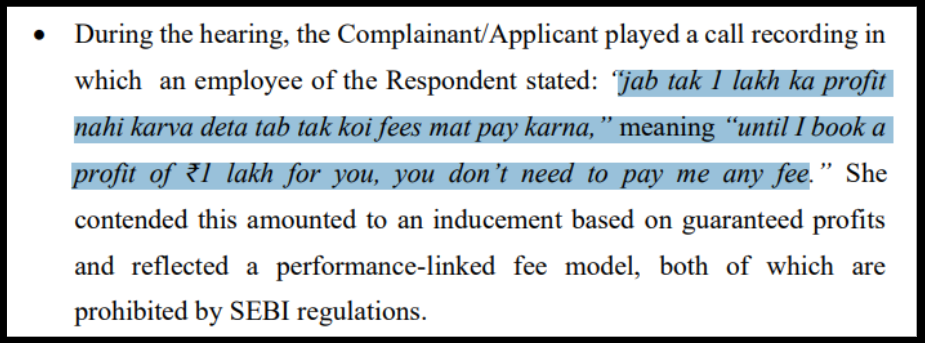
A key piece of evidence in this case was a recorded call, where a representative allegedly said: “jab tak 1 lakh ka profit nahi karva deta tab tak koi fees mat pay karna”, implying profit assurance, which is not permitted under SEBI regulations.
Shikha also highlighted that most communication happened over WhatsApp, and she did not receive proper support during live market situations, despite it being promised.
After receiving no satisfactory resolution, she escalated the matter through arbitration.
Arbitration Outcome:
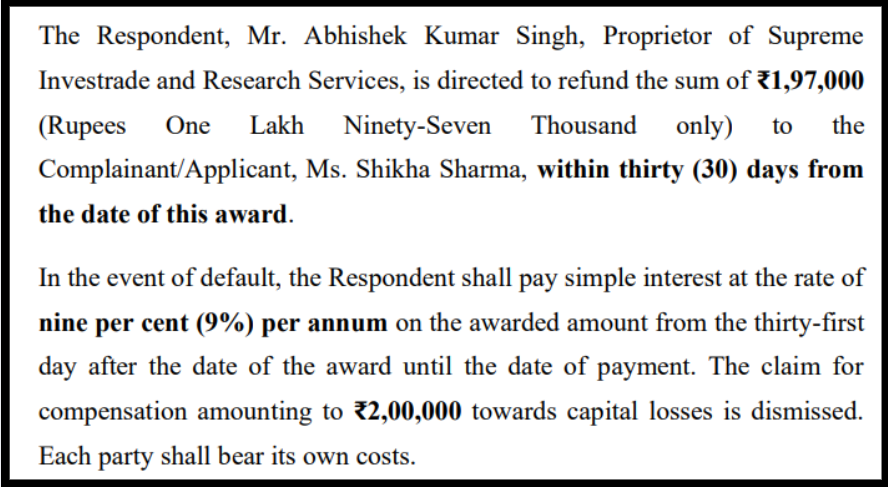
The arbitrator’s decision:
- Full refund of ₹1,97,000 was awarded.
- Compensation for trading loss was rejected.
The arbitrator found that the firm had engaged in misleading practices, including profit-linked assurances, non-transparent fee structuring, and providing trade-specific advice beyond the permitted scope of a Research Analyst.
However, the claim for trading loss was not accepted due to the inherent risk involved in market participation and the lack of direct causation.
Key Points from the Arbitration:
- Profit assurances can backfire legally: Any form of guaranteed or assured return, even verbal, is a clear violation and can strongly support the client’s case.
- Improper advice beyond RA scope is a serious breach: Giving specific buy/sell instructions crosses the boundary of what a Research Analyst is allowed to do.
- Non-transparent fee structures raise red flags: Charging amounts beyond advertised plans or restructuring packages after payment weakens the firm’s defence.
- WhatsApp communication without proper records is risky: Informal communication channels without proper documentation can go against the advisor in arbitration.
- Fee refund is possible if misrepresentation is proven: Unlike many cases, here the fee was refunded because the service itself was found to be misleading.
- Trading loss recovery remains difficult: Even with strong evidence, compensation for market losses is rarely granted due to the speculative nature of trading.
- Evidence is critical: Call recordings, payment proofs, and communication records played a decisive role in the outcome.
This case highlights an important reality: while regulatory violations can lead to relief, the type of relief depends heavily on what can be proven and how clearly the misconduct is established.
What Not to Do If You’re Already in This Situation?
If you’ve already paid and lost money following an advisor’s calls, here is what to avoid:
- Do not pay more money hoping to “recover” losses: This is the second trap, and it almost always makes the situation worse. Loss recovery upsells are the most common pattern in these cases.
- Do not stay silent: Most traders stay quiet because they feel embarrassed or don’t think anything can be done. Both assumptions are wrong.
- Do not trust only verbal commitments: If they’re offering a “goodwill gesture” or partial refund verbally, get it in writing before you agree to anything.
- Do not delete evidence: Every WhatsApp message, voice note, call recording, screenshot, and payment receipt is potential evidence. Preserve all of it, even if it seems trivial.
- Do not follow any SEBI-registered RA blindly: SEBI registration is necessary but not sufficient. Always verify that the firm’s actual practices match what’s permitted under the regulations. If something feels wrong, it probably is.
How to Report Against a Research Analyst?
If you have already paid fees, followed their calls, and incurred losses, here is a structured path forward:
- Collect Your Evidence: Gather everything, WhatsApp conversations, emails, payment receipts, call recordings if you have them, screenshots of any profit promises, and a timeline of events.
- Write a Formal Complaint to the Firm: Email [email protected] describing your grievance clearly. Request resolution within 30 days (as mandated by SEBI). Keep a record of this email.
- Register a Complaint in SCORES: If the firm doesn’t resolve your complaint satisfactorily within 30 days, file on SCORES (scores.sebi.gov.in). Be specific and factual. Attach evidence.
- File a Complaint in SMART ODR: If you are not satisfied with the outcome on SCORES, you can take the matter to the SMART ODR platform. This system enables structured online dispute resolution, including mediation and settlement for financial claims, without requiring you to engage in lengthy legal proceedings.
- Arbitration in Stock Market: For disputes involving subscription fee recovery or compensation for losses caused by specific advisory conduct, BSE’s arbitration mechanism offers a structured route. Note that BSE arbitration may involve filing fees.
Need Help?
If you’re uncertain about what to do next or feel confused by the process, you don’t have to go through it alone.
Simply register with us, and we’ll take care of the rest.
Once you reach out, our team will assess your case, organise the necessary details, and support you at every step. From preparing your complaint to choosing the right platform, we make the entire process easier for you.
You don’t have to handle everything by yourself; having the right support at the right time can make all the difference.
Conclusion
The story of Supreme Investrade is not unique. It reflects a wider problem in the research advisory space, where the language of regulation is used to build trust, and then that trust is exploited.
SEBI registration is a framework; it defines what an RA can and cannot do. It does not guarantee outcomes or remove market risk.
Investors should look beyond the registration label and ask whether the firm’s actual practices stay within SEBI’s defined limits.
If someone is promising you profits, showing you other people’s gains, pushing you to pay more after losses, or telling you when to enter and when not to exit your own trades, those are not signs of a good advisory.
They are the signs of a regulatory violation. Worse yet, aggressive tactics that cross legal bounds often pave the way for major malpractices like unauthorised trading by research analyst instances.
Protecting yourself from a Supreme Investrade fraud means knowing your rights, preserving your evidence, and never following any RA blindly, registered or not.





 Add us as a preferred source on Google »

