
How AI Courses Mislead Investors becomes clear the moment you open Instagram or YouTube and see pitches around AI-powered trading and machine learning systems promising massive profits.
Many of these courses rely less on transparent education and more on exaggerated claims, high-pressure sales tactics, and zero accountability when investors suffer losses.
Understanding how these schemes operate, the warning signs to watch for, and the protections available to investors is increasingly important.
How AI Stock Market Courses Exploit Investors?
Many AI stock market courses are not designed primarily to teach investing.
Instead, they are structured to trigger emotional buying decisions, upsell expensive programs, and create unrealistic expectations around trading success.
Understanding how AI courses mislead investors is a must because the marketing often looks educational on the surface, while the real objective is aggressive monetisation of aspiring investors.
1. The Free or Cheap Workshop Funnel
The ₹9 or ₹99 workshop is usually not the real product but a lead-generation tactic designed to create urgency and emotional buying pressure.
Participants are then pushed toward expensive AI trading courses costing ₹50,000 to ₹1,00,000 or more through limited-time offers and live sales pitches.
2. Guaranteed Return Claims in Course Marketing
Many AI stock market courses promote claims like “fixed monthly income” or “guaranteed returns,” despite SEBI rules prohibiting assured-profit advertisements by registered entities.
Such marketing creates unrealistic expectations and can cross into regulatory violations when linked to investment-related services.
3. Promoting Unverified AI Trading Tools
Several AI course platforms also market proprietary trading bots, scanners, or algo software without clearly disclosing exchange certification requirements.
Investors may end up using uncertified tools for live trading without understanding the compliance and financial risks involved.
4. Paid Media Dressed as Editorial Coverage
Many glowing “news articles” praising AI trading courses are actually paid promotional placements made to look like independent journalism.
Without clear “Sponsored” or “Advertisement” disclosures, these articles can mislead readers into treating marketing as unbiased editorial coverage.
5. Fake or Incentivised Reviews
Positive reviews on Google, Trustpilot, or testimonial pages are often clustered, repetitive, or posted immediately after workshops before any real trading experience exists.
This creates an artificial impression of credibility and success that may not reflect actual investor outcomes.
6. No Verifiable Track Record for the AI System
Most AI trading courses heavily promote profitability but fail to publish complete, audited, and timestamped records of all trade signals generated by their systems.
Instead, marketing usually relies on selective screenshots, curated profit images, and isolated success stories while ignoring losses and failed trades.
Under SEBI’s Advertisement Code, performance-related claims require proper substantiation and independent verification.
Despite this, most AI course platforms operating in India do not hold PaRRVA certification for the trading performance they advertise.
Common Issues Faced by Users of AI Trading Courses
Across Reddit, Quora, YouTube comment sections, and consumer complaint platforms, investors who paid for AI trading courses report a consistent experience.
It rarely starts badly.
The low-cost entry session feels genuinely useful. The full course covers real concepts, just wrapped in AI branding. The problems surface later related to how AI courses mislead investors.
Users across platforms describe the same sequence:
- The proprietary AI tool requires a separate paid subscription to work properly, something not disclosed up front

- Live trading results after completing the course do not match what the sessions demonstrated
- Refund requests go unanswered, and several users report being blocked after asking for one
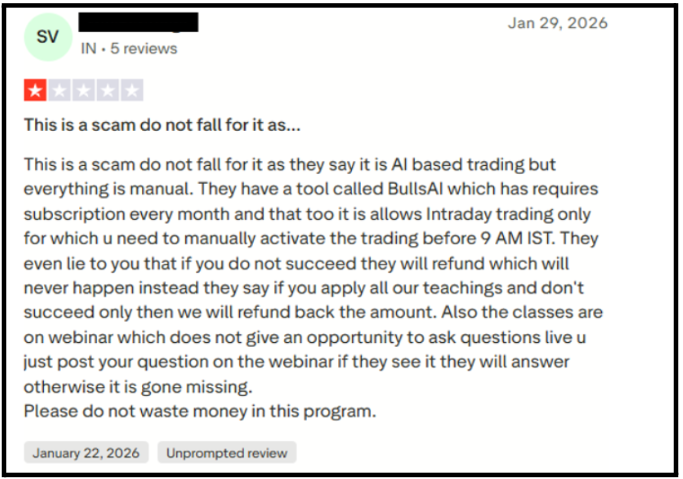
One platform that appears frequently in these independent accounts is Springpad AI, a SEBI-registered research analyst entity (INH000022950).
Users on Reddit describe their experience with platforms like Springpad AI Courses as “spammy” and “over-marketed.” YouTube comment sections on their ads carry consistent negative responses.
Multiple independent accounts describe the ₹9 workshop shifting quickly into pressure to buy a ₹1,00,000 course, with aggressive upselling of Bulls AI platform, alongside promotional content that implies guaranteed returns.

Springpad AI is a real, registered platform. But users say the gap between what the marketing suggests and what the course actually delivers is significant.
That gap, not the registration, is what investors need to evaluate before paying.
What Investors Must Know Before Buying an AI Trading Course?
Before paying for any AI trading course, regardless of the SEBI registration displayed in the footer, verify these things.
- A ₹9 workshop is a sales funnel, not a standalone educational product. Price what you are actually being asked to buy.
- Any guaranteed return claim in the course marketing is an SEBI violation. It does not matter whether it appears in a press release, a YouTube ad, or a PR article.
- SEBI registration confirms the entity exists; it does not certify course quality, AI tool accuracy, or trading outcomes.
- Ask specifically whether the AI trading tool is exchange-certified before using it for live trading.
- Check refund terms in writing before paying. “Satisfaction guaranteed” in a sales pitch and the actual refund policy are often very different things.
The strongest protection against misleading AI trading courses is careful verification before payment, not promises made during a sales pitch.
A few minutes spent checking claims, certifications, and refund terms can prevent significant financial and legal problems later.
What SEBI Says About AI Trading Courses?
AI trading education currently sits in a regulatory grey zone, but it is not completely unregulated.
Several provisions apply directly to course platforms that hold SEBI registrations.
| SEBI Rule | What It Means for AI Courses |
| Advertisement Code, Clause C(x) | No guaranteed return or accuracy claim allowed in any marketing material, including YouTube ads and landing pages |
| RA Code of Conduct, Clause 1 | Promoting a course with double-investment examples or profit guarantees violates the honesty requirement, even if labelled “educational” |
| PaRRVA Requirement | Any past performance claim requires independent verification before use in marketing; no major AI course platform currently carries this |
| Exchange Certification for Algo Tools | AI trading tools promoted alongside courses require BSE or NSE certification before retail investors can use them for live trading |
SEBI registration gives a course platform regulatory standing, but it does not exempt that platform from the rules that apply to every registered entity.
When a course’s marketing violates the Advertisement Code, the registration number in the footer becomes evidence of accountability, not protection.
How To Report Misleading AI Courses?
If an AI trading course platform made return claims that induced you to pay, provided a refund guarantee it did not honour, or promoted an uncertified algo tool without disclosure, you have regulatory options.
Step 1: Document All Marketing Material
Screenshot the course landing page, any promotional articles, YouTube ads, WhatsApp messages, and all sales communications before anything changes.
Marketing claims that induced your purchase are your strongest evidence.
Step 2: Send a Formal Complaint to the Platform
Write to the platform’s grievance officer by email and registered post.
State the specific claims that induced your purchase, what the course delivered, and what the refund policy said versus what you experienced. Give them 15 business days to respond.
Step 3: File a Complaint in SEBI
If the platform holds a SEBI registration, as several AI course brands now do, file a complaint on SEBI citing the specific Advertisement Code violation.
Guaranteed return claims and unverified accuracy figures in marketing material are independently reportable under Clause C(x).
Step 4: Report to ASCI
The Advertising Standards Council of India accepts complaints about deceptive advertising.
Paid media articles presented as editorial coverage, unsubstantiated “game changer” claims, and fake testimonials all fall within ASCI’s jurisdiction. File a complaint with supporting screenshots.
Step 5: Using Smart ODR and Other Escalation Options
If SEBI SCORES does not resolve the matter, investors can escalate the dispute through Smart ODR, exchange arbitration, or the Consumer Commission, depending on the complaint.
For example, Smart ODR handles disputes involving SEBI-registered entities, whereas BSE or NSE arbitration applies to trading losses caused by research recommendations or uncertified algo tools.
Similarly, investors facing misleading promises or refund denials can approach the Consumer Commission under the Consumer Protection Act, 2019.
Need Help?
If an AI trading course platform uses return promises to influence your payment decision, we help assess possible misrepresentation and misleading marketing.
Our services include:
- Case assessment: We review your payment records, marketing screenshots, and communications to identify which violations apply.
- Complaint drafting: Our team prepare precise complaints citing SEBI Advertisement Code, RA Regulations.
- SCORES and Smart ODR guidance: We walk you through every step of the filing process.
- Further escalation support: We help you prepare the next stage of action when initial complaints do not resolve the dispute.
Register with us to avail these.
The earlier investors act, the easier it becomes to preserve evidence and strengthen the chances of an effective regulatory or consumer remedy.
Conclusion
How AI courses mislead investors becomes clear through cheap workshop funnels, exaggerated return claims, selective testimonials, and paid media presented as independent news.
Before enrolling in any AI-powered trading program, investors should also understand the difference between a general trading workshop and a SEBI registered research analyst course.
While many institutes teach market concepts, a course conducted by a SEBI-registered Research Analyst is generally expected to operate within the regulatory framework applicable to Research Analysts.
Moreover, many platforms use SEBI registration numbers to create trust, even though registration does not guarantee ethical conduct or truthful marketing.
At the same time, SEBI’s Advertisement Code applies to investment-related promotions, which means informed investors can better identify misleading practices and take action early.