

Quick Summary
A SEBI registered research analyst cannot handle your trading account in India. Their job is to give research and buy, sell, or hold calls, nothing more. Only a Portfolio Management Service, with a ₹50 lakh minimum and its own licence, can legally trade your account for you. Even an investment adviser, who gives personal advice, cannot run your account. So when an analyst asks for your login or offers to “manage everything,” they are breaking a clear SEBI rule. This page shows you what an analyst can and cannot do, who is actually allowed to manage your money, and how to spot the line being crossed.
Someone offered to “handle everything” and just manage your trading for you. It sounded easy, so you are checking whether that is even allowed.
It is not. A research analyst running your account is against SEBI rules, full stop.
This page explains what the rule says, the difference between the three types of SEBI professionals, who can legally manage your money, and how to spot the moment an analyst crosses the line.
Can a Research Analyst Handle Your Account or Not?
No. A research analyst cannot handle your trading account. This is not a grey area. SEBI is clear about it.
A research analyst is allowed to do three things: prepare research reports, give general buy, sell, or hold calls, and share their opinion on a stock.
That is the whole job.
Nowhere in that list is running your account, placing your trades, or holding your login.
The rule comes straight from the SEBI (Research Analysts) Regulations, 2014, which defines an analyst as someone who prepares research and makes recommendations.
It says nothing about managing your money, because managing your money was never part of the role.
So the moment an analyst asks to log in and trade for you, they have stepped outside what their licence allows.
RA, IA, or PMS: Which One Can Actually Touch Your Money?
Most confusion comes from not knowing that SEBI licenses three very different roles.
People hear “SEBI registered” and assume it means the same thing every time. It does not.
Here is the difference in plain terms, because it decides who is allowed to do what with your account.
1. Research Analyst (RA)
An RA gives general research and buy, sell, or hold calls to a wide audience. Think of it as publishing an opinion, not as guiding you personally.
An RA cannot give you advice tailored to your personal situation, cannot hold your money, and cannot touch your account.
2. Investment Adviser (IA)
An IA can go a step further and give you personalised advice, suited to your income, goals, and risk level, but only after doing a proper risk assessment of you.
Even so, an IA still cannot hold your funds or trade your account. They advise you personally; you still place your own trades.
3. Portfolio Manager (PMS)
A PMS is the only one of the three that can actually manage and trade your account for you.
And it is not a casual service. SEBI requires a minimum investment of ₹50 lakh to open a PMS account; the manager must keep your money in a separate bank account, and they must send you regular performance reports.
So the test is simple. If someone offers to run your account but holds only a research analyst licence, they cannot legally do it, no matter what they call the service.
The only genuine SEBI registered account handling runs through a PMS, and nothing else qualifies.
If you are facing issues with a registered PMS, you can check our guide on how to file complaint against portfolio managers through official SEBI channels.
What Can a Research Analyst Do and Cannot Do?
Here is the boundary laid out plainly, so you can check any service against it.
A research analyst is allowed to: prepare research reports, give buy, sell, or hold recommendations with reasons, set price targets based on that research, do fundamental and technical analysis, and speak publicly to educate investors.
A research analyst is not allowed to: hold your money, manage your trading or demat account, ask for your login or password, accept deposits from you, or promise you guaranteed returns.
SEBI’s own investor guidance says it directly: do not hand your funds to a research analyst, and do not share your trading or demat login and password with them.
If a service you are paying for crosses into the “not allowed” side, that is not a small technicality. It is a regulatory violation you can act on.
And if an analyst has already asked for your login, what to do in that moment is covered in our guide on what to do when a research analyst asked for my ID and password.
Real SEBI Action Against Analysts Who Crossed the Line
The cases below come directly from SEBI’s official enforcement records.
Each one shows a real situation where a research analyst or registered firm crossed the legal boundary and faced regulatory consequences.
Case 1: Trustline Securities Ltd. SEBI Order
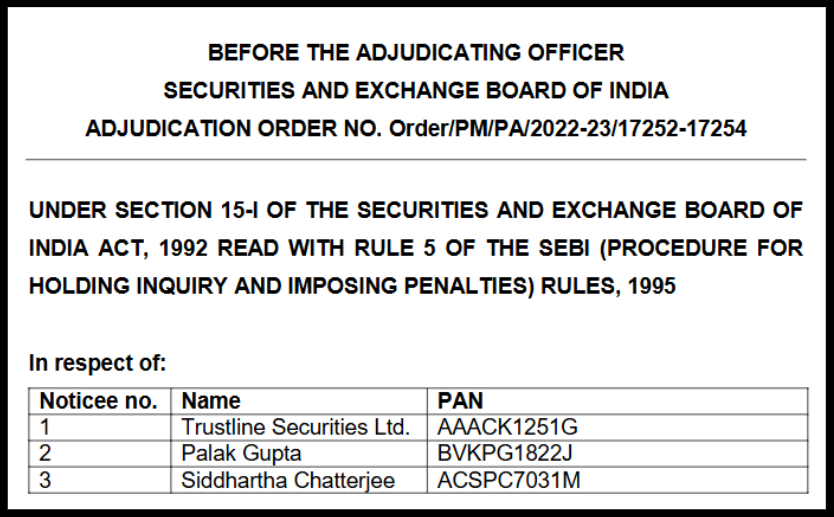
Trustline Securities Limited is a Noida-based firm registered with SEBI as both a stock broker and a research analyst (Registration No. INH100000528).
SEBI conducted an inspection of its books for the period April 2018 to March 2019.
The inspection uncovered several serious compliance failures. Two individual research analysts, Palak Gupta and Siddhartha Chatterjee, were also named in the proceedings.
Key Violations Found by SEBI
- Trustline failed to put in place any internal policy for monitoring and controlling the trading activities of its own research analysts. The firm admitted it had no mechanism to track RA trades. This meant research analysts were free to trade in the same securities they recommended, without oversight.
- The firm and its research analysts traded in recommended securities within the prohibited window, that is, within 30 days before and 5 days after the publication of research reports. This directly violates Regulation 16(2) of the RA Regulations, which exists specifically to prevent conflicts of interest.
- Trustline was simultaneously operating as a stock broker and a research analyst without properly segregating these two activities. Research analyst services were offered as an “add-on” to brokerage clients, without separate onboarding, separate complaint handling, or separate disclosures.
- Research analyst employees lacked the required NISM certification during the inspection period. Palak Gupta, Siddhartha Chatterjee, and another analyst named Pranay Guha all worked as research analysts without valid certifications at the time.
- Trustline failed to obtain SCORES authentication or maintain a separate complaint redressal mechanism for research analyst clients. All complaints, whether related to stock broking or research advisory, passed through a common helpdesk.
SEBI Penalty Imposed
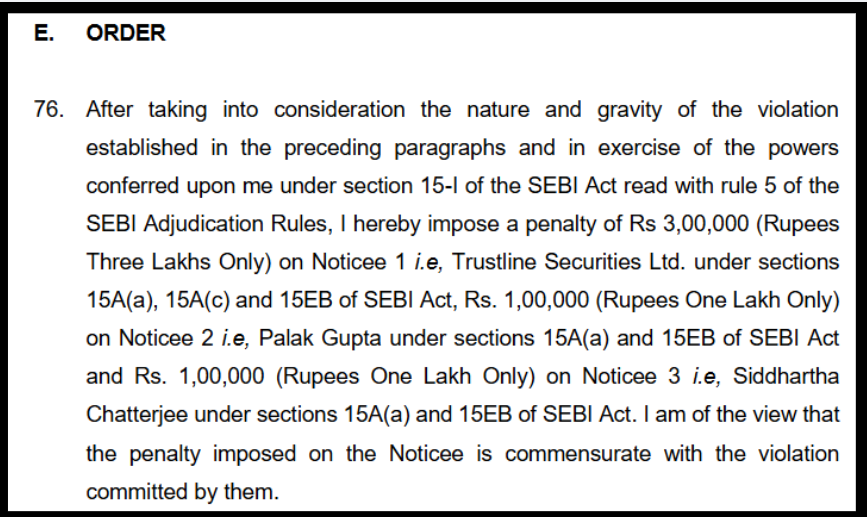
SEBI imposed a penalty of ₹3 lakh on Trustline Securities Ltd. and ₹1 lakh each on Palak Gupta and Siddhartha Chatterjee, for a total of ₹5 lakh across all three noticees.
Case 2: Eqwires Research Analyst SEBI Order
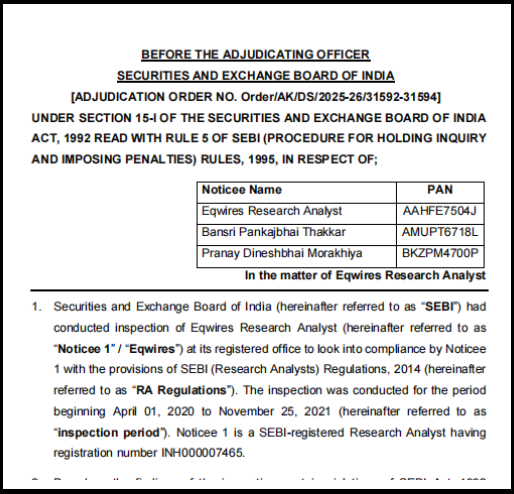
Eqwires Research Analyst is a SEBI-registered Research Analyst firm (Registration No. INH000007465) run by partners Ms. Bansri Pankajbhai Thakkar and Mr. Pranay Dineshbhai Morakhiya.
SEBI inspected the firm for the period April 2020 to November 2021.
What SEBI found goes well beyond a technical compliance lapse.
Key Violations Found by SEBI
- Eqwires obtained a client’s login credentials and an authorisation letter, then operated that client’s trading account for approximately 9 months. This was presented internally as an “add-on service” for clients who said they had no time to trade. SEBI was unambiguous: research analysts are strictly prohibited from operating client trading accounts or handling client funds.
- Despite holding only a Research Analyst registration, Eqwires marketed itself as an investment advisory firm. Client payment narrations in bank records used terms like “advisory service” and “fee for market tips,” confirming that clients understood themselves to be receiving advisory services.
- Eqwires issued client-specific trading recommendations through Telegram without carrying the mandatory disclosures required under the RA Regulations. SEBI clarified that all research recommendations, including those shared informally on Telegram or WhatsApp, qualify as research reports.
- The firm posted fake client testimonials on its website and social media. These included fabricated claims like “₹1 lakh profit in a month with ₹2.5 lakh capital” attributed to clients who had no such experience. SEBI found that Eqwires itself admitted some of these testimonials were not genuine.
- Eqwires projected exaggerated accuracy claims and near-guaranteed returns to attract new clients. This directly violates SEBI’s prohibition on return assurances by registered intermediaries.
SEBI Penalty Imposed
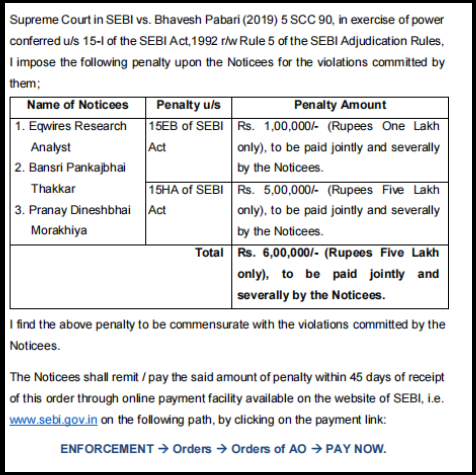
SEBI imposed a joint and several penalty of ₹6 lakh on Eqwires Research Analyst and its two partners, ₹1 lakh under Section 15EB for RA regulation violations, and ₹5 lakh under Section 15HA for fraudulent and unfair trade practices.
How to Spot an Analyst Crossing the Line?
You do not need to memorise the rulebook.
A few plain signals tell you an analyst is crossing the line.
They ask for your login, password, or OTP. They offer to “manage everything” so you do not have to. They promise a guaranteed return or a fixed profit.
They pressure you to hand over account access to “save time.”
Any one of these means the service has moved from advice into account handling, which an analyst is not allowed to do.
If this has already happened to you, meaning the account was actually traded or you handed over your login, that is a more serious situation covered in our guide on what to do when a registered analyst ran my account.
Has an analyst asked to run your account or hold your login?
We check whether the firm broke SEBI’s rules, tell you plainly where you stand, and help you act before any money moves.
What to Do If You Gave a Research Analyst Access to Your Account?
If you already gave an analyst access to your account or paid for a service that turned out to be illegal account handling, you can file a formal complaint.
Because the firm is SEBI registered, the full complaint route is open to you.
The complete step-by-step process, from the first grievance to arbitration, is set out in our guide to filing a complaint against SEBI registered research analyst.
The most important thing is to act quickly.
Change your login details now, save every message, and start the complaint before the trail goes cold.
Conclusion
The rule is simple and worth remembering. A research analyst can advise you. A research analyst cannot run your account.
Of the three SEBI roles, only a Portfolio Management Service, with its ₹50 lakh minimum, can legally trade on your behalf. A research analyst gives you a recommendation, and even an investment adviser only advises you personally.
In every case, you place your own trades.
If someone registered as an analyst asks for your login or offers to “handle everything,” that is your signal to stop.
The registration makes them a licensed adviser, not a manager of your money.
Frequently Asked Questions
No. An analyst can only give general buy, sell, or hold recommendations. Placing trades for you or running your account is account handling, which their registration does not allow.
A research analyst gives general research. An investment adviser gives personalised advice after assessing you. Only a portfolio manager, with a ₹50 lakh minimum, can actually trade your account for you.
No. SEBI clearly tells investors never to share their trading or demat login and password with a research analyst. A genuine analyst never needs it.
No. Registration only licenses them to give research and recommendations. It does not give them any right to hold your money or run your account.
Change your login details immediately, save all your messages and payment records, and file a complaint. The account handling itself is the violation you report.





 Add us as a preferred source on Google »

