
Quick Summary
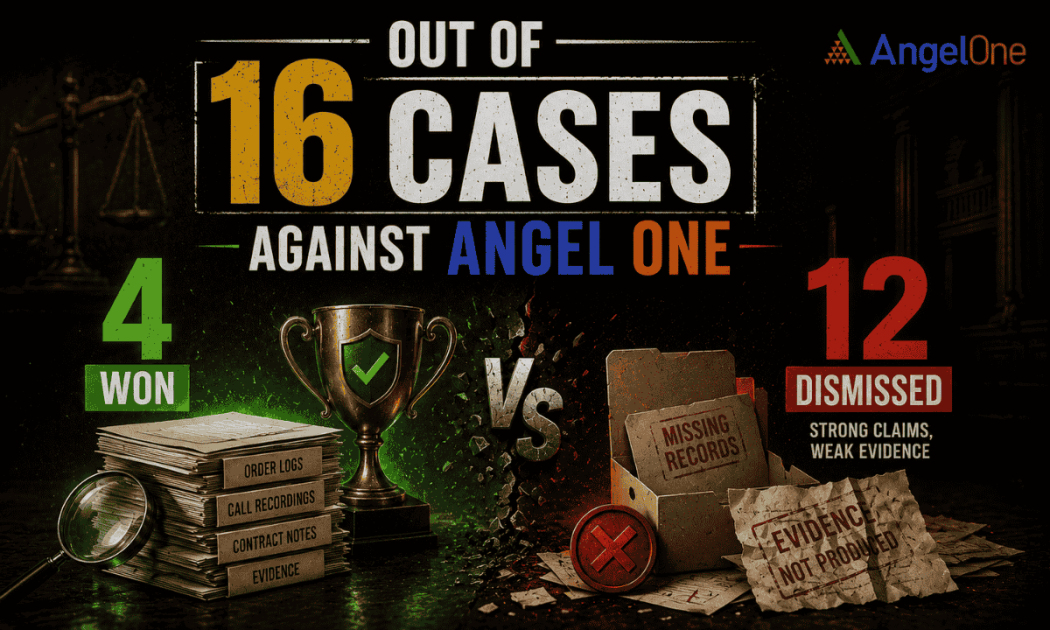
We went through 16 NSE and BSE arbitration awards involving Angel One Limited from 2021 to 2024. In 4 of them, the tribunal told Angel One to pay the client. The other 12 were dismissed. The wins ranged from ₹17,217 to ₹8,96,208, and several came with interest and cost on top. This page gives you the numbers, straight. The linked pages below take each type of case apart and show you how the clients who won actually got their money back.
Here is the thing most people do not know about arbitration.
It is not the broker’s grievance desk. It is not another email into the void. Instead, it is a neutral tribunal that hears your dispute and passes an award the broker has to honour.
For anyone who lost money and got nowhere with a complaint, that is the stage where things finally get real.
So we pulled the Angel One record and counted. Not the version anyone markets. Just what the awards say, based on what has been published as of this review.
Angel One Arbitration Cases: The Numbers
Let us start with the count, because that is what you came for.
| Count | |
|---|---|
| Total awards reviewed (2021 to 2024) | 16 |
| Client won or partly won | 4 |
| Dismissed | 12 |
And here is what the four wins actually put back in the client’s pocket.
| Year | Issue | Awarded |
|---|---|---|
| 2022 | Square-off without notice | ₹17,217 + 6% interest |
| 2023 | Unauthorised trading | ₹8,96,208 + 9% interest |
| 2023 | Glitch and disputed records | ₹2,76,812 + 18% interest + ₹50,000 cost |
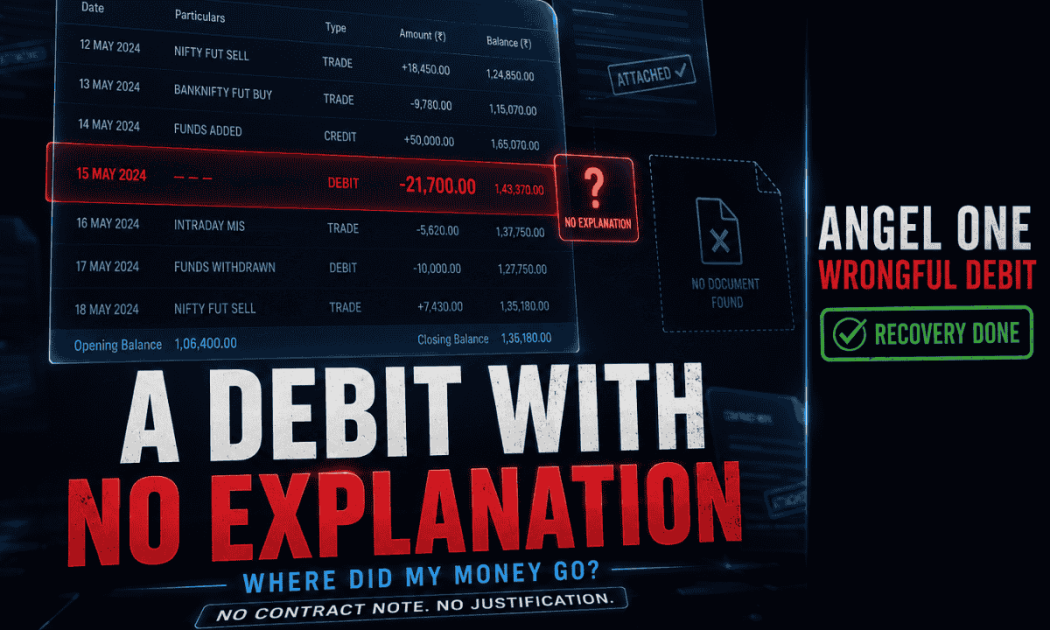
| 2023 | Wrongful debit | ₹21,700 + ₹25,000 cost |
So four clients out of sixteen walked away with money. Twelve did not.
Now, you can read that number two ways. You can look at 12 dismissals and think the odds are bad. Or you can look at why those 12 fell apart, which is the part that actually tells you something. So let us do that.
Why Most Angel One Arbitration Cases Get Dismissed
This is the section to read if you are sitting there wondering whether it is even worth filing.
Go through the 12 dismissed awards, and you notice something. Almost none of them were thrown out because the client had no real grievance. They were thrown out because of how the case was put together.
The same phrases come up again and again. “The applicant has not produced.” “No legal evidence to corroborate.” “The claim is not substantiated.” “The applicant did not demand the call recording.” Read enough of them, and the pattern is impossible to miss. The tribunal was not telling these people they were wrong. It was telling them they had not proved it.
That difference is everything, so sit with it for a second.
Arbitration runs on burden of proof. If you say the broker did something wrong, it is on you to show it. Not to feel it, not to describe it, to show it, with the right documents, asked for at the right moment, held up against the right regulation. Miss that and a genuine grievance dies on the table.
The Turning Point: Flawed Broker Records
Now look at the four who won. Every single one of them did that job properly. And every single one turned on the same weak spot: the broker could not stand behind its own paperwork.
Order logs that did not exist. A contract note that did not match the exchange’s own data. A debit sitting on the ledger with no document behind it. A position squared off with no notice trail to point to.
That is the whole game. When the broker’s records fall apart, the client wins. When the client cannot force the broker’s records into the open, the client loses, even with a real complaint.
So recovery against Angel One is not a fantasy. The awards are right there. But it is not automatic either, and it has nothing to do with how angry or how right you feel. It comes down to how the case is built.
And this is exactly where most people lose before they have really started. A claim rarely fails because the case was weak. It fails because the case was half-presented.
The grievance was real, but nobody pulled the right records, nobody met the burden of proof, nobody forced the broker to produce the logs it did not want to hand over.
That gap, between a real grievance and a proven one, is the whole difference between the 12 and the 4.
That gap is what we close. We build the claim the way the winning ones were built, with the documents and the regulations that leave the broker no room to stay quiet. Register with us to get the assistance.
Angel One Arbitration Cases by Type
Knowing the overall numbers is a good starting point, but the real value lies in looking at specific types of disputes.
Different types of grievances require entirely different approaches and evidentiary support to succeed.
The four wins were not random. Each one fits a category, and each category has its own page below that walks through what happened and how the client recovered.
| Case type | Arbitration | Page |
|---|---|---|
| Unauthorised trades in your account |
|
Angel One unauthorised trading arbitration |
| Money debited with no valid basis |
|
Angel One wrongful debit arbitration |
| Position squared off without notice |
|
Angel One square off arbitration |
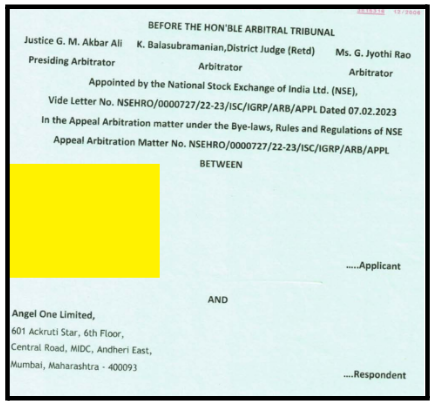
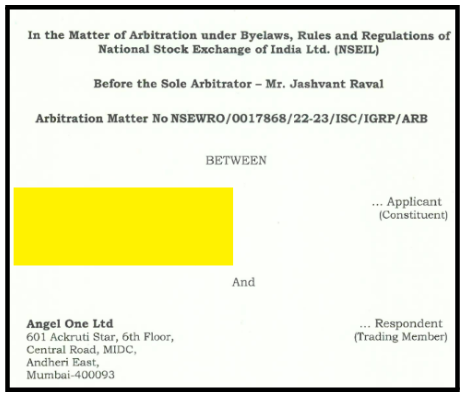
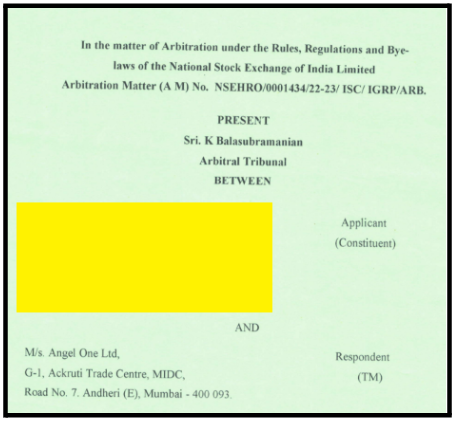
Not sure which one is yours? Start with the unauthorised trading page. It covers the most common situation and the biggest award in the set.
How Angel One Arbitration Actually Works
One thing worth clearing up, because people get this wrong and lose time over it.
Arbitration is not step one. It is the step after your complaint has already failed.
The path usually goes like this. First you complain to Angel One directly.
Then, if that goes nowhere, to the exchange’s grievance cell. Then the matter lands with the Investor Grievance Redressal Committee, which tries to conciliate it. And only if that does not settle it do you file for arbitration, where a tribunal hears the whole thing and passes a binding award.
If you are still at the early stages of that, our page on how to file complaint against angel one walks you through the complaint route from the very first email. This page is about what happens at the end of that road.
And here is the detail that should stop you from giving up too early. Three of the four wins happened at the arbitration or appeal stage, after the client had already been knocked back once.
In the biggest one, the grievance committee said no, the first arbitrator said no, and then the appeal tribunal overturned both and handed the client ₹8,96,208. A rejection early on is not the final word. It is often just the point where the case had not been built properly yet.
Conclusion
Across the awards we reviewed, the Angel One scoreline is 4 wins in 16, and the wins ran from ₹17,217 to nearly ₹9 lakh.
None of those four came down to luck. They came down to one thing: could the broker be forced to stand behind its own records, and did the client build the case to make that happen?
If you lost money with Angel One and your complaint hit a wall, arbitration is the stage where it can still turn into an actual payment. What decides which side of the 4-and-12 you land on is not how bad the loss felt. It is how the claim is put together.
Report. Recover. Stay Fraud Free.
Frequently Asked Questions
In the set of 16 awards we reviewed from 2021 to 2024, tribunals directed Angel One to pay the client in 4 cases, and dismissed the other 12. These numbers are based on awards published as of the review and do not cover every dispute ever filed.
In the reviewed awards, the four wins ranged from ₹17,217 to ₹8,96,208. Several carried extra interest of 6 to 18 percent, and one added ₹50,000 in cost. What you could recover depends entirely on your facts and the loss you can prove.
Mostly for lack of proof, not lack of a real grievance. The dismissed awards repeatedly note that the client did not produce the necessary records, did not demand the call recordings, or did not substantiate the claim. In arbitration, the burden sits with you, and that is where cases are won or lost.
Yes. In the largest win we found, both the grievance committee and the first arbitrator rejected the client before the appeal tribunal awarded ₹8,96,208. An early rejection can be challenged, and sometimes that is exactly where the real case begins.



 Add us as a preferred source on Google »

