

Quick Summary
An NSE tribunal ordered Angel One to pay a client ₹17,217 plus 6% interest after the broker squared off his position without giving him reasonable notice. Angel One liquidated the position the same day it sent the shortfall message, before expiry, and while the loss was still well below the level the client had been told to expect. The tribunal’s verdict: squaring off without proper notice breaches the principles of natural justice. This page shows you where the line sits, and when a forced square-off is worth challenging.
Let’s be fair to brokers for a second. Under the RMS policy of stock broker operations, they’re allowed to square off your position if you fall short on margin. That’s normal; it’s in the rules, and it protects everyone.
What’s not normal is doing it with no real notice, before you’ve had any genuine chance to add funds and save the position.
There’s a line between those two things, and in one reviewed case, Angel One walked straight over it.
An NSE tribunal ordered the broker to pay ₹17,217 for a square-off done without proper notice. Here’s exactly where that line sits, so you can tell which side your case is on.
Angel One Square Off: What Was Found
The client was running a hedged Nifty futures and options position, both legs expiring the same day. Then he accidentally unhedged it, which tipped his margin balance into the negative.
He called customer support that same day. And this is the crux of it. He says he was told he could carry the position forward by paying daily interest on the shortfall, and that Angel One would only square off if his total loss hit around 80% of the trade value.
So on that assurance, he held on. He even added ₹20,000 a few days later to shrink the shortfall. He was doing everything a reasonable person would do.
Then, before expiry and with the loss nowhere near that 80% mark, Angel One squared off the position anyway, booking a loss of ₹17,217. No prior notice.
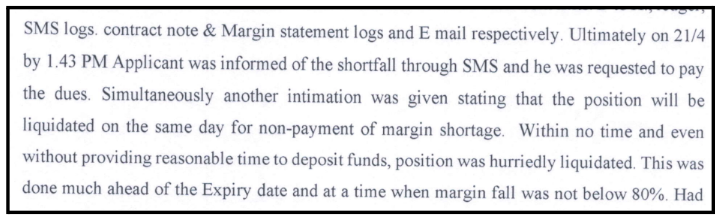
Where Angel One Lost: No Reasonable Notice
The tribunal zeroed in on the timing, and the timing is damning.
On the day of the square-off, Angel One sent the client an SMS about the shortfall at 1:43 PM, asking him to pay up. At more or less the same moment, it sent another message saying the position would be liquidated that same day. And then it did exactly that, fast, with no meaningful window to actually get funds in.
The tribunal’s finding was clear-cut. Yes, under NSE regulations, a broker can square off for a margin shortfall. But it cannot do it without proper notice, which the award described as sacrosanct, and without giving the client a reasonable chance to bring the margin in.
Firing off the demand and the liquidation in the same afternoon did not clear that bar. The award pointed out this was done well ahead of expiry, and while the loss was still below the 80% level the client had been led to expect.
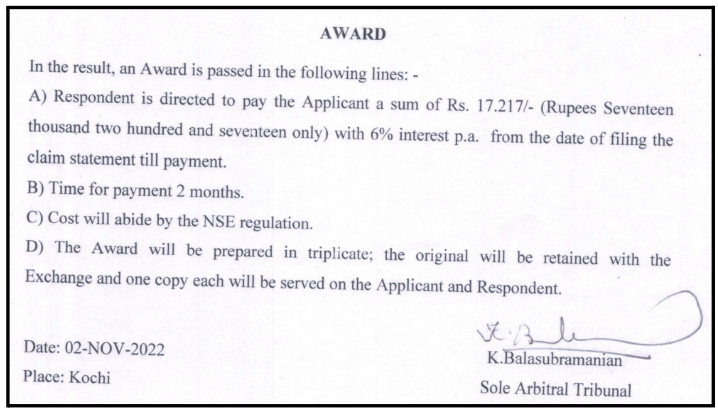
So the tribunal called the liquidation improper and bad, because it trampled the principles of natural justice. The loss was Angel One’s doing, and the broker was told to pay ₹17,217 plus 6% interest.
One more detail worth catching. The client had asked Angel One to produce the call recording of the assurance he’d been given. Angel One never produced it.
And the tribunal read that silence in the client’s favour, treating the broker’s failure to deny or produce the recording as backing up his version.
This isn’t the first time an audit trail gap has cost the broker.
In the angel one 13 year arbitration case, a recording surfaced only after Angel One had already told the exchange none existed, and it was treated with the same suspicion for the same reason: a broker’s own record-keeping gaps tend to work against it, not for it.
Additionally, a similar pattern emerged in another major dispute where Angel One provided logs that failed to stand up to scrutiny, displaying data that didn’t match the actual transaction timelines.
You can read how inconsistencies in logs break a broker’s defense in our detailed breakdown of the angel one unauthorised trading arbitration.
Angel One Square Off: What to Do If Your Position Was Liquidated?
A forced square-off is challengeable when the broker did it without proper notice or a reasonable chance to respond. The whole case turns on the notice trail, so that’s what you protect.
Pull these together now:
- Every SMS and email Angel One sent about the margin shortfall, with the exact timestamps
- The timestamp of the square-off itself, straight off your contract note
- Any record of an assurance you were given about when the position would be liquidated
- Your written request for the call recording of that assurance
- Proof of any funds you added to cover the shortfall
The comparison that decides it: line up the moment the demand was sent against the moment the position was liquidated. In the winning case, both landed the same afternoon, and that missing gap is what made the square-off improper. If your broker gave you a demand at 1:43 and closed you out minutes later, that’s your case right there.
Ask for the call recording in writing. If you were promised a threshold or a timeline on a call, that recording matters enormously. Here, the broker’s failure to produce it counted against it. Get your request in on paper so there’s a record you asked.
If you’re still early and haven’t filed a formal complaint, our page on how to file complaint against angel one covers the full route. A square-off dispute usually needs arbitration to settle, because the broker almost never concedes it before then.
Did Angel One close out your position before you had a chance to react?
We map the notice trail against the square-off timestamp, pull the assurance you were given, and build the claim on the notice failure that tribunals treat as decisive. Register with us for support around your complaint.
An Honest View of the Odds
Here’s the honest split, because not every square-off is a winnable one.
The whole thing comes down to separating a lawful margin square-off, which brokers are fully entitled to do, from an improper one done without notice. If the broker gave you clear, timely warning and a fair chance to add funds, the square-off will probably hold, even if it stung badly. But if it liquidated abruptly, the same day as the demand, before expiry, against an assurance it had given you, that’s the territory where the claim lives.
That’s a different fact pattern from an Angel One auto square off malfunction arbitration, where the system fails to trigger at all or genuine profit gets netted away in the aftermath, but the same principle of holding the broker to its own process applies.
The amounts here tend to be modest; no point dressing that up. But the principle, notice before liquidation, is a strong one, and tribunals take it seriously when the timeline shows the broker skipped it.
Conclusion
The ₹17,217 award drew the boundary. A broker can square off for a margin shortfall, but not without proper notice and a reasonable chance for you to respond.
When Angel One liquidated a position at 1:43 PM the same day it sent the demand, before expiry and against its own assurance, the tribunal held it had breached natural justice and made it liable for the loss.
If your position was force-closed before you had a fair shot at reacting, the square-off itself may be worth challenging.
Report. Recover. Stay Fraud Free.
Frequently Asked Questions
A broker can square off for a genuine margin shortfall, but NSE regulations require proper notice and a reasonable chance to add funds first. In the reviewed case, the tribunal held that squaring off without proper notice breaches the principles of natural justice.
Angel One sent the shortfall demand and liquidated the position in the same afternoon, at 1:43 PM, without giving reasonable time to deposit funds. It did this before expiry and while the loss was still below the 80% threshold the client had been assured of.
The tribunal directed Angel One to pay the client ₹17,217 plus 6% interest from the date of filing the claim.
If you were assured of a specific threshold or timeline on a call, that assurance shapes what counts as proper notice. In the reviewed case, the client asked for the call recording, Angel One didn't produce it, and the tribunal treated that failure as supporting the client.



 Add us as a preferred source on Google »

