
Quick Summary
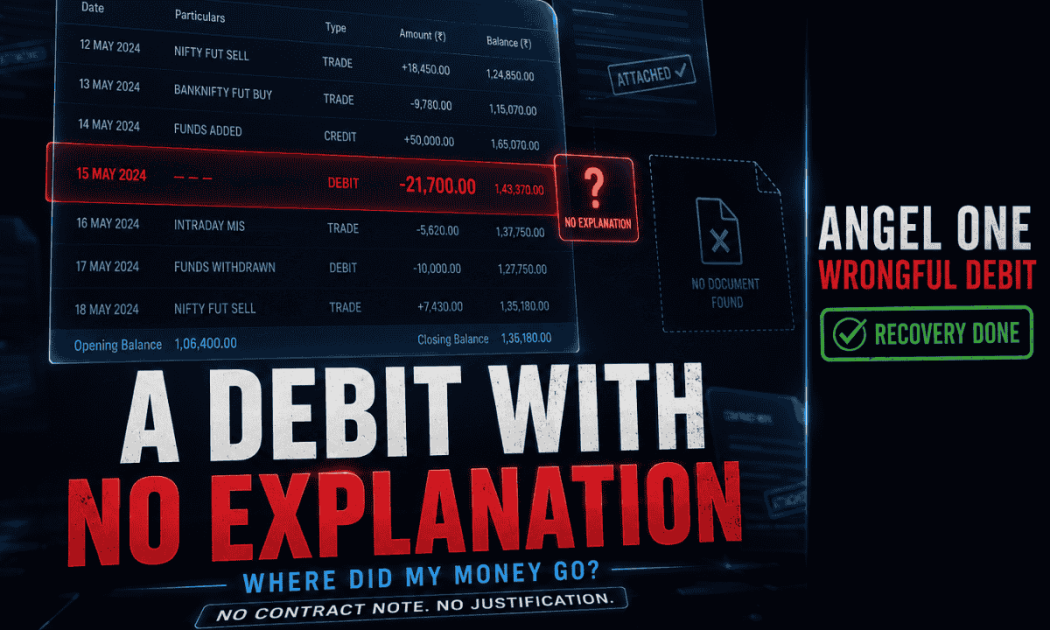
An NSE tribunal ordered Angel One to refund ₹21,700 plus ₹25,000 cost to a client after the broker took a dividend amount off her ledger with no contract note to back it. The tribunal’s finding was clean: the charge had no legal or contractual basis, and the broker would otherwise have simply pocketed the dividend for itself. This page shows you when a debit on your account is worth challenging, and how this client got hers reversed.
Not every broker dispute is about a bad trade. Sometimes it’s just a line on your ledger you can’t explain.
A charge appears. No contract note. No reason you can find. The money’s simply gone. You call, you email, and you get a shrug or silence.
That’s a wrongful debit, and here’s the good news: it’s one of the more winnable disputes there is. An NSE tribunal made Angel One hand back ₹21,700 that it had debited with nothing to support it. Here’s how the case came apart for the broker.
Angel One Wrongful Debit Case: What Was Revealed
The client held a futures sell position in PFC. The company declared a dividend, and the stock went ex-dividend on the settlement date.
Now, there’s a rule for this. When a dividend crosses a certain threshold, SEBI requires the opening price of the outstanding futures position to be knocked down by the dividend amount.
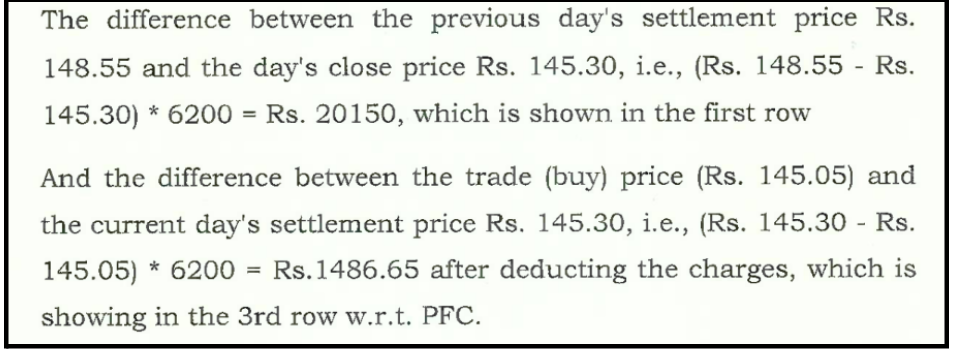
It’s automatic, and it happened here. The opening price dropped from ₹148.55 to ₹145.05, a cut of exactly ₹3.50, which was the dividend per share.
So the dividend was already dealt with, baked right into the price.
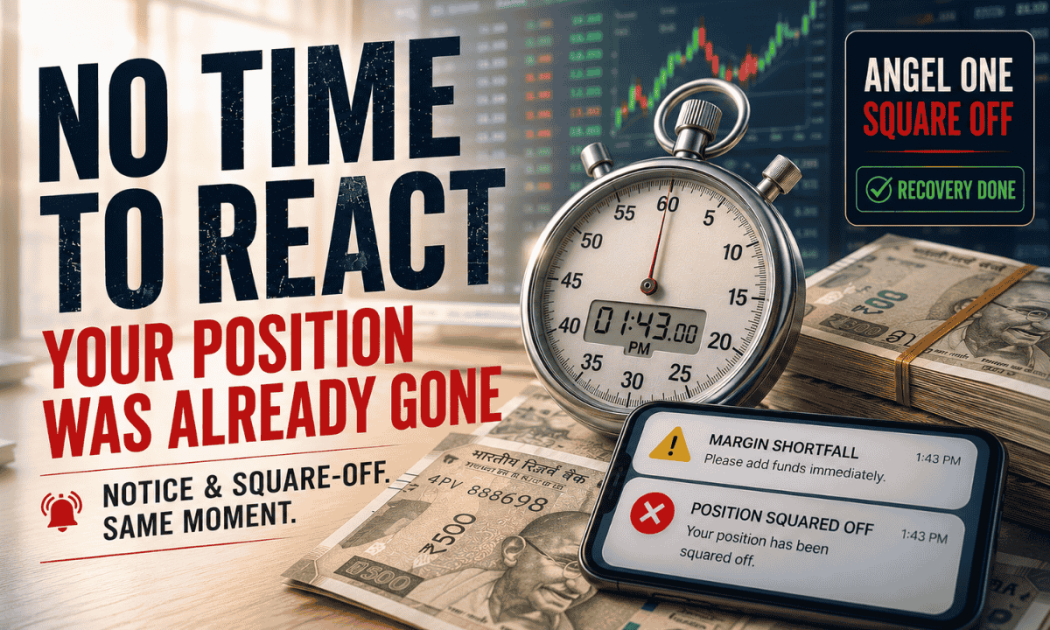
And then, separately, Angel One also debited ₹21,700 from her ledger. That’s ₹3.50 on her 6,200 shares. The exact same dividend, charged a second time.
She flagged it. The grievance committee gave her nothing. So she filed for arbitration.
Why Angel One Lost: A Debit With No Document
The tribunal did something refreshingly direct. It asked Angel One a plain question: did you debit this, and what backs it up?
Angel One’s first answer was that it hadn’t debited the amount at all.
However, as is common with many Angel One complaints regarding unexpected charges, the day’s summary was pulled up, and there it was, plain as day.
And that surfaced the real problem. The ₹21,700 was sitting in the summary with no contract note behind it.
Normally, a debit rides on a contract note, the document that creates the “you owe this” relationship in the first place. This one had nothing.
The tribunal’s reasoning is genuinely useful, so here’s what it worked through. The price adjustment the NSE circular demands was already done.
Once that’s done, there’s no reason to also claw the dividend back out of the client’s account.
The broker isn’t the one paying the dividend anyway, so why is it acting as a collector? And a debit dropped in like this, with no document, would just quietly turn into income for the broker.
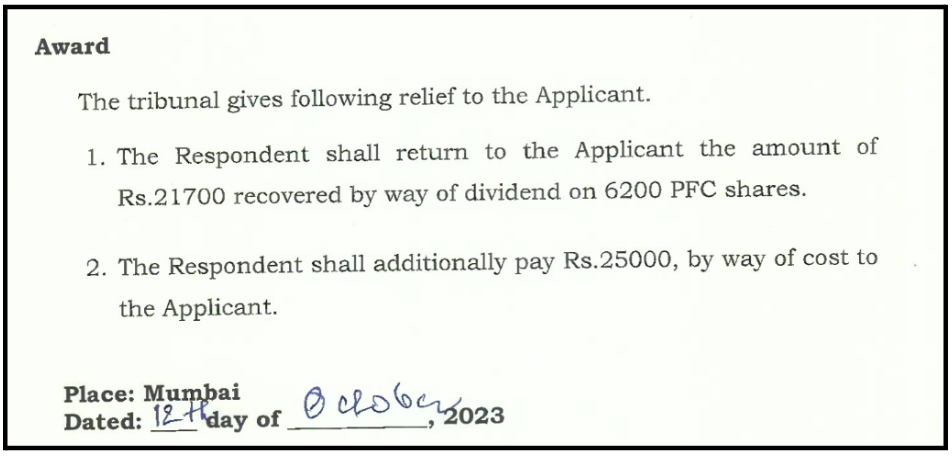
So the tribunal called it what it was: a recovery with no legal or contractual right behind it. It ordered the ₹21,700 returned, and added ₹25,000 in cost on top.
The principle it left on the record is one worth keeping in your back pocket. A broker shouldn’t gain from the dividend, and a debit with no document behind it cannot stand.
Angel One Wrongful Debit: What to Do If You Spot One?
This is one of the cleaner disputes to run, because the question is narrow and factual. Either there’s a document behind the charge, or there isn’t. No arguing about phone calls or who said what.
Pull these together now:
- Your full ledger for the period, downloaded from Angel One, with the disputed debit highlighted
- The contract notes for the same period, so you can show whether one exists for that debit
- Any statement or summary where the charge turns up
- Your written query to Angel One asking what the debit is for, and whatever reply you got, including silence
The question that wins it: ask Angel One, in writing, to produce the contract note or document that generated the debit. That’s it.
In the winning case, the absence of that document is precisely what did it. If no document exists, the charge has no legs to stand on, and you’ve handed the tribunal its answer.
Watch hard for double-counting. In this case, the dividend got handled once through the price adjustment, then charged again as a debit. That’s the pattern to look for.
Corporate-action adjustments, brokerage, penalty charges- these are the usual spots where the same thing quietly gets recovered twice, and nobody notices unless they line up the paperwork.
If you haven’t raised a formal complaint yet, our page on how to file complaint against angel one walks you through it.
This kind of dispute often needs arbitration to finish, because that’s the stage where a tribunal can actually order the refund.
Is there a charge on your Angel One ledger you can’t explain?
We reconcile your ledger against your contract notes, isolate any debit with no document behind it, and build the claim that forces the broker to either justify the charge or give it back. Register with us to get help around your complaint.
An Honest View of the Odds
Here’s the straight version, because it’s better than the trading-loss cases in one specific way.
Wrongful debit claims don’t hang on what someone said on a call, or on who really placed a trade. They hang on paperwork. Either the broker can produce a document justifying the charge, or it can’t. If it can, the debit probably stands. If it can’t, like here, the tribunal has a clean basis to order the money back.
The amounts are usually smaller than a big trading loss; no point pretending otherwise. But they’re also far more straightforward to argue. And notice this: in this very case, the ₹25,000 cost award was larger than the ₹21,700 debit itself.
Conclusion
The ₹21,700 refund set a simple rule. A broker can’t lift money off your ledger without a document behind it, and it can’t recover the same amount twice.
When Angel One debited a dividend that had already been handled in the price, with no contract note to support it, the tribunal ordered it back and tacked on ₹25,000 in costs.
If a charge on your account has no explanation, that’s not something to swallow and move on from. It’s something to make them answer for.
Report. Recover. Stay Fraud Free.
Frequently Asked Questions
Yes. If a debit lands on your ledger with no contract note or document justifying it, you can challenge it through the broker, the exchange grievance process, and arbitration. In the reviewed case, an NSE tribunal ordered Angel One to refund a debit that had no supporting document.
The dividend had already been accounted for through the mandatory cut in the futures opening price. Angel One then charged the same dividend a second time, ₹21,700, with no contract note behind it. The tribunal found no legal or contractual basis for the recovery.
The tribunal ordered Angel One to refund ₹21,700 and to pay a further ₹25,000 as cost to the client.
Your ledger showing the debit, your contract notes for the same period, and a written request asking the broker to produce the document behind the charge. If no document exists, the debit has no basis, which is exactly what decided the reviewed case.

 Add us as a preferred source on Google »

