

Quick Summary
An NSE arbitrator directed Angel One to pay a client ₹85,106, being profit the client had genuinely earned on separate trades the same day, which Angel One had quietly folded into a disputed loss instead of paying out. The client’s Intraday Auto Square Off facility failed to trigger at the promised threshold, causing a large loss on one position. But he had also made real profit on other trades that day, and Angel One tried to net that profit against the loss rather than pay it separately. This page walks through what he said, what Angel One said, and how the arbitrator separated the two.
Sometimes a broker’s error isn’t just the loss it causes. It’s the profit it quietly absorbs while blaming a technical failure.
An NSE arbitrator ordered Angel One to pay ₹85,106 in exactly this situation.
Arbitration Against Angel One Over Auto Square Off Failure: What Happened
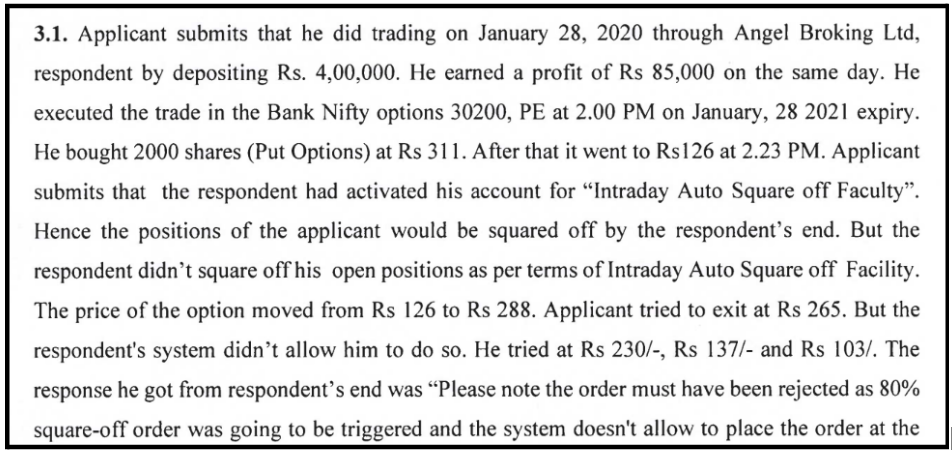
The client had activated Angel One’s Intraday Auto Square Off facility, under which the broker’s system is supposed to automatically close a position once losses hit a set threshold.
On 28 January 2021, a Bank Nifty options position moved sharply against him, and the auto square-off should have triggered well before it did.
Instead, the position stayed open through repeated price swings while he tried and failed to exit manually, receiving rejected orders and being told the system was managing the position automatically.
By the time it closed, the loss on that one position was far larger than the auto square off threshold should have allowed.
Separately, on the same trading day, he made eight other trades that were independently profitable, totalling ₹85,106.25 in genuine profit, fully documented in his contract note.
A grievance committee had already looked at the auto square-off failure itself and awarded him compensation, calculated from the net debit balance in his ledger.
That net figure combined the disputed loss with his separate, unrelated profit.
He noticed the profit had effectively vanished into that combined number and was never actually paid to him.
What He Argued
His argument in arbitration was narrow and specific.
He was not re-litigating the auto square off failure itself, which the grievance committee had already addressed.
He was pointing out that eight completely separate, profitable trades, with their own order numbers and no connection to the disputed position, had been quietly absorbed into a combined ledger figure instead of being paid to him.
That profit was undisputed and should be paid on its own terms.
What Angel One Argued
Angel One’s defence was procedural.
It said all profits and losses for a trading day get netted into one combined ledger figure by design, and there was no separate mechanism to pay out one portion of that figure in isolation from the rest.
This kind of procedural defence is common across Angel One complaints, where a broker leans on internal process rather than addressing the specific harm.
What the Arbitrator Concluded, and Why
The arbitrator rejected Angel One’s netting argument.
The eight profitable trades were entirely unconnected to the disputed auto square-off position, fully documented with their own order numbers, and there was no dispute that the profit was genuinely earned.
The arbitrator held that netting a real, undisputed profit against a separately disputed loss, without ever actually crediting that profit to the client, was not appropriate.
Angel One could not explain why a client who had genuinely earned ₹85,106 should simply not receive it because it happened to fall on the same trading day as an unrelated dispute.
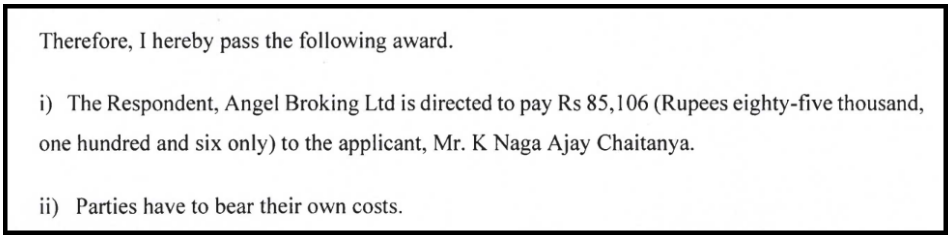
The arbitrator ordered the full ₹85,106 to be paid.
What to Check in Your Own Ledger
If you have had a dispute over an auto square off or risk management failure, check whether any of your genuine profit from the same period got absorbed into the disputed figure without being separately accounted for.
Gather now:
- Your full contract note for the disputed trading day, itemised trade by trade
- A separate calculation isolating any profitable trades that are unrelated to the disputed position
- The compensation or settlement figure the broker or grievance committee proposed, and how it was calculated
- Confirmation of whether your undisputed profit was actually credited, or only netted on paper
Separate what is disputed from what is not. In this case, the win came from isolating eight profitable trades that had nothing to do with the malfunctioning position, and insisting they be paid on their own terms rather than absorbed into a larger settlement figure.
Our page on how to file complaint against Angel One sets out the complaint route before arbitration.
For other auto square-off and technical failure cases, see Angel One square off arbitration.
Also, if you are interested in analysing different sets of violations leading to an arbitration, check the full set at Angel One arbitration cases.
Did a compensation figure from Angel One quietly absorb profit you genuinely earned?
Our team goes through your contract notes trade by trade, separates what is actually in dispute from what is not, and builds the claim to recover the undisputed profit that got netted away. Register with us for a free consultation.
An Honest View of the Odds
Claims that isolate a specific, documented profit from a larger disputed settlement tend to be strong, because the underlying trades are not in question, only whether they were properly paid out.
The harder part of these cases is usually the primary dispute itself: whether the auto square off genuinely malfunctioned.
But once that is established, or even set aside, a clearly documented separate profit is difficult for a broker to argue against.
Conclusion
The ₹85,106 award rests on a narrow but important principle.
A broker cannot net your genuine, undisputed profit against a separately disputed loss without ever paying that profit out.
If a settlement or compensation figure from your broker looks lower than expected, check whether real profit from the same period got folded into the calculation instead of being paid separately.
Report. Recover. Stay Fraud Free.
Frequently Asked Questions
Not without paying it out. If you have documented, undisputed profit from trades unrelated to the position you are disputing, a broker cannot simply absorb that profit into a combined ledger figure and withhold it from you.
It is a risk management feature that automatically closes a position once losses reach a set threshold, protecting the client from larger losses. When it fails to trigger on time, as in this case, the resulting extra loss becomes a valid dispute.
The arbitrator ordered Angel One to pay ₹85,106, representing profit the client had genuinely earned on unrelated trades the same day, which had been absorbed into a combined ledger calculation instead of paid out separately.
The client's own contract note, which itemised each of the eight profitable trades with individual order numbers, buy and sell prices, and timestamps, none of which were connected to the disputed auto square off position.



 Add us as a preferred source on Google »

