
Quick Summary
An NSE arbitrator overturned a 50% grievance committee award and directed Angel One to pay a client the full amount she claimed, after the broker’s mobile app repeatedly malfunctioned and its customer support stayed unreachable for an entire day. The grievance committee had initially split the loss equally, treating it as shared fault. The arbitrator disagreed, holding that a technical defect the client had no way to work around cannot be blamed on her, however many times it recurs. This page walks through what she said, what Angel One said, and why “no alternative” was the deciding phrase.
Repeated technical failures with no working alternative are treated differently from a one-off glitch.
An NSE arbitrator awarded a client the full amount of her claim for exactly this reason, after a grievance committee had initially split it in half.
Angel One not working during an open position is one of the more common triggers for these disputes, and this case shows how the outcome can shift once you look past the glitch itself.
Angel One Arbitration Over App Failure: What Happened
Over three separate trading days in January 2020, the client’s Angel One mobile app malfunctioned while she had open positions.
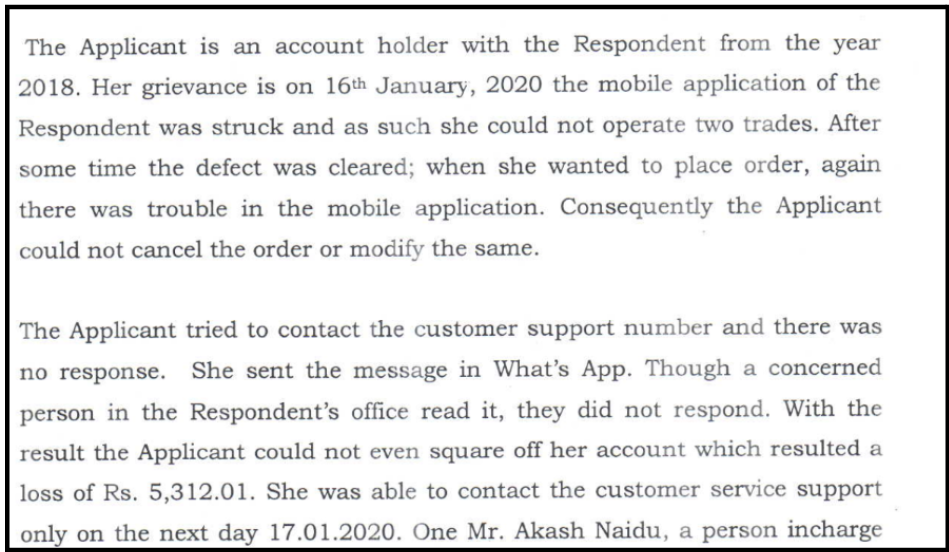
On 16 January, the app froze while she was trying to place and cancel trades. On 20 January, the same thing happened again, this time preventing her from squaring off her position, which resulted in a loss.
When she tried calling customer support after the first incident, there was no answer. She sent a message on WhatsApp. A member of Angel One’s staff read it and never replied.
It was only the following day that she reached a support representative, who told her the server had been down and that he personally had no access to fix anything.
The pattern repeated on 27 January, when she again could not modify or square off a position in time and sustained a third loss.
Her three losses totalled roughly ₹24,783.56.
What She Argued
Her argument to the arbitrator was that she had done everything a reasonable client could to act during each failure, called, messaged, and eventually spoken to a representative, and every single channel had failed her at some point.
This was not a case of her being careless with an open position. There had simply been no way to reach anyone who could help while the losses were accumulating.
She should not bear half the blame for a failure she had no ability to work around.
What Angel One Argued
Angel One’s core position, reflected in the earlier grievance committee decision, was that platform and technical defects fall outside its liability under the rules and regulations governing the broker-client relationship, and that some responsibility for managing an open position during any disruption rests with the client regardless of the circumstances.
This is a recurring stance across Angel One complaints, where the broker treats technical failure as a shared risk rather than its own responsibility to fix.
What the Arbitrator Concluded, and Why
The arbitrator looked at what genuinely distinguishes shared fault from full broker liability. The question is whether the client had any effective alternative way to act during the failure.
In this case, she had none. Phone support did not answer. A written message went unread in any meaningful sense, since it was seen but not acted on.
The one representative she eventually reached admitted he had no ability to help.
The arbitrator noted plainly that Angel One’s liability defence “can be accepted only if it establishes that in case of any defect, either due to electricity failure or in the mobile application, there is any effective alternative mode for the customer to get at the Respondent for the completion of the transactions.”
Angel One provided no such proof.
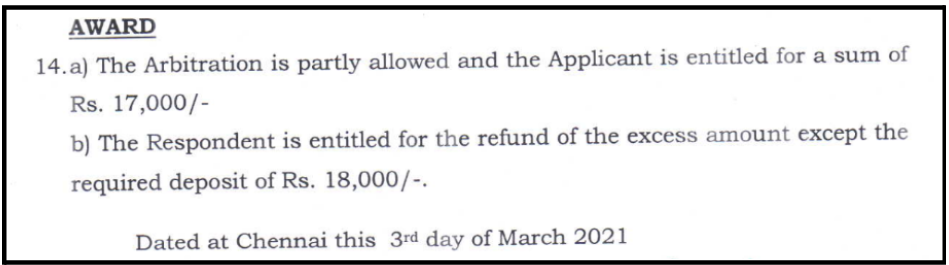
With no evidence of an alternative, and with the technical defect itself established and effectively undisputed, the arbitrator held Angel One fully liable for the entire claim, awarding the outstanding balance after crediting the amount already paid under the grievance committee’s earlier order.
Angel One paid the remaining ₹17,000 balance in full.
What to Document During an Outage
The strength of this kind of claim depends on proving you tried every available channel and none of them worked, not just that the app itself failed.
Gather now:
- Screenshots of the app failure itself, with timestamps
- Call logs showing attempts to reach customer support, including unanswered calls
- Any written message, email, or WhatsApp communication sent during the outage, including whether and when it was read or answered
- A record of when you finally reached someone, and what they told you about the cause of the outage
Prove the absence of an alternative, not just the presence of a glitch. The deciding factor in this case was not that the app failed. Apps fail.
It was that no other channel worked either. If you can show every route you tried was also blocked, that moves a shared-fault case toward full broker liability.
Our page on how to file complaint against Angel One covers the complaint route to take before arbitration becomes necessary.
Technical failure claims tend to succeed or fail based on the same underlying question of whether any working alternative existed at the time. To know about one and its outcome, see Angel One technical glitch arbitration.
For the full list of disputes decided across different tribunals, see Angel One arbitration cases.
Did an app failure and unresponsive support cost you a trade you couldn’t exit?
Our team documents every channel you tried during the outage and every one that failed, and builds the claim to show the tribunal there was no alternative route left to you. Register with us for a free consultation.
An Honest View of the Odds
Grievance committees often default to a 50% split when a technical failure is genuine, but the client also had an open position at risk.
That is a reasonable starting point, but it is not the final word.
Arbitration gives you a chance to push past that default by proving something more specific: that you had no working alternative during the failure.
Where you can show that clearly, as in this case, full recovery is realistic.
Conclusion
The full ₹17,000 balance recovered in this case did not come from proving the app failed. Angel One barely disputed that.
It came from proving that every other channel- phone, message, and support staff- also failed at the same time.
If a technical failure has cost you a trade, document not just the glitch itself but every attempt you made to work around it and could not.
Report. Recover. Stay Fraud Free.
Frequently Asked Questions
The grievance committee found shared fault without identifying what the client could have done differently. The arbitrator found she had no working alternative during the outage, phone support, written messages, and the eventual representative all failed to help her act in time, which shifted full liability to the broker.
Proof that you attempted every available channel and each one failed. A single failed app screenshot is weaker than a documented sequence of attempted calls, messages, and support responses that all led nowhere.
The arbitrator awarded the client the full remaining balance of her claim, roughly ₹17,000, after crediting the 50% already paid under the earlier grievance committee order.
Yes. Accepting a partial award from a grievance committee does not prevent you from pursuing arbitration for the remainder, as it did not in this case, where the client had already received 50% before the full amount was awarded on appeal.

 Add us as a preferred source on Google »

