

Quick Summary
An NSE arbitrator ordered Angel One to pay a client ₹59,800 for a loss caused by a technical glitch on its trading platform, after finding the broker had already compensated the same client for nearly identical glitches on three earlier occasions. Angel One tried to deny liability by citing a SEBI circular that shields brokers from responsibility for platform malfunctions. The arbitrator rejected that defence, pointing to the broker’s own prior conduct as proof it did not genuinely believe its own argument. This page walks through what the client said, what Angel One said, and why the broker’s own past behaviour decided the case.
A broker’s own past behaviour can become the strongest evidence against its present defence.
An NSE arbitrator awarded ₹59,800 in a case that turned on exactly that.
Arbitration Against Angel One Over Technical Glitch: What Happened
The client, an experienced trader who had used Angel One’s mobile app for over a year, ran into a familiar problem on 21 December 2020.
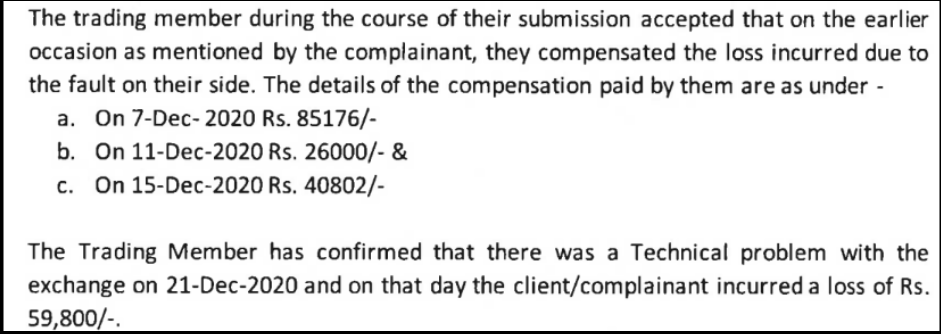
The app’s trading platform malfunctioned mid-session, Angel One not working properly when he needed to exit, and he lost his entire capital committed to that trade- a loss of ₹59,800.
This was not the first time.
On three separate earlier occasions in the same month, 7, 11, and 15 December 2020, Angel One had compensated him for near-identical glitches, paying out ₹85,176, ₹26,000, and ₹40,802 respectively.
When he raised the 21 December incident, customer support first blamed a satellite communication failure, an explanation he found nonsensical for a software platform issue, and then denied that any technical glitch had occurred at all. A similar failure pattern related to app is also documented in Angel One app failure arbitration.
What He Argued
His argument was built entirely on consistency.
If Angel One had compensated him three times in two weeks for the same category of problem, a fourth denial made no sense unless the broker was simply trying to avoid paying this time.
He was not asking the tribunal to accept his word alone that a glitch had occurred.
He was asking it to notice that Angel One’s own prior conduct already proved it took responsibility for exactly this kind of failure.
What Angel One Argued
Angel One leaned on SEBI’s 2011 circular, which states that a broker and exchange are not responsible for malfunctions in the broker’s own Internet-based trading system.
It also pointed to a clause in the client’s KYC agreement disclaiming liability for disruptions to online or offline trading services.
Its position was that, whatever had happened, the regulatory framework and the client’s own signed agreement placed the risk of a platform glitch on him, not the broker.
Also Read: Moneylicious Securities Arbitration, ₹4,53,081.60 awarded, with 12% interest attached.
What the Arbitrator Concluded, and Why
The arbitrator noted this defence directly conflicted with Angel One’s own actions.
The broker had compensated the client for the same category of technical failure three times in the preceding two weeks.
If Angel One genuinely believed the SEBI circular absolved it of all responsibility for platform glitches, it would not have voluntarily paid out compensation on three prior occasions for the identical issue.
The arbitrator held that this pattern of prior compensation undermined Angel One’s sudden reliance on the circular for the fourth incident.
Having already treated the earlier glitches as its own responsibility, the broker could not selectively invoke a blanket legal shield only when it suited the outcome, the kind of inconsistency that turns up across Angel One complaints once a client actually checks how similar cases were handled before.
The arbitrator ordered the ₹59,800 loss paid, without interest, finding the broker liable on the strength of its own prior conduct.

What To Do If a Platform Failure Costs You?
A single glitch complaint can be hard to prove on its own.
A pattern of glitches, especially ones the broker has already acknowledged or compensated, is much stronger.
Gather now:
- Every prior instance where you or other users experienced a similar platform issue, especially any where the broker paid compensation
- Screenshots and timestamps of the glitch itself, along with any error messages
- Your written communication with customer support, including any explanation the broker gave
- Records of any compensation you received previously for a similar issue
Check your own history with the broker first.
If this is not the first time you have faced a glitch, past compensation the broker paid you is some of the strongest evidence you can present, because it shows the broker’s own assessment of where responsibility lies.
Our page on how to file complaint against Angel One covers the complaint process to follow before arbitration becomes the next step.
For related cases involving platform and system failures, see Angel One auto square off malfunction arbitration, which covers a different kind of automated failure with its own outcome.
A broker’s prior handling of similar incidents often carries more weight than the specifics of any single glitch on its own.
For the full set of disputes decided across different tribunals and time periods, see Angel One arbitration cases.
Has a technical glitch on Angel One’s platform cost you money, especially if it has happened before?
Our team reviews your account history for prior glitches and any compensation you received, and builds the claim around the pattern the broker cannot walk away from. Register with us for a free consultation.
An Honest View of the Odds
A one-off glitch claim, with no history and no admission from the broker, is genuinely difficult given the regulatory shield brokers can point to.
Tribunals do take that circular seriously when it stands alone.
Where the broker has a documented pattern of treating similar incidents as its own responsibility, that pattern becomes powerful evidence, as it did here.
The question shifts from whether the broker is liable in the abstract to why it suddenly is not this time.
Conclusion
The ₹59,800 award turned on a simple contradiction.
Angel One could not credibly deny responsibility for a glitch it had compensated three times before under nearly identical circumstances.
If you have faced repeated technical issues with a broker, the history of how they handled the earlier ones may matter more than the specifics of the latest one.
Report. Recover. Stay Fraud Free.
Frequently Asked Questions
Yes, particularly if the broker has a history of compensating you or other clients for similar issues. That history can outweigh a general regulatory disclaimer the broker tries to rely on for a later incident.
The circular limits liability for platform malfunctions, but it does not prevent a tribunal from weighing the broker's own conduct. If a broker has previously treated similar glitches as compensable, that undermines a later claim that it bears no responsibility at all.
The tribunal ordered Angel One to pay ₹59,800, the loss suffered on the day of the glitch, without interest, based on the broker's own history of compensating the same client for nearly identical failures.
Documentation of prior similar incidents, especially any compensation the broker previously paid for them. A pattern of past acknowledgment is often more persuasive than arguing the technical facts of a single incident in isolation.


 Add us as a preferred source on Google »

