

Quick Summary
An NSE arbitral tribunal ordered Angel One to refund ₹87,641 plus interest, along with ₹10,000 compensation, to a senior citizen client charged brokerage far above the zero-brokerage plan she says she was promised. The case turned on a detail most investors never think to check: whether the KYC document even names the plan you supposedly agreed to. Angel One’s own paperwork could not say for certain which plan the client had opted for, and contradicted itself twice. This page walks through what she said, what Angel One said, and why the tribunal sided with her.
Excess brokerage is easy to overlook when it shows up as a small daily deduction.
An NSE tribunal ordered Angel One to refund ₹87,641 to a client who caught it. Here is the full story.
Arbitration Against Angel One Over Excess Brokerage: What Happened
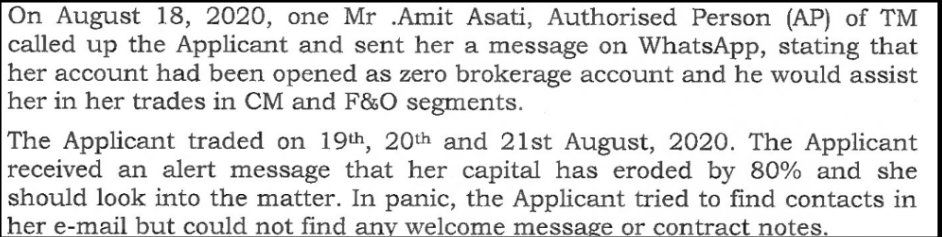
The client opened a trading account with Angel One in August 2020 after seeing an online advertisement.
A day later, the broker’s Authorised Person, Amit Asati, messaged her on WhatsApp confirming her account had been opened under a zero-brokerage plan called Angel iTrade Prime.
She started trading. Her email had been entered incorrectly on the account opening form, so she could not access her contract notes to check what she was actually being charged.
When an alert flagged unusual erosion in her account, she tried to reach the Authorised Person repeatedly. He did not respond.
By the time she got her contract notes on 31 August, she found she had been charged ₹100 per lot in F&O and 0.10% in equity for the two weeks since opening her account, far more than the zero-brokerage plan she had been promised, a clear case of Angel One excess charges that went uncorrected until she checked her own paperwork.
Angel One then quietly switched her to a correctly priced plan going forward, but never reversed what she had already been overcharged.
What She Argued
The client’s case was simple.
The Authorised Person who onboarded her had explicitly promised a zero-brokerage plan on WhatsApp, sent from a verifiable number tied to his official appointment.
She had never seen or signed anything naming a different, paid plan, because she could not even access her own KYC documents until after the damage was done.
She asked for the excess ₹87,641 back, plus interest, plus compensation for the stress of chasing an unresponsive broker as a senior citizen.
What Angel One Argued
Angel One’s position shifted over the course of the dispute, which became part of the problem.
In its first written submission, the broker said she had opted for the “Angel Preferred Plan.”
In a later submission, it said she had opted for the “Angel Classic Plan.” At the hearing, Angel One’s own representative admitted the first filing had been wrong.
The broker’s underlying argument was that the KYC document she had digitally signed showed a brokerage tariff sheet, and that whatever plan was reflected there was binding on her regardless of what the Authorised Person had said on WhatsApp.
Also Read: Moneylicious Securities Arbitration, an app that hung for four straight trading days in a row.
What the Tribunal Concluded, and Why
The tribunal went through the KYC document itself and found it did not actually name any plan next to her signature.
Angel One had claimed she selected a specific plan, but its own paperwork never said which one.
The inconsistency between the two written submissions made this worse.
A broker that cannot keep its own story straight about which plan applied has a harder time asking a tribunal to trust its version over the client’s.
The tribunal also noted that a grievance committee had earlier directed Angel One to arrange a meeting between the client and the Authorised Person so his role could be clarified.
Angel One never did this, even after the exchange official repeated the request, the kind of stonewalling that keeps surfacing in Angel One complaints once a grievance committee’s own directions go unmet.
Since the Authorised Person’s identity and appointment were independently confirmed through exchange records, the tribunal treated his WhatsApp message as genuine evidence of what she had actually been promised, and found nothing in Angel One’s inconsistent paperwork strong enough to override it.
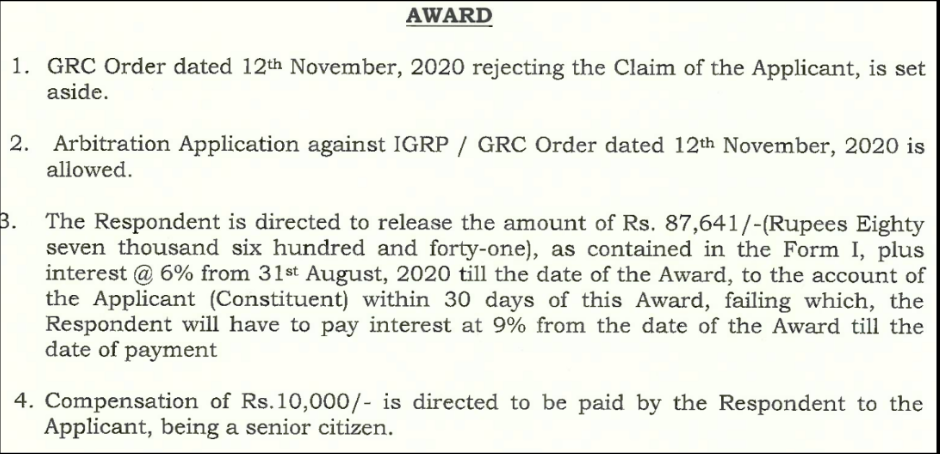
The tribunal ordered the excess brokerage refunded with interest, plus compensation given her age.
In total, Angel One was directed to pay ₹87,641, the full amount she had been overcharged during those two weeks.
What to Check on Your Own Account
If your brokerage looks higher than what you were promised at signup, the question to answer is simple: does your KYC document actually name the plan you supposedly agreed to?
Gather now:
- Your KYC document, checked specifically for whether a plan name appears next to your signature
- Any message, call, or email from your Authorised Person or Angel One confirming the brokerage plan you were offered
- Your contract notes for the disputed period, to calculate the exact overcharge
- A written request asking Angel One to arrange a meeting with your Authorised Person if their identity is disputed
Watch for inconsistent submissions. In this case, Angel One named two different plans in two different filings.
If a broker changes its story about which plan applies to you, that inconsistency is evidence in your favour, not a minor clerical error.
Our page on how to file complaint against Angel One covers the full route from a written complaint through to arbitration.
For the broader picture of how these cases resolve, see Angel One arbitration cases.
Is your brokerage higher than what you were promised when you opened your account?
Our team checks your KYC document against your contract notes, flags every inconsistency in the broker’s own paperwork, and builds the refund claim on exactly the gaps that decide these cases. Register with us for a free consultation.
An Honest View of the Odds
Excess brokerage claims are winnable when the broker’s documentation is inconsistent or incomplete, which happens more often than investors expect, especially with accounts opened through an Authorised Person rather than directly online.
The same logic applies to unauthorised trading disputes, where the burden similarly falls on the broker to produce clear proof of consent rather than on the client to disprove it.
Where the KYC clearly names a plan and matches what was charged, the claim is difficult.
Where it does not, as in this case, the burden shifts to the broker to explain the gap, and that is a burden brokers do not always meet.
Conclusion
The ₹87,641 award rests on a simple principle.
A broker cannot charge you for a plan its own KYC document cannot clearly identify, especially after contradicting itself about which plan that was.
If your contract notes do not match what you were promised at signup, check your KYC document first. That single page decided this case.
Report. Recover. Stay Fraud Free.
Frequently Asked Questions
Yes. If your KYC document does not clearly name the plan you were charged under, or if the broker's own submissions about your plan are inconsistent, that is strong grounds for a refund claim through arbitration.
That confirmation can count as evidence, particularly if the Authorised Person's identity and appointment are independently verifiable through NSE records. In the reviewed case, a WhatsApp message from a verified AP was treated as authentic proof of the plan offered.
The tribunal ordered Angel One to refund ₹87,641 with interest from the date the excess brokerage began, plus ₹10,000 in compensation given the client's status as a senior citizen.
Start with your KYC document. Check whether it names a specific brokerage plan next to your signature. If it does not, or if the broker has given inconsistent answers about which plan applies to you, that gap is the basis for a claim.


 Add us as a preferred source on Google »

