

Quick Summary
An NSE arbitration tribunal awarded a client ₹2,33,846 after Angel One sold his DHFL shares without authorisation to plug a ledger deficit the broker had itself created, and separately mispriced a forced Yes Bank share buyback. The tribunal found Angel One had created the shortfall by paying the client out too early, then used that self-created deficit to justify an unauthorised sale of his holdings. This page walks through both parts of the dispute, what each side argued, and how the tribunal decided.
Sometimes an unauthorised sale is not just about a missing order. It is about a broker creating the very shortfall it later uses as justification.
An NSE tribunal awarded ₹2,33,846 in exactly this kind of case.
Angel One Unauthorized Share Sale Arbitration Case: What Happened
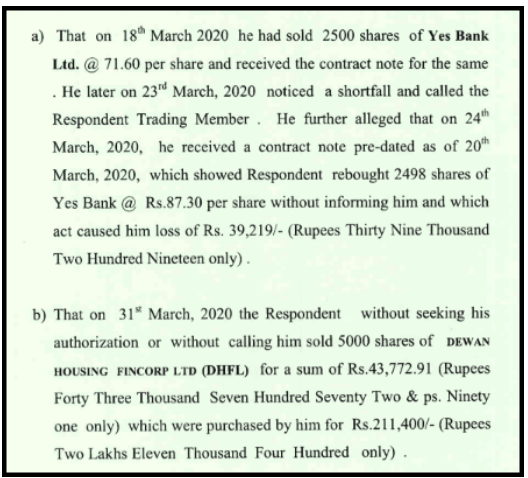
In March 2020, during the extreme volatility around the Yes Bank restructuring, the client sold 2,500 Yes Bank shares at ₹71.60 each and received a contract note confirming it.
Days later, Angel One reversed the sale, buying the shares back at ₹87.30, a much higher price, and backdated the contract note to make it look like the reversal happened two days earlier than it actually did.
Separately, Angel One paid ₹1,11,604 into the client’s bank account on 19 and 20 March, ahead of the Yes Bank settlement clearing.
That early payout created a shortfall in his ledger, the kind of self-inflicted debit that shows up again and again in Angel One complaints where a broker’s own processing decisions end up costing the client.
Angel One then sold 5,000 of his DHFL shares, worth ₹2,11,400 at purchase, for just ₹43,772.91, to cover that same shortfall.
What He Argued
The client’s position was that neither sale had anything to do with his own conduct.
He had sold his Yes Bank shares at a fair price and received confirmation. The reversal and repricing days later, at a rate that happened to favour Angel One, was not something he had authorised or could have anticipated.
On the DHFL shares, his argument was more direct. He had never asked Angel One to sell them.
The only reason a shortfall existed in his account at all was that Angel One itself had paid him out early.
A broker cannot create a debit through its own action and then sell a client’s holdings to fix it.
What Angel One Argued
On the Yes Bank leg, Angel One did not dispute that the reversal happened, but did not directly explain why it used a price from two days after the correct settlement date rather than the same-day closing price.
On the DHFL leg, Angel One’s defence was that it was entitled to sell shares to cover a genuine debit balance in the client’s account, and that the sale was a normal part of managing that shortfall, regardless of how the shortfall arose.
What the Tribunal Concluded, and Why
On the Yes Bank shares, the Tribunal checked the actual market data for the days in question.
Yes Bank’s closing price on 18 March, the day the original sale should have settled, was ₹60.80.
Angel One had instead used ₹87.30 from two days later, after its own delay in processing the reversal.
Priced correctly, the transaction would have produced a profit of ₹27,000 for the client, not the loss Angel One had booked. The tribunal corrected the pricing to the proper date.
On the DHFL shares, the tribunal rejected Angel One’s justification outright.
It traced the debit balance back to Angel One’s own early payouts, not to anything the client had done.
A shortfall the broker creates through its own timing cannot be used to justify selling the client’s holdings without consent.
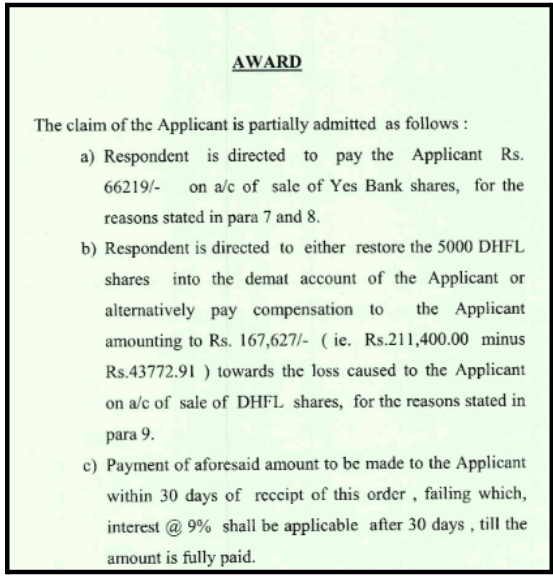
The tribunal gave Angel One the choice of returning the 5,000 DHFL shares or paying the difference between their purchase value and what they had been sold for.
Combined across both findings, the award came to ₹2,33,846.
Of the ₹2,33,846 total award, ₹66,219 came from the Yes Bank shares, and ₹1,67,627 came from the DHFL shares.
What to Do If a Similar Sale Happened to You?
An unauthorised sale claim is strongest when you can show the sequence of events, not just the sale itself. What happened right before the sale often matters as much as the sale.
Gather now:
- Your ledger for the weeks before and after the disputed sale, to trace what created any shortfall
- Contract notes for the disputed transaction, checked against actual market prices for the dates involved
- Any payout, credit, or debit Angel One made to your account around the same time
- A written request asking Angel One to explain, in writing, what specifically justified the sale
Check the dates against real market prices. In this case, Angel One priced a reversal two days later than it should have, at a price that happened to favour the broker.
Cross-checking your contract note dates and prices against public market data can expose exactly this kind of gap.
Our page on how to file complaint against Angel One covers the complaint route to take before arbitration becomes necessary.
For other cases like this one, see Angel One arbitration cases, which brings together disputes decided across different tribunals and time periods.
The same market volatility that produced this case also generated several other disputes worth reading alongside it.
These include Angel One Yes bank lock in arbitration which covers related disputes from the same period.
Did Angel One sell shares from your portfolio without your consent?
Our team traces the sequence of ledger entries around the sale, checks the pricing against actual market data, and builds the claim on whichever gap the broker cannot explain. Register with us for a free consultation.
An Honest View of the Odds
These cases hinge on sequence and pricing, both of which are verifiable from records the broker itself generates.
That makes them more provable than disputes that depend on what was said on a phone call.
Where a broker sells your holdings to cover a shortfall it created through its own payout timing, and where it prices a reversal at a date or rate that favours itself, tribunals have shown they will unwind both.
That principle has held up even in extreme cases; the Angel One 13 year arbitration case took over a decade and multiple rounds of appeal to resolve, but it was ultimately decided on the same kind of documentary evidence: a client agreement clause the broker couldn’t argue around.
Conclusion
The ₹2,33,846 award rests on two separate findings.
A broker cannot reverse a trade at a self-serving, delayed price when the correct same-day price is available. And a broker cannot sell your shares to cover a shortfall that its own actions created.
If shares have disappeared from your portfolio without your authorisation, check what happened in your ledger in the days before the sale.
That sequence is often where the real story is.
Report. Recover. Stay Fraud Free.
Frequently Asked Questions
A broker can act on a genuine shortfall, but not one it created through its own actions, such as an early payout. If the shortfall traces back to the broker's own timing rather than your trading activity, an unauthorised sale to cover it is challengeable.
Angel One reversed a sale two days after it should have, at a much higher buyback price, and backdated the contract note. The tribunal found the correct same-day price would have produced a profit, not a loss, for the client.
The tribunal awarded a combined ₹2,33,846, comprising ₹66,219 on the mispriced Yes Bank reversal and ₹1,67,627 for the DHFL shares sold without authorisation, or the option to have the shares restored instead of the cash amount.
The sequence of ledger entries around the disputed sale, and the actual market price on the correct date. Both are available in your account statements and public market data, which makes this kind of claim easier to substantiate than a dispute over a verbal conversation.


 Add us as a preferred source on Google »

